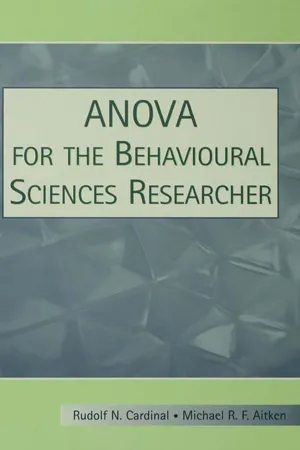
This new book provides a theoretical and practical guide to analysis of variance (ANOVA) for those who have not had a formal course in this technique, but need to use this analysis as part of their research.
From their experience in teaching this material and applying it to research problems, the authors have created a summary of the statistical theory underlying ANOVA, together with important issues, guidance, practical methods, references, and hints about using statistical software. These have been organized so that the student can learn the logic of the analytical techniques but also use the book as a reference guide to experimental designs, realizing along the way what pitfalls are likely to be encountered.
, we'll summarize what most people want to know to get going—how to choose and perform an ANOVA. Few researchers read ANOVA theory before starting to analyse, much as statisticians may complain about this, so we might as well be pragmatic. Chapter 1 can be combined with Chapter 3, which talks about common things that are required in ANOVA analysis, and Chapter 5, which shows how to perform an ANOVA in SPSS.
• Then, in Chapter 2
, we'll cover what ANOVA does and what it assumes—things researchers should have known before running an ANOVA but quite possibly didn't.
• In Chapter 3
, we'll walk through what most people need to do to complete an ANOVA analysis.
• In Chapter 4
, we'll look at experimental design and analysis issues, such as how to analyse changes from previous or baseline values, and when and how to perform post hoc tests.
• In Chapter 5
, we'll look at how to use the SPSS software package to perform different ANOVAs.
• In Chapter 6
, we'll look at linear contrasts and trend analysis, two useful but probably under-used techniques of ANOVA.
• In Chapter 7
, we'll cover complex theory that most people will never need, but that may lead to a better general appreciation of ANOVA concepts.
• In Chapter 8
, we'll look at a variety of ANOVA models that can be used for different experimental designs. These will range from the very simple (one-way ANOVA) through the very useful (mixed designs with both between- and within-subject factors) to the very complicated. This material is for reference.
• In Chapter 9
, we'll revise mathematics that is touched on occasionally elsewhere, and cover advanced mathematics that underpins computerized calculations of complex ANOVAs.
•Chapter 10
gives statistical tables for reference.
• There's also a glossary
and suggestions for further reading
.
Key to symbols:
= fairly easy, and important
= important but not exciting
= reference material; look up the model that you need to use
= difficult mathematics in places; not necessary for basic analysis
Notes that are more advanced than the rest of the section they are in are usually placed at the end of their section and always marked by a vertical rule in the margin, like this. They may be safely ignored if you prefer!
1.2 Background knowledge
This book is aimed at graduate students and behavioural science researchers who need to perform analysis of variance (ANOVA). Covering the theory of ANOVA is one thing; putting it into practice in psychology and neuroscience research unfortunately requires using the technique at a level at which even statisticians debate the proper methods. This is depressing to the beginner; we hope this book helps. It covers simple ANOVA and also some complex techniques that are not often used but are rather powerful. It also provides reference material about different ANOVA designs. It assumes a basic knowledge of statistics. Explicit coverage of the background knowledge can be found in Aitken & Cardinal (2006), including:
1.Designing experiments and describing results. Basic mathematics; variables and measurement; populations and samples (and the concept of estimating population parameters from sample statistics); descriptive and inferential statistics; exerting control (independent and dependent variables, between- and within-subject experimental designs); measures of central tendency (mean, mode, median); measures of dispersion (including variance, standard deviation, range, interquartile range); example questions.
2.Probability and the normal distribution. Probability (including Bayes' theorem and Bayesian inference); discrete and continuous random variables; the normal distribution (Z scores, the one-sample Z test for scores of known variance, confidence intervals); the logic of null hypothesis testing (including the interpretation of p values, Type I and Type II error, power, Bayesian statistical inference, one- and two-tailed tests and how to choose between them, common fallacies); example questions.
3.Exploratory data analysis. Histograms; stem-and-leaf diagrams; Tukey box-plots (‘box-and-whiskers’ plots); outliers; testing for outliers; when to exclude outliers; non-normal distributions (skew, kurtosis); when and why to transform data; example questions.
4.Investigating sample means: t tests. Rationale behind ; tests; paired and unpaired tests for related and unrelated data; the one-sample t test; confidence intervals; the standard error of the mean; the two-sample, paired t test; the two-sample, unpaired t test (for equal and unequal sample variances); the standard error of the difference between means; assumptions of t tests; the F test for comparison of variances; derivations and the central limit theorem; graphical representation of within- and between-subject variability; power and things that affect it; example questions.
5.Nonparametric difference tests. Background; the Mann-Whitney U test for two independent samples; the Wilcoxon matched-pairs signed-rank test for two related samples; using the Wilcoxon signed-rank test as a one-sample test; how to choose between parametric and nonparametric approaches; supplementary material; example questions.
1.Binomial, sign, and χ2 tests. Categorical data; the binomial distribution; the sign test; the goodness-of-fit χ2 test for two and more than two categories; the contingency χ2 test; assumptions of the χ2 test and common errors; supplementary material (odds ratios, relative risk, multinomial distribution, derivations); example questions.
7.Correlation and regression. Scatter plots; correlation (Pearson's r); significance tests applied to correlation; nonparametric correlation (r...
Table of contents
Cover
Half Title
Full Title
Copyright
Dedication
CONTENTS
PREFACE
CHAPTER 1: QUICK SUMMARY
CHAPTER 2: UNDERSTANDING THE BASICS
CHAPTER 3: PRACTICAL ANALYSIS
CHAPTER 4: PITFALLS AND COMMON ISSUES
CHAPTER 5: USING SPSS FOR ANOVA
CHAPTER 6: CONTRASTS AND TRENDS
CHAPTER 7: ADVANCED TOPICS
CHAPTER 8: SPECIFIC DESIGNS
CHAPTER 9: MATHEMATICS
CHAPTER 10: STATISTICAL TABLES
GLOSSARY
FURTHER READING
REFERENCES
INDEX
Trusted by 375,005 students
Access to over 1.5 million titles for a fair monthly price.
Study more efficiently using our study tools.
Frequently asked questions
Yes, you can cancel anytime from the Subscription tab in your account settings on the Perlego website. Your subscription will stay active until the end of your current billing period. Learn how to cancel your subscription
No, books cannot be downloaded as external files, such as PDFs, for use outside of Perlego. However, you can download books within the Perlego app for offline reading on mobile or tablet. Learn how to download books offline
Perlego offers two plans: Essential and Complete
Essential is ideal for learners and professionals who enjoy exploring a wide range of subjects. Access the Essential Library with 800,000+ trusted titles and best-sellers across business, personal growth, and the humanities. Includes unlimited reading time and Standard Read Aloud voice.
Complete: Perfect for advanced learners and researchers needing full, unrestricted access. Unlock 1.5M+ books across hundreds of subjects, including academic and specialized titles. The Complete Plan also includes advanced features like Premium Read Aloud and Research Assistant.
Both plans are available with monthly, semester, or annual billing cycles.
We are an online textbook subscription service, where you can get access to an entire online library for less than the price of a single book per month. With over 1.5 million books across 990+ topics, we’ve got you covered! Learn about our mission
Look out for the read-aloud symbol on your next book to see if you can listen to it. The read-aloud tool reads text aloud for you, highlighting the text as it is being read. You can pause it, speed it up and slow it down. Learn more about Read Aloud
Yes! You can use the Perlego app on both iOS and Android devices to read anytime, anywhere — even offline. Perfect for commutes or when you’re on the go. Please note we cannot support devices running on iOS 13 and Android 7 or earlier. Learn more about using the app
Yes, you can access ANOVA for the Behavioral Sciences Researcher by Rudolf N. Cardinal,Michael R.F. Aitken in PDF and/or ePUB format, as well as other popular books in Psychology & History & Theory in Psychology. We have over 1.5 million books available in our catalogue for you to explore.