- 272 pages
- English
- ePUB (mobile friendly)
- Available on iOS & Android
eBook - ePub
About this book
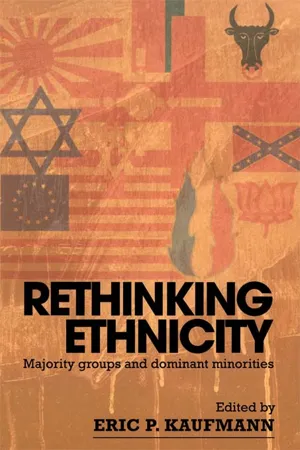
The impact of liberal globalization and multiculturalism means that nations are under pressure to transform their national identities from an ethnic to a civic mode. This has led, in many cases, to dominant ethnic decline, but also to its peripheral revival in the form of far right politics. At the same time, the growth of mass democracy and the decline of post-colonial and Cold War state unity in the developing world has opened the floodgates for assertions of ethnic dominance. This book investigates both tendencies and argues forcefully for the importance of dominant ethnicity in the contemporary world.
Information
Part I
Conceptualising dominant ethnicity
1
Ethnic cores and dominant ethnies
Anthony D.Smith
References
In the burgeoning literature of the 1950s and 1960s on ‘ethnicity’, as it came to be called, one bedrock assumption was almost universally endorsed. Ethnicity adhered to numerical and sociological cultural minorities, never to numerical and sociological majorities in a given state. National states, it was conceded, were rarely monoethnic. The great majority consisted of a nation and one or more ethnic minorities. On the one hand, there was the historic ‘nation’, the most populous, the wealthiest and the politically dominant of the cultural groups in the state, even if it was not indigenous. On the other hand, there were the minority populations, immigrants of a different culture, if not religion, each of them less populous, poorer and without power, acculturating to the national Way of Life and in the throes of assimilation. These were ‘the ethnics’, in contrast to the ‘nation’, into which they were to be incorporated and integrated, if not melted down.
This was, broadly speaking, the image of the ‘national state’ held by American sociologists at the time, and it was clearly drawn from the peculiar experience of immigrant societies, notably the United States. We see it even in more sensitive treatments like those of Nathan Glazer and Daniel Moynihan. How far the image conformed to the reality is another matter; and in particular, I leave aside the rather different issues raised by the history and status of the Blacks in the United States, defined in terms of ‘race’, from which sociologists and politicians alike wished to differentiate other non-Black minorities, partly through the use of the term ‘ethnicity’. Here I want to show how this specifically American image and usage of the term ‘ethnicity’ have distorted our overall understanding of the dynamics of ethnicity and nationhood, and how historians and social scientists have tried to produce a more valid and useful framework for the analysis of the interrelations of ethnicity and nationhood, as well as for our understanding of the origins and development of nations.1
A critique of ‘minority ethnicity’
We might start with the term itself. Although as a noun the term ‘ethnicity’, signifying, like social class, either a sub-field of the study of stratification, or a type of status group, or both, seems to have originated after the Second World War, its roots in an adjectival concept referring to the origins and culture of a group are far older. They reach back to the first Greek usage, in Homer. Here, ethnos refers to a band or host or tribe—be it of friends or fighting men or a swarm of bees, or of named groups like ethnos Lukiōn, ethnos Achaiōn. In Pindar we read of the ethnos of men or women, in Herodotus of the to Medikon ethnos, and in Plato of the ethnos of heralds.2
What these usages appear to have in common is that the groups in question possess certain common cultural, and in some cases physical, attributes. The named groups also appear to have some territorial referent. Herodotus seems to have thought that the cognate concept of genos referred to a smaller kinship group, a sub-division of ethnos, but he sometimes uses gens interchangeably with ethnos, much as the Romans tended to use genos to refer to larger civilised peoples, other than themselves, the populus Romanus. For the Romans, the concept of natio, on the other hand, was reserved for distant, usually barbaric tribes, and only in the Middle Ages did it begin to acquire its modern usage, alongside the old Roman usage of gens. However, no such consistency informed the ancient Greek usage in respect of ethnos. Though, like the apparent Jewish opposition between the ‘am Israel and the goyim, the Greeks clearly distinguished Ellenes from barbaroi, their use of the term ethnos covered all ‘peoples’ who possessed common cultural traits.3
These ancient usages, untidy as they may appear, were nevertheless highly influential for the ways in which later epochs sought to describe relations between cultural and territorial groups. Thus, in the New Testament and Church Fathers, the goyim, or Gentiles, rendered by ta ethnē (which in turn were translated into the nationes of the Vulgate), referred to all peoples apart from the Jews and Christians. This suggests a considerable overlap, if not identity, between ethnos and natio, in contrast to the opposition between ethnic groups and nations, and ethnicity and nationhood, in modern Western, and specifically American, usage. Of course, terms frequently change their meaning. But here we have two diametrically opposed traditions, in one of which the terms ‘ethnic’ and ‘national’, and ethnic group and nation, overlap or are even synonyms, while in the other, they are radically different and opposed concepts.4
The argument from etymology brings us immediately to that from history. Here I think it useful to contrast two kinds of historical development, the one endogenous, the other exogenous, the one based on long resident communities, the other on recently arrived populations, the one claiming to be indigenous and autochthonous, the other immigrant and pioneering. I refer, of course, to the Middle Eastern and European societies, on the one hand, and, on the other hand, to the immigrant societies of North America, Australia and Argentina.
In the first of these, we are confronted by an evolution of long resident ethnic groups or, in the French term, ethnies in the formation of nations over la longue durée. The concept of ethnie refers to a named human popula-. tion with a myth of common origins and ancestry, shared historical memories, one or more elements of common culture, and a measure of solidarity, at least among the elites. This slow development from ethnie to nation was often accompanied by the use of force on the part of the centralising state of a dominant ethnie who constituted the state's core against adjacent ethnies and its conquest of their territories, as occurred in England, France, Spain, Sweden and Russia. Throughout this long-drawn-out process, the leading personnel of the state were largely drawn from the members of its core ethnie, and, equally important, its social, religious, military and political institutions, as well as its customs and codes, were those of the dominant ethnie's elites. To this, largely European, evolution I shall shortly return, for it has been pivotal to the formation of nations and national states.5
In the second kind of trajectory, one or more ethnies pioneered the development of a new territory and attracted immigrants from many other ethnies, who formed the nation through voluntary submission to common myths, symbols, norms and codes and with differing degrees of social mobility and intermarriage. Of course, we should be careful not to exaggerate the historical differences between the two models of nation-formation. Even in immigrant societies, there was a pioneering or leading ethnie, which soon assumed a position of dominance in the nineteenth-century state. But, apart from the much shorter time-span involved, there was no forcible incorporation of long resident ethnies, except for the indigenous peoples; while, on the other hand, there was a clear desire for integration into the state by successive waves of immigrants. As a result, it was much easier to oppose the concept of the territorial nation or national state to the ethnic groups formed by incoming migrants eager for rapid integration into the host culture.6
Here, the argument from history finds its complement in that from sociology. There is an important difference between ethnies whose attachments to particular territories, for example Euzkadi or Slovenia, appear to be ‘immemoriar, their origins being lost in a haze of legends, and the fairly recent and relatively well documented arrival of immigrant groups who have no particular attachments to this or that territory within the large host state and no wish to politicise their cultures and historical mythologies in opposition to the national state into which they seek rather to be integrated.
It is little wonder if, in the latter case, quite different terms are used to denote the immigrant communities, the ethnic groups, from the total community of the host state, or nation. The relations between ethnic groups and the nation differ greatly from those obtaining between a peripheral ethnie and the state in long-resident national states. In immigrant societies, the governing impulse, with a few exceptions among indigenous and Black peoples, has been to integrate, if not assimilate; and this has been more or less acceptable, the return to a ‘symbolic ethnicity’ notwithstanding. Whereas, in long-resident societies, no such mutual understanding has prevailed in the case of resident or ‘homeland’ ethnies. Even in the French case, where the republic has sought to homogenise its citizens, there has been considerable resistance by the resident ethnies— Bretons, Corsicans, Alsatians and the like. This has demonstrated the historic dominance of the French ethnie within the French national state, something that its members have taken for granted in equating France and the French national state with the French ethnie. And, from the standpoint of the Scots and Welsh, not to mention the Irish, the same might be said of the English, for whom Britain and Britishness was simply an extension of their own identity.7
Ethnic cores and nation-formation
Despite these historical and sociological contrasts, the consequences of these two trajectories for the creation of nations and for their internal relations may not, after all, be that different.
Let me start with nation-creation. It has often been argued that in Europe the state, together with nationalism, forged nations, not the other way round. This is, in general, the thesis of political modernists like John Breuilly, Charles Tilly, Michael Mann and Anthony Giddens. It is also, quite explicitly, the message of Eric Hobsbawm, and more subtly that of Ernest Gellner. In all their theories and approaches, the modern, centralised, professional state plays the central role in the drama of nation-creation. If, for Gellner, the state mediates modernisation, for the other theorists it provides the impetus and engine for modernisation and nation-creation, a process that becomes increasingly an intended outcome of mass mobilisation by elites.8
But this was clearly an over-simplification. For one thing, it overlooked the fact that the strong Western states, which provided the buttress and proof of the ‘theory’, were themselves founded on a degree of ethnic and cultural homogeneity at the centre during the period of their foundation and initial development. It was this relative ethnic homogeneity of the core that enabled the state to expand without internal ethnic fissure, such as we have witnessed in Sub-Saharan Africa. Religion provided a second unifying factor. We do not have to embrace Hastings’ view that nations are a Christian product and phenomenon to see how a widely accepted biblical and providentialist reading of the role of dynastic kingdoms helped to buttress these Western medieval Christian states. The drive for religious, and cultural, homogenisation by absolutist states was predicated on a long history of divine chosenness of the ethnic core. Third, the growth of shared historical memories and an ‘ethno-history’ among the elites of dominant ethnic cores has helped to underpin and legitimise the dynastic state and its wars. It has also provided a repertoire of ethnic myths and symbols of heroes and saints, exploits, battles and sacrifices, on which later generations of the dominant ethnie have been able to draw when they and their state have been under threat.9
While many factors encouraged, and impeded, the growth of strong states, the combination of ethnic bonds, biblical religion and shared ethno-history, which so often produced a sense of ethnic election and mission, constituted a powerful support, indeed a necessary condition, for the states that would later help to forge nations. In other words, viewed diachronically, the state could be seen to play a mediating role between an initial ethnic core which it helped to consolidate and the subsequent formation of nations. For this reason, in some cases, France and England among them, it is no easy matter to discern the shift from ethnic core to nation. What is clear is that the strong aristocratic state built upon this ethnic core began to expand both through conquest of outlying areas and through bureaucratic incorporation of the middle (and much later the lower) classes of the state's population, imposing the language, culture and religion of the dominant ethnie, and drawing a large part of its administrative personnel from that same core ethnie. Such a complex process, involving the state, ethnic core, aristocracy and religion, represented the first, and perhaps the most influential, of the trajectories of nation-formation, and at its centre we can discern the pivotal role of an ethnic core.10
It might be thought that the second major trajectory of nation-formation, that of vernacular mobilisation, denoted not just a different, but a diametrically opposed, role for ethnies, one that is perhaps more akin to that of ethnic minorities in immigrant societies like the United States. After all, their sociological point of departure is quite different. Unlike the ‘lateral’, aristocratic ethnies whose members built up the strong states of western and northern Europe, much of eastern and south-east Europe, as well as parts of Asia, consisted of ‘vertical’ or demotic ethnies, which were generally smaller, more compact and more exclusive than their lateral counterparts. Some, it is true, like Bohemia, Bulgaria and Serbia, could point to a history of medieval statehood, or, like the Greeks, to a special role in a wider Orthodox empire. But most of them were subject ethnies of far-flung empires, often submerged and with only shadowily documented histories. In these cases, it was an enlightened intelligentsia which, touched by Romanticism and attracted to an historicist nationalism, sought to return to an ethnic past, and recover it for themselves and their ‘people’, along with a vernacular culture and language. But, as a consequence of their mobilising endeavours, a remarkable transformation occurred. Like the ugly duckling that became a swan, several of these neglected erstwhile minorities, once roused and politicised, became dominant ethnies in the new national states that were created by the Great Powers—in Hungary, Czechoslovakia, Yugoslavia, Bulgaria, Romania and Georgia. The point, of course, is that in Europe, and in parts of Asia, these long-resident ‘peripheral’ ethnies, on becoming masters in their own houses, transmuted into dominant ethnies in national states, or indeed into dominant nations—with or without small ethnic minorities and peripheral ethnies within their borders. So that, though their starting-point and trajectories were quite different, these demotic ethnies arrived at much the same dominant-ethnie national end-point as their Western European ‘lateral’ counterparts.11
Other kinds of polity later followed the Western bureaucratic route, often quite deliberately. In later Tsarist Russia and Meiji Japan, for example, the dominance of the ethnic core was clearly displayed in an admittedly multicultural setting, and in the late nineteenth and twentieth centuries policies of cultural homogenisation were increasingly enforced. The Young Turks, too, attempted a Turkification of the Ottoman empire, in line with an integral nationalism, with disastrous results, preparin...
Table of contents
- Front Cover
- Half Title
- Title Page
- Copyright
- Dedication
- Contents
- Illustrations
- Contributors
- Acknowledgements
- Introduction
- Part I Conceptualising dominant ethnicity
- Part II Dominant ethnicity in transition
- Part III Dominant ethnicity resurgent
- Index
Trusted by 375,005 students
Access to over 1.5 million titles for a fair monthly price.
Study more efficiently using our study tools.
Frequently asked questions
Yes, you can cancel anytime from the Subscription tab in your account settings on the Perlego website. Your subscription will stay active until the end of your current billing period. Learn how to cancel your subscription
No, books cannot be downloaded as external files, such as PDFs, for use outside of Perlego. However, you can download books within the Perlego app for offline reading on mobile or tablet. Learn how to download books offline
Perlego offers two plans: Essential and Complete
- Essential is ideal for learners and professionals who enjoy exploring a wide range of subjects. Access the Essential Library with 800,000+ trusted titles and best-sellers across business, personal growth, and the humanities. Includes unlimited reading time and Standard Read Aloud voice.
- Complete: Perfect for advanced learners and researchers needing full, unrestricted access. Unlock 1.5M+ books across hundreds of subjects, including academic and specialized titles. The Complete Plan also includes advanced features like Premium Read Aloud and Research Assistant.
We are an online textbook subscription service, where you can get access to an entire online library for less than the price of a single book per month. With over 1.5 million books across 990+ topics, we’ve got you covered! Learn about our mission
Look out for the read-aloud symbol on your next book to see if you can listen to it. The read-aloud tool reads text aloud for you, highlighting the text as it is being read. You can pause it, speed it up and slow it down. Learn more about Read Aloud
Yes! You can use the Perlego app on both iOS and Android devices to read anytime, anywhere — even offline. Perfect for commutes or when you’re on the go.
Please note we cannot support devices running on iOS 13 and Android 7 or earlier. Learn more about using the app
Please note we cannot support devices running on iOS 13 and Android 7 or earlier. Learn more about using the app
Yes, you can access Rethinking Ethnicity by Eric P. Kaufmann in PDF and/or ePUB format, as well as other popular books in Politics & International Relations & Comparative Politics. We have over 1.5 million books available in our catalogue for you to explore.