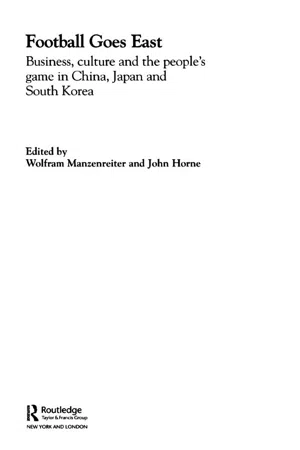
Football Goes East
eBook - ePub

Football Goes East

Business, Culture and the People's Game in East Asia

  1. 288 pages
  2. English
  3. ePUB (mobile friendly)
  4. Available on iOS & Android
eBook - ePub

Football Goes East

Business, Culture and the People's Game in East Asia

About this book

Global popular culture and big business have revolutionised the East in a generation. Football, Sport of the masses and now commercial super power, has travelled with this tide of change in the East in its own right.

The development of football as a major participatory sport in Japan, Korea and China makes it an ideal case study for analysis of the complex relationship between sport, culture, society and economy in the East. Football is also a useful entry point for examination of the phenomena of increasing globalisation, and this theme is widely discussed.

This broad ranging collection of essays includes:

- Social change and national identity
- Women's football and gender traditions
- Finance and investment in football
- The development of professional football
- Football and the media
- Football Fans, 'hooligans' and soccer supporter culture

Trusted by 375,005 students

Access to over 1.5 million titles for a fair monthly price.

Study more efficiently using our study tools.

Information

Publisher
Routledge
Year
2004
eBook ISBN
9781134365579

1 Football, culture, globalisation

Why professional football has been going East

John Horne and
Wolfram Manzenreiter

Introduction

Speaking to an audience in Tokyo in 1989 the late French sociologist Pierre Bourdieu declared ‘I think that if I were Japanese I would dislike most of the things that non-Japanese people write about Japan’ (Bourdieu 2000: 3). Recognising that it had been ‘the curiosity of exotic particularism’ that had ‘inspired so many works on Japan’ (Bourdieu 2000: 3), he was arguing against the ‘particularized reading’ of specific analyses, and especially in the case of his own classic study Distinction (Bourdieu 1984). As in a previous collaboration (Horne and Manzenreiter 2002), our aim in bringing a collection of essays together is strongly motivated by the recognition that research about sport in the East Asian region has often been treated in a similar particularised fashion.
The orientalist fascination Bourdieu was alluding to has been an unavoidable component of the publishing frenzy shortly before and after the 2002 Football World Cup co-hosted by Japan and Korea. To the work of freelance writers (Bennie 2002; Moffett 2002; Moran 2002; Perryman 2002; Willem 2002) and academics (Sugden 2002; Sugden and Tomlinson 2003) we should also add our own edited collections. While we recognise the logic of the argument, we strongly reject the charge of exploitation raised by a reviewer who suspected our earlier book to be one more example of the media trend toward ‘constructing’ mega-events. We concede that the ever increasing amount of literature that follows any Olympics or World Cup nowadays is primarily caused by the mega-event status itself: sports events of truly global reach receive extensive media coverage and thus attract heightened attention on a world-embracing level. The efficacy of this cycle is guaranteed by the allied forces of transnational organisations in charge of media business, corporate finance, and sport administration that we refer to as the allied dominion of the worldwide sports empire. The pervasiveness of this empire of sport is a strong argument why sociologists should not eschew deconstructing its flagship events, e.g. mega-events, or more generally, the way in which cultural products (such as sports) are produced, packaged, transmitted and consumed in a globalising world.
With another acknowledgement to Bourdieu we can also answer the question why we need another book about football in Japan, Korea and China, even though the 2002 World Cup has happened and now we can move on. To a certain degree, sport is reflective and constitutive of society. Hence writing about sport in society is writing about society – in the case of this collection, writing about the contemporary experience of social life in China, Japan and Korea. If these analyses of football in East Asia aspire to be more widely meaningful, they have to be framed by an explanatory model that reveals the universal principles of particular cases. Universalising the particularisms bound up with a singular historical experience and making them recognisable as universal is a principle we provided our contributors with as a guideline. Such a technique is able to unravel the mechanisms of cultural imperialism that are based on exactly the opposite procedure: particularisms become false universalisms because of the negation of their historical groundedness (Bourdieu and Wacquant 1999: 41). Hence when particular aspects of football in the Far East are assessed in each of the following chapters, the analysis of our contributors is also concerned with football in the home country of the readers. What we also hope to demonstrate here is that after all the massive media coverage and audience interest has faded away, the actual significance of football in these countries has become more pronounced beyond the event-ridden hype. Taking into account the ways in which football as a commodity and an experience is embedded inter-regionally as well as internationally, we feel confident that this collection reveals some of the social, cultural, economic and political factors that will ensure that football continues to develop in East Asia.
Whether football in ‘the East’ can ever be taken seriously is for us not a question of relevance. Fine recent examples that deserve acknowledgement have been provided by South Korea’s successful run against European football powerhouses during the 2002 World Cup, the early defeats of England and Germany by Japan and South Korea respectively at the World Youth Championship in 2003 and Japan’s 1–1 draw with England in June 2004. But this is a case of the right answer to the wrong question. The proposition behind the question is indicative of a Eurocentric perspective as well as a football world-view that neglects the appeal of the game beyond its hyper-mediatised flagship events. Football, as will be demonstrated, is a serious matter for large groups of the population in the East, and the appeal football has found in the East is taken dead seriously by the international media, sport organisations, European club sides, and other sellers and bidders on the global football market. As the world sport, football continues to attract investment, fans, sponsors, media and political attention in most countries that have football associations affiliated to the Federation International of Football Associations (FIFA). FIFA’s ‘Big Count’, conducted in 2000 and released in April 2001, produced an estimated 242,378,000 regular football players, or 4.1 per cent of the world’s population. In 2004, the centenary year of the organisation, there are 204 members, making it the largest single sport association in the world. FIFA comprises six continental confederations with the following national football association membership – CAF (Confederation Africaine de Football, 52), AFC (Asian Football Confederation, 45), UEFA (Unions des Associations Europeennes de Football, 51), CONCACAF (Confederacion Norte-Centro-americana y del caribe de Futbol, 35), CONMEBOL (Confederacion Sudamericana de Futbol, 10), and OFC (Oceania Football Confederation, 11). According to the ‘Big Count’, active football participation was most popular in CONCACAF countries (8.4 per cent of the population), Europe (6.7 per cent), South America (6.5 per cent), followed by Oceania (4.4 per cent), Asia (3 per cent) and then Africa (2.9 per cent) (Westerbeek and Smith 2003: 103–4). Yet these data deserve some caution as they are based on self-reporting by national associations plus a generous estimation of non-registered players. Depending on the organisational grade and the self-esteem of the issuing authority, numbers on the pitch and on the page will unavoidably differ to an unaccountable degree. What is sure is the uneven distribution of football talent and purchasing power. Of all professional football players 75 per cent play in European or South American leagues that generate worldwide interest, support, and commodity markets. The concomitant differences in economic power are a major determinant of centre– periphery relations among the confederations in FIFA. The AFC, albeit representing the continent with the largest population, is granted only four or five entrants to the final of the World Cup tournament. Yet we expect this number to rise in the coming years, assuming that the world sport empire does not implode.
Aside from football, East Asia will come even more to the fore as a central focus for business and military/geo-political concerns in the foreseeable future. Martin Jacques (2003) from the London School of Oriental and African Studies has argued, for us poignantly, that ‘within the next five years, East Asia will be home to the second and third most powerful economies in the world. The world’s centre of gravity has already shifted to the Pacific, and East Asia has already replaced Europe as the second most powerful economic region’. The remarkable rise of East Asia in terms of economic and political development over the past two or three decades stands in sharp contrast to other peripheral regions of the modern world-system. Yet as Cumings (1987), Arrighi (1996) and others have knowledgeably observed, their incorporation within the networks of power of the United States has been a fundamental condition for the rise of Japan, Taiwan, South Korea, and most recently China. Well before Japan’s asset-inflated bubble economy, the end of the Cold War world system, and the spread of network communication technology, Wallerstein (1991) outlined a possible scenario in which Japan might become a new world hegemon, outstripping the USA as the leading producer of new prime products. Yet Wallerstein also indicated a no less plausible alternative in which the USA and Japan paired up against their main competitors from Europe. Arrighi et al. (2003) also contextualised their prediction of the re-emergence of East Asia as the most dynamic region of the global economy – as it was before the rise in the nineteenth century of a Western-dominated global hierarchy of wealth – in a much longer temporality. The observation of China’s recent reclaiming of economic supremacy in the region has been related to the century-old sinocentric tributary trade system that stretched across the entire region (Arrighi et al. 2003). China’s entry into the World Trade Organisation in December 2001 marked a process in which its vast population has been swept along in a tide of marketisation that could transform the everyday life of roughly one-fifth of the planet’s inhabitants. North Korea remains on the list of the current American administration’s ‘rogue states’, enabling the USA to divide the world along an ‘axis of evil’. As we will argue, both aspects of international trade and international relations are crucial for understanding why football acquired such a high standing in the region. This book thus contributes to debates about sport and globalisation, globalisation and the nation state, the commercial logic of global football and the specific experiences of football fans, players and followers in the three nations.

Sport, globalisation and Bourdieu

Robertson (2000: 458ff) argues that there are broadly two paradigmatic approaches to globalisation – one sees it as primarily an economic phenomenon and the other, which he argues for, is a more inclusive, multi-dimensional conception. Unlike him, however, we argue that the relative significance and relation of each of the separate, but not separable dimensions of globalisation, revolves around the economic significance for the other dimensions. In this respect we follow the lead of Bourdieu’s sociological ideas once more. A creative reading of his central concepts of habitus, social field, and capital in the light of globalisation expands our understanding of social transformations in a world beyond the nation-state. Since sociology has traditionally been engaged with thinking society as the something that exists within a nation state, a world where relations are defined by ties that transcend national borders is quite an intellectual challenge. Freed from the containment by the nation-state, a sociology of sport in the light of globalisation is required to analyse social, economic, and cultural relations in sport on a transnational level. In such a configuration, social rather than geographical hierarchies (as in traditional developmental trajectories of West vs. East) organise the global field of football, its consumption as well as its production.
Responses to the ‘G-word’ (Miller et al. 2001) range from uncritical adoption, wary acceptance, to resistance, which Held et al. (1999) referred to as hyperglobalisers, transformationalists and sceptics. In sports studies Maguire (1999) used modernisation, globalisation and Americanisation approaches to approximate these positions. As Houlihan (2003) is at pains to point out, there is a danger that the term, like many other social scientific ‘buzz-words’, has come to explain everything and nothing. There is a need to distinguish between different dimensions of globalisation – political, economic and cultural – and consider the relative significance of each to the other and their relationship. Whether globalisation is seen as a process or an outcome, an organising principle, a conjuncture or a project, is a first distinguishing feature of writing on the subject. Houlihan (2003) suggests that it is necessary to specify what would need to be present to talk with confidence about a globalised world. What’s more, we also need to consider the reach of globalisation and the response of those on the ‘receiving end’ of it. In principle we agree with the need for clarification enforced by the overuse of the concept of globalisation.
For us, globalisation is first of all a ‘practical logic’, or a logic in practice that has come to be diffused on a planetary scale. In the sense of the taken-for-granted assumption, or orthodoxy, of the contemporary time it resembles the consciously managed version or weaker notion of doxa, which Bourdieu (1977) explained in his Outline of a Theory of Practice as ‘theses tacitly posited on the hither side of all inquiry’. Yet placing globalisation merely in the sphere of consciousness, even though it seems to have found access to regions that are deeper than mere ideologies, would fail to take its real-life dimensions into account. We also consider globalisation as an outcome of social and economic struggles, certainly not from a moralising point of view, but from a theorising angle. Yet we do not see any point in reviewing here a long-standing discussion on the terminology that has been treated in detail by many much more knowledgeable writers. We basically agree with a more relational, than substantial, definition of globalisation. This views it as ‘a process or a set of processes which embodies a transformation in the spatial organisation of social relations and transaction – assessed in terms of their extensity, intensity, velocity and impact – generating transcontinental or interregional flows and networks of activity, interaction and the exercise of power’ (Held et al. 1999: 16). As researchers interested in the social dimensions of sport in contemporary society, we pose two sets of interrelated questions to these flows and processes: first, we explore how sport is affected by globalisation at the local, national and regional levels, and second, how sport contributes to globalisation. Adequate answers are only offered by a methodology taking both political economy and cultural realms of globalisation into account.
As is well known, Bourdieu’s view of society rejects the objectified notion of classes opposing each other in their struggle for dominance. Instead, the social world is conceptualised as a multi-dimensional social space rooted in various patterns of differentiation and distribution. Social space is structured according to the specific distribution of different forms of capital, which can be of material as well as symbolic quality. Cultural capital, which depends to a great degree on up-bringing and schooling, and social capital, which is based on the usage of institutionalised social networks, can be transferred into economic capital, which of course is also convertible to other forms of symbolic capital. Thus the specific value of a form of capital is determined by its assessment in relation to alternative variants within a social field. These are largely autonomous realms in which and between which struggle and contestation over resources takes place. The acquisition of capital, and the position of an individual within a field, is directly linked with the habitus, or the individual’s embodied social history. Habitus, which Bourdieu also referred to as structurising structure, comprises of an individual’s preferences, dispositions, inclinations and perspectives. As an internalised system of unconsciously held patterns of behaviour, the habitus generates behaviour, taste, perceptions, and convictions. Different arrangements are constituted by inherited asset structures and the social conditions of production, which create relationships between them. As the distribution and the accumulation of capital resources prescribes an individual’s position in society, the dominant group of social actors are eager to maintain control over the classification scheme. Capital ownership enables them to exert influence on the consolidation of a common-sense worldview, which is a basic guarantee for the stability of the system.
The recognition of the habitus as one organising principle of social structure enabled Bourdieu to bridge the gap between structuralist and social agency theories. This is particularly of relevance for thinking about choice and action in a contemporary context where common-sense ideas about life and society, the social order and even the global system have fallen short of the rhetoric of neoliberalist globalisation. Despite growing knowledge about the social costs of capitalist development, which promotes inequality, rising income disparities and a widening gap between the developed and underdeveloped world, social conflicts remain contained by the dominant image of a global movement beyond political controllability. Thus the fractures have led the majority of critics and the underprivileged into inertia and resignation, rather than into resistance and rebellion. While orthodox Marxism criticises Bourdieu’s notion of symbolic capital as a major betrayal of the theory of surplus-value, the cornerstone of Marxism, we regard it as an important correction to a serious shortcoming in Marxist theory, in which culture is reduced to the role of the superstructure of the economic base. This is a very important point helping to rescue a valuable theory from plain economism. As noted above, globalisation cannot be regarded purely as a commercially-driven process aiming at the creation of a global market for products whose popular consumption leads to the standardisation of cultures that were once distinctive. But we do want to stress the relative importance of economic capital and the capitalist mode of production, distribution and exchange within the globalisation of sports.
In the late 1970s, Bourdieu suggested it was useful to think about the practice and consumption of sport as a form of supply that meets a specific social demand. Such an assessment necessitated, first, conceiving of the production of sport as an autonomous field with its own logic and distinctive history, and second, to think about the social conditions that enable members of society to acquire these sports products. Transformations of the supply side depend on the relation between the kinds of sports, new entries and technologically altered products; on the demand side, sport preferences are embedded into the habitus and thus subjugated to broader transformations of society (Bourdieu 1985: 111–12). Globalisation impacts on both the supply of and demand for sport, as will become evident throughout this book. The contestation of sport games has come to be challenged, if not dominated, by football in social fields which are no longer exclusively based on their locally distinguishable past.

Globalisation in sport studies: a critical review

In addition to those already listed, recent contributions to the debate about sport and globalisation include Bairner (2001), Miller et al. (2001), Silk and Andrews (2001), Hargreaves (2002), Houlihan (2003) and Rowe (2003). Whereas the first three tend to focus on sport’s contribution to global culture, the instrumentalisation of sport in globalising processes...

Table of contents

  1. Cover Page
  2. Title Page
  3. Copyright Page
  4. Illustrations
  5. Contributors
  6. Preface
  7. 1 Football, Culture, Globalisation
  8. Part I The business of football in East Asian nation-states
  9. Part II Players and supporters of the East Asian game
  10. Part III Football, representation and identity in East Asia after 2002
  11. Part IV Football in East Asia beyond the nation-state

Frequently asked questions

Yes, you can cancel anytime from the Subscription tab in your account settings on the Perlego website. Your subscription will stay active until the end of your current billing period. Learn how to cancel your subscription
No, books cannot be downloaded as external files, such as PDFs, for use outside of Perlego. However, you can download books within the Perlego app for offline reading on mobile or tablet. Learn how to download books offline
Perlego offers two plans: Essential and Complete
  • Essential is ideal for learners and professionals who enjoy exploring a wide range of subjects. Access the Essential Library with 800,000+ trusted titles and best-sellers across business, personal growth, and the humanities. Includes unlimited reading time and Standard Read Aloud voice.
  • Complete: Perfect for advanced learners and researchers needing full, unrestricted access. Unlock 1.5M+ books across hundreds of subjects, including academic and specialized titles. The Complete Plan also includes advanced features like Premium Read Aloud and Research Assistant.
Both plans are available with monthly, semester, or annual billing cycles.
We are an online textbook subscription service, where you can get access to an entire online library for less than the price of a single book per month. With over 1.5 million books across 990+ topics, we’ve got you covered! Learn about our mission
Look out for the read-aloud symbol on your next book to see if you can listen to it. The read-aloud tool reads text aloud for you, highlighting the text as it is being read. You can pause it, speed it up and slow it down. Learn more about Read Aloud
Yes! You can use the Perlego app on both iOS and Android devices to read anytime, anywhere — even offline. Perfect for commutes or when you’re on the go.
Please note we cannot support devices running on iOS 13 and Android 7 or earlier. Learn more about using the app
Yes, you can access Football Goes East by John Horne,Wolfram Manzenreiter in PDF and/or ePUB format, as well as other popular books in Social Sciences & Chinese History. We have over 1.5 million books available in our catalogue for you to explore.