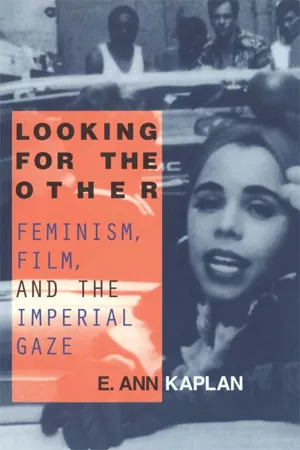
What happens when white people look at non-whites? What happens when the gaze is returned? Looking for the Other responds to criticisms leveled at white feminist film theory of the 1970s and 1980s for its neglect of issues to do with race. It focuses attention on the male gaze across cultures, as illustrated by women filmmakers of color whose films deal with travel.
Looking relations are determined by history, tradition, myth; by national identity, power hierarchies, politics, economics, geographical and other environment. Travel implicitly involves looking at, and looking relations with, peoples different from oneself. Featured films include Birth of a Nation, The Cat People, Home of theBrave, Black Narcissus, Chocolat, and Warrior Marks. Featured filmmakers include D.W.Griffith, Jacques Tourneur, Michael Powell, Julie Dash, Pratibha Parmar, Trinh T. Min-ha, and Claire Denis.
- 256 pages
- English
- ePUB (mobile friendly)
- Available on iOS & Android
eBook - ePub
About this book
Information
Part I
Backgrounds: Theories of Nation, Psychoanalysis and the Imperial Gaze
1.
Travel, Travelling Identities and the Look
“Look, a Negro!” It was an external stimulus that flicked over me as I passed by. I made a tight smile. “Look a Negro!” It was true. It amused me, “Look, a Negro!” The circle was drawing a bit tighter. I made no secret of my amusement.
—Frantz Fanon, Black Skin, White Masks
Black slaves, and later manumitted servants, could be brutally punished for looking, for appearing to observe the whites they were serving, as only a subject can observe, or see.
—bell hooks, Black Looks
Can the subaltern speak? What must the elite do to watch out for the continuing construction of the subaltern? The question of “woman” seems most problematic in this context . . . if you are poor, black and female you get it in three ways.
—Gayatri Spivak, “Can the Subaltern Speak?”
This is a book about inter-racial looking relations in film. Such relations are inseparable from the formation of subjectivities, and from historical (local and global) cultural specificities. While my Women and Film: Both Sides of the Camera focused mainly on how white men gaze at white women within western culture, and at what happens in those gaze structures, this book asks questions about the inter-racial look. What happens when white people look at non-whites? What happens when the look is returned—when black peoples own the look and startle whites into knowledge of their whiteness? What mirroring processes (going both ways) take place in inter-racial looking? just as Gayatri Spivak asked “Can the Subaltern Speak?” (Spivak 1988), I will ask not only “can the subaltern look?” but how does the subaltern look?
Like everything in culture, looking relations are determined by history, tradition, power hierarchies, politics, economics. Mythic or imaginary ideas about nation, national identity and race all structure how one looks, but these myths are in turn closely linked to class, politics and economic relations. The possibilities for looking are carefully controlled, as illustrated in hooks’ quotation above. Looking is power, as Michel Foucault has amply shown.
Nor have looking relations within aesthetic practices remained the same. The “discovery” of three-dimensional perspective in Renaissance art was not accidental but part of a dramatic change in western culture’s thought system: a premodern medieval gaze in western culture was directed upwards, to God and the Heavens. The human and natural worlds were but symbols for reading God’s will, of no import themselves. Early modernism found enlightenment man, looking at man (it is significant that women were not yet a proper category separate from man because the Christian belief—that woman was made from man—remained despite enlightenment thought). This in turn evolved into a late modernist subject-object looking, as new industrial panoptic structures (to borrow Foucault’s well-worn term) were developed to deal with the increasing numbers of people requiring surveillance. Not incidentally, it was in late modernism (roughly, 1860 to 1960) that “woman” developed as a cultural and social category (mainly a category of “trouble” that provoked patriarchal control locating woman as “object” of the dominating male gaze), as I explain more fully below. In this period, feminist movements were organized, cinema and psychoanalysis emerged as responses to new industrial structures and looking relations, and racism (along with homophobia) was organized around colonialism. The invention of photography—following the discovery of three-dimensional art practices in the west—created a new set of looking relations, and changed humans’ conceptions of themselves irrevocably. Moving images in film, TV and video further changed looking relations.1
The period this book concentrates on first, then, is late modernism. Predictably, contemporary scholars are able to analyze looking relations in late modernism because, as the millennium nears, global cultures are on the brink of a dramatic new shift in such relations brought about by digital and electronic technologies. Often termed postmodern technologies, virtual reality and World Wide Web electronic networks are already having an impact on the structures of race and gender looking relations, as I will suggest at the end of the book. It is only when a paradigm is nearing its end that its structures come clearly into view. Yet it is vital to understand the structures of a paradigm just passing because its shapes will impact on the new one. Second, the book moves on to look at some of the new postmodern subjectivities—so-called “hybrid” subjects, subjectivities-in-between, or the multiple subjects at the borders that Trinh T. Minh-ha, Maria Lugones, Michele Wallace and Gloria Anzaldúa describe—in films by independent filmmakers.
Humans have always travelled for a broad variety of reasons: they travel out of necessity (to get food and water or, most recently, as “guestworkers” to obtain a living and return home), for power (to control more territory), for pleasure (to look at new things and peoples), for scientific and cultural knowledge, for political or religious survival (to escape imprisonment for one’s beliefs), for missionary zeal (to convert others to one’s beliefs), for greed (to exploit other people’s resources). Importantly, some peoples are coerced into travel for the gain of other people, as in the slave trade.
Travel implicitly involves looking at, and looking relations with, peoples different from oneself. In James Clifford’s words, “If we rethink culture and its science, anthropology, in terms of travel, then the organic, naturalizing bias of the term culture—seen as a rooted body that grows, lives, dies, etc.—is questioned. Constructed and disputed historicities, sites of displacement, interference, and interaction come more sharply into view” (Clifford 1992, 101). But paradoxically, while travel may destabilize a fixed notion of culture, it heightens a sense of national belonging. People’s identities when they are travelling are often more self-consciously national than when they stay home. In addition, travel provokes conscious attention to gender and racial difference.
In order to narrow my topic, which is still too large even if confined to late modernism and early postmodernism, I limit the kinds of travel I deal with while keeping the other kinds of travel in mind; and I take as my terrain films about travel and the metaphorical concepts of travelling that women of color have developed.2 My focus, then, is partly on looking relations between colonizers and colonized, between Americans from diverse ethnic cultures, and between travelling women (of color) and the peoples they visit, as these relations may be studied in films about literal travel. Select films about travel allow me to examine thought systems about and constructions and organization of looking relations in specific historical moments, contexts and political and economic conditions. The films offer an appropriate site within which to examine how looking is conceived, what looking is possible and what boundaries there are to looking relations. They also offer a terrain where I can examine the linked nature of inter-racial and inter-gender looking relations developed by women filmmakers through concepts of travel as metaphor or trope that belie the home/journey binary.
Film itself travels, is a particular kind of space, and offers narratives about spatial relations. The film site allows speculation on how changes in looking relations may mitigate racism as well as sexism and homophobia: Who is allowed or forbidden to look? What constraints does western culture set up around the look? How do looking relations exacerbate race relations? How may new visual paradigms and technological possibilities ameliorate or worsen race relations?
As noted, looking relations are never innocent. They are always determined by the cultural systems people travelling bring with them. They are also determined by the visual systems a particular stage or type of technology makes possible. Films dealing with people travelling as noted above reveal how American culture mobilizes interracial and inter-cultural looking relations. Meanwhile, independent films by women of color in turn offer study of intervention in, and resistance to, dominant looking relations, with all the cultural implications such resistance involves.
Film-viewing is itself a specific site for examining the looking relations of film technology. This book will explore how film technology may impact on inter-racial looking relations. Through spectator identification with screen images, what possibilities does independent film offer for new experiences in racial looking—outside the dominant scopic regime? May film “intervene in the symbolic order through practices of reappropriation or re-signification which . . . affect and alter the imaginary . . .” (De Lauretis 1994, 297)? How far is film limited by its particular spectatorial technology? How far may its anxious gazes be turned back on itself? These and other questions will be addressed.
Both the look and the gaze, as noted here and in the preface, are symptomatic of important aspects of culture: these include concepts of nation and science which I am particularly concerned with in this book. As I’ll argue in chapter 2, both “nation” and “science,” as monolithic categories deployed in mainstream culture, interpellate people through the gaze and through technology. Both the gaze and the look also have powerful psychic dimensions that I want to comment briefly on. In the epigraph to this chapter, bell hooks links the repressed subjectivity of the subaltern with looking structures, much as white feminists had earlier linked repressed female subjectivity with how looking was gendered to produce the male gaze. In her case, hooks notes that only white people, i.e., those conceived as subjects, can observe and see. Since blacks are not constituted as subjects, they cannot look (i.e., look for whites, satisfy openly their curiosity about whites) let alone gaze (in the sense of dominating, objectifying). If Lacan overdetermined the place of looking in subject formation, the experience people cite (not to speak of Fanon’s research cited below) indicates that gaze structures—that is, being interpellated by the gaze or being excluded from looking—have powerful psychoanalytic implications. Let’s return to Frantz Fanon writing in the 1950s: “Mama, see the Negro! I’m frightened!”’ This by now familiar quotation from Fanon’s Black Skin, White Masks literalizes black self-alienation (in the context of 1950s French colonialism) produced dramatically through the “gaze.” Having grown up as part of an elite class in Colonial Martinique, the (inherently imperialist) gaze of the white child startled Fanon out of an inner identification that did not include blackness as something horrifying, different, to be objectified. Fanon continues to say that “My body was given back to me sprawled out, distorted, recolored, clad in mourning in that white winter day.” Fanon does not return the gaze (as women filmmakers in the 1980s and beyond do), but rather allows it to shatter his identity. The inner self-constructs (Fanon implies that he thought of himself in some sense as “white”—hence he is “recolored” as black) found themselves in conflict with outer manifestations of the body—in this case, dark skin color. And yet, the cultural, historical, economic and political accumulation of connotations by the time the child sees Fanon have rendered such a superficial accident deeply determining.3 Fanon is in mourning—ironically for whiteness on that “white winter day”—i.e., he is in a country (Switzerland) that exudes whiteness literally (through its snow-capped mountains) and metaphorically (by resisting immigration).4
Against the different background of American slavery, let’s recall Du Bois’ brilliant insight into American blacks’ double-consciousness around the turn of the century: “It is,” he says, “a peculiar sensation, this double-consciousness, this sense of always looking at one’s self through the eyes of others, of measuring one’s soul by the tape of a world that looks on in amused contempt and pity. One ever feels this twoness—an American, a Negro; two souls, two thoughts, two unreconciled strivings, two warring ideals in one dark body, whose dogged strength alone keeps it from being torn asunder” (my emphasis) (Du Bois 1903, 16–17). Here Du Bois recognizes American blacks’ very conscious psychic splitting—parallel to, or following from, the Fanonian moment of the “look”—and the suffering this brings. Importantly, Du Bois includes the aspect of a national identity—being American—vying with a racial identity, being “Negro.” The two did not fit together in 1903. But why? It must have been because the mythic construct of “America” excluded the category of Negro, thus causing a psychic splitting for the black American. Whether or not, in the wake of the 1960s civil rights movements and the resulting social and political changes in American culture, such a splitting still exists is debatable. Most likely, different black communities would answer in diverse ways in the 1990s. But for my purposes, the way in which the construct “nation” implies a looking relation is central and will be studied in the next chapter.
James Baldwin, in Switzerland as was Fanon, also focuses on the look as he recounts visiting a village where no black people have come before. In contrast to the white man astounding Africans in villages, Baldwin says that he finds himself, “without a thought of conquest . . . among a people who have cost me more in anguish and rage than they will ever know, who yet do not even know of my existence” (Baldwin 1963, 147). That is, although Baldwin does look at the Swiss, they cannot imagine his look, and thus effectively eliminate it.
More recently, bell hooks has re-visioned Du Bois’ “doubleness” from a black female perspective in “Representations of Whiteness”: “this contradictory longing to possess the reality of the (white) Other, even though that reality wounds and negates, is expressive of the desire to understand the mystery, to know intimately through imitation, as though such knowing worn like an amulet, as mask, will ward away the evil, the terror” (hooks 1992, 166). But black looking, hooks shows, was severely controlled by whites: “black slaves, and later manumitted servants, could be brutally punished for looking, for appearing to observe the whites they were serving, as only a subject can observe, or see” (168). Later on, hooks wonders what she saw “in the gazes of those white men who crossed our thresholds that made me afraid, that made black children unable to speak?” (170).5
But note that hooks opens up the space for blacks returning the white looking-position: the only thing is—they have to do this secretly. Whites cannot know that blacks are looking (and are subjects) because blacks would be punished, hooks herself has theorized an “oppositional” gaze in which blacks recuperate their negative images in popular culture. Isaac Julien, meanwhile, has since the early 1980s been working on “the motif of the ‘direct look’,” as Kobena Mercer called it (Mercer 1991, 200). “Through his dialogic textual strategy, Julien overturns this double-bind (black people as objects of representation and as forbidden access to the means of representation) as the black subject ‘looks back’ to ask the audience who or what they are looking for” (200). Carrie Mae Weems (along with other black photographers, filmmakers and painters) also looks back from the “object” position. Responding consciously to the omission of women of color in 1970s feminist film analysis, Weems’ “protagonist not only functions independently of the white women who are her friends (upsetting the usual role assigned black women in white films), but several times within the photography sequence she stares directly at the viewer” (Andrea Kirsh 1993, 15).
Also recently, Arjun Appadurai (born to a Brahmin family in Bombay but living in America) describes himself as having experienced the pain of the “look,” this time from an enraged white man (whose car was temporarily stopped by Appadurai’s) greeting Appadurai with “a stream of invective, in which the punchline, directed to me was: ‘wipe that dot off your head, asshole’ or words to that effect” (Appadurai 1993, 801). Appadurai comments: “It’s not exactly that I thought I was white before, but as an anglophone academic born in India and teaching in the Ivy League, I was certainly hanging out in the field of dreams, and had no cause to think myself black” (802).
The commonality (within some difference) of these experiences of diasporan peoples of color in different historical periods, contexts and locations...
Table of contents
- Cover Page
- Half Title page
- Title Page
- Copyright Page
- Dedication
- Table of Contents
- Acknowledgments
- Preface
- Part I Backgrounds: Theories of Nation, Psychoanalysis and the Imperial Gaze
- Part II Travelling Postcolonialists and Women of Color
- References
- Index
Trusted by 375,005 students
Access to over 1.5 million titles for a fair monthly price.
Study more efficiently using our study tools.
Frequently asked questions
Yes, you can cancel anytime from the Subscription tab in your account settings on the Perlego website. Your subscription will stay active until the end of your current billing period. Learn how to cancel your subscription
No, books cannot be downloaded as external files, such as PDFs, for use outside of Perlego. However, you can download books within the Perlego app for offline reading on mobile or tablet. Learn how to download books offline
Perlego offers two plans: Essential and Complete
- Essential is ideal for learners and professionals who enjoy exploring a wide range of subjects. Access the Essential Library with 800,000+ trusted titles and best-sellers across business, personal growth, and the humanities. Includes unlimited reading time and Standard Read Aloud voice.
- Complete: Perfect for advanced learners and researchers needing full, unrestricted access. Unlock 1.5M+ books across hundreds of subjects, including academic and specialized titles. The Complete Plan also includes advanced features like Premium Read Aloud and Research Assistant.
We are an online textbook subscription service, where you can get access to an entire online library for less than the price of a single book per month. With over 1.5 million books across 990+ topics, we’ve got you covered! Learn about our mission
Look out for the read-aloud symbol on your next book to see if you can listen to it. The read-aloud tool reads text aloud for you, highlighting the text as it is being read. You can pause it, speed it up and slow it down. Learn more about Read Aloud
Yes! You can use the Perlego app on both iOS and Android devices to read anytime, anywhere — even offline. Perfect for commutes or when you’re on the go.
Please note we cannot support devices running on iOS 13 and Android 7 or earlier. Learn more about using the app
Please note we cannot support devices running on iOS 13 and Android 7 or earlier. Learn more about using the app
Yes, you can access Looking for the Other by E. Ann Kaplan in PDF and/or ePUB format, as well as other popular books in Media & Performing Arts & Film & Video. We have over 1.5 million books available in our catalogue for you to explore.