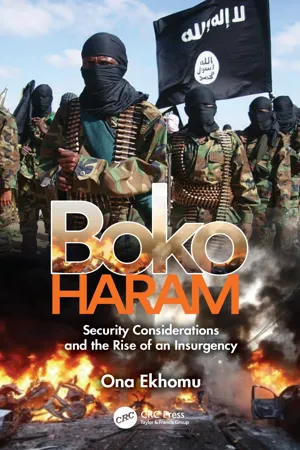
Boko Haram analyzes the activities and atrocities of Nigeria's Jihadi terrorist group, Boko Haram, in the context of global religious fundamentalism and extremism. The book traces the early beginnings of the religious sect, the conversion of its leader to radical Islam in 2002, and the group's campaign of violence beginning in 2009 and continuing to the present.
The group's attacks against a variety of targets are examined in detail as are their general tactics and strategies. The Nigerian government response is also examined in order to provide critical lessons to counterterrorism planners, policy and government officials, and scholars. The initial military response was hampered by capability and legislative constraints including a lack of arms and ammunition, a lack of modern counterterrorism equipment, training gaps, leadership issues, intelligence gaps, politicization of the conflict, and limited support to the Nigerian military by the international community.
Boko Haram looks at the work that has been done thus far, and what work needs to continue, to make gains to combat, marginalize, and ultimately defeat Boko Haram and resolve the conflict facing Nigeria.
Key features:
Outlines the history of Boko Haram and its emergence in Nigeria
Provides the latest developments on fundamentalism in Nigeria, the growth of Boko Haram and the government response
Focuses on the attacks, attack methodology and targeting of Boko Haram, addressing best-practice countermeasures
Examines Boko Haram's ties to other Islamist groups including ISIL/ISIS and others
Details the importance for international cooperation in responding to Boko Haram's activities and threats.
About the Author:
Dr. Ona Ekhomu, CFE, CPP, CSP, PCI, CPOI was born in Irrua, Nigeria. He holds the PhD from University of Pittsburgh. A policy analyst and security expert, Ekhomu is Chairman Trans-World Security Systems Ltd. and Chairman School of Management and Security (Lagos, Nigeria). President of Trans-World Security Systems Inc. of Chicago, Illinois, USA, Ekhomu is also a lecturer in the Sociology Department of the University of Lagos, Nigeria. He is President of the Association of Industrial Security and Safety Operators of Nigeria; Africa Representative of the International Foundation for Protection Officers; and former Regional Vice-President (West and Central Africa) of ASIS International. Ekhomu is author of Kidnap: Face to Face with Death (2014) and Effective Personal & Corporate Security (2009).
Since 2009, Nigeria has faced a determined and deadly Islamist fundamentalist insurgency. The Islamist group known as Jama’atu Ahlus-Sunnah Lidda’Awati Wal Jihad, better known by its nickname “Boko Haram,” was founded in 1995 as a Sunni Salafist organization preaching Islam and providing services to the poor, to widows and to vagrant children (almajiris). The group, then known as the Sahaba, was led by a Muslim cleric, Malam Lawan Abubakar. In 2002, Malam Lawan relocated from Nigeria to Saudi Arabia for further studies at the University of Medina.1
Subsequent to the departure of Malam Lawan, older clerics in the Sahaba group chose a charismatic, intelligent, diplomatic, gifted, young versatile preacher named Mohammed Yusuf to succeed him.2 The choice of a younger and more energetic leader was aimed at injecting youthful energy and drive into the religious organization. It was hoped that with a younger leader the group would increase its appeal to the youth and thereby increase its membership. The strategy succeeded as the group experienced a significant increase in membership and it became very influential among religious organizations in Northern Nigeria.
The new leader of the Sahaba Group, Mohammed Yusuf, had high school education but was not able to gain admission into the University of Maiduguri to further his education. He served in the Yobe State civil service. An ethnic Kanuri from Girair Village in Yobe State, Yusuf was a fiery and gifted preacher. He received high-quality religious education under the Kano-based Izala cleric, Sheikh Ja’afar Mahmud Adam. Malam Yusuf, a precocious and intelligent scholar, was praised by his revered teacher Sheikh Adam as “the leader of young people.”
Figure 1.1 Photo of Mohammed Yusuf.
According to a prominent Zaria-based Salafi imam, the new leader of the Sahaba had also been mentored by the leader of the Islamic Movement of Nigeria (IMN), Sheikh Ibrahim el-Zakzaky. The IMN is the umbrella organization of the Shiites sect in Nigeria, which is different from the Sunni sect that Yusuf represented. Yusuf later became the Borno State amir (leader) of Jama’atu al-Tajdid al-Islami (JTI) which translates into Movement for the Revival of Islam. The group JTI was a Kano-based IMN breakaway group founded in 1994 that continued Sheikh Ibrahim el-Zakzaky’s confrontational stance toward the government but through Salafist doctrine. The members of JTI are suspected of having carried out the beheading of Mr. Gideon Akaluka, a Christian Ibo trader in Kano accused of desecrating the Holy Koran. In 2002, Yusuf became the Borno State representative on the Supreme Council for Sharia in Nigeria (Figure 1.1).
THE CONVERSION
The trajectory of the Sahaba group changed from service and preaching to extremism when in 2002 Malam Mohammed Yusuf met a radical, fanatical cleric named Mohammed Alli. Mohammed Alli indoctrinated Yusuf into the Taliban extremist ideology of strict Wahabism. Coming under the doctrinal influence of Mohammed Alli became a turning point for Yusuf as a person and the organization that he led.
Alli was a devout fundamentalist who believed in jihad. The Taliban came into prominence in Afghanistan in 1994 led by Mullah Mohammed Omar, a puritanical cleric. He recruited members from Koranic schools hence the name “Taliban” which means “student.” The Talibans, whose fundamentalist doctrine did not favor anything Western, took over political control of Afghanistan from 1996 to 2001 and implemented strict Islamic Sharia code with stonings, amputations, public executions and harsh treatment of women.
The Muslim coalition that defeated the Soviets was united by their fundamentalism – Wahabism and Sunni Salafism. The Talibans began a process of converting Muslims to their extremist ideology in order to reduce the “pollutant” effects of Western civilization on pure Islam. Based upon the Taliban radical ideology, Yusuf regarded secular governance as morally bankrupt and Western education as antithetical to pure Islam.
Alli proselytized to Yusuf that Western education only led to Westernization and secularization. He posited that Western education brought greater dependence on income. He condemned the lifestyle, opulence, ego and vanity of Western-educated elites (Yan Boko). Alli argued that governance was ineffective in the hands of Yan Boko and that it merely led to growth in white collar crime, collapse of societal values, debauchery and other social vices. To the traditionalist Taliban mindset this was appalling and horrific. Alli urged Yusuf to change society beginning with his group by becoming a true jihadist.
The conversion of Yusuf changed the doctrine of the Sahaba group to a Taliban-style traditional orthodoxy that considered Westernization as aberrant, abhorrent and unIslamic. The teaching was that Western education pollutes and dilutes Islam. It maintained that Western institutions were infidel and must be avoided by Muslims.
BOKO HARAM
With radicalization came new realities and changes. Sahaba group leader Mohammed Yusuf concluded that although Western education (Boko or Book) significantly improved material well-being, it did not lead to wholesale conversion to Islam. Ironically, “Boko” or sorcerers (the educated elite) were respected in the Muslim North. “Book school” taught Islam more effectively than the local Islamiyya school which is also known as “Makaranta Alo.” It was known that Yan Boko had deeper knowledge of Islam than almajiri. However, the Boko version of Islam was impure. The Yusufiyyas (meaning the followers of Yusuf) then concluded that Western education (Boko) is sinful or forbidden (Haram).
Basic Religious Beliefs
The Boko Haram sect does not believe in banking, taxation or jurisprudence in the country. It considers those economic and legal practices to be haram. The zealots argue that Western education is unIslamic as it practices things that Allah and the Holy Prophet reject. Some of these practices include the mixing of boys and girls under the same shade, and the teaching of evolution theory and rotation of the earth.
Boko Haram members removed themselves from contact with other city dwellers in places like Maiduguri, Bauchi, Damaturu and Kano and built their own communities where they could interact with fellow sect members only. They strategically located their communes on the outskirts of town, apparently in order to escape Western vices.
The Taliban doctrine teacher Mohammed Alli convinced Yusuf to avoid democracy, civil service and Western education. Yusuf subsequently resigned from the Yobe State government as counseled by Alli.
With Mohammed Yusuf’s conversion, Ja’amatu Ahlus-Sunna Lidda Awatil Wal Jihad became a radicalized Muslim sect at the Ndimi Mosque in Maiduguri. The religious sect viewed Nigerian society as extremely corrupt. It also considered the Borno State Government led by Alh. Mala Kachalla an epitome of corrupt governance. Yusuf’s aversion to Gov. Kachalla’s alleged corruption informed his decision to work for the victory of the All Nigeria Peoples Party (ANPP) in the 2003 gubernatorial election. Senator Ali Modu Sheriff was the ANPP candidate for governor in the 2003 election.
As a pre-condition for supporting Senator Sheriff, Mohammed Yusuf was promised the implementation of strict Sharia code in Borno State. The charismatic preacher, pleased with this pledge, urged his followers to support the candidacy and eventual election of the ANPP candidate.
Senator Ali Modu Sheriff’s political career included serving as the Senator representing Borno Central Senatorial Zone on the platform of the United Nigeria Congress Party (UNCP) during General Sani Abacha’s military regime. Senator Sheriff ran again for the senate in 1999 on the platform of the ANPP and won the election.
It was the gubernatorial candidature of Senator Ali Modu Sheriff that brought him into close contact with Mohammed Yusuf and the Yusufiyya movement. Instead of implementing the strict Sharia code which he had promised as a pre-condition for Yusuf’s electoral support, Senator Sheriff created a Ministry of Religious Affairs and appointed the national secretary of the Yusufiyya movement, Alhaji Buji Foi, as the Commissioner of Religious Affairs.
Mohammed Yusuf and his group were disappointed that the strict Sharia code which Governor Sheriff had promised them was not implemented. It was a betrayal of trust and further reinforced the radical Islamic ideology that his group should have nothing to do with government. Realizing that he had been cheated by the governor of Borno State, Yusuf resigned his appointment with the government as did Alhaji Buji Foi, the State Commissioner for Religious Affairs.
THE HIJRA
The fundamentalist cleric Mohammed Alli did a good job indoctrinating the charismatic Yusuf, who accepted almost all the tenets of radical Islam except one – hijra (migration from a bad place to a better place).3 Alli tried to persuade Yusuf to migrate with him from Maiduguri to Yobe State in a hijra, Yusuf declined.4 He saw his calling as service to the less privileged and preaching the true Islamic faith.
THE NIGERIAN TALIBAN
The terminology “Nigerian Taliban” was first used by US government officials to describe the small radical Islamic group that migrated in October 2003 from Maiduguri to Yobe State, camping at a small desert village named Zagi-Biriri in Tarmuwa Local Government Area. Zagi-Biriri Village is 70 km north of Damaturu, the Yobe State capital.
The sect, which styled itself “Talibans of Yobe,” comprised university undergraduates, ex-military personnel and professionals, among others.5 Consistent with their religious beliefs, they maintained a Spartan dress code and wore a long beard – similar to that of the Talibans in Afghanistan. The Yobe Taliban group named itself Ali Sunnah Wal Jamma (“Followers of Prophet Mohammed’s Teachings”).
The choice of the remote desert location was to insulate the Yobe Talibans from what they perceived as the corrupt Nigerian system and...
Table of contents
Cover Page
Half Title
Title Page
Copyright Page
Dedication
Table of Contents
Acknowledgements
Preface
The Author
Prologue
Part One Historical Background
Part Two Choice of Targets
Part Three Combating Insurgency
Index
Trusted by 375,005 students
Access to over 1.5 million titles for a fair monthly price.
Study more efficiently using our study tools.
Frequently asked questions
Yes, you can cancel anytime from the Subscription tab in your account settings on the Perlego website. Your subscription will stay active until the end of your current billing period. Learn how to cancel your subscription
No, books cannot be downloaded as external files, such as PDFs, for use outside of Perlego. However, you can download books within the Perlego app for offline reading on mobile or tablet. Learn how to download books offline
Perlego offers two plans: Essential and Complete
Essential is ideal for learners and professionals who enjoy exploring a wide range of subjects. Access the Essential Library with 800,000+ trusted titles and best-sellers across business, personal growth, and the humanities. Includes unlimited reading time and Standard Read Aloud voice.
Complete: Perfect for advanced learners and researchers needing full, unrestricted access. Unlock 1.5M+ books across hundreds of subjects, including academic and specialized titles. The Complete Plan also includes advanced features like Premium Read Aloud and Research Assistant.
Both plans are available with monthly, semester, or annual billing cycles.
We are an online textbook subscription service, where you can get access to an entire online library for less than the price of a single book per month. With over 1.5 million books across 990+ topics, we’ve got you covered! Learn about our mission
Look out for the read-aloud symbol on your next book to see if you can listen to it. The read-aloud tool reads text aloud for you, highlighting the text as it is being read. You can pause it, speed it up and slow it down. Learn more about Read Aloud
Yes! You can use the Perlego app on both iOS and Android devices to read anytime, anywhere — even offline. Perfect for commutes or when you’re on the go. Please note we cannot support devices running on iOS 13 and Android 7 or earlier. Learn more about using the app
Yes, you can access Boko Haram by Ona Ekhomu in PDF and/or ePUB format, as well as other popular books in Politics & International Relations & Management. We have over 1.5 million books available in our catalogue for you to explore.