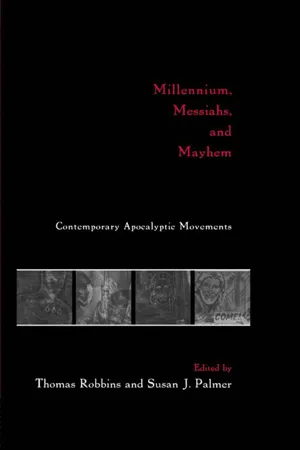
As we approach the Millennium, apocalyptic expectations are rising in North America and throughout the world. Beyond the symbolic aura of the millennium, this excitation is fed by currents of unsettling social and cultural change. The millennial myth ingrained in American culture is continually generating new movements, which draw upon the myth and also reshape and reconstruct it. Millennium, Messiahs, and Mayhem examines many types of apocalypticism such as economic, racialist, environmental, feminist, as well as those erupting from established churches. Many of these movements are volatile and potentially explosive.
Millennium,Messiahs, and Mayhem brings together scholars of apocalyptic and millennial groups to explore aspects of the contemporary apocalyptic fervor in all orginal contributions. Opening with a discussion of various theories of apocalypticism, the editors then analyze how millennialist movements have gained ground in largely secular societal circles. Section three discusses the links between apocalypticism and established churches, while the final part of the book looks at examples of violence and confrontation, from Waco to Solar Temple to the Aum Shinri Kyo subway disaster in Japan.
Contributors: James Aho, Dick Anthony, Robert Balch, Michael Barkun, John Bozeman, David Bromley, Michael Cuneo, John Dimitrovich, John Hall, Massimo Introvigne, Philip Lamy, Ronald Lawson, Martha Lee, Barbara Lynn Mahnke, Vanessa Morrison, Mark Mullins, Ansun Shupe, Susan Palmer, Thomas Robbins, Philip Schuyler and Catherine Wessinger.
eBook - ePub
Millennium, Messiahs, and Mayhem
Contemporary Apocalyptic Movements
- 344 pages
- English
- ePUB (mobile friendly)
- Available on iOS & Android
eBook - ePub
Millennium, Messiahs, and Mayhem
Contemporary Apocalyptic Movements
About this book
Information
Secularizing the Millennium

Secularizing the Millennium
Survivalists, Militias, and the New World Order
5
Philip Lamy
Timothy McVeigh and Terry Nichols, arrested in connection with the April 19, 1995, bombing of the Alfred P. Murrah Federal Building, are purported to be responsible for the deaths of 168 people, including nineteen children, in one of the worst acts of domestic terrorism the United States has experienced. The bombing in Oklahoma City magnified attention on paramilitary extremists of the far right, including the so-called “militia movement” with which McVeigh and Nichols allegedly had been associated in Kingman, Arizona. In the next few weeks Americans learned a lot about the militia movement and a growing paramilitary, antigovernment subculture that had literally exploded in the country. These extremists were armed and angry at the U.S. government for eroding the rights of American citizens; they espoused a “patriotic” and separatist philosophy; they practiced survivalism, or disaster preparedness, and predicted the collapse of civilization; and they feared that a conspiracy to create a socialist one-world government and a “new world order” was unfolding.
Militia leaders and supporters pointed to Ruby Ridge, where in 1992 a white supremacist named Randy Weaver had resisted arrest on illegal weapons charges, and so had been “attacked” by United States marshals. During a shoot-out and subsequent standoff, Weaver's wife, his fourteen-year-old son, and a U.S. marshal were killed. There also had been the tragic events in Waco, Texas, in the spring of 1993, where an apocalyptic sect called the Branch Davidians, led by David Koresh, a man who claimed to be the messiah, came into fatal contact with federal law enforcement agencies of the FBI and the Bureau of Alcohol, Tobacco and Firearms (ATF), once again over the alleged possession of illegal firearms. “Ruby Ridge” and “Waco” became rallying cries for a millenarian movement comprised of Americans who were losing patience with their government and federal law enforcement and were taking up arms, joining paramilitary organizations such as the militias, and practicing survivalism in preparation for the Apocalypse.
For “secular” millennialists the Apocalypse will most likely be man-made— brought about by social, economic, or industrial collapse, environmental degradation, race war, civil war, or nuclear war. Salvation may not be in the hands of a messiah but in the preparations of the individual. Survivalism— the philosophy and practice of disaster preparedness—is an example of secular millennialism. To survivalist-oriented individuals and groups such as the militias, the Patriot Movement, Soldier of Fortune magazine, and the Unabomber, evil is represented by the government and big business, the mass media, technology, the entire complex industrial society, and the greatly feared emerging “new world order.” The mix of survivalism with apocalypticism—as doom-sayers take up arms, hide out in the country's hinterlands, and start throwing bombs at the “system”—reflects a secularization of millennialism, an increasingly popular and combustible mix.
SECULARIZING THE MILLENNIUM
Today millennial expressions are found not only in revitalized messianic movements like the Branch Davidians, but in groups that appear, at least on the surface, not to be religious in orientation. Secular millennialism is principally a nonreligious set of prophecies that have been identified in a wide variety of political and revolutionary movements throughout history (Cohn 1957; Hobsbawm 1959; Hyams 1974; Bellah 1967; Lamy 1992; Greil and Robbins 1994). In an important book on millenarian movements entitled Primitive Rebels (1959), historian Eric Hobsbawm outlined the basic differences between religious and secular millenarian movements. The classic religious movements, best represented by those that have periodically developed in the history of Christianity, have three main features. First, there is a total rejection of the present evil world and a belief in its imminent demise and replacement by a more humane and just one. Second, religious millennialists believe a messiah will return to build the new Utopian world through supernatural action. Third, there is a fundamental vagueness concerning how the new world will come about, including the actual timing and sequence of events, since most of this will be caused by supernatural intervention.
Hobsbawm contrasts the religiously inspired millenarian movements with the more secular forms, which primarily lack supernatural elements, especially the belief that the Apocalypse will be engineered by God and that the millennium will be ushered in by the Second Coming of Christ. Instead, secular millennialists build an organization of ideology, politics, and an alternative plan for society. They also view the collapse of civilization as imminent, and hope to hasten its demise so as to institute a new historic period. For secular millenarian movements evil is represented not by supernatural forces but by human ones, generally those who rule or persecute them. Secularists, however, can adopt apocalyptic imagery and ideas to frame their beliefs and actions, thus instilling a fervor in followers that closely approximates that of the classical millennialist. For example, survivalists often speak of the imminent collapse of civilization and “nuclear Armageddon” with the zeal of a doomsday prophet. On the other hand, religious movements can adopt secular ideas by interpreting current events through the prism of the classical myth that Revelation, for example, provides. Some Christian fundamentalists confidently predict that the millennium will be ushered in by nuclear war, economic collapse, environmental destruction, or a combination of them all, “if that's God's will.” Likewise, the Branch Davidians stockpiled weapons and food in a survivalist fashion in anticipation of the tribulations and Armageddon. Hobsbawm also suggests that between the “pure” or classical millenarian movement and the more secular kind, all manner of intermediate groups are possible.
This appears to be the case in American culture today, where elements from the classical apocalyptic tradition merge with modern and secular forms such as survivalism, producing a strange array of “postmodern” millennial phenomena. Survivalism is a “practical” approach to disasters—natural, man-made, or supernatural—because it addresses the physical survival of nuclear war, economic collapse, environmental degradation, race war, or some other major societal disaster, through crisis relocation, the stockpiling of food and weapons, and the practice of survival strategies. Most survivalists are convinced that the current social, ecological, and industrial world order is corrupt and moribund. Furthermore, many believe that the U.S. government and United Nations are controlled by an international elite set to create a slave-like, “socialist” new world order. Survivalists have taken steps to prepare for the collapse of civilization and the subsequent wars, economic and environmental degradation, and other “tribulations” that are likely to ensue.
Survivalism provides a modern site where the millennial myth has “fractured”— its symbols and meanings reproduced and redefined through the beliefs and experiences of a militant right-wing millennialism. In certain ways survivalism reflects the severe downside of the millennial myth. The survivalist philosophy speaks of mass destruction and mass death. It is not interested in reforming the system; the collapse of civilization is imminent. However, it does offer a plan of action—a kind of personal redemption or self-salvation—in the manner of surviving the great destruction of the current order and living on to build a new and better one.
THE MILLENNIAL MYTH
Perhaps the most famous example of apocalypticism is the Christian Apocalypse or Revelation of John. The final book in the Bible, Revelation was probably written in the Roman Emperor Domitian's reign in A.D. 95, when Christians were being persecuted for their unpatriotic refusal to worship the deified governor. John of Patmos, Revelation's author, saw Rome as the Antichrist, and he wrote to strengthen the faithfuls' resistance to engaging in public rituals that honored the emperor's divinity. Written in a literary style that only the initiated (presumably the author's original audience) would fully understand, Revelation is the least understood and most misinterpreted book in the Bible. However, it is also one of its most influential.
Like Jewish apocalypticists of the Greco-Roman era, John saw the Messiah appearing amid a series of catastrophic events culminating in the near success of the Antichrist, the evil false prophet who, during the final days, rises in leadership to deceive the world. The Messiah destroys the Antichrist, brings redemption for the chosen, and establishes a new spiritual world beginning with the millennium. Revelation presents the Roman persecutions of Christians as the beginning of a universal war between the forces of good and evil. While Revelation has no single indisputable meaning, its very ambiguity has left it open to numerous interpretations and has imbued it with the power and persistence of myth.
While a great number of volumes have interpreted the vast complexities of Revelation, some of the more outstanding visions and striking symbols can be summarized under the following themes: Tribulation; the Dragons, Beasts, and Antichrist; Babylon; Redemption; Armageddon; and Millennium. Plagues of famine, disease, earthquakes, and war visited on humankind by God or other supernatural forces represent the Tribulation that will accompany the end-times. Revelation is also populated by demonic beasts, dragons, and the Antichrist—different personifications of Satan that plague and corrupt humankind. Armageddon expresses the militaristic and moral imagery of great battles and final war with the demonic hosts. Babylon is the metaphor for the ancient city, reflected in Revelation as the rich, sinful, and corrupted whore (and people) who had fallen away from God. Redemption refers to the belief that a savior or messiah (Jesus Christ) will return to redeem the chosen and damn the cursed. The last feature is the promise of the millennium, a new Utopian world transformed by supernatural action.
The millennial myth is a symbolic form of belief that acts as a powerful metaphor for real human events. It provides a context in which to interpret current events and give meaning and direction to people's lives. The myth is like a floating framework for explaining the “big picture” for both religious and secular millenarian movements and all manner of “intermediate groups.” By examining the paramilitary and survivalist subculture as expressed through Soldier of Fortune magazine, the militia and Patriot movements, and the “Unabomber's Manifesto,” I will demonstrate how elements of the millennial myth take secular forms in adaptation to the current age. In contrast, I will show how religious millennial groups, such as the Branch Davidians or the Christian right, adapt their beliefs to the current events of the day, often taking forms similar to the secularists.
TRIBULATION: FEAR AND LOATHING IN LAS VEGAS
The age-old battle against tyranny raged on at the 1995 Soldier of Fortune Convention and Exposition held at the Sands Hotel and Casino in Las Vegas in the fall of 1995.1 Celebrating its twentieth anniversary, Soldier of Fortune Magazine: The Journal of Professional Adventurers (SOF) brings together an odd assortment of characters, including mercenaries, survivalists, militiamen and women, and all manner of paramilitary patriots, antigovernment zealots, and would-be Rambos. For five days and four nights more than 500 conventioneers, many in fatigues or other military dress, attended seminars on combat weaponry and survival strategies in the morning, fired machine guns and discussed “Grass Roots Activism” in the afternoon, and debated the politics of the “new world order” over drinks and blackjack in the evenings. Gun enthusiasts competed in “the world's premier three gun shooting match,” while other conventioneers competed in pugil-stick fighting, a pool-side paintball gun shoot-out, or explored “The Warrior's Way.” At the SOF Exposition Center more than one hundred exhibitors hawked paramilitary and survivalist weaponry, equipment, literature, videos, services, even “isolated rural properties.” Paladin Press, publishers of “the Action Library,” displayed dozens of their best-selling books and videos, including Fallout Survival, New I.D. in America, The Ultimate Sniper, and State of the Art Survival Caching.
The temper of the 1995 SOF Convention seemed quieter than the patriotism and bravado displayed at the 1990 Convention, held during the Persian Gulf War, but it also seemed angrier and more bitter (Lamy 1992). In April there had been the Oklahoma City bombing, and the intense focus it had brought on the militia movement and related organizations like Soldier of Fortune. A congressional hearing was currently underway regarding possible FBI abuses in the 1992 shoot-out at Ruby Ridge, Iowa. And there had been Waco; the April 1993 tragedy is viewed by many on the survivalist right, including many at the SOF Convention, as a vicious and murderous attack on a small, independent American church by fascist law enforcement agents of the American government.
For the past twenty years it was tyrants like Idi Amin, Moammar Gadaffi, the Ayatollah Khomeini, Saddam Hussein, and the former Soviet Union that infected the world, according to Soldier of Fortune. And while international tyrants still exist, SOF has turned it sights increasingly inward—at the U.S. government and federal law enforcement agencies, especially the FBI and the now-infamous ATF. Distrust, anger, and fear of the government was evident throughout the convention. It was in every conventioneers' packet in a war...
Table of contents
- Cover Page
- Half Title Page
- Title Page
- Copyright Page
- Dedication
- Contents
- Acknowledgements
- Introduction Patterns of Contemporary Apocalypticism in North America—Thomas Robbins and Susan J. Palmer
- Section One: Theories of Apocalypticism
- Section Two: Secularizing the Millennium
- Section Three: Apocalypticism and the Churches
- Section Four: Violence and Confrontation
- Contributors
- Index
Trusted by 375,005 students
Access to over 1.5 million titles for a fair monthly price.
Study more efficiently using our study tools.
Frequently asked questions
Yes, you can cancel anytime from the Subscription tab in your account settings on the Perlego website. Your subscription will stay active until the end of your current billing period. Learn how to cancel your subscription
No, books cannot be downloaded as external files, such as PDFs, for use outside of Perlego. However, you can download books within the Perlego app for offline reading on mobile or tablet. Learn how to download books offline
Perlego offers two plans: Essential and Complete
- Essential is ideal for learners and professionals who enjoy exploring a wide range of subjects. Access the Essential Library with 800,000+ trusted titles and best-sellers across business, personal growth, and the humanities. Includes unlimited reading time and Standard Read Aloud voice.
- Complete: Perfect for advanced learners and researchers needing full, unrestricted access. Unlock 1.5M+ books across hundreds of subjects, including academic and specialized titles. The Complete Plan also includes advanced features like Premium Read Aloud and Research Assistant.
We are an online textbook subscription service, where you can get access to an entire online library for less than the price of a single book per month. With over 1.5 million books across 990+ topics, we’ve got you covered! Learn about our mission
Look out for the read-aloud symbol on your next book to see if you can listen to it. The read-aloud tool reads text aloud for you, highlighting the text as it is being read. You can pause it, speed it up and slow it down. Learn more about Read Aloud
Yes! You can use the Perlego app on both iOS and Android devices to read anytime, anywhere — even offline. Perfect for commutes or when you’re on the go.
Please note we cannot support devices running on iOS 13 and Android 7 or earlier. Learn more about using the app
Please note we cannot support devices running on iOS 13 and Android 7 or earlier. Learn more about using the app
Yes, you can access Millennium, Messiahs, and Mayhem by Thomas Robbins, Susan J. Palmer, Thomas Robbins,Susan J. Palmer in PDF and/or ePUB format, as well as other popular books in Theology & Religion & Religious Eschatology. We have over 1.5 million books available in our catalogue for you to explore.