eBook - ePub
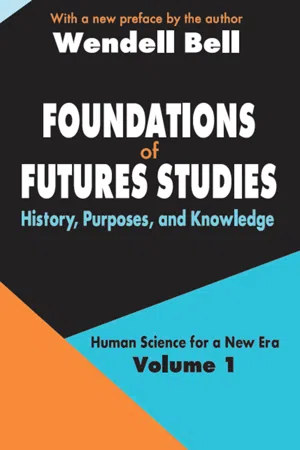
Foundations of Futures Studies
Volume 1: History, Purposes, and Knowledge
- 390 pages
- English
- ePUB (mobile friendly)
- Available on iOS & Android
eBook - ePub
Foundations of Futures Studies
Volume 1: History, Purposes, and Knowledge
About this book
Futures studies is a new field of inquiry involving systematic and explicit thinking about alternative futures. It aims to demystify the future, make possibilities for the future more known to us, and increase human control over the future. This book summarizes and expands contributions of futurists to the envisioning power and well-being of humanity. Bell brings together futurist intellectual tools, describing and explaining not only the methods, but also the nature, concepts, theories, and exemplars of the field.Foundations of Futures Studies fulfills Bell's five main purposes for writing this two-volume effort: (1) to show that futures studies, like other fields from anthropology to zoology, exists as an identifiable sphere of intellectual activity; (2) to create a teaching instrument that can be used as a basic text for core courses in futures studies; (3) to futurize the thinking of specialists in other disciplines; (4) to contribute to the further development and improvement of futures studies; and (5) to provide tools to empower both ordinary people and leaders to act in ways that create better futures for themselves and their societies. Bell maintains that despite its sometimes doomsday rhetorical style and widespread use by special interests, futures studies offers hope for the future of humanity and concrete ways of realizing that hope in the real world of our everyday lives. It will appeal to all interested in futures studies, as well as sociologists, economists, political scientists, and historians.
Information
1
Futures Studies: A New Field of Inquiry
Thinking About the Future
Recently, at a Chinese restaurant, my fortune cookie revealed these words of wisdom: “The smart thing to do is to prepare for the unpredictable.” We might all agree that that’s smart. But exactly how do we go about preparing for the unpredictable? If something is totally unexpected, then it seems impossible to prepare for it because we don’t know what “it” is. “Be prepared” may be good advice, but be prepared for what? Shall we be prepared to abandon ship, escape fire, move to the country, shovel snow, take a surprise examination in chemistry, spend the million dollars we’ll win in a lottery, be run over by a truck, write our acceptance speech for the Nobel Peace Prize, or what? The possibilities—likely and unlikely—are too numerous to contemplate if we try to prepare for what is truly unpredictable. Such an effort could become an endless and fruitless search.
The future—fortunately or unfortunately, depending on whether or not we like surprises—is like that. The best laid plans can go awry. Unexpected things can happen to us. The future contains an element of uncertainty. Nonetheless, we do try to prepare for the future and to deal with its uncertainties. Moreover, in our everyday lives we do so surprisingly well, although some people seem to do it better than others.
We also try to control the future, not only to “prepare” for it by adapting to what we think is coming, but to make things happen that we want to happen. We map out the next day or the next few years; we plan our future marriage or occupational career, knowing, of course, that things may not turn out exactly as we have planned.
Most of us do not give much conscious thought to how we do this, so we don’t have ready answers to such questions as: What procedures do we use when we think about the future? How do we prepare to carry out our plans and projects? What makes us successful in shaping or adapting to the coming future? At any given time, what alternative courses of action are open to us? What will be the future consequences of choosing to do one thing rather than others? What ought we to want the future to be?
These are central questions of futures studies, a new field of inquiry that involves systematic and explicit thinking about alternative futures. It is a growing body of work that is based on distinctive perspectives and assumptions and that utilizes specific theories, methods, and values. It aims to demystify the future, to make possibilities for the future more known to us, and to increase human control over the future. In the broadest sense, futurists hope to inform people’s expectations of the future and to help make their efforts to shape the future to their worthy values and purposes more effective. In some sense, thus, futures studies helps us to “prepare for the unpredictable.”
The Universality of Time Perspectives
Thinking about the future, of course, is not new. It is a universal phenomenon that can be traced back to the dawn of human prehistory. In every known society, people have conceptions of time and the future, even though some of their conceptions appear diverse, with different emphases on past and future and different degrees of elaboration and detail.
Divination, for example, is found in some form in every society. Sometimes it involves, as its root meaning suggests, discovering the will of the gods, but, more generally, it refers to finding obscure or secret things, including discovering the future by eliciting a divine response. In some cultures, a belief in fatalism predominates. In others, the hope of taking action to avoid a calamitous predicted event or to bring about a desirable one is common. Although it often concerns the everyday interests of particular individuals, divination also may involve grand prophecies dealing with the destinies of whole tribes and nations.
The range of techniques of divination is truly staggering. Fortune-telling, as done in one culture or another, has included the examination of the configurations of such animal organs as lungs, gall-bladders, intestines, hearts, stomachs, and livers. Particular configurations of such organs were correlated with presently observed events and, then, taken to portend similar consequences for the future. Ancient diviners made observations, continually corrected them, and produced “a huge corpus of cuneiform handbooks devoted to every possible configuration” (Hallo 1993: 6).
Other methods of divination include observing the patterns a fire makes as it burns (pyromancy), consulting the patterns of fire-cracked shoulder blades (scapulimancy), and watching cheese coagulate (tyromancy). They include, also, interpreting the patterns made by pouring oil on water, observing human facial features and bodily functions, and finding meanings in spittle, flowers, knotted threads, hemp seed, the whites of eggs, apples in water, ashes, salt, or cabbages. In fact, any phenomena in the world have been pressed into service to foretell the future (Hallo 1993). Oneiromancy (dream interpretation), for example, existed long before Sigmund Freud; William W. Hallo (1993: 5) believes that it may have been the oldest means of forecasting and gives an example of its use in Sumer as early as the twenty-fifth century B.C.E. In one society or another, all sorts of sorcerers, witches, shamans, sacrificial victims, and other oracles and readers of omens have been consulted in order to discover and to control the future (EB 1974: 916-20; Turner 1968; Yalman 1968).
The underlying belief in the ancient Near East, for example, was that “both omen and consequence were alike the expression of the same divine intent—the one as its announcement, the other as its fulfillment” (Hallo 1993: 6). More generally, however, anthropological studies of divination are not neatly separated from the study of magic, because it is not always a simple matter to distinguish an act which is meant to foretell the future from one which is meant to control it through intervention with supernatural powers.
Distinctions between past and future can also be seen in rites of passage. People recognize through ceremonial activities the major changes in individuals’ lives, such as birth, coming of age, marriage, and death. Such changes represent transitions from past to future social roles and alterations in rights and duties as individuals move through the life course (Goody 1968). Peoples of nonliterate societies typically appeal to gods and goddesses, or perhaps to less elevated spirits of some kind including those of their ancestors, to increase the availability of game animals, the yield of the harvests, and the fertility of the tribe—all future-oriented thoughts.
In modern industrial societies many of us take for granted, and largely ignore, the fact that divination of various kinds exists in our midst and is sincerely believed in by some otherwise sophisticated people and followed by many others who may be skeptical but do not completely reject it. Thus, ouija boards are consulted, forked sticks used to decide where to dig a well for water, bumps on the head examined by phrenologists, I Ching—the Chinese Book of Changes—studied, tea leaves and Tarot cards examined, black cats seen as omens, and, most widespread of all, astrological horoscopes are read—in daily newspapers and even university bookstores—to discover what the stars, planets, sun, and moon and their various interconnections have to tell us about what the future has in store for us.
The ability to anticipate the future begins early in life, as soon as a newborn child learns that his crying results in reactions from other people. At first, such anticipation reaches only into the immediate future, the briefest of moments beyond the present, perhaps without any conception that the immediate future is a different time than the present. As a child gets older, his or her time horizon begins to develop and then expand. Consciousness of the past is pushed farther back in time, eventually well beyond an individual’s personal experiences into those of his parents and grandparents, then still farther back into the oral traditions and charter myths of the tribe or the written histories and archaeological remains of earlier cultures and civilizations. So, too, time consciousness is pushed forward, beyond the immediate future farther into the time that is yet to come.
As children learn a language, of course, they also learn the time perspectives of their culture (Fraisse 1968). But such learning does not occur all at once. Children begin by talking solely about the present, about objects and events in the here and now. Later, they acquire the notion of nonpresent, grasping first the idea of the past, things that they have already experienced. After that, they begin to understand the notion of the future, things that they have not yet experienced. In learning about the nonpresent, children at first tend to confuse words like “yesterday” and “tomorrow.” Harner (1975), for example, in his study of two- to four-year-old children found that they began by interpreting “yesterday” as both past and future, that is, as “not present.” Next they got the meaning of “yesterday” right, then, finally, they learned what “tomorrow” meant (Clark and Clark 1978: 251).
Although the vast majority of languages have tenses, there are a few tenseless languages. There are, however, no timeless languages. For even in a tenseless language, the ideas of past, present, and future can be understood and communicated. For example, in a tenseless language, conveying ideas about time is achieved by other means such as adverbials, the aspectual contrast of perfect or imperfect, and context (Gell 1992).
The scale of time perspectives—that is, how far into the past and how far into the future an individual’s thinking goes—may vary from one society to another. It varies also among individuals within the same society, especially within large and complex societies characterized by considerable social inequality. But some time perspectives, some conception of past and future, and some effort to predict or control the future appear to be part of the language and culture of all—or nearly all—peoples.
Time, like space, is an inevitable aspect of individual experience and social interaction. Everything occurs at some time and in some place. Although at quite different rates, nearly everything changes from one time to another. Thus, it is not surprising to find that time is in some degree a part of human consciousness everywhere. After critically reviewing the anthropological literature on time, Gell (1992: 315) concludes that, despite some claims to the contrary, nowhere do “people experience time in a way that is markedly unlike the way in which we do ourselves.” Everywhere, there is past, present and future. Everywhere, time moves on and on. Everywhere, time “is always one and the same” (see chapter 3).
The Utility of Divination
The modern approach to the study of the future, like primitive divination, includes an effort to discover and often, if possible, to control the future, to bend it to human will. Unlike divination, though, it is not based on beliefs in the supernatural, magic, mystification of methods, superstition, or the secret powers of particular individuals or groups. Rather, the opposite is the case. Futures studies is part of modern humanism, both philosophical and scientific. It is secular. Futurists, the practitioners of the futures field, aim to demystify the future, to make their methods explicit, to be systematic and rational, to base their results on the empirical observation of reality where relevant, and to test rigorously the plausibility of their logic in open discussion and intellectual debate. They also use creativity and intuition. Although some futurists occasionally abuse these values, they remain the ideals that most futurists strive to fulfill.
Despite the enormous qualitative differences between divination and modern futures research, we should not underrate divination nor dismiss it too quickly as utter nonsense. As James Frazer understood in his classic anthropological work, The Golden Bough, primitive practice is often based on “excellent observation of natural phenomena and involves a theory of causality” (Yalman 1968: 521). Today, many of our theories of causality are different and, therefore, so are many of our observations since they are guided by them. Especially, the meanings that we assign to our observations are different than those used in divination.
At least, divination could eliminate paralyzing indecision when an individual was faced with the uncertainties of the future. It could help a group in conflict decide what future course of action to take, thereby resolving the dispute and legitimating a given decision. Flipping a coin, of course, can—and for some people does—serve the same function of permitting decisive action in perplexing situations with no greater knowledge of the future than a fifty-fifty chance of being right. At most, divination did more. For example, the diviner does better than mere chance in guessing the future—or whatever secret was at issue—where the diviner could rely on his past experience of similar situations or ferret out the implicit knowledge revealed by the anxieties of his clients that lay below the level of their own consciousness. Additionally, in deciding such questions as where to hunt, divination sometimes provided a more or less randomized exploitation of the habitat and, thus, was adaptive.
In fact, divination may have at least one major advantage over modern futures research, since for either to be of much use people have to believe in it. There is no question but that in many nonliterate societies people had great faith in their diviners, more, no doubt, than many people in modern, industrial societies generally have in their futurists.
Recent Origins of Futures Studies
Faith in modern futurists may be increasing, though, if it is accurately measured by the rapid, even astonishing, growth of futures studies during the last few decades. Of course, as I show in subsequent chapters, futures studies can be viewed as a recent culmination of a long, sometimes interrupted, sometimes waning as well as waxing development of ideas stretching as far back as the Greeks and, beyond that, even to the primordial diviners we have just discussed. Yet the specific origins of the modern futures movement are much closer to us.
It is risky, of course, to pick a particular date and say that is when something began, because it is easy to question the choice with examples of precursors of various kinds. For example, a good case can be made for dating the recent origins of futures studies from the publication of H. G. Wells’s Anticipations of the Reaction of Mechanical and Scientific Progress upon Human Life and Thought that first appeared in 1901 in the British magazine, The Fortnightly Review (Wager 1991). Among other things, Wells proposed “a science of the future” and, in a radio talk over the B.B.C. in 1932, he claimed that not only Professors of Foresight were needed, but entire Faculties and Departments of Foresight to anticipate and prepare for the coming future (Wells 1987). Another good case might be made for tracing the modern futures movement to the futuristic novels of the French writer, Jules Verne, which were published in the 1860s and 1870s.
Although in volume 2, chapter 1, I discuss some early writers—from Thomas More to Karl Marx—whose works have provided many of the themes, purposes, and exemplars that have helped shape modern futures studies, my aim in this chapter is more modest. Here, I limit myself to a few recent illustrative strands of intellectual history that appear to have led to—or in one case might have led to—the creation of futures studies as it is today.
Ogburn and Technology
One such strand is that of sociologist William F. Ogburn and his coworkers, especially S. Colum GilFillan. U. S. President Herbert Hoover appointed a President’s Research Committee on Social Trends in 1929. The committee, headed by Ogburn, produced the most comprehensive description of social change in American society up to that time. The report, Recent Social Trends in the United States, was published in 1933. After the election of Franklin D. Roosevelt as president of the United States in 1932, Ogburn was once again called to public service. He served as an active member of the U. S. National Resources Committee and helped shape its report, Technological Trends and National Policy, Including the Social Implications of New Inventions (1937).
Ogburn’s method included forecasting the future by quantitatively determining long-term trends concerning the past, and, then, projecting them into the future for a number of decades. He considered such trends, for example, as the “increasing role of government and the growth of large businesses” (Jaffe 1968: 279).
Ogburn’s theory of social change emphasized the role of invention. For him, change in the modern world typically followed a causal sequence beginning with some technological invention or innovation. The technological change, in turn, produced change in economic organization, which produced change in social institutions—such as the family or government. Finally, according to Ogburn, changing social institutions produced change in people’s social philosophy, that is, in their beliefs, attitudes, and values. He would also agree that the sequence was sometimes circular, with social philosophies altering the demand for certain types of inventions and, thus, leading to technological change and starting the causal sequence over again (Jaffe 1968: 279).
Ogburn made many contributions to the study of the social effects of technology and he cofounded and was the first president of the Society for the Study of Technology. Thus, there are ample justifications for the claim that some people make for him that he was the father of technology assessment (Cornish 1977: 74). Technology assessment has become one standard approach to futures research, has been institutionalized in a variety of organizations, such as the U.S. Congress’s Office of Technology Assessment, and has been a career path for prominent futurists, such as Joseph F. Coates and Vary T. Coates.
Also, Ogburn’s idea that a society should produce a quantitative picture of itself as a way of knowing where it had been, where it was going, and how to make sound decisions about social policy grew into the “social indicators movement” in the 1960s. The idea had never died, but during World War II it was largely suspended as the war mobilized nearly all activities, including statistical work, directly for the war effort itself. After the war, the idea of the need to monitor the state of the society by using a variety of social indicators—from population, labor force participation, and technological change to crime, education, and health—took hold again (Innes 1990).
The Twentieth Century Fund published a report on “America’s Needs and Resources” in 1947 and again in 1955. President Lyndon B. Johnson in 1966 set up a group in the then-Department of Health, Education, and Welfare to develop social indicators and to use them to monitor societal welfare. That same year Raymond A. Bauer published Social Indicators. The Russell Sage Foundation advanced the social-indicator movement further with the 1968 publication of Indicators of Social Change: Concepts and Measurements, authored by leading scholars (Sheldon and Moore 1968). By 1972, Wilcox et al. found over 1,000 published articles and books on the subject, and,...
Table of contents
- Cover Page
- Foundations of Futures studies
- Copyright Page
- Contents
- List of Figures
- List of Tables
- Acknowledgements
- Preface to the 2003 Edition
- Preface
- 1. Futures Studies: A New Field of Inquiry
- 2. The Purposes of Futures Studies
- 3. Assumptions of Futures Studies
- 4. Is Futures Studies an Art or a Science?
- 5. An Epistemology for Futures Studies: From Positivism to Critical Realism
- 6. Methods and Exemplars in Futures Research
- References
- Index
- About the Author
Trusted by 375,005 students
Access to over 1.5 million titles for a fair monthly price.
Study more efficiently using our study tools.
Frequently asked questions
Yes, you can cancel anytime from the Subscription tab in your account settings on the Perlego website. Your subscription will stay active until the end of your current billing period. Learn how to cancel your subscription
No, books cannot be downloaded as external files, such as PDFs, for use outside of Perlego. However, you can download books within the Perlego app for offline reading on mobile or tablet. Learn how to download books offline
Perlego offers two plans: Essential and Complete
- Essential is ideal for learners and professionals who enjoy exploring a wide range of subjects. Access the Essential Library with 800,000+ trusted titles and best-sellers across business, personal growth, and the humanities. Includes unlimited reading time and Standard Read Aloud voice.
- Complete: Perfect for advanced learners and researchers needing full, unrestricted access. Unlock 1.5M+ books across hundreds of subjects, including academic and specialized titles. The Complete Plan also includes advanced features like Premium Read Aloud and Research Assistant.
We are an online textbook subscription service, where you can get access to an entire online library for less than the price of a single book per month. With over 1.5 million books across 990+ topics, we’ve got you covered! Learn about our mission
Look out for the read-aloud symbol on your next book to see if you can listen to it. The read-aloud tool reads text aloud for you, highlighting the text as it is being read. You can pause it, speed it up and slow it down. Learn more about Read Aloud
Yes! You can use the Perlego app on both iOS and Android devices to read anytime, anywhere — even offline. Perfect for commutes or when you’re on the go.
Please note we cannot support devices running on iOS 13 and Android 7 or earlier. Learn more about using the app
Please note we cannot support devices running on iOS 13 and Android 7 or earlier. Learn more about using the app
Yes, you can access Foundations of Futures Studies by Jose Valciukas,Wendell Bell in PDF and/or ePUB format, as well as other popular books in Social Sciences & Social Science Research & Methodology. We have over 1.5 million books available in our catalogue for you to explore.