eBook - ePub
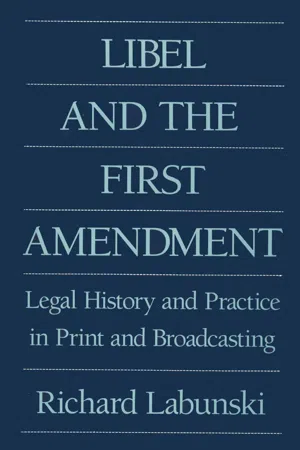
Libel and the First Amendment
Legal History and Practice in Print and Broadcasting
- 260 pages
- English
- ePUB (mobile friendly)
- Available on iOS & Android
eBook - ePub
Libel and the First Amendment
Legal History and Practice in Print and Broadcasting
About this book
As the recent cases involving William Westmoreland and Ariel Sharon re-veal, libel suits filed against media organizations have become an increas-ingly serious problem in recent years. The potential for inhibiting news coverage or even putting a news organization out of business has never been greater. This book explores historical and contemporary issues relating to libel suits against media organizations, emphasizing the consequences of the development of libel law for the First Amendment. It also considers the spe-cial problems that broadcasters have with libel suits and their potentially in-hibiting effect on television news coverage. Labunski traces the development of libel law largely from 1964, when the Supreme Court entered the libel arena for the first time and began a twenty-year effort to develop standards that are fair to both sides. He de-scribes the hostile environment which journalists must enter when they de-fend themselves in court. He also demonstrates the complexity and inconsis-tency that have resulted from the state-by-state creation of libel standards. Labunski offers suggestions, some more easily accomplished than others, that will help us get out of the libel "morass" which twenty years of Su-preme Court activity and lower court litigation have produced. This book will be of particular value to students of the First Amendment, communica-tion scholars, working journalists, and anyone who wants to better under-stand the complex development of libel laws and the effect of libel suits on news coverage.
1
Journalists in Court: A Hostile Environment
Of the many troubling issues facing journalists in the 1980s, none is more complicated and potentially damaging to their First Amendment rights than libel. There are indications that the number of lawsuits against media organizations has been increasing at an alarming rate in recent years. The possibility that a single successful lawsuit will put a newspaper or broadcasting station out of business has never been greater. Even meritless suits brought to harass journalists can be costly to defend. The expense and commitment required to fight a libel suit can make even the most courageous editor or news director think more carefully about doing the next controversial story.
Not long ago it could hardly have been imagined that a jury would award $26.5 million to a former Miss Wyoming who claimed that a fictional story in a magazine was actually about her.1 In the last few years newspapers in large and small cities have lost libel suits in which plaintiffs have been awarded huge sums of money.2 Several cases have sent shock waves throughout journalism: a newspaper in Illinois lost a $9.2 million suit because of a memo written by two reporters that was never published;3 a broadcasting company spent $7 million on legal expenses in a case it eventually settled for a reported $1.25 million;4 and a jury so badly misunderstood a judge's explanation of the applicable libel laws in awarding $2 million to the president of an oil company that the judge had to overturn the verdict.5
The impact of such lawsuits, even when journalists are at fault, could significantly affect what people read in newspapers and hear and see on radio and television. A form of self-imposed censorship, the natural hesitancy to do a story that although true might be difficult to prove in court, could deprive readers and viewers of access to important information about their communities and public officials. Such self-imposed censorship is especially ominous because it is virtually immeasurable.6
The increasing number of libel suits and the size of the monetary awards are only part of the problem. The U.S. Supreme Court, which nationalized libel laws some twenty years ago, has decided a number of major libel cases by adopting standards it has been unable or unwilling to enunciate clearly. No journalist, no matter how schooled in law and judicial process, knows for certain what standard of liability will be applied to a particular case. By adopting several tests that determine if the plaintiff is a public or private figure, or whether the controversy involves a public issue, the Court has failed to provide guidance to even the most perceptive journalist, or to individuals seeking to vindicate their reputation. In a major decision the Court even deviated from a test it had established in the very same opinion.7 The result has been substantial variance among lower courts in complying with Supreme Court decisions, and much confusion.8 The disarray of libel laws and recent well-publicized cases in which plaintiffs have won in or out of court large sums of money from news organizations have probably emboldened the subjects of news stories to file lawsuits in what is clearly an already litigious society.
Ever since its landmark decision in New York Times v. Sullivan9 in 1964, the Court has attempted to balance reputational interests with First Amendment press freedoms. Our society legitimately recognizes the right of individuals to be free from the printing or broadcasting of defamatory falsehoods made in reckless disregard for whether they were true or not. Except in the minds of a few individuals, the First Amendment has never been held to be so absolute.10 Society has a substantial interest in preventing irresponsible journalists from damaging the reputations of public figures and private individuals.
Yet society also has a compelling interest in seeing that the press freedoms granted under the First Amendment allow the media to cover the activities of government and individuals with a reasonable margin of error, and without the responsibility of proving that everything printed or broadcast was true. That protection is necessary for an independent and courageous press, even if individual reputations sometimes suffer. Particularly for journalists producing a daily newspaper or daily newscast, there must be latitude in which they can make mistakes without being held to so strict a standard of liability that innocent errors are severely punished. Although special care must be taken when news stories involve private individuals who, through no effort of their own, are thrust into a public controversy, there must still be sufficient room for error.11
In attempting to balance these competing interests, the Supreme Court, in a series of cases from 1964 to 1971, initially added weight to the First Amendment side of the scales.12 The Court believed that state libel laws, a mixture of English common law and restrictive statutes, provided insufficient protection to the press.13 After growing increasingly concerned that its rulings had caused a serious imbalance, the Court from 1974 to 1979 tried to recalibrate the scales by adding weight to the reputational side.14 Rather than delineate rules that provide appropriate protection to each side, the Court's decisions have only obscured the constitutional framework of libel laws and created tests that do not provide the necessary balance.
Applying historical principles of libel law to modern electronic media has proved to be especially difficult. Most libel cases have involved a lawsuit directed at a newspaper. Long before the first broadcasting station went on the air more than half a century ago, newspapers and magazines informed and entertained the public.15 When the First Amendment became part of the U.S. Constitution in 1791, the Framers could not have imagined television networks broadcasting live pictures of men walking on the moon, or cable systems delivering dozens of channels, or radio and television networks bouncing their signals off satellites orbiting many miles above the earth's surface. Nor could they have conceived the potential that television in particular has to inflict damage to an individual's reputation.
Today broadcasting has assumed a role that could not have been envisioned by even its strongest advocates a few decades ago. Americans in substantial numbers are puttting down their newspapers and turning to television as their primary source of news.16 The special informing function that broadcasting has assumed makes its vulnerability to libel suits a subject of much importance. How the nature of the journalism practiced by broadcasters makes them susceptible to libel suits is worthy of serious examination.
The special position that the First Amendment is granted in our system is a recognition of the paramount importance of the free exchange of ideas to self-government. Freedom of speech and press provisions of the First Amendment are designed to remove barriers that interfere with the exchange of information citizens need to make intelligent decisions when choosing public officials and shaping policy.
The Constitution, however, protects other rights that sometimes conflict with the First Amendment. The right to a fair trial can be imperiled by an irresponsible press more interested in public curiosity than public interest. Threats to national security may weaken the First Amendment's intolerance for prior restraint. The right to vindicate a damaged reputation predates our own Constitution, and both criminal and civil libel cases were heard by our courts long after the First Amendment became part of the Constitution.
"Balancing” the First Amendment with other societal interests has become immensely difficult but is of no less importance today. Much of the balancing is done in a courtroom, where journalists and others fight to preserve the vitality of the First Amendment. It is, however, a forum journalists are increasingly afraid to enter. And when defending libel suits before juries, they sometimes learn that their “readers” and “viewers” are not entirely happy with the way they do their jobs, and are often unconvinced that the First Amendment grants them special protection.
Journalists in Court
All journalists, whether working for print or electronic media, are facing increasingly hostile courts and a skeptical public that often contend that journalists enjoy only the rights granted to all citizens. Particularly when attempting to cover criminal trials, journalists have found judges to be impatient with First Amendment claims that journalists are entitled, because of their special informing function, to certain privileges not granted to others. In various cases courts have held that the First Amendment does not grant reporters a constitutional right to keep confidential the names of sources;17 that police can conduct unannounced raids on newsrooms armed only with a search warrant;18 that a reporter who refuses to name a source of information may be jailed for contempt;19 and that preliminary hearings, and sometimes trials, can be closed to the press.20 In libel cases courts have held that a plaintiff may look for the forum most unfriendly to First Amendment interests to file the suit even when neither the plaintiff nor the defendant has any relationship to that state;21 and some judges have held in libel cases that even if reporters have granted confidentiality, they must reveal the names of sources. If a reporter refuses, the judge assumes there was no source and a default judgment is entered for the plaintiff.22 Considered together, the cases indicate the increasingly unfriendly environment that journalists are forced to enter when defending libel suits.
Confidential Sources
On June 29, 1972, the Supreme Court issued a decision long awaited by journalists and others. Do news reporters have a constitutional privilege against disclosing sources of information or the information itself? By a 5-4 decision, the Court held that no such constitutional privilege exists, at least when reporters are called before grand juries to testify about criminal activity.23
Reporter Paul Branzburg wrote a series of stories in the Louisville Courier-Journal about two persons, whom he did not identify, who synthesized hashish from marijuana. Branzburg had personally observed the possession of the drugs and the synthesis process. When he was called before the county grand jury and asked to identify the pair, Branzburg refused on the grounds that the Kentucky shield law and the state and U.S. constitutions granted him a privilege to keep the names of the individuals confidential.24
Branzburg moved to quash the subpoena issued by the grand jury because it would entail a drastic “incursion upon First Amendment freedoms in the absence of compelling Commonwealth interest in requiring [Branzburg's] appearance before the grand jury."25 Branzburg also argued that he must be excused from any appearance before the grand jury because once he “is required to go behind the closed doors of the grand jury room, his effectiveness as a reporter in these cases [use and sale of illegal drugs] is totally destroyed."26 Justice Byron White, writing for the majority of the Supreme Court in Branzburg v. Hayes, said the sole issue is the obligation of reporters to respond to subpoenas as other citizens are required to do and to answer questions relevant to an investigation into the commission of a crime:
Until now the only testimonial privilege for unofficial witnesses that is rooted in the Federal Constitution is the Fifth Amendment privilege against compelled self-incrimination. We are asked to create another by interpreting the First Amendment to grant newsmen a testimonial privilege that other citizens do not enjoy. This we decline to do.27
White indicated that refusing to grant journalists such a privilege would not necessarily interfere with the news-gathering process, but in any event, he believed the public interest in pursuing and prosecuting crimes must take precedence. He noted that none of the traditional types of infringement on press freedom was at issue in the Branzburg case such as prior restraint, a tax on the publication, or denial of access to sources. If grand juries abused their powers, White promised that the courts would intervene. He also argued that the press was far from powerless to protect itself from abuse:
There is much force in the pragmatic view that the press has at its disposal powerful mechanisms of communication and is far from helpless to protect itself from harassment or substantial harm. . . . Newsgathering is not without its First Amendment protections. . . . Official harassment of the press undertaken not for purposes of law enforcement but to disrupt a reporter's relationship with his news sources would have no justification.28
White's “pragmatic” point, that the press is far from helpless to protect itself, overlooks the fact that it is not the “pres...
Table of contents
- Cover
- Half title
- Title Page
- Copyright Page
- Dedication
- Table of Contents
- 1. Journalists in Court: A Hostile Environment
- 2. The Evolution of Libel Laws: Complexity and Inconsistency
- 3. The Nationalization of Libel Laws: The Search for Standards
- 4. "Public Figures" and the "Public Interest": The Search for Standards Continues
- 5. Recalibrating the Scales: The Private Person
- 6. Broadcasting and Libel: Potential for Trouble
- 7. Getting Out of the Libel Morass
- Index
Trusted by 375,005 students
Access to over 1.5 million titles for a fair monthly price.
Study more efficiently using our study tools.
Frequently asked questions
Yes, you can cancel anytime from the Subscription tab in your account settings on the Perlego website. Your subscription will stay active until the end of your current billing period. Learn how to cancel your subscription
No, books cannot be downloaded as external files, such as PDFs, for use outside of Perlego. However, you can download books within the Perlego app for offline reading on mobile or tablet. Learn how to download books offline
Perlego offers two plans: Essential and Complete
- Essential is ideal for learners and professionals who enjoy exploring a wide range of subjects. Access the Essential Library with 800,000+ trusted titles and best-sellers across business, personal growth, and the humanities. Includes unlimited reading time and Standard Read Aloud voice.
- Complete: Perfect for advanced learners and researchers needing full, unrestricted access. Unlock 1.5M+ books across hundreds of subjects, including academic and specialized titles. The Complete Plan also includes advanced features like Premium Read Aloud and Research Assistant.
We are an online textbook subscription service, where you can get access to an entire online library for less than the price of a single book per month. With over 1.5 million books across 990+ topics, we’ve got you covered! Learn about our mission
Look out for the read-aloud symbol on your next book to see if you can listen to it. The read-aloud tool reads text aloud for you, highlighting the text as it is being read. You can pause it, speed it up and slow it down. Learn more about Read Aloud
Yes! You can use the Perlego app on both iOS and Android devices to read anytime, anywhere — even offline. Perfect for commutes or when you’re on the go.
Please note we cannot support devices running on iOS 13 and Android 7 or earlier. Learn more about using the app
Please note we cannot support devices running on iOS 13 and Android 7 or earlier. Learn more about using the app
Yes, you can access Libel and the First Amendment by Richard E. Labunski in PDF and/or ePUB format, as well as other popular books in Law & Law Theory & Practice. We have over 1.5 million books available in our catalogue for you to explore.