- 376 pages
- English
- ePUB (mobile friendly)
- Available on iOS & Android
eBook - ePub
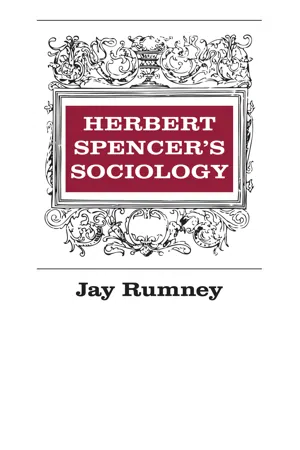
Herbert Spencer's Sociology
About this book
The republication of this book is eminently fitting at this time. Jay Rumney's Herbert Spencer's Sociology first appeared in 1937. In that year Talcott Parsons, citing Crane Brinton, declared: "Spencer is dead. But who killed him and how?" It was the thesis of Parsons' famous The Structure of Social Action that the evolution of scientific theory had put an end to Spencer. For more than a generation the man whose name had been synonymous with sociology was, or so it seemed, repressed and forgotten.
Information
CHAPTER I
THE SCOPE OF SOCIOLOGY
THAT imposing edifice, The Principles of Sociology,1 whose construction took two decades to complete, incorporated many architectural features, the design of which Spencer had adumbrated many years before. In a series of letters on the Proper Sphere of Government, published in the Nonconformist newspaper in 1842, and republished as a pamphlet in 1843, Spencer expressed a belief in the conformity of social phenomena to invariable laws—in human progression as determined by such laws—in the moral modification of man as caused by social discipline—in the tendency of social arrangements of themselves to assume a stable equilibrium—in the repudiation of State control over various departments of social life—and in the limitation of State action to the maintenance of equitable relations among citizens.2 In Social Statics, 1850, there is everywhere manifested a recognition of the evolution of man and of society, as in both cases determined by the incidence of conditions—the actions of circumstances, and of the fact that organic and social evolution are expressions of the same law. It is further maintained that the essence of the social process is the interaction between individuals and society, between the units and the mass, and their adaptation as a result of the adjustment of the natures of men to society and of the social organization to the nature of its constituent units. Where adaptation is incomplete, and the machinery of society is disjointed and creaking, social evils and imperfections will necessarily result. Fortunately, there is always available the lubricating oil of Evolution to minimize and ultimately to abolish all social friction. The universal tendency is towards harmonious adaptation, perfect equilibrium. In support of this argument, Spencer adduces two biological laws. The first will ruthlessly exterminate individuals who cannot adapt themselves—the survival of the fittest—a dogma that Spencer had arrived at before Darwin. The second will favour individuals whose natures have become adapted to social life, and transmit their acquired modifications to a next generation—a Lamarckian dogma which Spencer accepted. This more perfect adaptation is a phase in a process of universal development that is ever tending towards the creation of higher and still higher types of being. Throughout nature there runs a transcendental and spiritual force in virtue of which nature, and society as part of nature, evolve according to immanent laws towards a final “individuation.” Coleridge and Schelling, biology and physics, Idealism and Materialism are inextricably interwoven.
Between 1850 and 1860, Spencer clarified and elaborated these views and shaped them into a system of philosophy. In the Development Hypothesis, 1852, the law of evolution or development as against the special-creation interpretation of the universe is presented with great skill. Another influence—that of Malthus, is evident in the Theory of Population, 1852, where it is argued that owing to excessive reproduction and the continual pressure of rapidly multiplying organisms upon the slowly increasing means of support there is struggle and selection and the evolution of higher types. In the Theory of Style, 1852, the view is put forward that development in literary style is analogous to development in society in that it implies not “a series of like parts simply placed in juxtaposition, but one whole made up of unlike parts that are mutually dependent.” In the Art of Education, 1854, it is claimed that true methods of education consist in the gradual unfolding of the mental faculties and in a progression from the simple to the complex and from the indefinite to the definite. His Essay on Manners and Fashions, 1854, shows that ecclesiastical, political and ceremonial restraints trace back to one primitive form “ in conformity with the laws of evolution and of all organized bodies.” It maintains that “ government originally one and afterwards subdivided for better fulfilment of its function must be considered as having been in all its branches, political, religious and ceremonial—beneficial ; and indeed absolutely necessary. Government “ must be regarded as subserving an office made needful by the unfitness of aboriginal humanity for social life; and the successive diminutions of its coerciveness in State, in Church and in Custom, must be looked upon as accompanying the increasing adaptation of humanity to its conditions.” And, finally. “ there requires to be borne in mind the third fact that the genesis, the maintenance and the decline of all governments, however named, are alike brought about by the humanity to be controlled; from which may be drawn the inference that on the average, restrictions of every kind cannot last much longer than they are wanted, and cannot be destroyed much faster than they ought to be.”3
Spencer was the first to apply Evolution to the study of Sociology, and on Evolution, together with development and progress, depends the architecture of his synthetic system. Spencer has now a formula with which he explains the Genesis of Science, 1854, the Origin and Function of Music, 1857, and, finally, the Cosmos and everything in it. In Progress: Its Law and Cause, Spencer delivers his credo. It is that the law of organic progress is the law of all progress. Whether it be in the development of the Earth, in the development of Life upon its surface, in the development of Society, of Government, of Manufacture, of Commerce, of Language, Literature, Science, Art, this same evolution of the simple into the complex through successive differentiations holds throughout. From the earliest traceable cosmical changes down to the latest results of civilization, we shall find that the transformation of the homogeneous into the heterogeneous is that in which progress essentially consists.”4 Later on Spencer added another factor, increase in coherence, and evolution connoted that a change must show increasing heterogeneity, together with increasing coherence.
A few other essays of this period are important for the bearing they have on Spencer’s sociological thought. Transcendental Physiology, 1857, collates those laws of development and function which apply to all organisms. Representative Government—What is it Good For ? 1857, presents the thesis that “ representative government is best for securing justice, but is the worst for all other purposes.” In the Social Organism, 1860, two points are made, that society is a growth and that it is a social organism. Spencer’s Sociology may be regarded as a detailed expansion of these statements, and a skilful application of those mentioned above.
But it is important to remember that this sociological structure was one among many edifices reared by Spencer; it may even be regarded as one storey of his intellectual building. To understand the Principles of Sociology, therefore, it is necessary to know something about the elaborate architectural plan Spencer had conceived. In brief, this was the construction of the complete history of the know-able universe on the broad and wide foundation of Evolution, and the fitting together of every department of inorganic and organic nature into one connected whole. The plan was adhered to closely (although inorganic nature had to be omitted) and Spencer devoted his life to its execution. First Principles, the Principles of Biology, the Principles of Psychology, the Principles of Sociology, and the Principles of Morality were the fruits of his labour and constitute his System of Synthetic Philosophy.5
This vast undertaking influenced to a considerable extent the construction of Spencer’s Sociology. The First Principles, his Biology and Psychology were apt to become the framework of the Sociology, often determining unconsciously both the selection and the brickwork of facts. They are in a sense the a priori elements of whose truth Spencer was already certain when applying them towards the elucidation of sociological problems. It is thus necessary to outline in brief Spencer’s main philosophical doctrines. These were as follows6:—
1. Throughout the universe, in general and in detail, there is an unceasing redistribution of matter and motion.
2. This redistribution constitutes evolution where there is a predominant integration of matter and dissipation of motion, and constitutes dissolution where there is a predominant absorption of motion and disintegration of matter.
3. Evolution is simple when the process of integration, or the formation of a coherent aggregate, proceeds uncomplicated by other processes.
4. Evolution is compound when along with this primary change from an incoherent to a coherent state there go on secondary changes, due to differences in the circumstances of the different parts of the aggregate.
5. These secondary changes constitute a transformation of the homogeneous into the heterogeneous—a transformation which, like the first, is exhibited in the universe as a whole and in all (or nearly all) its details—in the aggregate of stars and nebulae; in the planetary system; in the earth as an organic mass; in each organism vegetal or animal (Von Baer’s law); in the aggregate of organisms throughout geologic time; in the mind; in society; in all products of social activity.
6. The process of integration, acting locally as well as generally, combines with the process of differentiation to render this change, not simply from homogeneity to heterogeneity, but from an indefinite homogeneity to a definite heterogeneity; and this trait of increasing definiteness, which accompanies the trait of increasing heterogeneity is, like it, exhibited in the totality of things, and in all its divisions and subdivisions down to the minutest.
7. Along with this redistribution of the matter composing any evolving aggregate, there goes on a redistribution of the retained motion of its components in relation to one another; this also becomes, step by step, more definitely heterogeneous.
8. In the absence of a homogeneity that is infinite and absolute, this redistribution, of which evolution is one phase, is inevitable. The causes which necessitate it are:
9. The instability of the homogeneous, which is consequent upon the different exposure of the different parts of any limited aggregate to incident forces. The transformations hence resulting are complicated by—
10. The multiplication of effects : every mass, and part of a mass on which a force falls subdivides and differentiates that force, which thereupon proceeds to work a variety of changes; and each of these becomes the parent of similarly multiplying changes: the multiplication of these becoming greater in proportion as the aggregate becomes more heterogeneous. And these two causes of increasing differentiations are furthered by—
11. Segregation, which is a process tending ever to separate unlike units, and to bring together like units, so serving continually to sharpen or make definite differentiations otherwise caused.
12. Equilibration is the final result of these transformations which an evolving aggregate undergoes. The changes go on until there is reached an equilibrium between the forces which all parts of the aggregate are exposed to, and the forces these parts oppose to them. Equilibration may pass through a transition stage of balanced motions (as in a planetary system) or of balanced functions (as in a living body), on the way to ultimate equilibrium; but the state of rest in inorganic bodies, or death in organic bodies, is the necessary limit of the changes constituting evolution.
13. Dissolution is the counterchange which sooner or later every evolved aggregate undergoes. Remaining exposed to surrounding forces that are unequilibrated, each aggregate is ever liable to be dissipated by the increase, gradual or sudden, of its contained motion; and its dissipation, quickly undergone by bodies lately animate, and slowly undergone by inanimate masses, remains to be undergone at an indefinitely remote period by each planetary and stellar mass which, since an indefinitely remote period in the past, has been slowly evolving: the cycle of its transformations being thus completed.
14. This rhythm of evolution and dissolution, completing itself during short periods in small aggregates, and in vast aggregates distributed through space completing itself in periods which are immeasurable by human thought, is, so far as we can see, universal and eternal: each alternating phase of the process predominating—now in this region of space, and now in that—as local conditions determine.
15. All these phenomena, from their great features down to their minutest details, are necessary results of the persistence of force under its forms of matter and motion. Given these in their known distributions through space, and, their quantities being unchangeable either by increase or decrease, there inevitably result the continuous redistributions distinguishable as evolution and dissolution, as well as all those special traits above enumerated.
16. That which persists, unchanging in quantity but ever changing in form, under these sensible appearances which the universe presents to us, transcends human knowledge and conception; is an unknown and unknowable power, which, we are obliged to recognize as without limit in space, and without beginning or end in time.
The metaphysical basis of the foregoing conceptions and the implications of such an eschatological law of evolution do not concern us here. Their importance lies, as we shall see later, in the way they influenced Spencer’s treatment of the numerous problems dealt with in his Sociology. Indeed one definition Spencer gives of Sociology is “ the study of evolution in its most complex form.”7 He frankly admits that he was apt “ to be enslaved by a plan once formed”8 and “ too much given to wandering off into the abstract.”9 He realized he was a “ bad observer of humanity in the concrete.”10 These defects, characteristic of Spencer as man and thinker, give his Sociology a certain mechanical twist, a certain dryness that have deterred the student from its study. This is unfortunate, for there are permanently valuable elements in it which no present day sociologist dare neglect. Nuggets of gold are not generally found on the surface of the earth. They must be mined and quarried. It is so with Spencer. He needs close and careful study. Certainly the summary way in which he is dismissed by many modern sociologists and political scientists is to be deplored. To regard his Principles of Sociology as a recent writer does, as “an imposing but not very necessary book,”11 is to betray a lack of appreciation of the significant impact Spencer ...
Table of contents
- Cover Page
- Title Page
- Copyright Page
- Foreword
- Introduction
- Preface
- Acknowledgment
- Contents
- CHAPTER I. The Scope of Sociology
- CHAPTER II.—Biology, Psychology, History
- CHAPTER III.—Types of Society
- CHAPTER IV.—Woman, Family, Race
- CHAPTER V.—Society, State, Government
- CHAPTER VI.—Property and Economic Institutions
- CHAPTER VII.—Ghosts, Ancestors, Gods
- CHAPTER VIII.—Factors of Social Change
- CHAPTER IX.—Social Evolution
- CHAPTER X.—Social Progress
- CHAPTER XI.—Conclusion
- Appendix. Prospectus of a System of Philosophy issued by Herbert Spencer in 1858
- Introductory note to Bibliography
- Index
Trusted by 375,005 students
Access to over 1.5 million titles for a fair monthly price.
Study more efficiently using our study tools.
Frequently asked questions
Yes, you can cancel anytime from the Subscription tab in your account settings on the Perlego website. Your subscription will stay active until the end of your current billing period. Learn how to cancel your subscription
No, books cannot be downloaded as external files, such as PDFs, for use outside of Perlego. However, you can download books within the Perlego app for offline reading on mobile or tablet. Learn how to download books offline
Perlego offers two plans: Essential and Complete
- Essential is ideal for learners and professionals who enjoy exploring a wide range of subjects. Access the Essential Library with 800,000+ trusted titles and best-sellers across business, personal growth, and the humanities. Includes unlimited reading time and Standard Read Aloud voice.
- Complete: Perfect for advanced learners and researchers needing full, unrestricted access. Unlock 1.5M+ books across hundreds of subjects, including academic and specialized titles. The Complete Plan also includes advanced features like Premium Read Aloud and Research Assistant.
We are an online textbook subscription service, where you can get access to an entire online library for less than the price of a single book per month. With over 1.5 million books across 990+ topics, we’ve got you covered! Learn about our mission
Look out for the read-aloud symbol on your next book to see if you can listen to it. The read-aloud tool reads text aloud for you, highlighting the text as it is being read. You can pause it, speed it up and slow it down. Learn more about Read Aloud
Yes! You can use the Perlego app on both iOS and Android devices to read anytime, anywhere — even offline. Perfect for commutes or when you’re on the go.
Please note we cannot support devices running on iOS 13 and Android 7 or earlier. Learn more about using the app
Please note we cannot support devices running on iOS 13 and Android 7 or earlier. Learn more about using the app
Yes, you can access Herbert Spencer's Sociology by Jay Rumney in PDF and/or ePUB format, as well as other popular books in Social Sciences & Social Theory. We have over 1.5 million books available in our catalogue for you to explore.