- 1,136 pages
- English
- ePUB (mobile friendly)
- Available on iOS & Android
eBook - ePub
About this book
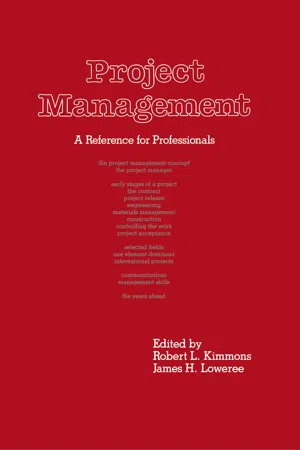
""Highlighting the practical side of real-life project execution, this massive reference stresses project management as an independent profession--detailing the varied applications where project management is used and examining the numerous and diverse project management responsibilities and tools.
IV The Contract
OVERVIEW
In today’s litigious society, contractual agreements reached prior to the initiation of a project, and the actions and reactions to those agreements throughout the course of the work, may very well determine the success or failure of the venture.
The inclusion of a discussion on contracts in a general treatise on the management of projects is offered with some trepidation. The complexity of modern projects and the general tenor of the current environment clearly demand competent legal counsel. Experienced project managers don’t play lawyer; nor do they operate in a vacuum, using experts as decision makers. They have a basic understanding of all phases of their project, and evaluate the recommendations of experts for implementation within the context of project-specific conditions.
In many organizations the project manager may not have decision-making authority regarding contractual issues, or the manager may be assigned after contract award, but when the opportunity to participate is available, the manager should take the initiative. Once a project is released, it’s your contract, your project.
The concepts used to arrive at the content of this unit on the legal aspects of project management are twofold: first, fundamental business considerations, or project management prerequisites; second, extended discussions of issues common to the management of projects in the engineering and construction industries. Extended discussions include: the advantages and disadvantages of lump-sum and reimbursable contracts as perceived by the owner and the contractor; joint venture contracts; and, the management of risks and claims—peripheral areas in the past, vital areas today.
CONTRACT CONSIDERATIONS AND CONTRACT TYPES
A contract is an agreement to do or not to do something. The services to be supplied by one party, and the costs and fees to be paid by the other party, and all of the conditions affecting this exchange (thi principal considerations) are agreed upon during the negotiation process. The well-written contract serves as a legal and operational memorandum of understanding of the agreements reached between two parties.
Basic contractual issues are covered: why have a contract; the limits; why it should be in writing; and a basic check list applicable to the engineering and construction industry. Two principal contracts, cost plus and lump sum, receive extended treatment.
JOINT VENTURES
A joint venture approach should be considered when the combined strengths of two or more entities result in a joint organization with unique credentials in a targeted business area. A joint venture is a relationship where each party needs the other to achieve a common mutually beneficial objective. Without this synergistic consideration, there is seldom justification for the formation of a shared business venture.
Several basic considerations are covered: a joint venture is defined; the choice- joint venture or corporation; the factors favoring the joint venture; and typical terms to be evaluated for inclusion in a joint venture agreement.
PRECONSTRUCTION PHASE
A considerable number of construction awards are based upon documents prepared by an architect /engineer for an owner, as differentiated from turnkey work. The cost and duration of the construction program is thus largely determined by the quality of the preconstruction process initiated by the owner and architect/engineer. All too often the documents, prepared to meet the objectives of the owner, aren't critically reviewed for "constructability." When detailed specifications are prepared by the owner's representative, that is, architect /engineer, the financial and contractual risks of the contractor are far more limited than realized by the owner.
The contractual positions of the owner and contractor are reviewed in detail; a comprehensive summary of 116 projects analyzed by the National Electrical Contractors Association (NECA) is presented to show the principal reasons for poor project cost/ schedule performance, and, by inspection, how the preconstruction phase impacts performance; finally, a lengthy checklist is included to guide the owner in the preparation of construction bid packages.
GUARANTEES, WARRANTIES, LIABILITIES
There are four distinct categories of "express" guarantees in the design/construction industry: design/mechanical; field workmanship; equipment (vendors); performance (process). These guarantees are express in that they are set forth in the agreement as opposed to "implied"-created by the law regardless of the contractual terms.
The express guarantees are discussed in detail; the concept of implied guarantees is reviewed; the elements of guarantees—coverage, time frame, liabilities—are described ; and certain other liabilities, such as tort, are covered.
RISK MANAGEMENT AND INSURANCE
Two kinds of risk are found in the business community: one dynamic, one static. Dynamic risks, generic to market, management, and political sources, can result in either profit or loss. Static risks, those that typically arise from loss or damage to property, or personal injury, and usually transferable to insurance underwriters for a price, only result in losses.
A diverse category of available coverages is discussed, including property insurance, casualty insurance, workers compensation, and surety bonds. The pros and cons of "wrap-up" insurance, a program applicable to very large projects, are presented.
CLAIMS MANAGEMENT
The management of claims is an integral part of the entire project management program. Claims management is incorrectly considered to be the handling of claims after problems arise. When this thinking is corrected, most disputes can be settled as they occur. A good claims management system should be in place prior to contract award, and readily implemented as disputes develop.
A claims management program divides a project into four management phases: contract formation, contract performance and administration, claims/dispute resolution, and preparation for litigation support.
All parties should bear in mind that effective management of changes and conflicts as they arise is far more economical than waiting until money has been wasted, the schedule devastated, and both sides have moved toward legal action. If, however, the claim leads to litigation, the prospect of building cooperative relationships between the parties is dim, leaving one simple objective: to win. The least time-consuming and most economical way to achieve this is with a well-prepared claim.
1 Contract Considerations and Contract Types
MATTHEW A. McLAUGHLIN Davy McKee Corporation, Pittsburgh, Pennsylvania
A contract is an agreement or promise to do or not to do something. We will discuss here contracts and contract types principally from a functional viewpoint and specifically from the viewpoint of the project manager.
It is sometimes said that contracts exist only for "legal" reasons. The implication is that they serve no functional purpose or even that they do more harm than good, and in any event are an expensive nuisance "to be put behind us as quickly as possible." Unfortunately, these views are valid if the contract isn’t negotiated, written, and implemented knowledgeably and skillfully.
Properly used, a contract can aid in the achievement of project goals. The project manager should view it like any other project tool, such as drawings, tools, labor, equipment. The manager should understand the principles of the contracting process and the content of the specific contract to be used for the project, so that it may be used as an efficient and effective tool in the execution of the project.
The contract negotiation process will define the basis for the principal considerations: the services to be rendered by one party, and the costs and fees to be paid by the other party. Apart from arriving at a court-enforceable document, the contract negotiating process can identify potentially contentious issues and develop sound business understandings. A well-written contract can serve practically as well as legally as a memorandum of the agreements reached between two parties, defining the rights and obligations of the parties in most common and many complex situations.
If you conclude that a substantial part of the following material deals with matters you or others normally delegate to lawyers or contract administrators, you will not be wrong. However, legal and contract administration considerations are not ends unto themselves. They bear on and are a part of project execution. Accordingly, your knowledge of what your experts are doing and have done should be sufficient to assure that the contract element is an integrated and effective element of the total project.
You will also be correct if you conclude that it is unlikely that all of the following suggestions can be implemented on any project, and that in certain instances they should not be. Our purpose is to provide a basis for the establishment of objectives and the identification of tradeoffs, so that you can contribute to the process of contract negotiation effectively.
Basic Considerations
Why Have A Contract
In abstract theory a contract is not essential to the performance of a project. Most of life’s activities are carried on without contracts. However, contracts are useful where performance involves substantial, complex, or extended commitments, and particularly where they are interdependent. The contract is used to define these commitments and the liabilities inherent in nonperformance on the part of either party. It provides a record of the commitments and the agreements-a basic project reference document. It provides a foundation for court decisions if one party refuses to perform.
Understand What You Want To Do, The Limits, And How The Contract Can And Does Affect These Factors
A workable contract should define what it is you want to do, what others are to agree to do, and any limits on the obligations on either party. These principles are basic to all good contracts.
The completed and signed contract should be studied in detail to fully understand how it will impact the objectives of the project and your style of management. In skilled hands, the consequences of deficient words and agreements can be minimized; in clumsy hands, valuable rights, though agreed upon and reflected in the contract, are lost.
If you are not directly involved in the contract negotiations, try to understand what is happening and what has happened in the contracting process. Long after senior management, sales, tax specialists, counsel, and other intermediaries have departed the immediate scene, you will have to live with the die they have ca§t. It is possible that the agreement may be inadequate and the wording ambiguous regarding the intent of the agreement. Ask questions, seek clarification; you are responsible fpr implementing the contract.
Get It In Writing And Get It Signed—But Don'T Give Up If You Haven'T
There are practical reasons why you should always have a written contract.
- Although in certain cases §n oral contract can be enforced, there are rules that require that certain contracts be in writing. These rules can be quite complicated. The moral is to avoid the problem by getting the contract in writing.
- A written contract will minimize disputes and confusion about what was agreed -a problem which can and will arise on projects of extended duration and complexity. You want to minimize arguments about who agreed to provide exactly what, when, how, and the terms of payment.
If it is necessary that a specific contract be in writing in order for it to be enforceable, it is also nprmally required that it be signed by the party against whom it is to be enforced. By signing the contract, the parties are manifesting in a practical way that the specific document is their "legal handshake." However, if faced with a situation where only an oral agreement was made and the other party won't perform, don't abandon hope too quickly. There are circumstances—highly specific—under which such an agreement can sometimes be considered binding and enforceable.
As a a last resort, if you cannot enforce the contract or obtain enforcement, you may be able to recover for the goods and services you have supplied based on their reasonable value to the other party, but if you haven't yet provided the services or goods, you may not be able to recover your costs, or you may recover only a portion of your costs, since the value measured is normally the value to the recipient.
Frequently there are practical reasons why a contract cannot be signed before the work commences. Every day that you work without a written contract leaves you exposed to the risks discussed.
Include All Important Terms And Contingencies
Unless certain essential items have been agreed, the contract, oral or written, cannot be enforced because no one, including the courts, will be able to determine the essential terms. There are many cases involving contracts where a term as essential as price has not been agreed upon. A contract must, at the least, include a description of what is to be done and the price to be paid for th...
Table of contents
- Cover Page
- Title Page
- Copyright Page
- Preface
- Code of Ethics for the Project Management Profession
- Contributors
- I Project Management
- II The Project Manager
- III Early Stages Of A Project
- IV The Contract
- V Project Release
- VI Engineering
- VII Materials Management
- VIII Construction
- IX Controlling The Work
- X Project Acceptance And Closeout
- XI Project Management In Selected Fields
- XII When One Element Is Dominant
- XIII International Projects
- XIV Communications
- XV Management Skills
- XVI The Years Ahead
- Index
Trusted by 375,005 students
Access to over 1.5 million titles for a fair monthly price.
Study more efficiently using our study tools.
Frequently asked questions
Yes, you can cancel anytime from the Subscription tab in your account settings on the Perlego website. Your subscription will stay active until the end of your current billing period. Learn how to cancel your subscription
No, books cannot be downloaded as external files, such as PDFs, for use outside of Perlego. However, you can download books within the Perlego app for offline reading on mobile or tablet. Learn how to download books offline
Perlego offers two plans: Essential and Complete
- Essential is ideal for learners and professionals who enjoy exploring a wide range of subjects. Access the Essential Library with 800,000+ trusted titles and best-sellers across business, personal growth, and the humanities. Includes unlimited reading time and Standard Read Aloud voice.
- Complete: Perfect for advanced learners and researchers needing full, unrestricted access. Unlock 1.5M+ books across hundreds of subjects, including academic and specialized titles. The Complete Plan also includes advanced features like Premium Read Aloud and Research Assistant.
We are an online textbook subscription service, where you can get access to an entire online library for less than the price of a single book per month. With over 1.5 million books across 990+ topics, we’ve got you covered! Learn about our mission
Look out for the read-aloud symbol on your next book to see if you can listen to it. The read-aloud tool reads text aloud for you, highlighting the text as it is being read. You can pause it, speed it up and slow it down. Learn more about Read Aloud
Yes! You can use the Perlego app on both iOS and Android devices to read anytime, anywhere — even offline. Perfect for commutes or when you’re on the go.
Please note we cannot support devices running on iOS 13 and Android 7 or earlier. Learn more about using the app
Please note we cannot support devices running on iOS 13 and Android 7 or earlier. Learn more about using the app
Yes, you can access Project Management by Kimmons in PDF and/or ePUB format, as well as other popular books in Business & Project Management. We have over 1.5 million books available in our catalogue for you to explore.