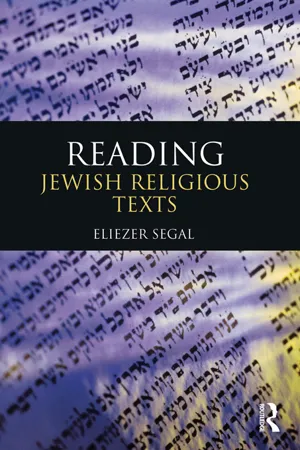
Reading Jewish Religious Texts introduces students to a range of significant post-biblical Jewish writing. It covers diverse genres such as prayer and liturgical poetry, biblical interpretation, religious law, philosophy, mysticism and works of ethical instruction. Each text is newly translated into English and accompanied by a detailed explanation to help clarify the concepts and arguments. The commentary also situates the work within its broader historical and ideological context, giving readers an enhanced appreciation of its place in the Jewish religious experience. This volume includes a comprehensive timeline, glossary and bibliography.
- 234 pages
- English
- ePUB (mobile friendly)
- Available on iOS & Android
eBook - ePub
Reading Jewish Religious Texts
About this book
Information
1 Prayers and Liturgical Texts
Daily Prayer: The Eighteen Blessings
The “Eighteen Blessings” is first attested in rabbinic traditions from the first century CE as a prayer that is to be recited three times every day (with additional recitations on special occasions). The title aptly describes its formal structure: it is a sequence of “blessings,” that is to say, passages containing the formula “Blessed are you, O Lord.” The Talmud provides considerable detail as to the themes of the blessings, but does not prescribe specific texts; and scholars are in disagreement about whether a specific text of the prayer actually existed in ancient times. The Talmud traces the choice of themes and their sequence to biblical sources, and though some of those explanations are quite plausible, it is not possible to fully reconstruct the prayer’s origins.
The prayer is worded so that the worshipper’s perspective is always expressed in the plural (“we,” “us”) form, and this is consistent with the communal nature of its content. There are few references to individual concerns and needs. Rather, most of the blessings consist of petitions and hopes on behalf of the entire community or nation, including several eschatological themes. The link between the idealized past and future is evident in many passages.
According to Jewish law, the obligation to recite this prayer applies whether or not one is in a communal setting, though congregational worship is preferred. When recited communally, a prayer leader (“representative of the congregation”) repeats the prayer after the worshippers have recited it individually in a quiet tone. This practice originated in ancient times when the texts of the prayers were categorized as part of the “oral Torah” that could not be written down, and hence it could not be presumed that everyone was capable of reciting all the prayers from memory. There are certain portions of this prayer that may only be recited in full in a congregational setting.
The following text is compiled from manuscripts in the Cairo Genizah and represents versions of the Palestinian rite as it was recorded in the early medieval era. Though its content (if we ignore the many stylistic differences) is quite similar to the standard versions that are in use among traditionalist Jewish communities today, there are nevertheless some significant differences as well. Most prominent among these is probably the fact that this version is actually composed of eighteen blessings, as its ancient name should imply. The Babylonian version that has now been adopted universally contains nineteen blessings, because the two topics of the fourteenth blessing—the restoration of the Davidic dynasty and of Jerusalem—were divided up into two separate blessings.
In most respects, the meaning of this prayer is quite straightforward and understandable, and consequently it can be understood without an extensive explanation. The headings that appear before each blessing are not part of the actual text, but are based on the terminology used in the Talmud.
The Eighteen Blessings:1
1 The Forefathers
Blessed are you O Lord, our God and God of our forefathers
The God of Abraham, the God of Isaac and the God of Jacob,
The great God, the mighty and awesome, the supreme God
who bestows lovingkindness.
He is the master of all
and he remembers the gracious deeds of the forefathers
and brings a redeemer to their children’s children
for the sake of his great name, in love.
King, savior and protector.
Blessed are you, O Lord, shield of Abraham.
2 God’s Power
You are mighty forever, O Lord
resurrecting the dead, you are great to redeem.
[He who causes the wind to blow and the dew to fall,]
He who apportions life graciously,
who resurrects the dead with great compassion,
who supports those who are falling and frees those who are confined and keeps his faith with those who sleep in the dust.
Who is like unto you, the powerful one?
And who resembles you,
the one who causes death and life?
And you are faithful to revive the dead.
Blessed are you, O Lord, who revives the dead.
Comments
Note how a declaration of belief in the resurrection of the dead was given a central place in this blessing which is supposed to speak in general terms of God’s great power. This harks back to the era of the Second Temple when belief in resurrection was a distinctive doctrine of the Pharisee sect and was denied by their rivals the Sadducees.
The focus on rainfall reflects the crucial importance of seasonal rain in the land of Israel (and it is the main theme of blessing 9 below). For Jewish peasants, the prospect of abundant, life-giving rainfall at the conclusion of the dry summer months was comparable to the miraculous restoration of life to the dead.
3 Sanctification of God’s Name
You are holy and your name is holy
and the holy ones each day praise you, Selah.
Blessed are you, the holy God.
Comments
“the holy ones” refers to the angels.
“selah” a Hebrew word, probably some sort of musical direction, that is inserted for emphasis in biblical poetry.
When recited with the prayer leader in a congregational setting, a more elaborate version of this blessing is used. The leader and the congregation responsively reenact the prophetic visions of the angels praising God, incorporating mystically charged verses such as “Holy, holy, holy is the Lord of hosts; the whole earth is full of his glory” (Isaiah 6:3) and “Blessed be the glory of the Lord from his abode” (Ezekiel 3:12).
4 Knowledge
You bestow knowledge on humans
and instruct people in understanding.
Bestow upon us knowledge and understanding.
Blessed are you, O Lord who bestows wisdom.
5 Repentance
Cause us to return, our father, to your Torah,
and bring us near, our king, to your worship.
And draw us back in complete repentance before you.
Blessed are you, O Lord, who desires repentance.
6 Forgiveness
Forgive us, our father, for we have sinned.
Absolve us, our king, for we have transgressed.
Blessed are you, O Lord, the compassionate who is abundant in forgiveness
7 Redemption
Behold our affliction and fight our battles.
Redeem us speedily for the sake of your name.
Blessed are you, O Lord, the redeemer of Israel.
8 Healing
Heal us, Lord, that we may be healed
and bring upon us a full healing for all our wounds.
For you are God, the merciful healer.
Blessed are you, O Lord, who heals the sick of his people Israel.
9 The Seasons
Bless for us, Lord our God, this year for good and all the varieties of its grain.
And give dew and rain on the face of the earth
for your name’s sake.
And satisfy the whole world from the blessings of your goodness.
And moisten the face of the universe with the richness of the gifts of your hands.
And preserve and rescue, O Lord our God, this year from all kinds of destruction and all kinds of punishment.
Have care and compassion, and be merciful toward us and toward all its fruits.
And may we enjoy abundance and peace and blessing for its outcome as the blessing of the good years.
And instill a blessing in the work of our hands.
For you are the God who is good and does good.
Blessed are you, O Lord, who blesses the years.
Comments
Different versions of this blessing are recited in the winter (that is, the rainy season) and in the summer. In the former case, the prayer is for rain and in the latter, it is for dew.
10 Ingathering of the Exiles
Sound the trumpet for our liberation
and raise up a banner for the ingathering of our exiles.
Blessed are you, O Lord, who gathers the dispersed of his people Israel.
11 Justice
Restore our judges as at first,
and our counsellors as in the beginning,
and remove from us agony and sighing,
and reign over us you alone
in mercy and righteousness and justice.
Blessed are you, O Lord, the king who loves righteousness and justice.
12 Heretics
May the apostates have no hope,
and may the malicious empire be speedily uprooted,
and may it be destroyed in our ...
Table of contents
- Cover
- Half Title
- Title Page
- Copyright
- Contents
- Introduction
- 1. Prayers and liturgical texts
- 2. Aggadah and Midrash
- 3. The literature of halakhic discourse
- 4. Jewish bible commentaries
- 5. Philosophy and rational theology
- 6. Esoteric, mystical and kabbalistic texts
- 7. Moralistic and ethical writings
- Timeline of Jewish religious texts and authors
- Glossary
- Notes
- Bibliography of Jewish religious texts in English
- Index
Trusted by 375,005 students
Access to over 1.5 million titles for a fair monthly price.
Study more efficiently using our study tools.
Frequently asked questions
Yes, you can cancel anytime from the Subscription tab in your account settings on the Perlego website. Your subscription will stay active until the end of your current billing period. Learn how to cancel your subscription
No, books cannot be downloaded as external files, such as PDFs, for use outside of Perlego. However, you can download books within the Perlego app for offline reading on mobile or tablet. Learn how to download books offline
Perlego offers two plans: Essential and Complete
- Essential is ideal for learners and professionals who enjoy exploring a wide range of subjects. Access the Essential Library with 800,000+ trusted titles and best-sellers across business, personal growth, and the humanities. Includes unlimited reading time and Standard Read Aloud voice.
- Complete: Perfect for advanced learners and researchers needing full, unrestricted access. Unlock 1.5M+ books across hundreds of subjects, including academic and specialized titles. The Complete Plan also includes advanced features like Premium Read Aloud and Research Assistant.
We are an online textbook subscription service, where you can get access to an entire online library for less than the price of a single book per month. With over 1.5 million books across 990+ topics, we’ve got you covered! Learn about our mission
Look out for the read-aloud symbol on your next book to see if you can listen to it. The read-aloud tool reads text aloud for you, highlighting the text as it is being read. You can pause it, speed it up and slow it down. Learn more about Read Aloud
Yes! You can use the Perlego app on both iOS and Android devices to read anytime, anywhere — even offline. Perfect for commutes or when you’re on the go.
Please note we cannot support devices running on iOS 13 and Android 7 or earlier. Learn more about using the app
Please note we cannot support devices running on iOS 13 and Android 7 or earlier. Learn more about using the app
Yes, you can access Reading Jewish Religious Texts by Eliezer Segal in PDF and/or ePUB format, as well as other popular books in Theology & Religion & Jewish Theology. We have over 1.5 million books available in our catalogue for you to explore.