![]()
1 Understanding primary schools today
QTS Standards
5, 6, 20, 21b, 32, 33
Changing personnel
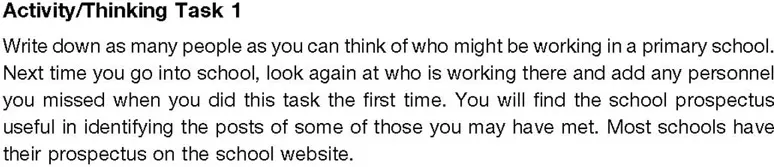
Most people, outside the primary sector, when asked this would probably start off with teachers. Then, if there remained a pregnant silence, would move on to other school-based workers such as site managers, cleaners and a secretary. When children are asked this, they generally include themselves very early on. It is as if we retain a memory of the old Victorian and Edwardian photographs of classrooms with a teacher, pupils and perhaps the odd pupil monitor. Today's schools are staffed very differently and the primary purpose, of this chapter is to help readers to identify some of the less obvious but extremely important personnel working in today's primary schools.
A tour round a primary school
I spend a lot of time in primary schools and this is an example of a brief tour I took round a school last week. I arrived at the school at 8.30 and standing on the playground, talking to a parent was Adam, the learning mentor. Later we will look at his role more closely. It is useful to remember at this stage that the titles, roles, responsibilities and pay of many of the support workers varies from school to school and from one LA to another.
I entered the school, pushing the doorbell to check me into the building, The small office is staffed by a secretary and two administrative assistants. Also sitting there at 8.45 was the site manager and the head teacher. Both of these had been in school since 6.45 and were having a well-deserved cup of tea. A TA was using the photocopier.
After signing in and saying my hellos, I then turned left into the school and walked down a small set of steps, which were altered some years ago to accommodate children, staff and visitors with mobility issues. Turning into the first room, I met with the parent mentor, three parents and one eight-month-old baby. We chatted briefly about the work they were going to be doing and I moved down the corridor to meet with a teacher with whom I work. Her senior management post changed recently from being a subject coordinator to holding a post as a LTR (learning and teaching responsibility). There were three other adults with her in the classroom. One was a TA and the other a special needs assistant (SNA). Neither would be in the same classroom all day. The third adult was a student teacher undertaking a placement. On another day in this same classroom, there is a trainee TA. All four adults have children's learning as their key responsibility and, at the. time of my visit, the class teacher was organising her team for the day to ensure that maximum learning takes place.
I then came out of this classroom and entered another one. This was my reason for visiting the school. For on Tuesdays, I am a student taking a European computer driving licence (ECDL). The class is run by a further education (FE) lecturer from the local community college. The other students are either parents or people working in the school. We are all doing different courses and are at different stages. The provision is part of the LA programme called FACE — family and community education. Its aim is to 'skill up' members of the local community, to give them confidence as well as skills to improve their and their children's life chances.
When I left the school three hours later, I met with the local safety inspector who was running a cycling award course on the playground for the Y5 children.
All these people were school based because it was seen that their work enhanced children's learning. This has been made even clearer under the Every Child Matters agenda (DfES, 2003), although at least two of those I met on my tour would not be under the remit of the ICS department of the local authority (LA).
Roles and responsibilities
There were many other workers in school on my tour day. These include the welfare staff, who supervised the children at lunchtime and who have had several courses on outdoor play; the cook and catering staff who had been involved with courses on healthy eating and hygiene; voluntary workers; specialist support staff; professionals from other public services; professionals from charities; and once a week one of the local priests who takes an assembly in this non-denominational school. He is also a school governor. In this chapter we are concentrating on identifying those different groups whose work is directly linked to enhancing children's learning. They can be categorised into four different groups:
- those employed directly by the school;
- educational support workers, not employed by the school, but whose service may be paid from the school budget;
- external providers who are employed by other public and private agencies;
- volunteers.
These adults are often given the generic title of paraprofessionals. The Training and Development Agency for Schools (TDA) calls them support staff. I prefer the term allied educational professionals as it recognises the professional work they do with children within a formal educational context.
Allied professionals employed by the school
The teaching assistant, the special needs assistant and the learning mentor whom I met would all come into the category of allied professionals. They and other allied professionals may:
- work semi-autonomously with pupils throughout the day and report to a line manager within the school;
- give generic learning support in classes or learning units with work or assessment tasks prepared by the class;
- work with a child identified with special learning needs;
- work or manage a unit or centre within the school such as a nurture group for children who need particular support in the school situation;
- work in more than one role, e.g. a TA in the morning and a learning mentor in the afternoon;
- have variable training and qualifications.
The government is determined, quite rightly, to try and ensure that all those working in schools have the appropriate qualifications to do so. These are still very variable and can be school based; cluster based; I A. FE or HE based; nationally based — including on-line provision; self-determined professional development and life-experience based. Many allied professionals have qualifications prior to their employment by a particular school.
Not only does training vary but so does salary. Some allied professionals are on yearly full pay, like teachers; many are paid 'pro-rata' — for example, paid for only 45 weeks of the year, rather than 52; some pay may be based on qualifications and specialist skills held; some on recommended national rates. Some may be school based, often through more informal negotiation and some are negotiated at local level via trade unions.
Educational support workers — not employed by the school, but whose services may be paid from the school budget
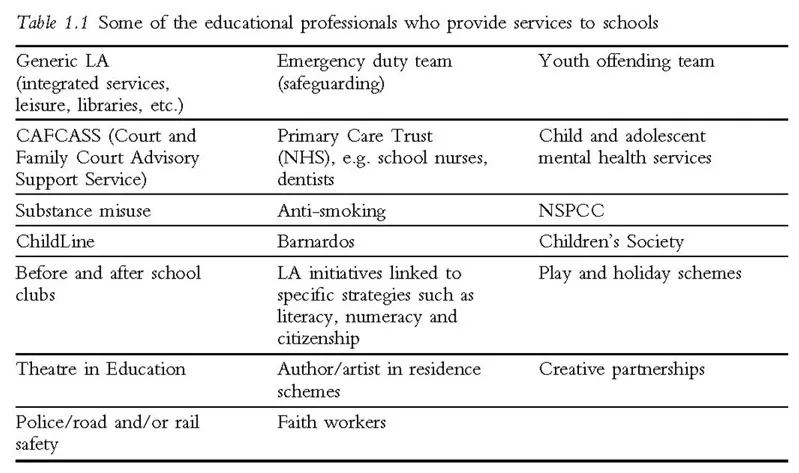
There is a range of other workers, not employed by the school directly, but whose work can be closely linked to improving and enhancing children's learning. They are often employed in more than one school and may cover secondary as well as primary pupils. These include:
- counsellor
- pupil attendance and education Welfare
- special needs integrated support
- behaviour support
- ethnic minority support
- integrated children's services manager
- educational social worker.
External providers — employed by public and private agencies, including charities
Volunteers
There are also, particularly in primary schools, unpaid volunteers. Some may spend whole days in school, others just a couple of hours a week and others may work in several schools. These include:
- parents and carers and other relatives;
- community workers;
- partnership workers;
- governors;
- student teachers;
- work experience/trainees;
- former teachers;
- charity workers, where the school pays an agreed amount to the charity for administration but the worker is unpaid, e.g. Volunteer Reading Help (VRH).
Exemplars
In the following section we look very briefly at three of those whom I met on my visit around the school. They are the learning mentor, the TA and the parent mentor.
The learning mentor
Twelve years ago it would have been rare to find learning mentors in the English education system or indeed many of the other allied professionals found now. Learning mentors have a generic brief to 'break down barriers to learning'.
The history of their introduction and success in schools provides a useful rationale for many of the role definitions we now find assigned to allied professionals. For this reason, a brief look at their development provides a useful practical as well as theoretical base for this chapter. A much fuller version is available in Campbell and Fairbairn's (2005) book on support staff.
Table 1.2 Template for Activity/Thinking Task 2
| Name or title of member of staff | Responsibilities | Employed by |
| | | |
| Comments: | | |
Background
Learning mentors came from one strand of the DfES Excellence in Cities (EiC) programme. This was introduced in March 1999 to tackle 'specific problems facing children in our cities. Through a combination of initiatives, EiC aimed to raise the aspirations and achievements of pupils and to tackle disaffection, social exclusion, truancy and indiscipline and improve parents' confidence in cities' (Hughes, 2005).
The EiC initiative had come out of some good practice projects from within the UK, but also had imported ideas from the US (e.g. magnet schools). The programme was largely met with enthusiasm by the schools where it was originally introduced, who saw it as a recognition that more than words were needed to raise aspirations and hope for pupils in their schools. Since then the initiative has expanded across most schools in the country and has been subject to two excellent National Training Programmes. These training programmes provided mentors with a formal qualification in mentoring.
The current DCSF website on learning mentors defines learning mentors as:
- salaried staff who work with school and college students and pupils to help them address barriers to learning;
- a bridge across academic and pastoral support roles with the aim of ensuring that individual pupils and students engage more effectively in learning and achieve appropriately;
- a k...