- 568 pages
- English
- ePUB (mobile friendly)
- Available on iOS & Android
eBook - ePub
About this book
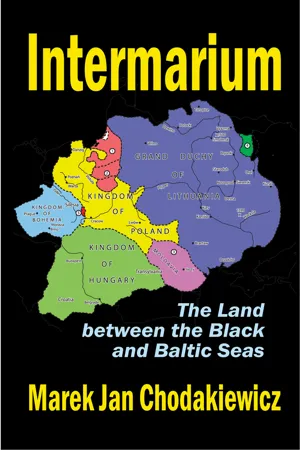
History and collective memories influence a nation, its culture, and institutions; hence, its domestic politics and foreign policy. That is the case in the Intermarium, the land between the Baltic and Black Seas in Eastern Europe. The area is the last unabashed rampart of Western Civilization in the East, and a point of convergence of disparate cultures. Marek Jan Chodakiewicz focuses on the Intermarium for several reasons. Most importantly because, as the inheritor of the freedom and rights stemming from the legacy of the Polish-Lithuanian/Ruthenian Commonwealth, it is culturally and ideologically compatible with American national interests. It is also a gateway to both East and West. Since the Intermarium is the most stable part of the post-Soviet area, Chodakiewicz argues that the United States should focus on solidifying its influence there. The ongoing political and economic success of the Intermarium states under American sponsorship undermines the totalitarian enemies of freedom all over the world. As such, the area can act as a springboard to addressing the rest of the successor states, including those in the Caucasus, Central Asia, and the Russian Federation. Intermarium has operated successfully for several centuries. It is the most inclusive political concept within the framework of the Commonwealth. By reintroducing the concept of the Intermarium into intellectual discourse the author highlights the autonomous and independent nature of the area. This is a brilliant and innovative addition to European Studies and World Culture.
Part I
Intermarium: A Brief History
The Muscovite was an enemy to all liberty under heavens.1
—Zygmunt II August (Sigismund Augustus), King of Poland, Grand Duke of Lithuania, the Lord and Master of Ruthenia, to Elisabeth I,
Queen of England, 1560
Polonized Germans, Tatars, Armenians, Gypsies, [and] Jews can belong to the Polish nation if they live for the common ideal of Poland . . . A Negro or a Redskin can become a real Pole, if he adopts the spiritual heritage of the Polish nation, which is contained in its literature, art, politics, customs, and if he has an unwavering will to contribute to the development of the national life of the Poles.2
—Wincenty Lutosławski, 1939
A rat crept softly through the vegetation
Dragging its slimy belly on the bank
While I was fishing in the dull canal
On a winter evening round behind the gashouse
Musing upon the king my brother’s wreck
And on the king my father’s death before him.
White bodies naked on the low damp ground
And bones cast in a little low dry garret,
Rattled by the rat’s foot only, year to year.3
Dragging its slimy belly on the bank
While I was fishing in the dull canal
On a winter evening round behind the gashouse
Musing upon the king my brother’s wreck
And on the king my father’s death before him.
White bodies naked on the low damp ground
And bones cast in a little low dry garret,
Rattled by the rat’s foot only, year to year.3
—T. S. Eliot, The Waste Land
1
The Origins
Intermarium refers to the space between the Black and Baltic Seas, which circumscribe it in the north and south, respectively. Its geographic boundaries are perhaps best explained by rivers. The latter, however, approximate the area’s sprawl, rather than strictly delineate it. In the north the boundaries follow the Baltic coast from the estuary of the Vistula and, then, the Neman until the Gulf of Finland, where they slope south through Lake Peipus into Velikaya River. They proceed toward the general area where the Western Dvina bends, the Svir originates, and the Berezina, Sozh, and Desna, in turn, meet the Dnieper as it flows into the Black Sea. The boundaries hug its coast until the delta of the Danube to move sharply north from there following the Prut toward the Dniester and the Bug as it veers west to meet the Vistula and complete the cycle in its estuary at the Baltic.
As far as its topography, the Intermarium consists mostly of flatlands. Steppes dominate its southern part, the Ukraine, in particular. Post-glacial lakes dot the sylvan countryside in the north, specifically in what is now Estonia, Latvia, and Lithuania, as well as contemporary Poland’s Mazuria (East Prussia, Borussia). In between the southern steppes and northern lakes, there are the Pripet marshlands, primarily in contemporary Belarus, but also creeping into Ukraine. The area is also heavily forested there. The Carpathian mountains are the only formidable topographical obstacle, delineating the south-western boundary of the Intermarium.
The region’s climate produces hot, humid summers and cold, frigid winters with extreme temperature shifts. Because of the proximity to the North Pole, the north-eastern parts of the Intermarium experience long days in summertime. In winter and fall, daylight appears for a brief spell only. Early spring and late fall are customarily rainy and dreary. A cyclical thaw and ubiquitous mud cause arguably greater obstacles to humans than blinding snow and freezing temperatures.
Human transactions in the region date back several millennia. Most archeological activities have focused on the rim of the Intermarium. In particular, the Black Sea coastal area has yielded some interesting finds from the Scythian culture. In the west, the Roman influences infiltrated through Dacia, or present-day Romania. Eclectic artifacts from a variety of cultures have also been discovered in burial sites in the southern steppes. The north has been less bountiful for archeologists.
H. J. Mackinder famously referred to the Intermarium as the “geographic pivot of history.”4 He who mastered the pivot, controlled the world. Hence, constant struggles for the Intermarium ensued. Geographic determinism aside, the Intermarium has indeed witnessed its share of invasions. Most of them, however, were incursions from the east. Much of the time, before the early modern times, in particular, it was the case of the nomads simply passing through. During the Völkerwanderung before the fifth century and after, successive waves of visitors from Asia spilled across the southern areas of the Intermarium. The Goths, Vandals, Huns, Langobards, and others sojourned there, sometimes remaining for a century only to proceed further west. The Slavs who arrived in their wake settled the area permanently.5
The name Slav comes from the Slavic designation for “word” (Polish: słowo; Russian: slovo). The Slavs called everyone who spoke a related Slavic language “Słowianie” (Russian: slaviane), or “people of the word.” Anyone who did not was considered a foreigner. The Germans had the dubious distinction of being known as “the mute ones” (Niemcy—stemming from niemi). Apparently, the ancient Slavs assumed that the German language sounded like the guttural noises made by the speech-impaired. On the other hand, the Germans and others, including Romans and Byzantines, tended to use the word “Slav,” or sclavus (σκλάβος), to denote “a slave.” Slavic lands were customary poaching grounds for the human animal and the destination of choice for slavers from as far afield as Muslim-dominated Iberia. They also craved amber which originated chiefly on the Baltic coast.
We should keep in mind that at that time much of central and eastern Europe consisted of impassable primeval forest. Interaction with others was rare and limited to trade and war. By the same token, the boundaries were not drawn firmly and borders were left mostly open. On the periphery of the Slavic world, but also sometimes in its midst, there were settlements of other ethnic groups, including the Norsemen, Goths, and others.
In time, the Slavs soon split into three distinct groups: western, southern, and eastern. Western Slavs chose central European lands between the Bug and Elbe rivers. In the future they would become Poles, Czechs, Slovaks, and Lusatian Sorbs. To the west, across the Elbe, they bordered the Germanic tribes, including the Saxons. Southern Slavs claimed the Balkans. There the ancestors of the Serbs, Croats, Slovenes, Bulgarians, and Macedonians cohabitated with the Greeks (Byzantines), the Illyrians (future Albanians), the Vlahs, the Dacians (future Romanians), the Avars, the Magyars (Hungarians), and others.
Eastern Slavs settled in the middle of the Intermarium. Theirs was arguably the most inaccessible realm. Naturally, these ancestors of the modernday Russians, Ukrainians, and Belarusians at first lacked any coherent national consciousness. Instead, they identified themselves with their tribes: Polochians, Radimichians, Tivertsians, Dulebians, and others. The names of the tribes stemmed often from their place of settlement. For example, the Polianians were the people of the fields, while the Derevlians were the folk of the forest. Their institutional arrangements were similar to other Slavic peoples. Tribes were divided into clans that consisted of families following the patriarchical principle. The eldest male issue presided over an extended family dwelling under one roof or a small encampment. On important occasions families would hold a clan assembly (veche). All could speak but the elders presumably had the final vote. Periodically, women were left in charge for extended spells as able-bodied males embarked upon hunting and war expeditions. By the eighth century, these eastern Slavic people were firmly established in what collectively would soon be known as Ruthenia (Rus’) and its inhabitants as the Ruthenians.6
The word “Ruthenians” derives most probably from a Scandinavian name for rowers. It was the Viking raiders who, through trade and war, first settled in the far north-east of the Intermarium in the late eighth century. They dominated the local Finno-Ungaric and Slavic people. Eventually, these Norsemen took over Kiev, the principal city of the eastern Slavs. According to an ancient chronicle, the Kievians themselves invited Viking chieftain Rurik and his men to establish order or settle a dispute. They remained permanently. They developed rudimentary state institutions to control the surrounding Slavic population which they exploited and looted. Their prince owned all the land of Rus’. His was a patrimonial realm. He could grant land, and take it away just as easily. It was from Rurik that each Ruthenian prince (knyaz) traced his descent, hence the Rurikovich dynasty. The Scandinavians or Varangians, as they were known locally, supplied much of the ruling caste of the eastern Slavs.
Soon, however, the Varangians became assimilated in language and customs. They underwent Slavicization and shared the lot of their people. They also inserted more dynamism in the activities of the supposedly relaxed east Slavs. Trade, dynastic disputes, and war-making boomed. The rulers of the Ruthenian lands involved themselves in a multitude of projects both within and without. At home, they built mostly wooden fortresses and towns. They burned and uprooted forests for cultivation. They fostered trade and settlement. But most of all each Ruthenian-Varengian prince endeavored to advance up the hierarchical ladder to capture the ultimate prize: the overlordship of Kiev. Hardly any of the princelings bid for the prize on his own; most schemed in a variety of convoluted alliances within the extended family. Some called for foreign assistance, including quite commonly from Poland and Hungary. The winners rewarded their followers with loot taken from neighboring countries and the realms of the losing Ruthenian princes. Those who failed in their bid for Kiev died or fled into exile. The exiles often concluded alliances with their foreign hosts and the deals often would be sealed with marriages. A few, invariably female, married exotic Western Europeans and, thus geographically removed, were out of the power game. However, some Ruthenian blue bloods took Polish and Hungarian spouses; others aimed for the Byzantine “born in purple” imperials (and, less glamorously, the nomadic Polovtsian chieftains). And thus the process of seeking the ultimate prize in Kiev would inevitably repeat itself.7
To appreciate the medieval dynamic of love and war-making, we should briefly introduce the neighbors of Rus’. To the west the Ruthenians connected with the Poles, Slovaks, Hungarians, and the descendants of the Dacians (Wallachians and Moldavians). To the north the Ruthenian living space abutted territories settled by the Balts. These included the ancestors of present-day Estonians, who were part of the Finno-Ungaric migration from beyond the Altai, just like the Hungarians. However, Samogitians, Lithuanians, Latvians, and other linguistically related Baltic groups were the last Indo-Europeans settlers in the Intermarium. In the east, between the eighth and eleventh centuries, the Ruthenians came into contact with the Khazars, Pechenegs (Patzinaks), Polovtsy (Cumans), and other Turkic people of the steppe. It was from there that the Muslim traders penetrated the lands of Ruthenia and reached as far north as the Baltic Sea. In the south, the Ruthenians occasionally extended their presence to the Black Sea and even the Byzantine Empire.8
Notes
1. Quoted in Isabel de Madariaga, Ivan the Terrible: First Tsar of Russia (New Haven, CT and London: Yale University Press, 2005), 418, n. 14.
2. Wincenty Lutosławski, Posłannictwo polskiego narodu (The Task of the Polish Nation) (Warszawa, 1939), 23–24, quoted in Marek Jan Chodakiewicz and Wojciech Jerzy Muszyński, eds., Złote serca czy złote żniwa? Studia nad wojennymi losami Polaków i Żydów (Warszawa: Th e Facto, 2011), 331, also in English as Golden Harvest or Hearts of Gold: Essays on Wartime Poles and Jews (Washington, DC: Leopolis Press, 2012), 305, which was further edited by Paweł Styrna. Professor Lutosławski was a renowned philosopher at the public level associated closely with the National Democratic movement (Poland’s Christian nationalists) and, at the personal level, a very good friend of Roman Dmowski, the movement’s undisputed leader.
3. T. S. Eliot, The Waste Land, 1922, http://www.bartleby.com/201/1.html (accessed April 23, 2012).
4. More precisely, the reference was to the southern chunk of Intermarium, and the rest of what the geopolitician considered to be the steppe of “Russia.” See H. J. Mackinder, “The Geographical Pivot of History,” The Geographical Journal 23, no. 4 (April 1904): 421–37.
5. See Paul M. Barford, The Early Slavs: Culture and Society in Early Medieval Eastern Europe (Ithaca, NY: Cornell University Press, 2001); Florin Curta, The Making of the Slavs: History and Archaeology of the Lower Danube Region, ca. 500–700 (Cambridge and New York: Cambridge University Press, 2001); Francis Dvornik, The Slavs in European History and Civilization (New Brunswick, NJ: Rutgers University Press, 1962); David W. Anthony, The Horse, the Wheel, and the Language: How Bronze-Age Riders from the Steppes Shaped the Modern World (Princeton, NJ and Oxford: Princeton University Press, 2007).
6. For the latest interpretation see Serhii Plokhy, The Origins of the Slavic Nations: Premodern Identities in Russia, Ukraine, and Belarus (Cambridge and New York: Cambridge University Press, 2006); and for a very brief explanation see Matthew Bielawa, “An Understanding of the Terms ‘Ruthenia’ and ‘Ruthenians’,” Genealogy of Halychyna/Eastern Galicia (2002), http://www.halgal.com/ruthenian.html (accessed April 23, 2012). See also an exchange by Michel Bouchard, “The Medieval Nation of Rus’: The Religious Underpinnings of the Russian Nation,” Ab Imperio no. 3 (2001): 97–121; and Ildar Garipzanov, “Searching for ‘National’ Identity in the Middle Ages (the Response of a Europeanist),” Ab Imperio no. 3 (2001): 143–46.
7. See Wladyslaw Duczko, Viking Rus: Studies on the Presence of Scandinavians in Eastern Europe (Leiden and Boston, MA: Brill, 2004). And see the following essays in Ildar H. Garipzanov, Patrick J. Geary, and Przemysław Urbańczyk, eds., Franks, Northmen, and Slavs: Identities and State Formation in Early Medieval Europe (Turnhout: Brepols Publishers, 2008): Oleksi P. Tolochko, “The Primary Chronicle’s ‘Ethnography’ Revisited: Slavs and Varangians in the Middle Dnieper Region and the Origin of the Rus’ State,” (169–88); and Przemysław Urbańczyk, “Slavic and Christian Identities During the Transition to Polish Statehood,” (205–22). Urbańczyk suggests a Viking component in the founding of the modern Polish state. See Przemysław Urbańczyk, Trudne początki Polski (Diffi cult Beginnings of Poland) (Wrocław: Wydawnictwo Uniwersytetu Wrocławskiego, 2008).
8. Florin Curta and Roman Kovalev, eds., The Other Europe in the Middle Ages: Avars, Bulgars, Khazars, and Cumans (Leiden and Boston, MA: Brill, 2008); Harry Norris, Islam in the Baltics: Europe’s Early Muslim Community (London and New York: Tauris Academic Studies, an imprint of I.B. Tauris Publishers, 2009), 4–17.
2
Medieval Ruthenia and the Mongols
Byzantium played an important role in the history of Ruthenia. At first, the lands of the Eastern Roman State were a lusty target for looting expeditions. But trade also flourished there. In time, the ruling Ruthenian princes intermarried with the Byzantine dynasts. It was directly from Constantinople that the Ruthenian rulers adopted Orthodox Christianity. A lengthy process of the conversion commenced in 867 with the establishment of an Eastern Orthodox bishopric of Rus’. It concluded, in 988, with the ceremonial baptism of the dukes and people of Kiev, by then the principal city and fortress of the Ruthenians. Th e latter also accepted high culture from Constantinople, including Old Church Slavonic with its Cyrillic alphabet for liturgy and administration.
Along with Eastern Orthodoxy the masters of Kiev and its off-shoots adopted its peculiar doctrine of caesaro-papism, the idea of the supremacy of the lay ruler over the spiritual guardian of the Faith. Th e State dominated the Chur...
Table of contents
- Cover
- Half Title
- Title
- Copyright
- Dedication
- Contents
- Introduction
- Background
- Sources and Method
- Part I. Intermarium: A Brief History
- Part II. The Armageddon and Its Aftermath (1939-1992)
- Part III. Post-Soviet Continuities and Discontinuities: Domestic and Foreign Challenges
- Part IV. Chain of Memory
- Conclusion
- Appendix I: The Death Toll in the Intermarium during the Twentieth Century
- Appendix II: Maps
- Bibliography
- Index
Trusted by 375,005 students
Access to over 1.5 million titles for a fair monthly price.
Study more efficiently using our study tools.
Frequently asked questions
Yes, you can cancel anytime from the Subscription tab in your account settings on the Perlego website. Your subscription will stay active until the end of your current billing period. Learn how to cancel your subscription
No, books cannot be downloaded as external files, such as PDFs, for use outside of Perlego. However, you can download books within the Perlego app for offline reading on mobile or tablet. Learn how to download books offline
Perlego offers two plans: Essential and Complete
- Essential is ideal for learners and professionals who enjoy exploring a wide range of subjects. Access the Essential Library with 800,000+ trusted titles and best-sellers across business, personal growth, and the humanities. Includes unlimited reading time and Standard Read Aloud voice.
- Complete: Perfect for advanced learners and researchers needing full, unrestricted access. Unlock 1.5M+ books across hundreds of subjects, including academic and specialized titles. The Complete Plan also includes advanced features like Premium Read Aloud and Research Assistant.
We are an online textbook subscription service, where you can get access to an entire online library for less than the price of a single book per month. With over 1.5 million books across 990+ topics, we’ve got you covered! Learn about our mission
Look out for the read-aloud symbol on your next book to see if you can listen to it. The read-aloud tool reads text aloud for you, highlighting the text as it is being read. You can pause it, speed it up and slow it down. Learn more about Read Aloud
Yes! You can use the Perlego app on both iOS and Android devices to read anytime, anywhere — even offline. Perfect for commutes or when you’re on the go.
Please note we cannot support devices running on iOS 13 and Android 7 or earlier. Learn more about using the app
Please note we cannot support devices running on iOS 13 and Android 7 or earlier. Learn more about using the app
Yes, you can access Intermarium by Marek Jan Chodakiewicz in PDF and/or ePUB format, as well as other popular books in History & Eastern European History. We have over 1.5 million books available in our catalogue for you to explore.