eBook - ePub
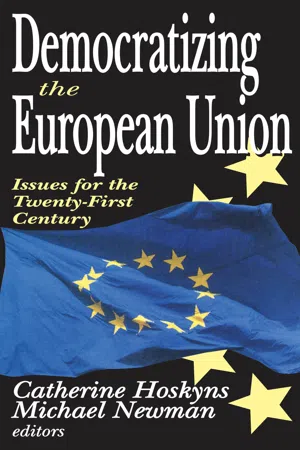
Democratizing the European Union
Issues for the Twenty-first Century
- 224 pages
- English
- ePUB (mobile friendly)
- Available on iOS & Android
eBook - ePub
About this book
The European Union's "democratic deficit" and ways that might be found to resolve it are hot issues in both academic debate and practical politics. Democratizing the European Union offers a fresh approach to this subject by bringing together a diverse range of authors who have been actively involved either in analyzing the activities of the European Union or participating in them.The contributors go beyond a primarily institutional approach by highlighting issues having to do with values, participation, and exclusion. Collectively this volume also transcends the limitations of abstract theory. Embracing a range of perspectives, and including discussions of major contemporary challenges, such as enlargement and economic and monetary union, this book contains a detailed analysis of the response of New Labour to the democratization debate. The contributions include: Sue Cohen, "Social Solidarity in the Delors Period"; Sverker Gustavsson, "Reconciling Suprastatism and Accountability: A View from Sweden"; Stefano Fella, "A Europe of the Peoples? New Labour and Democratizing the EU"; John Lambert and Catherine Hoskyns, "How Democratic is the European Parliament?"; Valerio Lintner, "Controlling Monetary Union"; Mary Kaldor, "Eastern Enlargement and Democracy"; Richard Kuper, "Democratization: A Constitutionalizing Process"; and Catherine Hoskyns, "Democratizing the EU: Evidence and Argument."Democratizing the European Union is essential reading for all those with an interest in the EU and broader questions of democracy. It is also particularly useful for students of European Studies and practitioners involved in EU policymaking and lobbying.
Information
1
Introduction
MICHAEL NEWMAN
In the final year of the twentieth century two very different episodes in European Union (EU) affairs highlighted issues of democracy. The first, in January, was the establishment of Economic and Monetary Union (EMU) among eleven of the member states. This simultaneously raised questions about democracy both within the states and at EU level. If governments no longer possess traditional levers of macro-economic policy, this implies an important new stage in the erosion of domestic autonomy. At the same time the independence of the European Central Bank will limit the possibilities of intervention by the governments or the European Parliament at the EU level. Thus EMU could weaken democratic control of economic policy within the member states without establishing any new form of European political intervention. The second, unplanned, event came two months later when the European Parliament forced the resignation of the whole Commission over allegations of fraud and corruption. Previously termed the Parliament’s ‘nuclear weapon’ – on the grounds that it was too powerful ever to be used – the threat to dismiss the whole Commission put democratic accountability of the institutions at the forefront of the politics of European integration. However, neither EMU nor the crisis of the Commission reveals the full extent of the difficulties involved in democratizing the EU, for the problems are deeply embedded in its historical development.
The historical context
The structure and policy-making system of the EU bear the imprint of the early post-war years when political and economic elites constructed European integration on the basis of a ‘permissive consensus’. Convinced of the imperative need to establish peace, particularly by overcoming the historic conflict between between France and Germany, and to create economic interdependence as a basis for growth, the ‘Six’ built institutions which reflected these priorities. Certainly, the European Coal and Steel Community and the European Economic Community (EEC) also included parliamentary assemblies but, as each country nominated its members to these bodies, the system paid little more than lip service to democratic principles. While the electorates of the member states appeared to support the construction of a ‘new Europe’, and believed that they were deriving benefits from it, the Community’s policy-making system was generally accepted. However, the accession of states, such as Britain, which were less communautaire than the original members, and recurrent economic recessions after the end of the long boom in the early 1970s, progressively undermined the tacit public support which had provided the basis of the integration process.
The first reaction by the Community to this growth of indifference and hostility was to seek greater legitimacy, rather than to enhance democracy. This resulted in some tangible benefits, particularly when Jacques Delors sought a more active social policy, partly as a means of enhancing popular support for the Community. However, some of the responses to the problem were of a more symbolic nature, such as the provision of passports of the same size and colour in all countries, the use of the blue and yellow flag as the Community logo, and the adoption of Beethoven’s ninth symphony as its anthem. Emulating the process by which national identities were cemented, the hope was that such appeals to emotion would create a similar bond between ordinary people and the ‘European project’. A further development of this kind, with far greater potential importance, was the establishment of EU citizenship, realized for the first time in the Treaty of European Union (TEU, the Maastricht Treaty) which took effect in 1993. Since a condition of acquiring this status was citizenship in a member state, and the majority of the rights of EU citizens had already been acquired in earlier phases of the integration process, the innovation was again largely symbolic. Moreover, while citizenship (at least of certain kinds) may be related to democracy, it is not inherently democratic. The new articles introduced in the Maastricht Treaty should therefore be viewed as part of the continuing attempt to enhance the legitimacy of the EU. Given the continuing growth of ‘Euro-scepticism’ and nationalist populism in many of the member states during the 1990s, these efforts have clearly been unsuccessful.
Calls for the democratization of the Community increased throughout the 1980s. Both the demands of directly elected MEPs for greater power and the evident impact of European policies on the domestic domain led to demands for a fundamental transformation of the decision-making system. These, coupled with the need for greater legitimacy and efficiency, resulted in a series of gradual changes. The Single European Act, which was implemented in 1987, went some way to meet the claim of the European Parliament that an enhancement of its legislative role would reduce the ‘democratic deficit’. A new co-operation procedure was introduced and extended with the establishment of ‘co-decision’ in the Maastricht Treaty. The enunciation of the ambiguous doctrine of ‘subsidiarity’ in this treaty, with its emphasis on taking decisions as closely as possible to the citizen, also had potential democratic relevance. Moreover, the Amsterdam Treaty, signed in 1997, has taken some more significant steps. First, it has reduced and simplified the previously complex and numerous procedures of decision-making in which the European Parliament is involved, and has broadened the scope of the simplified co-decision procedure. Second, the Parliament was given the right of approval of the Commission president, while the Commission president’s own role was also strengthened. This combined process represented a significant step in defining clearer lines of accountability, which the Parliament used with such dramatic effect in March 1999. Third, there was also a stronger commitment to transparency in decision-making (which had been foreshadowed at Maastricht and at the Edinburgh summit in 1992). It was thus agreed that the minutes of Council meetings when acting in a legislative capacity, together with the votes and an explanation of them, would be made public, and that there would be a right of access to all Council, Commission and Parliament documents related to EU decision-making. The Amsterdam Treaty introduced new articles in areas concerning human rights. It provided new sanctions (ultimately including suspension of membership) against member states violating the principles of democracy and human rights, and the Court of Justice was also granted jurisdiction to ensure that the Community institutions respected fundamental rights as guaranteed by the European Court of Human Rights. Finally, provision for legislation against racism (and other forms of discrimination) was included in the treaty.
All these were significant changes, although it is also easy to detect weaknesses in each of them. For example, past practice does not suggest that the theoretical commitment to transparency will be implemented satisfactorily in practice; it will be extremely difficult to secure a Council decision in favour of sanctions for human rights abuses, given the requirement of unanimity; and the implementation of effective anti-discrimination legislation will depend on governments demonstrating a political will which is not currently in evidence. However, there is a further fundamental problem with the steps towards democratization taken by the Community thus far. Piecemeal changes have occurred without any thoroughgoing discussion of the nature of the democracy that is being sought. Yet the difficulties involved in democratizing the EU are not only the practical ones of securing the necessary changes, but are also theoretical. For it is not at all obvious how a democratised Union is even to be conceptualized.
We hope that this book makes an important contribution to the debate over such problems. Its approach differs from most of the existing literature, which tends to concentrate on the EU institutions, or on interest group activity, or on rather abstract and esoteric theory. Our purpose has been to cross these boundaries by bringing together theorists and campaigners, and those who take a ‘national’ perspective with those who consider the issues transnationally. It also argues that democratization must be understood in relation to values as well as procedures, and that this requires acceptance of complexity. The following sections elucidate the issues addressed within the volume.
Definitions of democracy
The initial problem is that there is, of course, no agreement about the definition of ‘democracy’ itself. Yet different concepts will imply quite different policy prescriptions about the way in which the EU might be democratized. It is therefore necessary to begin by clarifying the assumptions of the editors on these issues, which provided the starting point for the book. We accept the basic features of the liberal democratic model – such as the freedoms of opinion, expression and organization, universal suffrage, a choice of political representatives and the separation of powers – as important elements in any viable conception of democracy. However, democracy is not simply a set of procedures, but also incorporates substantive values, and our position in relation to three key debates about values and relative priorities must be elucidated, for these underlie the themes of the book.
The first concerns the relationship between liberty and equality. Most would accept that both concepts are constituent elements of democracy, but also that there are tensions between them. Our position on liberty accepts the traditional catalogue of liberal civil and political freedoms but rejects neo-liberal definitions of liberty on the grounds that these effectively defend the privileges of those who already possess power and privilege. In our view, one of the main functions of public authorities is to use political power to redistribute resources in favour of the disadvantaged. Otherwise they are negating equality, which is both a condition and a goal of democracy. However, if equality is elevated to become the sole principle, it can lead to the elimination of fundamental liberties. It follows that democracy implies some form of balance between the goals of liberty and equality, and that in present circumstances democratization requires a move towards greater equality.
Second, we regard the empowerment of ordinary people as a crucial aim Unlike some theorists who see the debate between the advocates of ‘democratic elitism’ and ‘participatory democracy’ as procedural, we therefore believe that greater participation is a substantive value as an aspect of empowerment. This does not mean that ‘direct democracy’ is possible in large and complex societies. We regard representation as indispensable, and political parties as necessary agencies for articulating and implementing policies and providing leadership. However, these must not be viewed as substitutes for active participation at all levels. Protest is also a legitimate political activity, and organizations and channels of mass involvement should be nurtured both because of their effects upon the participants and their impact in bringing about change.
Third, the book is based on the view that democratization demands a move towards greater ‘inclusiveness’. It therefore rejects notions of democracy that stress the interests of the ‘insider’ against those of the ‘outsider’, the dominant nation against the minority nation, and traditional roles and values against those that challenge stereotypes. We assume instead that democracy must be as inclusive as possible in relation to ethnicity, religion, gender and sexuality. In this respect the recent work on ‘deliberative democracy’, elaborating an ideal in which all those affected by decisions should be able to participate equally and openly in the deliberative process by which policy outcomes are determined is helpful (Bohman and Rehg 1997).
Application to the EU
Yet even among those who share these values there is a further fundamental conceptual difficulty in the subject matter of the book: is the democratization of the EU an appropriate aim? Many argue against the idea on the grounds that democracy is working, or that it could and should work, within the confines of the ‘nation state’. In Britain this view is now mainly associated with the last Conservative government and ‘Eurosceptics’ of the right. However, there are left-wing variants of the position and, as Sverker Gustavsson explains, one of these is common among Social Democrats in Sweden (Chapter 3). Their argument is that democratizing the EU would strengthen its supranational power, thereby giving it more scope to encroach on the domestic polity. This in turn would weaken democracy within the ‘nation state’, since it would diminish the control of the elected government over policy-making. It therefore follows that it is better to restrict supranational democracy by maintaining the EU as a union of independent states.
Since the notion that the demos should rule within the polity lies at the core of the concept of democracy, the defenders of independent states appear to have a strong argument in their favour. Their case is often reinforced by the claim that the demos is constituted by the nation, which has the right to self-government without external interference. Furthermore this doctrine may also be underpinned with the argument that particular values, such as social and economic equality and empowerment, are pursued by ‘nation states’. For it may then be concluded that certain forms of supranationalism make it increasingly difficult for such goals to be achieved. As Valerio Lintner argues, this may certainly be the case in relation to the Maastricht project for EMU (Chapter 5). However, there are also major weaknesses in the state-centred doctrine.
Challenges to the state!
In the first place, it can certainly be challenged on normative grounds. States which claim to represent a particular demos may in fact be controlled, to a great extent, by economic and political elites rather than by the people as a whole. Similarly, there is room for considerable scepticism about the claim that states are always ‘nation states’. Certainly in the UK a particular nation has dominated the state, while minority nations have largely been excluded from power. In such circumstances, rather than maintaining democracy, the state-centred doctrine may simply mean the continued dominance of the current elites. In contrast, a democratic alternative might be to establish effective political power at a regional level, with smaller and minority nations controlling their own affairs. Finally, it may be argued that more cosmopolitan forms of democracy are desirable on principle. Thus many of those who favour democratizing the EU regard this as an important goal in its own right on the grounds that exclusivism and intolerance are immanent dangers within the ‘nation state’, which could be overcome in a transnational form of democracy.
There are also good reasons for maintaining that the statecentred doctrine is no longer tenable in practice. The EU has already encroached on the domestic sphere. Community law takes precedence over state legislation, there is Community competence over an ever-increasing range of policy areas, and there is a high level of economic interdependence and inter-penetration. It is therefore hardly plausible to draw a rigid distinction between inter-state relations and the domestic polity, and it is evident that much policy-making evades democratic participation or control at any level. If democratization is a fundamental goal, it cannot therefore be pursued solely in relation to the member states and must also involve the EU as a whole.
Some commentators appear to believe that the answer lies in transferring a federal model of liberal democracy to the EU itself. This might involve the conversion of the Commission into a democratically elected executive, with the Council of Ministers and the European Parliament acting as a bicameral legislature, respectively representing the member states and the people. However, it must surely be acknowledged that the EU is not at present a state, even of a federal kind. The governments maintain decisive power in key areas of policy and some of the states are major actors in the international system in their own right. And if the EU were ever to evolve into a supranational democratic state there would be further theoretical and normative problems to consider: would the comparative rigidity of a federal system be compatible with the fluidity of the current world? If not, any constitutional settlement might be anachronistic as soon as it came into operation. Could Community structures, procedures and assumptions be tailored to the plurality of peoples, languages, political consciousness and traditions within its domain? If not, the federation would contradict the goal of inclusiveness, which suggests that diversity should be tolerated and fostered. Such questions may need to be answered in the future but, in the present circumstances, it seems more helpful to accept that the EU is a complex entity, with power distributed unevenly between levels and across policy areas, and to ask how stronger elements of democracy may be introduced into it.
Approaches to democratization
Yet even if state-centrism and federalism are both rejected as representations of the present situation, at least three different possible perspectives on democratizing the EU remain. The first (Approach 1) might suggest that political and social movements should operate in regions, countries and in EU institutions to advance democracy, and that it it is necessary to work on different levels for different policy areas. This approach does not begin with a blueprint for the EU institutions but assumes that they will be shaped by the interactions between the movements and by continuing conflicts over the distribution of power. Those who adopt this as their starting point may happily accept the possibility that the EU will remain an inchoate and untidy entity.
The second perspective (Approach 2) might hold that certain necessary changes follow from both basic liberal principles and the substantive values outlined above. Liberalism would require the EU to reform its own procedures – for example, by introducing greater transparency and freedom of information. The goals of inclusiveness and a move in the direction of equality would imply a broader conception of the rights to be guaranteed by the Court of Justice: for example, the implementation of effective anti-discrimination laws, and the definition of a minimum level of social provision. This approach would therefore view the EU as a guarantor of rights, the conception of which may be enlarged over time.
The third perspective (Approach 3) would go be...
Table of contents
- Cover
- Title Page
- Copyright Page
- Contents
- List of Contributors
- Acknowledgements
- Abbreviations
- 1 Introduction
- 2 Social solidarity in the Delors period: barriers to participation
- 3 Reconciling suprastatism and accountability: a view from Sweden
- 4 A Europe of the peoples? – New Labour and democratizing the EU
- 5 How democratic is the European Parliament?
- 6 Controlling Monetary Union
- 7 Eastern enlargement and democracy
- 8 Democratization: a constitutionalizing process
- 9 Democratizing the EU: evidence and argument
- Index
Trusted by 375,005 students
Access to over 1.5 million titles for a fair monthly price.
Study more efficiently using our study tools.
Frequently asked questions
Yes, you can cancel anytime from the Subscription tab in your account settings on the Perlego website. Your subscription will stay active until the end of your current billing period. Learn how to cancel your subscription
No, books cannot be downloaded as external files, such as PDFs, for use outside of Perlego. However, you can download books within the Perlego app for offline reading on mobile or tablet. Learn how to download books offline
Perlego offers two plans: Essential and Complete
- Essential is ideal for learners and professionals who enjoy exploring a wide range of subjects. Access the Essential Library with 800,000+ trusted titles and best-sellers across business, personal growth, and the humanities. Includes unlimited reading time and Standard Read Aloud voice.
- Complete: Perfect for advanced learners and researchers needing full, unrestricted access. Unlock 1.5M+ books across hundreds of subjects, including academic and specialized titles. The Complete Plan also includes advanced features like Premium Read Aloud and Research Assistant.
We are an online textbook subscription service, where you can get access to an entire online library for less than the price of a single book per month. With over 1.5 million books across 990+ topics, we’ve got you covered! Learn about our mission
Look out for the read-aloud symbol on your next book to see if you can listen to it. The read-aloud tool reads text aloud for you, highlighting the text as it is being read. You can pause it, speed it up and slow it down. Learn more about Read Aloud
Yes! You can use the Perlego app on both iOS and Android devices to read anytime, anywhere — even offline. Perfect for commutes or when you’re on the go.
Please note we cannot support devices running on iOS 13 and Android 7 or earlier. Learn more about using the app
Please note we cannot support devices running on iOS 13 and Android 7 or earlier. Learn more about using the app
Yes, you can access Democratizing the European Union by Catherine Hoskyns, Michael Newan in PDF and/or ePUB format, as well as other popular books in Politics & International Relations & Constitutions. We have over 1.5 million books available in our catalogue for you to explore.