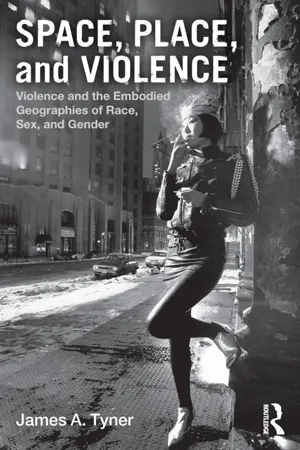
Direct, interpersonal violence is a pervasive, yet often mundane feature of our day-to-day lives; paradoxically, violence is both ordinary and extraordinary. Violence, in other words, is often hidden in plain sight. Space, Place, and Violence seeks to uncover that which is too apparent: to critically question both violent geographies and the geographies of violence. With a focus on direct violence, this book situates violent acts within the context of broader political and structural conditions. Violence, it is argued, is both a social and spatial practice. Adopting a geographic perspective, Space, Place, and Violence provides a critical reading of how violence takes place and also produces place. Specifically, four spatial vignettes – home, school, streets, and community – are introduced, designed so that students may think critically how 'race', sex, gender, and class inform violent geographies and geographies of violence.
eBook - ePub
Space, Place, and Violence
Violence and the Embodied Geographies of Race, Sex and Gender
- 240 pages
- English
- ePUB (mobile friendly)
- Available on iOS & Android
eBook - ePub
Space, Place, and Violence
Violence and the Embodied Geographies of Race, Sex and Gender
About this book
Trusted by 375,005 students
Access to over 1.5 million titles for a fair monthly price.
Study more efficiently using our study tools.
Information
1
EVERYDAY GEOGRAPHIES OF VIOLENCE
We often think of the ‘everyday’ as those mundane, banal, even trivial activities that occupy our daily lives. We wake up and brush our teeth, shower, eat and expel our bodily wastes. We work and go to school. We eat (again) and go to bed. And there is a familiar regularity—a comforting routine—to our everyday. Strangely, this routine is often perceived as boredom. Indeed, according to Philip Wander the everyday becomes “the grey reality enveloping all we do.”1
Violence is also part of our everyday life. As Hille Koskela explains, “Being too afraid to take a path across a dark park is a practical question of everyday life.”2 Likewise, according to Elizabeth Stanko,
If any of us takes measures to try to guarantee our safety—such as staying alert on the street, resisting arguments with our intimates because their bad tempers might lead to a beating, or avoiding certain public places that make us feel uneasy—we are automatically taking violence into account as a possible occurrence in our lives.3
However, we don’t even have to leave the confines of our homes to be exposed to violence. Simply watching the latest Hollywood blockbuster movie or television show is also a part of our everyday life. And these shows are increasingly violent. Indeed, 35 years ago Timothy Hartnagel and his colleagues found that 80 percent of all prime time television shows included violence, and that the frequency of violent episodes was eight per hour.4
Consequently, “most of us are exposed to violence in one form or another on a fairly regular basis. Being exposed to violence means you can either be witness to violent behavior or be victimized by violence.”5 According to recent surveys, there are an estimated six million children abused or neglected each year in the United States; moreover, studies indicate that nearly 40 percent of boys and 50 percent of girls saw someone else being slapped at home. And this exposure to violence is not limited to the home. Other studies report that as many as eight out of ten children report that they have seen someone else threatened with violence, or beaten up, at school.6
The role of violence in our everyday lives is paradoxical. On the one hand, violence, and here I mean actual, physical violence, is pervasive. Indeed, the number of violent acts committed every day is staggering. According to a World Health Organization report, world-wide approximately 4,400 people die every day because of intentional acts of self-directed, interpersonal, or collective violence. In the year 2000, for example, an estimated 1.6 million people died a violent death. About half of these deaths were suicide, a fifth were war-related, while one-third were homicide-related.7 Untold thousands more are injured or suffer other non-fatal consequences as a result of being the victim or witness to acts of violence.
Despite (or because of?) these statistics, we often don’t associate violence as a mundane feature of our existence. Instead, violence is that which interrupts our day-to-day activities. We are confronted with violence; violence is something that happens, that occurs, that disrupts our normal routines. We are shocked when we learn that a close friend has been physically assaulted; we are saddened and horrified to hear on the nightly news that a teenager shot and killed a number of his classmates. These out-of-the-ordinary, or extraordinary, events may give us pause, and a chance to reflect on our lives, but beyond this, are viewed as separate from our lives. Indeed, it is something that happens to someone else, someplace else; not us, and certainly not here.
On the other hand, even extraordinary violence has become mundane and banal. Indeed, violence has become so common-place that it often recedes into that ‘grey envelope’ of the everyday. This claim was recently brought home on the streets of New York City. On April 18, 2010, a 31-year-old homeless man was stabbed after attempting to help another woman who was being mugged. The man, Hugo Alfredo Tale-Yax, crumbled to the sidewalk and lay in a pool of blood. And yet while he lay dying, at least 25 people walked past Tale-Yax; none of the people stopped to offer assistance. Incredibly, one person did pause to photograph the dying man.8
Commentators were quick to offer explanations for this outwardly callous behavior. Perhaps everyone assumed someone else called the police. Perhaps people were scared to get involved. Perhaps they assumed he was drunk (and thus, not ‘worthy’ of assistance?). Despite the many excuses forwarded, the fact remains that many people did not waver in their day-to-day activities; it was as if the crumpled body of Tale-Yax was simply a part of their everyday landscape.
How do we make sense of this paradox—that violence is both ordinary and extraordinary? How do we make sense of violence as part of our day-to-day existence? How does violence shape our perceptions and conceptions of particular places? In turn, how do these places—homes and schools, streets and communities—inform our understanding of violence? Is there a lesson to be drawn from these questions?
At this point, let me quickly note what this book is and is not. It is not a text book on the definition or explanation of violence. My shelves and perhaps yours also, are filled with books on the subject of violence.9 Likewise, hundreds of academic journals regularly publish thousands of articles on violence. Many of these books and articles are exceptionally insightful and indeed provide some guidance to my own work. However, the existing literature does not present the story that I want to tell. As a geographer, I am interested in the twin concepts of ‘space’ and ‘place’. And I believe that these two concepts are intimately related to violence. Consequently, I want to better understand ‘space’ and ‘place’ (or, simply, geography) from the standpoint of violence; concurrently, I want to better understand violence from the standpoint of geography.
That said, there are many different ways of approaching violence from a geographic perspective. We can for example map out distributions of violence (i.e., where murders occur) and seek causal explanations to account for these patterns. We might also ‘step inside’ the minds of violent people and try to understand how they perceive the world around them—their spaces and places and how these environments influence their actions. Here, however, I pursue another direction. My concern is on interpersonal violence in the context of broader political and structural conditions of violence. I want students to think through and understand how direct violence informs and is informed by broader social processes, such as capitalism, patriarchy, sexism, and nationalism. I want students to understand, also, how these broader structures and processes frame our thinking about violence—frames that make some types of violence visible while obscuring others.
Note that I do not attempt to ‘explain’ violence; instead, I hope to provide some level of understanding. The difference is not as subtle as it might appear. To ‘explain’ something implies a level of knowledge that permits predictions to be made. Following Dan Flannery and Randall Collins—two preeminent, but very different, scholars of violence—I do not believe that we can ever ‘explain’ and thus ‘predict’ violence. It is possible, however, to provide a level of understanding. Flannery, for example, notes that “we have yet to develop any foolproof way of picking out who will act violently toward others and when, and under what circumstances violence will occur.” Otherwise, Flannery continues,
If we were so good at predicting who would become violent, we would do a better job of picking out school shooters, individuals who randomly shoot at motorists at gas stations and on highways, and those who kill their coworkers over some workplace dispute.10
Randall Collins agrees. He writes that “It is a false lead to look for types of violent individuals.” Collins explains that though there are some statistical correlations between some variables (e.g., poverty, ethnicity, and age) and certain kinds of violence, these fall short of predicting most violence.11
The philosopher Wilhelm Dilthey (1833–1911) considered that while we explain nature, we understand social life and human intentions.12 Consequently, Dilthey proposed that we seek verstehen, a German word which roughly translates as a cross between the English terms ‘understanding’ and ‘empathy’. In other words, verstehen seeks to understand why people do what they do, in terms of their own personal theories; it is an appreciation of context rather than an attempt at prediction.13
Space, place, and violence. These are the main characters in the stories that follow. In the four substantive chapters that comprise this book, I present four spatial vignettes that capture some of the many ways in which our characters relate. I do so comparatively, in an attempt to understand how violence informs both space and place and, concomitantly, how space and place inform violence. First, however, it is necessary to introduce our characters. I begin with an overview of violence as an academic subject. This is complemented with a brief discussion of the concepts of ‘space’ and ‘place’. Combined, these components provide the foundation for geographic understanding of violence.
Violence as Subject
Violence surrounds us … And we know it. It lurks in dark alleys and empty parking lots. It hides in our homes and our schools. It peers at us from our television screens, movie theaters, and now even our electronic game consoles—as our ‘entertainment’ activities are increasingly saturated with images of violence. And it roams across our football fields, race-car tracks, and other sporting venues.
But what is violence? The word itself provides little in the way of understanding. We routinely speak of tornados, earthquakes, and other ‘natural events’ as being violent. We also describe both car crashes and collisions on the football field as violent. In recognition of these many and varied usages, Richard Mizen laments that the “word ‘violence’ tends to be used in such a loose and broadly defined way that its use as a precise term of description or as a clear concept is severely limited.”14
In Space, Place, and Violence I approach direct violence15 from the standpoint forwarded by the World Health Organization:
The intentional use of physical force or power, threatened or actual, against oneself, another person, or against a group or community, that either results in or has a high likelihood of resulting in injury, death, psychological harm, maldevelopment or deprivation.16
As Etienne Krug and his colleagues explain, this usage (attempts to) encompass all types of violence and, more significantly, reflects both the context and ‘nature’ of violence.
Violence, following this approach, is further sub-divided into three categories: self-inflicted, interpersonal, and collective. Self-inflicted violence includes both suicide and self-abuse. Interpersonal violence, conversely, includes violence committed by one person toward another and two broad types are recognized: family/partner and community. The former type of interpersonal violence is distinguished primarily by life-span and living arrangement (i.e., domestic violence, child abuse/violence, and elder abuse); the latter includes ‘acquaintance’ and ‘stranger’ violence. Lastly, collective violence includes group forms of violence, and may include warfare or gang behavior.
As with any definition, the above categories are neither mutually exclusive nor necessarily exhaustive. Moreover, as detailed later in this book, many of these terms are likewise subject to debate. The term ‘community’, for example, is a heavily laden term that influences our understanding of violence. Consequently, specific chapters will revisit our definition of violence.
Although my focus is to provide an understanding of the relationships between space, place, and violence, it is necessary to briefly consider the purported causes of violence. It is common-place for academics to note that violence cannot be attributed to a single cause; that any given act of violence is both contingent and context-dependent. To this end, a useful starting point is provided, again, by the World Health Organization. Here, four ‘levels’ of factors are thought to increase the likelihood of one becoming either a victim or a perpetrator. The most proximate level is biological, or personal, which would include the ‘body’ itself. Key characteristics include demographic factors (e.g., age, sex/gender, education, income), personality disorders, and drug use.17 In the United States, for example, young men are statistically more likely to be both victims and perpetrators of physical violence. Indeed, world-wide the differences between male-on-male violence and female-on-female violence are immense and, according to Daly and Wilson, these are universal. In their meta-analysis of 34 same-sex homicide studies around the world, they conclude that there is no known human society in which the level of lethal violence among women even begins to approach that of men.18 This suggests that there must be a strong biological component to violent behavior—a component that nevertheless can be (and has been) modified by societal factors (e.g., laws, customs, and other practices). Many social scientists, however, are reluctant to consider the role that biology plays in violent behavior. As Alvarez and Bachman explain, because of their academic training, social scientists have tended to focus on social factors and have often ignored biological theories.19 Indeed, many social scientists remain indignant to any explanation that speaks of biology.20
The body, however, must remain central to our understanding of violence. Bodies commit violent acts (e.g., people yell, punch, kick, shoot, and engage in other ‘harmful’ acts); and violence is commonly enacted on bodies. However, the body–violence linkage is not so simple. Too often we take bodies, including our own, for granted. By this I don’t mean that we forget to eat properly or exercise regularly. Rather, I mean that we don’t always question how our bodies—and other people’s bodies—influence our daily activities. We know, of course, that our bodies come in different sizes, shapes, sexes, and colors. We know, also, that these physical traits provide meaning to other people. And often these meanings are beyond our control. Tall people are often assumed to be better leaders; obese people are perceived to be lazy. And the meanings attributed to skin color (e.g., race) are well established.
Physical traits, or, more precisely, the meanings attached to bodily traits, go a long way toward ‘explaining’ some (but not all) violent acts. Both hate and sex crimes, for example, are obvious sets of violent acts that are precipitated largely on the basi...
Table of contents
- Cover
- Title
- Copyright
- Contents
- Preface
- Acknowledgments
- 1. Everyday Geographies of Violence
- 2. Home
- 3. School
- 4. The Streets
- 5. Community
- 6. Violence and the Pedagogy of Impunity
- Notes
- Bibliography
- Index
Frequently asked questions
Yes, you can cancel anytime from the Subscription tab in your account settings on the Perlego website. Your subscription will stay active until the end of your current billing period. Learn how to cancel your subscription
No, books cannot be downloaded as external files, such as PDFs, for use outside of Perlego. However, you can download books within the Perlego app for offline reading on mobile or tablet. Learn how to download books offline
Perlego offers two plans: Essential and Complete
- Essential is ideal for learners and professionals who enjoy exploring a wide range of subjects. Access the Essential Library with 800,000+ trusted titles and best-sellers across business, personal growth, and the humanities. Includes unlimited reading time and Standard Read Aloud voice.
- Complete: Perfect for advanced learners and researchers needing full, unrestricted access. Unlock 1.5M+ books across hundreds of subjects, including academic and specialized titles. The Complete Plan also includes advanced features like Premium Read Aloud and Research Assistant.
We are an online textbook subscription service, where you can get access to an entire online library for less than the price of a single book per month. With over 1.5 million books across 990+ topics, we’ve got you covered! Learn about our mission
Look out for the read-aloud symbol on your next book to see if you can listen to it. The read-aloud tool reads text aloud for you, highlighting the text as it is being read. You can pause it, speed it up and slow it down. Learn more about Read Aloud
Yes! You can use the Perlego app on both iOS and Android devices to read anytime, anywhere — even offline. Perfect for commutes or when you’re on the go.
Please note we cannot support devices running on iOS 13 and Android 7 or earlier. Learn more about using the app
Please note we cannot support devices running on iOS 13 and Android 7 or earlier. Learn more about using the app
Yes, you can access Space, Place, and Violence by James A. Tyner in PDF and/or ePUB format, as well as other popular books in Social Sciences & Gender Studies. We have over 1.5 million books available in our catalogue for you to explore.