- 465 pages
- English
- ePUB (mobile friendly)
- Available on iOS & Android
eBook - ePub
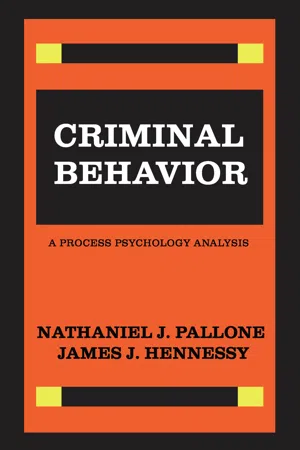
Criminal Behavior
About this book
Crime Statistics suggest that Americans are not a notably law-abiding people. With some 13 million felonies reported every year, it is not surprising that few topics engage public attention and imagination more compellingly than the dynamics of criminal behavior. Volume and ubiquity alone might suggest the psychology of criminal behavior is well understood and there exists an integrated body of explanatory theory and empirical evidence. But in fact only fragmentary and incomplete accounts have thus far appeared. Criminal Behavior is virtually unique in providing a comprehensive psychological paradigm that fits across variant species of crime, while meeting the requirements of science and the needs of law enforcement and administration of justice in controlling criminal behavior.The authors begin this remarkable text by outlining a model for criminal behavior based not on abnormal psychology but on the tenets of social learning theory. They illuminate the processes by which criminal activity is initiated and repeated, including personal constructs, stimulus determinants, and behavioral repertoires. They define four process elements that interact in precipitating criminal behavior-inclination, opportunity, expectation of reward, expectation of impunity. They show how these process elements are regulated and confined by a series of complex and variable boundary conditions in specific criminal offenses. Conceptual, methodological, and operational constraints on the study of criminal behavior are defined, and statistically and behavioral science data bearing upon larceny and homicide, two crimes at diametric extremes, are examined in detail.Pallone and Hennessy locate and define those psychological variables that render comprehensible the process whereby formally criminal acts are construed as possible and desirable by individual actors and show how those actors self-select psychosocial environments that facilitate or at least do not impede the commission of crime. They identify and explain the phenomenon of 'tinderbox violence.'Its comprehensive perspective and balanced consideration of competing viewpoints make Criminal Behavior an ideal text for students and teachers of criminology and of the psychology of criminal behavior. It is also a pioneering work for psychologists, sociologists, criminologists, and law-enforcement official.
Information
□ Chapter 1
A Process Psychology Paradigm for Criminal Behavior
WE AMERICANS SEEM NOT TO BE A NOTABLY LAW-ABIDING PEOPLE. IN A typical year, some 14 million episodes of serious (felonious) crime are reported to law enforcement authorities in the United States, with many million more episodes of minor crime, and with perhaps as many as 21 million additional criminal victimizations which are not formally reported (Maguire & Flanagan, 1991, pp. 251, 353). On any given day, more than 1,000,000 of us are incarcerated in state or Federal prisons as a result of conviction for felony crime, with another nearly 3,250,000 of us in jails or juvenile reformatories or otherwise under the supervision of correctional authorities through probation or parole (Bureau of Justice Statistics, 1990, 1991; Maguire & Flanagan, 1991, pp. 564-565, 567, 578, 606; Langan, 1991).
If one assumes (and the assumption is barely warranted) a single perpetrator in each episode of serious crime reported, it appears that one of every 17 of us commits a crime each year; victimization data suggest that one of every eight of us is victimized each year; and something approximating 3% of those of us beyond infancy are either in custody or under correctional supervision each day as a result of criminal behavior.
Hence, it is not surprising that few topics engage the public attention or stir the public imagination more compellingly than the dynamics of criminal behavior. In the information media, accounts of criminal activity (especially of violent crime) and of apprehension and trial are almost invariably accompanied by facile observations about individual motivation and/or about the pathogenic social circumstances surrounding the crime. It is not atypical that the enterprising crime reporter spices his or her account with quotable observations from psychologists and psychiatrists in the community who, despite the ethical urgings of their principal professional organizations (American Psychological Association, 1978; American Psychiatric Association, 1974, 1984; Stone, 1976) are not reluctant to comment on the psyche of a real, alleged, or imagined perpetrator whom they have never personally observed, clinically or otherwise.
As is to be expected, crimes that achieve notoriety on a national scale — ranging from attempted assassinations to economic crimes like “insider trading”— energize the press to ever greater inventiveness (Hamilton, 1986). For their part, the entertainment media (television, motion pictures, fiction) have become incorrigible in offering easy interpretations about the interplay between internal psychological forces and criminal behavior, to the horror and delight of viewer and reader.
□ Current Status of A Scientific Psychology of Criminal Behavior
Volume and ubiquity alone might thus readily elicit the impression that the psychology of criminal behavior is well understood scientifically, that an integrated body of theory and empirical evidence undergirds the facile psychological interpretations that everywhere regale the reader and viewer — and hence represent but its “pop” outcroppings.
But that impression proves illusory. Despite more than a century and a half of careful study since the English physician Joseph Pritchard invented in the 1830s a mental illness he termed “moral insanity” to explain criminal behavior (Pichot, 1978, p. 56), and many more centuries of non-empirical speculation by insightful philosophers, physicians, and litterateurs, formulation of a broad- gauged, widely applicable, and scientifically-anchored psychology of criminal behavior remains at a relatively primitive stage. Though insightful and expert experimentalists and conceptualists have developed well-integrated psychological explanations for specific types of criminal behavior (e.g., homicide, arson, rape, shoplifting), few have attempted to construct a comprehensive psychology of criminal behavior which fits equally across the variant species of crime.
Criteria for a Comprehensive Psychology of Criminal Behavior
Such a comprehensive psychology of criminal behavior should both meet the requirements of psychological science and prove serviceable to the interests of the enforcers of law and the administrators of justice. To do so, that comprehensive psychology should simultaneously provide both a reliable understanding of the psychological factors that antecede criminal behavior of various sorts, ranging from minor offenses to those of the greatest gravity, and signposts leading to prediction and control. Judged by these stringent criteria, a quick reading would suggest that the process of formulating a comprehensive, scientifically-anchored psychology of criminal behavior remains fragmentary and incomplete (Janeksela & Miller, 1985).
Nor are the reasons for this state of affairs difficult to discern. As succeeding chapters on boundary conditions in the conceptual and empirical domains which constrain the empirical base for the scientific study of criminal behavior suggest, there are limitations inherent in the enterprise. They originate in the variant conceptual domains in which scientific psychology operates, on the one hand, and that demarcated by the legislative definition, regulation, and formal adjudication of behavior as criminal on the other. They extend into the empirical domain as well, affecting both the character of the subjects upon whom scientific studies of criminal behavior can be carried out and the methods of inquiry thereby available to psychologists who study criminal behavior.
⇨ Retrospective Clinical Analysis by Long Distance
Illustrative of the eagerness to perform clinical analyses retrospectively is a study by Marohn (1987) of John Wesley Hardin, an adolescent cowboy-killer of the 19th century much celebrated by Hollywood. According to Marohn (p. 271), Hardin “never established the capacity to regulate internal tensions and strong affects,” so that “he used self-objects for regulation instead.” Thus, his string of killings is attributed to an undiagnosed and untreated case of narcissism.
No less fantastic for its proximity in time to the criminal events is Bailey’s (1985) “paleopsychological” rendering of mass murderer Ted Bundy, who had sexually brutalized and murdered some three dozen young women and was executed in Florida, with the governing dynamics attributed to a “breakdown of neopsychological inhibitions, which [breakdown] allowed extreme phylogenetic regression to occur.”
In the same wildly speculative vein, Montanile (1986) analyzed at long distance Bernhard Goetz, the so-called “New York subway vigilante” who crippled a would-be assailant by means of an unlicensed revolver. According to Montanile (p. 55), “Goetz expressed the group fantasy feelings of many persons in the US and acted out the public’s own murderous desires, providing a release for many persons for the pent-up feelings of frustration, anger, and fear.” Montanile continues by asserting that “Persons in a group (all of whom share the same fantasy) go through four group-fantasy stages (strong, cracking, collapse, and upheaval)” and that “the US was in the upheaval stage” at the time of Goetz’s actions — with the quite obvious implication that he was merely an actor in a sociodrama which had its origins elsewhere than in his psyche.
But in some large measure the current state of affairs obtains because those psychologists who have studied criminal behavior empirically (in common, to be sure, with a wide array of investigators in other areas of human behavior) have typically adopted the assumptions, biases, and investigatory methods of differential psychology rather vthan those of process psychology.
Emphasis on Differences or Commonalities?
By definition, differential psychology takes as its province the illumination of differences between people that result in variant behavior between different behavers. Virtually by definition, differential psychology is not particularly interested in those commonalities between people or within situations that are likely to elicit similar behavior.
For these reasons, it is a fair assessment to say that differential psychology has consistently displayed at least an implicit preference for univariate explanation over multivariate explanation — not in the sense that differential psychologists have sought to discover the sources of behavior in single variables, but rather in the sense that it has been their belief that the sources of behavior can be discovered in singular and unitary sets of variables.
Thus, differential psychology formulations are likely to hold that Behavior A is attributable to measurable differences between persons in personality traits denominated X, Y, and Z or to measurable differences in intelligence, or perhaps even to interaction between level of intelligence and the “amount” of traits X, Y, and Z. The bias has remained even after the introduction of sophisticated means for data analysis by means of computerization.
Behavior as A Function of Interaction
At the diametric polarity, those convinced that the determinants of behavior lie in the characteristics of the stimuli which elicit behavior and not at all in differences between behavers (a set of assumptions which undergirds much of contemporary empirical sociology) are likely to formulate equally univariate statements that attribute behavior exclusively to stimulus determinants.
And, in the via media, there stands the conceptual position that holds that behavior is a function of the dynamic calculus through which intra-person and stimulus characteristics interact. That position, virtually by definition, represents a multivariate stance.
Though the differential tradition is (accurately) said to have given birth to psychology as a science, there is a fallacy inherent in regarding the two as coextensive. To assert (quite correctly) that psychology has not yet successfully differentiated, on the basis of measurable intra-person traits or characteristics, those who have behaved criminally from those who have not — much less proved itself capable of identifying in advance those whose internal traits will compel them to behave criminally at some future time — is not to assert that psychology has failed to illuminate the process by which criminal behavior is emitted.
Hence, the pivotal position in a process psychology interpretation of criminal behavior holds that the process by which criminal behavior is emitted results not from single antecedents that can be identified by focusing either on intra-person variables alone or on extrapsychic properties inhering in stimulus situations that seem to elicit or invite behavior of one sort rather than of another sort. Instead, such an interpretation focuses on the process by which criminal behavior is emitted, construing that process as a dynamic interchange between the person and the environment — between intraperson propensities to behave toward certain objects (and in certain ways; and in certain ways toward certain objects, but not toward other objects) and those situational cues and variables which highlight certain objects and seem to invite, permit, or tolerate certain ways of behaving.
⇨ Criminal Personality Profiles
One of the newer “techniques” to emerge in the field of “forensic psychology” has been denominated criminal personality profiling. According to Pinizzoto (1984), “profiling focuses attention on individuals with personality traits that parallel traits of others who have committed similar offenses. Close examination of the crime scence and the extrapolation of certain relevant psychological material leads to a profile.” As Douglas, Ressler, Burgess & Hartman (1986, p. 401) describe it, this “developing technique” is intended to reveal “the kind of person most likely to have committed a crime by focussing on personality characteristics. A basic premise is that the way persons think directs their behavior. The profiling process moves from input through a decision models stage considering the type and style of the crime. After further assessment, a generated profile is applied to the investigation.’ ’
Quite clearly, such an approach absolutely demands the existence of a rock-solid body of empirical evidence linking "personality characteristics” to criminal behavior of one or another sort, a condition sharply contrary to fact — or to the present state of the science. Instead, the procedure operates largely through unwarranted over-generalization from clinical evidence that may be systematically biased rather than representative of the offender groups whose “profiles” are to be drawn on the basis thereof. In addition to failure to meet generally accepted scientific canons (a topic further explored in Chapter 4), the procedure is likely to yield wildly high proportions of “false positives.” Despite the fictionalized popularity of such techniques when they are displayed in films like The Silence of the Lambs, doubtless the courts and opposing counsel will have a field day when “criminal personality profiles” are adduced as evidence in trials — perhaps equal to that enjoyed when clairvoyants give testimony.
□ Univariate vs. Multivariate Explanations for Behavior
Suppose that you and I and your brother Sam (or sister Sal) have each purchased a new automobile within the last month — and that each vehicle has been manufactured by the same automaker. Who among us would believe that your “reasons” for purchasing your vehicle are the same as mine — or that either of us have reasons that are identical with those of Sam or Sal?
For one of us, purchase price may have been paramount; for another, fuel economy; for another, brand loyalty; for two of us, but not the third, ease of financing, or accessibility to service facilities, or whatever, may have been an important consideration; availability of an acceptable model ready for delivery (in contrast to a long wait for a custom order to be placed with the factory) may have played a role in my decision, but not in yours — and the examples could multiply endlessly. That is by way of illustrating that, ...
Table of contents
- Cover Page
- Criminal Behavior
- Copyright Page
- Contents
- Displays, Figures, Tables
- Preface
- 1 A Process Psychology Paradigm for Criminal Behavior
- 2 Conceptual Constraints in Studying Criminal Behavior
- 3 Operational Constraints in Studying Criminal Behavior
- 4 Methodological Constraints in Studying Criminal Behavior
- 5 Statistical Perspectives on Criminal Homicide: The Offense As It Is Committed
- 6 Psychological Perspectives on Criminal Homicide: Variables Within the Offender
- 7 Psychological Perspectives on Homicide: Social Learning and Stimulus Determinants
- 8 Criminal Homicide: Extended Clinical Case Illustrations
- 9 Larceny: Statistical and Psychological Perspectives
- 10 Refinements, Implications, Applications
- Glossary
- References
- Index of Authors and Names
- Index of Topics
Trusted by 375,005 students
Access to over 1.5 million titles for a fair monthly price.
Study more efficiently using our study tools.
Frequently asked questions
Yes, you can cancel anytime from the Subscription tab in your account settings on the Perlego website. Your subscription will stay active until the end of your current billing period. Learn how to cancel your subscription
No, books cannot be downloaded as external files, such as PDFs, for use outside of Perlego. However, you can download books within the Perlego app for offline reading on mobile or tablet. Learn how to download books offline
Perlego offers two plans: Essential and Complete
- Essential is ideal for learners and professionals who enjoy exploring a wide range of subjects. Access the Essential Library with 800,000+ trusted titles and best-sellers across business, personal growth, and the humanities. Includes unlimited reading time and Standard Read Aloud voice.
- Complete: Perfect for advanced learners and researchers needing full, unrestricted access. Unlock 1.5M+ books across hundreds of subjects, including academic and specialized titles. The Complete Plan also includes advanced features like Premium Read Aloud and Research Assistant.
We are an online textbook subscription service, where you can get access to an entire online library for less than the price of a single book per month. With over 1.5 million books across 990+ topics, we’ve got you covered! Learn about our mission
Look out for the read-aloud symbol on your next book to see if you can listen to it. The read-aloud tool reads text aloud for you, highlighting the text as it is being read. You can pause it, speed it up and slow it down. Learn more about Read Aloud
Yes! You can use the Perlego app on both iOS and Android devices to read anytime, anywhere — even offline. Perfect for commutes or when you’re on the go.
Please note we cannot support devices running on iOS 13 and Android 7 or earlier. Learn more about using the app
Please note we cannot support devices running on iOS 13 and Android 7 or earlier. Learn more about using the app
Yes, you can access Criminal Behavior by James Hennessy in PDF and/or ePUB format, as well as other popular books in Social Sciences & Forensic Psychology. We have over 1.5 million books available in our catalogue for you to explore.