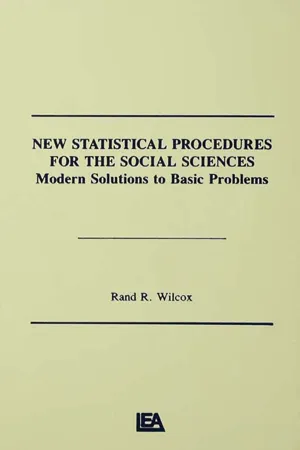
This unique volume addresses the inadequacies of basic statistical methods that standard textbooks tend to ignore. The author introduces new procedures with accompanying tables that illustrate the practicality of the methods. Concentrating on basic experimental designs that are central to research in the social sciences, Wilcox describes new nonparametric techniques, two-way ANOVA designs, and new results related to the analysis of covariance and repeated measure design. This book serves as the ideal reference and supplement to standard texts by making the statistical advances of the last thirty years accessible to graduate students and researchers.
eBook - ePub
New Statistical Procedures for the Social Sciences
Modern Solutions To Basic Problems
- 442 pages
- English
- ePUB (mobile friendly)
- Available on iOS & Android
eBook - ePub
About this book
Information
CHAPTER ONE
INTRODUCTION TO STATISTICS
It is probably fair to say that most undergraduates and beginning graduate students in the social sciences would never take a statistics course unless they were told they had to study statistics in order to get their degree. However, as students become more advanced, they realize that statistics is an invaluable tool for understanding the world in which we live. What makes the importance of statistics particularly obvious to anyone involved in research and experimentation is that most journal articles rely on statistical techniques when trying to make inferences about the people they are studying. Often I hear researchers saying that they wish they had a better understanding of statistical techniques. Fortunately, the application and correct interpretation of statistics can be accomplished without having an unusually strong background in mathematics—all that is required is a good background in high school algebra. While it is true that the theory of statistics can be mathematically complex, the point is that much of this theory need not concern those who are primarily interested in applying the techniques.
On the other hand, some theory Is extremely important if you hope to avoid silly errors and erroneous conclusions when applying statistical procedures. Theory tells you precisely what a statistical procedure does. Perhaps the single most common error, even among experienced researchers, is making inferences that are not justified based on the statistical procedure that was used. Examples of where this problem occurs are given throughout the book.
While the emphasis in this book is on applications and recent developments in basic techniques, the first six chapters emphasize the basic theory needed to understand the most commonly used procedures. There is considerably more statistical theory than is covered in these chapters, but if too much emphasis is put on theory, it is easy to lose sight of how statistical procedures can be used to solve practical problems.
1.1 THE PURPOSE OF STATISTICS
To begin to understand why statistics is important, consider the following situations. Suppose you run some tests on manic depressives and you find that they have an unusually low level of some hormone that is suspected of influencing behavior. You might be tempted to conclude, or at least speculate, that this hormone has a relationship with being manic depressive. That is, you might think that all manic depressives have a lower than normal level of this hormone.
Next suppose you want to know how people feel about a particular political issue. For example, you might be interested in whether adults believe in banning all nuclear power plants. If you ask a few people about their attitudes on this subject, and most say that they favor a ban, you might want to conclude that most people in the United States have a similar attitude.
As a final situation, suppose you compare the SAT scores of ...
Table of contents
- Cover
- Full Title
- Copyright
- Contents
- Dedication
- LIST OF SYMBOLS
- PREFACE
- CHAPTER ONE INTRODUCTION TO STATISTICS
- CHAPTER TWO PROBABILITY
- CHAPTER THREE RANDOM VARIABLES, DISTRIBUTIONS AND ESTIMATION
- CHAPTER FOUR BINOMIAL AND NORMAL DISTRIBUTIONS
- CHAPTER FIVE HYPOTHESIS TESTING
- CHAPTER SIX STUDENT'S T, CHI-SQUARE AND F DISTRIBUTION
- CHAPTER SEVEN COMPARING TWO MEANS
- CHAPTER EIGHT ONE-WAY ANOVA
- CHAPTER NINE MULTIPLE COMPARISONS
- CHAPTER TEN TWO-WAY ANOVA
- CHAPTER ELEVEN REPEATED MEASURES AND RANDOMIZED BLOCKS DESIGNS
- CHAPTER TWELVE SELECTION TECHNIQUES
- CHAPTER THIRTEEN CORRELATION AND REGRESSION
- CHAPTER FOURTEEN CATEGORICAL DATA
- CHAPTER FIFTEEN NONPARAMETRIC PROCEDURES
- APPENDIX A TABLES
- APPENDIX B ELEMENTARY MATRIX ALGEBRA
- ANSWERS
- AUTHOR INDEX
- SUBJECT INDEX
Trusted by 375,005 students
Access to over 1.5 million titles for a fair monthly price.
Study more efficiently using our study tools.
Frequently asked questions
Yes, you can cancel anytime from the Subscription tab in your account settings on the Perlego website. Your subscription will stay active until the end of your current billing period. Learn how to cancel your subscription
No, books cannot be downloaded as external files, such as PDFs, for use outside of Perlego. However, you can download books within the Perlego app for offline reading on mobile or tablet. Learn how to download books offline
Perlego offers two plans: Essential and Complete
- Essential is ideal for learners and professionals who enjoy exploring a wide range of subjects. Access the Essential Library with 800,000+ trusted titles and best-sellers across business, personal growth, and the humanities. Includes unlimited reading time and Standard Read Aloud voice.
- Complete: Perfect for advanced learners and researchers needing full, unrestricted access. Unlock 1.5M+ books across hundreds of subjects, including academic and specialized titles. The Complete Plan also includes advanced features like Premium Read Aloud and Research Assistant.
We are an online textbook subscription service, where you can get access to an entire online library for less than the price of a single book per month. With over 1.5 million books across 990+ topics, we’ve got you covered! Learn about our mission
Look out for the read-aloud symbol on your next book to see if you can listen to it. The read-aloud tool reads text aloud for you, highlighting the text as it is being read. You can pause it, speed it up and slow it down. Learn more about Read Aloud
Yes! You can use the Perlego app on both iOS and Android devices to read anytime, anywhere — even offline. Perfect for commutes or when you’re on the go.
Please note we cannot support devices running on iOS 13 and Android 7 or earlier. Learn more about using the app
Please note we cannot support devices running on iOS 13 and Android 7 or earlier. Learn more about using the app
Yes, you can access New Statistical Procedures for the Social Sciences by Rand R. Wilcox in PDF and/or ePUB format, as well as other popular books in Psychology & History & Theory in Psychology. We have over 1.5 million books available in our catalogue for you to explore.