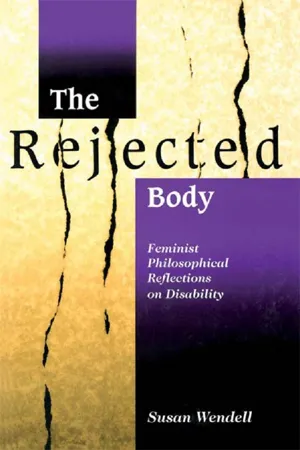
The Rejected Body argues that feminist theorizing has been skewed toward non-disabled experience, and that the knowledge of people with disabilities must be integrated into feminist ethics, discussions of bodily life, and criticism of the cognitive and social authority of medicine. Among the topics it addresses are who should be identified as disabled; whether disability is biomedical, social or both; what causes disability and what could 'cure' it; and whether scientific efforts to eliminate disabling physical conditions are morally justified.
Wendell provides a remarkable look at how cultural attitudes towards the body contribute to the stigma of disability and to widespread unwillingness to accept and provide for the body's inevitable weakness.
- 214 pages
- English
- ePUB (mobile friendly)
- Available on iOS & Android
eBook - ePub
About this book
Information
1
Who Is Disabled? Defining Disability
The question of how we should define disability is not merely the beginning of an analytic exercise. We encounter the problem of definition as soon as we take an interest in disability. For example, how many people have disabilities? Estimates of the incidence of disability worldwide and within countries vary greatly among the estimators, because not only methods of gathering information about disabilities, but also understandings of what constitutes disability, vary greatly among those gathering the information. Questions of definition arise in countless practical situations, influence social policies, and determine outcomes that profoundly affect the lives of people with disabilities.
Definitions of disability officially accepted by government bureaucracies and social service agencies determine people’s legal and practical entitlement to many forms of assistance, where assistance is available. This may include economic help for such purposes as: education, training, and retraining; obtaining equipment, such as wheelchairs for basic mobility or computers for basic communication; modifying a home or a vehicle to enable a person with a disability to use it; hiring assistants to help with bodily maintenance and household tasks; even obtaining medical supplies such as medications and bandages. For people with disabilities who are unemployed, it includes the basic support to buy food and shelter. It also includes eligibility for accessible housing and special forms of transportation, and even for such seemingly minor (but actually major) means of access as a disabled parking sticker.
Socially accepted definitions of disability determine the recognition of disability by friends, family members, and co-workers. Recognition of a person’s disability by the people s/he is closest to is important not only for receiving their help and understanding when it is needed, but for receiving the acknowledgement and confirmation of her/his reality, so essential for keeping a person socially and psychologically anchored in a community. It is not uncommon for friends and even family members to desert a person who has debilitating symptoms that remain undiagnosed. They may insist that the ill person is faking, or mentally ill and unwilling to get appropriate treatment. People whose disability is unrecognized are frequently pressured to keep up a pretense of normality, to continue to work as if nothing were wrong, and/or to undergo unnecessary psychiatric treatment.
Definitions of disability are important to those who are organizing people with disabilities for political purposes, for example, to press for fuller recognition of their rights, for increased accessibility to public places, or for better opportunities to work. There have been struggles within political groups of people with disabilities, especially in recent years, to include more categories of people. For example, people with AIDS and with debilitating chronic illnesses like ME fought within disability groups for the recognition that they too are disabled, share similar needs and struggles, and suffer similar forms of insult, discrimination, distrust, and exclusion.
Definitions of disability affect people’s self-identity. Recognizing yourself as disabled and identifying with other people who are disabled and learning about their experiences can all contribute to understanding and interpreting your own experiences, and to knowing that you are not alone with problems that you may have believed were unique to you. But being identified as disabled also carries a significant stigma in most societies and usually forces the person so identified to deal with stereotypes and unrealistic attitudes and expectations that are projected on to her/him as a member of this stigmatized group.1
A careful effort to define disability can clarify our conceptions of disability and reveal misconceptions and false stereotypes. For example, for many people the paradigmatic disabled person is a young, healthy, paraplegic man who has been injured in an accident but continues to be athletic, or a young, healthy, professionally successful blind woman who has ‘overcome’ her handicap with education. In fact, arthritis, rheumatism, heart and respiratory disease, stroke, Parkinsonism, hypertension, and epilepsy are major causes of disability in Canada, the United States, and Great Britain, and many people with disabilities in these countries are also ill and/or old (Health and Welfare Canada and Statistics Canada 1981; Statistics Canada 1986 and 1991; Pope and Tarlov 1991; LaPlante 1991; Bury 1978).
The United Nations Definitions
The United Nations definition of disability (UN 1983: I.e. 6-7) is widely used and tends to be favoured by disability activists and other advocates of greater opportunities for people with disabilities (Wright 1983, 10—12; Fine and Asch 1988, 5-6). It offers the following definitions of and distinctions among impairment, disability, and handicap:
“Impairment: Any loss or abnormality of psychological, physiological, or anatomical structure or function. Disability: Any restriction or lack (resulting from an impairment) of ability to perform an activity in the manner or within the range considered normal for a human being. Handicap: A disadvantage for a given individual, resulting from an impairment or disability, that limits or prevents the fulfillment of a role that is normal, depending on age, sex, social and cultural factors, for that individual.”
Handicap is therefore a function of the relationship between disabled persons and their environment. It occurs when they encounter cultural, physical or social barriers which prevent their access to the various systems of society that are available to other citizens. Thus, handicap is the loss or limitation of opportunities to take part in the life of the community on an equal level with others. (UN 1983: I.e. 6-7)
There are two things I like about the UN definitions. First, they are general enough to include many conditions that are not always recognized by the general public as disabling, for example, debilitating chronic illnesses, such as Crohn’s disease, which limit people’s activities but do not necessarily cause any immediately observable disability. I shall return to this aspect of the definitions later in this chapter. Second, the definition of handicap explicitly recognizes the possibility that the primary causes of a disabled person’s inability to do certain things may be social; they may be lack of opportunities, lack of accessibility, lack of services, poverty or discrimination, and they often are. It is this latter aspect of the definitions that makes them appealing to advocates for people with disabilities.
Nevertheless, there are several criticisms I have of the UN definitions that may throw some light on the nature of disability and the problems associated with defining it. First, the definitions of “impairment” and “disability” seem to imply that there is some universal, biologically or medically describable standard of structure, function, and human physical ability. As we shall see, there would be important advantages to employing some universal standards, should we be able to agree on them. Yet surely what are “normal” structure, function, and ability to perform an activity all depend to some degree on the society in which the standards of normality are generated. For example, I, who can walk about half a mile several times a week but not more, am not significantly disabled with respect to walking in my society, where most people are not expected to walk further than that in the course of their daily activities. But in some societies, in Eastern Africa for example, where women normally walk several miles twice a day to obtain water for the household, I would be much more severely disabled. It is not just that I would be considered more disabled in those societies but that I would in fact need constant assistance to carry on the most basic life activities. What is normal ability in urban Western Canada is neither normal nor adequate ability in rural Kenya.
Failure to recognize that standards of structure, function, and ability are socially relative could be dangerous to people with disabilities. If the standards employed are generated by people in highly industrialized societies, many people in less industrialized societies and in rural areas where there are fewer technological resources will be considered non-disabled when they are in fact in need of special assistance to survive and participate in life where they are.
On the other hand, definitions of impairment and disability could be relativized too much to some societies. If most people in a particular society are chronically undernourished, that society’s standards of “normal” functioning might become so low as to mask the widespread disability among its citizens that starvation is causing. Another particularly disturbing example is the genital mutilation of girls. In societies where the majority of people approves of the practice and the vast majority of girls has been mutilated, the girl who has a clitoris (and other external sexual organs, depending on the form of mutilation practiced) is considered abnormal. Yet because genital mutilation often causes severe infections, shock, hemorrhage, and chronic physical and mental health problems, in addition to reducing or destroying some women’s capacities for sexual pleasure, I cannot believe that the rest of the world should accept uncritically those societies’ standards of normal structure and function for women. To do so seems a betrayal of the girls and women whose lives, health, and sexuality are endangered by mutilation.2
Iris Marion Young’s statement that “women in sexist society are physically handicapped,”3 and her arguments in support of it present another strong challenge to the idea that culturally relative standards of physical structure, function, and ability should be accepted. Young argues that lack of opportunities and encouragement to develop bodily abilities, rigid standards of feminine bodily comportment, and constant objectification and threat of invasion of their bodies combine to deprive most women in sexist societies of their full physical potential. In these societies, a “normal” woman is expected to lack strength, skills, and the range of movement that “normal” men are expected to possess and that she might have developed had she grown up in a less sexist society. If we accept these standards uncritically, we will tend to overlook the ways that those societies create physical disadvantages for women.
Thus there seem to be problems both in denying the social and cultural relativity of impairment and disability (as used in the UN definitions) and in accepting it. The UN definitions seem to recognize the relativity of standards of ability while attempting to universalize them by using the phrase “in the manner or within the range considered normal for a human being.” Unfortunately, that does not amount to a practical recognition of the relativity of disability. A woman in Kenya who can walk only as much as I can will still not be considered disabled with respect to walking, because her ability falls within the worldwide range considered normal. Nor does it universalize standards enough to create the basis for criticizing societies whose standards of health and good functioning fall too low for some or all of their members. The standards of such societies could still be seen to fall, by definition, in the “range considered normal for a human being.”
Philosopher Ron Amundson suggests that we define disabilities as “the absences of basic personal abilities.” (Amundson 1992, 108) “Basic personal abilities” enable us to perform such actions as “moving one’s arms, standing, seeing and hearing things in the environment,” and also to remain alert for several hours a day and to remain active without unreasonable fatigue. The actions they enable us to perform are “biomedically typical of the human species (suitably relativized to age and perhaps sex).” This is an attractive attempt to universalize the concept of disability via an appeal to common sense (with some additional appeal to biomedical standards) . Yet the idea of a basic personal ability seems less clear when we ask, “How well?” or “How much?” How well must one see or hear in order to have the basic personal ability? How long must one be able to stand or how fast must one be able to walk? Is running a basic personal ability? I find myself unable to answer these questions without first asking about the circumstances of the person whose abilities are being discussed. How much ability is basic, like how much ability is normal, seems to depend on how much is necessary to perform the most common tasks of daily living in a particular physical and social environment. For example, far more strength and stamina are necessary to live where there is no water on tap, where it gets cold and there is no central heating, where a fire has to be built every time a meal is cooked, and all the clothes are washed by hand. In such an environment I would be considered a helpless invalid, and indeed I would lack most of the personal abilities I would need.
Appeal to what is biomedically typical of the human species would not seem to help settle the question, since people who are biomedically identical have different personal abilities, and people who have the same personal abilities are biomedically different. Eyeglasses, hearing aids, good prostheses, and other products of medical technology optimize the abilities of some people, while others, who have identical physical conditions but do not have access to the technology, lack the same abilities. People who use strong but completely effective corrective lenses may have the same personal ability to see as people with uncorrected good eyesight; do we want to call them or their seeing biomedically identical? Of course, in asking whether a person is disabled we could consider only whether a person’s biology is typical of the human species, but Amundson would not like that, since, as he points out, atypical and even pathological biology is not necessarily disabling, that is, it does not necessarily affect a person’s abilities adversely. I think we are stuck with the problem that the question of what abilities are basic, like that of what abilities are normal, is to a significant extent relative to the environment in which the abilities are exercised.
This is not the same point as claiming that a person’s physical structure, function, or ability may or may not be disadvantageous in a given environment. Like the authors of the UN definitions and others (e.g., see Wright 1983), Amundson distinguishes “disability” from “handicap.” He defines “handicap” as “an opportunity loss sustained by an individual resulting from the interaction between that individuals (biomedical) disability and the specific environment in which the individual’s opportunities exist” (Amundson 1992, 111). So, applying this to my most recent example, I might lack most of the basic personal abilities required in my environment, but I still might live quite well, participate actively in my community, and have many valuable opportunities if I could buy the services most people perform for themselves. For reasons I will explain shortly, I like Amundson’s definition of “handicap” better than that offered by the United Nations.
Nevertheless, we still need some recognition of the relativity of standards of structure, function, and ability to the customs and conditions of different societies so that what the UN calls “impairment” and “disability” will be concepts that are useful and accurate in identifying those individuals who may need adjustments in their environment or direct assistance in order to survive and participate in their societies. On the other hand, we also need some cross-cultural comparisons and criticism of societies’ standards of structure, function, and ability to perform activities. Such comparisons could contribute to raising the standards and, eventually, the levels of health in a society and help to protect people whose ill health or disability might serve the interests of others within their society.
My other criticisms of the UN definitions concern how they define “handicap.” Because that definition refers to “a role that is normal, depending on age, sex, social and cultural factors, for that individual,” the definitions imply that women can be disabled, but not handicapped, by being unable to do things which are not part of the “normal” roles of women in their societies. Thus, for example, if it is not considered essential to a woman’s role in a given society that she be able to read, then a blind woman who is not provided with education in Braille or good alternatives to printed material is not handicapped by that lack of assistance, according to these definitions. In general, where the expectations for women’s participation in social and cultural life are considerably lower than they are for men, disabled women’s opportunities will be severely constrained, and the UN has, through its own definitions, robbed itself of the ability to criticize the circumstances in which many disabled women live.
Moreover, disability in women often goes unrecognized and rehabilitation of women is often minimal because of the expectation that women need only be able to function well enough to perform household duties (Fine and Asch 1988; Russo and Jansen 1988; Driedger and Gray 1992). On the other hand, because women’s unpaid work in the home (and in volunteer activities) is not publicly valued, and because disability is still defined in many places as the inability to earn wages, women’s inabilities to perform their traditional unpaid labour often go unrecognized as disability (Reisine and Fifield 1988).
In addition, the UN definitions suggest that we can be disabled, but not handicapped, by the normal process of aging, since although we may lose some ability, we are not “handicapped” unless we cannot fulfill roles that are normal for our age. Yet the fates of old people and of people with disabilities tend to be linked in a society because aging is disabling. A society that provides few resources to allow disabled people to participate in its activities will be likely to marginalize all people with disabilities, including the old, and to define the appropriate roles of old people as very limited, thus disadvantaging them. I think the UN should recognize that old people can be handicapped unnecessarily by their societies, but its definitions seem to prevent that recognition.
Realizing that aging is disabling helps non-disabled people to see that people with disabilities are not ‘Other,’ that they are really themselves at a later time. Unless we die suddenly, we are all disabled eventually. Most of us will live part of our lives with bodies that hurt, that move with difficulty or not at all, that deprive us of activities we once took for granted, or that others take for granted—bodies that make daily life a physical struggle. We need understandings of disability and handicap that do not support a paradigm of humanity as young and healthy. Encouraging everyone to acknowledge, accommodate, and identify with a wide range of physical conditions is ultimately the road to self-acceptance as well as the road to increasing the opportunities of those who are disabled now.
Ron Amundson objects to Norman Daniels’s classifying the disabled with the group Daniels calls the “frail elderly,” that is, those who, according to Daniels, are experiencing a normal reduction in biomedical functioning associated with aging. Amundson says of this: “To the extent that frailty and opportunity reduction is a natural consequence of aging, classifying disability with...
Table of contents
- Front Cover
- Half Title
- Title Page
- Copyright
- Contents
- Acknowledgements
- Introduction
- 1. Who Is Disabled? Defining Disability
- 2. The Social Construction of Disability
- 3. Disability as Difference
- 4. The Flight from the Rejected Body
- 5. The Cognitive and Social Authority of Medicine
- 6. Disability and Feminist Ethics
- 7. Feminism, Disability, and Transcendence of the Body
- Notes
- References
Trusted by 375,005 students
Access to over 1.5 million titles for a fair monthly price.
Study more efficiently using our study tools.
Frequently asked questions
Yes, you can cancel anytime from the Subscription tab in your account settings on the Perlego website. Your subscription will stay active until the end of your current billing period. Learn how to cancel your subscription
No, books cannot be downloaded as external files, such as PDFs, for use outside of Perlego. However, you can download books within the Perlego app for offline reading on mobile or tablet. Learn how to download books offline
Perlego offers two plans: Essential and Complete
- Essential is ideal for learners and professionals who enjoy exploring a wide range of subjects. Access the Essential Library with 800,000+ trusted titles and best-sellers across business, personal growth, and the humanities. Includes unlimited reading time and Standard Read Aloud voice.
- Complete: Perfect for advanced learners and researchers needing full, unrestricted access. Unlock 1.5M+ books across hundreds of subjects, including academic and specialized titles. The Complete Plan also includes advanced features like Premium Read Aloud and Research Assistant.
We are an online textbook subscription service, where you can get access to an entire online library for less than the price of a single book per month. With over 1.5 million books across 990+ topics, we’ve got you covered! Learn about our mission
Look out for the read-aloud symbol on your next book to see if you can listen to it. The read-aloud tool reads text aloud for you, highlighting the text as it is being read. You can pause it, speed it up and slow it down. Learn more about Read Aloud
Yes! You can use the Perlego app on both iOS and Android devices to read anytime, anywhere — even offline. Perfect for commutes or when you’re on the go.
Please note we cannot support devices running on iOS 13 and Android 7 or earlier. Learn more about using the app
Please note we cannot support devices running on iOS 13 and Android 7 or earlier. Learn more about using the app
Yes, you can access The Rejected Body by Susan Wendell in PDF and/or ePUB format, as well as other popular books in Philosophy & Ethics & Moral Philosophy. We have over 1.5 million books available in our catalogue for you to explore.