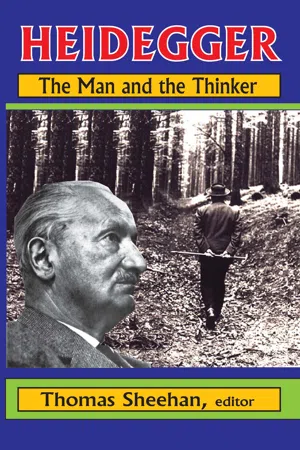
Martin Heidegger, perhaps the most influential philosopher of this century, is in many ways “a man without a biography.”1 He once opened a lecture on Aristotle with the information: “He was born, he worked, he died.” Much the same could be said of Heidegger. Born in southwest Germany in 1889, he worked there all his life except for five years at Marburg, and died there on May 26, 1976. Yet within the span of those 86 years his thought shook the world of philosophy.
In Heidegger the biography and the course of thinking are virtually coterminous. From beginning to end he lived in his thought. The only biography worth writing, therefore, is a philosophical one which charts the sources and development of his thinking. What follows is not that, but only a collection of fragments to fill in some gaps in the period leading up to the 1927 publication of his major work, Sein und Zeit (hereafter: SZ).
FROM MESSKIRCH TO FREIBURG: 1889-1909
Martin Heidegger was born on Thursday, September 26, 1889, in Messkirch, Baden-Wurttemburg, of Friedrich Heidegger (1851-1924) and Johanna Kempf Heidegger (1858-1927). Both parents were Roman Catholics, his father the sexton of St. Martin’s Church in Messkirch. His mother’s family traces its origins in the region back in an unbroken line to 1510, and his father’s family name kept the resonances of the region: die Heide, heath, moorland. He had a sister, Mariele, and a brother, Fritz, who survives him in Messkirch. Everything about his family and youth bespeaks the simplicity of a farming town on the eastern edge of the Black Forest, which Heidegger himself celebrated in his essay “The Pathway.” His earliest formal education (until 1903, age thirteen) took place at the local public schools in Messkirch. Just after his fourteenth birthday a promising future as a priest sent young Martin to the Jesuit secondary school at Konstanz, some thirty miles south of his native town, where he spent three years (1903-1906) followed by three more at the Jesuit Bertholds-Gymnasium in Freiburg (1906-1909).
Those six years of secondary school were momentous in the formation of the young thinker. They were the time, he tells us, when “I acquired everything that was to be of lasting value.”2 This was the period of his training in Greek and Latin (he continued to read Greek authors every day of his life except for the war years3), his discovery of Adalbert Stifter (1905) and Friedrich Hölderlin (1908), and perhaps most important of all, the first encounter with his abiding question about the meaning of Being. In the summer of 1907, when the seventeen-year-old scholar was home on vacation from the Bertholds-Gymnasium, his “fatherly friend and fellow Swabian,” Father Conrad Gröber, then pastor of Trinity Church in Konstanz, later bishop of Meissen (Saxony) and archbishop of Freiburg,4 gave him Franz Brentano’s On the Several Senses of Being in Aristotle.5 This straightforward 220-page treatise examined the meaning of the Greek participle on (which has the verbal sense of “to-be-in-Being” as well as the substantive sense of “that^which-is-in-Being”) and found it to be a homonym whose analogous meanings Aristotle ordered according to a fourfold distinction: Being as “accidental,” being as true, being as potential and actual, and being according to the schema of the categories. Heidegger repeatedly characterized the work as “my first guide through Greek philosophy in my secondary school days,” as “the ‘rod and staff of my first awkward attempts to penetrate into philosophy,” and as “the first philosophical text through which I worked my way, again and again from 1907 on.”6 More important than the book was the question it awoke in him but could not answer: if that-which-is-in-Being (das Seiende) has several meanings, what does “Being itself (das Sein) mean in its unity? From this question, rooted in Aristotle (and not in Husserl!), the line leads, with some wavering, to the publication of SZ.
FREIBURG: FROM STUDENT TO LECTURER: 1909-1916
In 1909, the end of his secondary education, the twenty-year-old Heidegger entered the novitiate of the German Province of the Jesuits at Feldkirch, Austria, near the border with Lichtenstein, but he was dismissed after only a few weeks for reasons of health. Thereupon he entered the archdiocesan seminary at Freiburg, where the spiritual directors were also Jesuits, and simultaneously matriculated at the Albert Ludwig University in Freiburg.7 From the fall of 1909 through the summer of 1911, he studied theology and some philosophy until he abandoned entirely the idea of becoming a priest and left the seminary. But he continued his studies at the university with a concentration on philosophy until the summer of 1913 when at the age of 23 he completed his doctoral dissertation, The Doctrine ofJudgment in Psychologism, under the directorship of Arthur Schneider.8
From his first semester at the university Heidegger began reading, with little enough success, Edmund Husserl’s Logical Investigations. The reason, he recalls, is that “I expected a decisive aid in the questions stimulated by Brentano’s dissertation,”9 and Husserl, he knew, had been a student of Brentano’s in Vienna. But the “realist” Husserl of the Logical Investigations (1900-1901) had already begun to give way to the “transcendental” Husserl who would write the Ideas (1913),10 and from early on, the young Heidegger seems to have understood that whereas phenomenological method might help him to “articulate the whole region of ‘Being’ in its various modes of reality,”11 Husserl’s turn toward transcendental subjectivity could only bar the way. For in 1910 we find Heidegger reading Husserl’s programmatic essay “Philosophy as Strict Science” and at the end, next to the sentence “Not from philosophies but from issues [Sachen] and problems must the impulse to research proceed,” writing the following marginal note: “Wir nehmen Husserl beim Wort.” “We take Husserl at his word.” He had already begun to see that not consciousness, as in Husserl, but rather aletheia, as in the Greeks, was the central issue for philosophy. In that regard, he has said, the appearance of Werner Jaeger’s The History of the Genesis of Aristotle’s Metaphysics (1912) awakened his keen interest in the problematic of truth or disclosure (aletheia) in Metaphysics IX, 10.
Catholic thinkers also exerted great influence on Heidegger during his first two years at the university. Maurice Blondel’s L’Action, which Heidegger told Henry Dumery he read “secretly” while with the Jesuits, continued to earn his praise until late in his life. And in the spring of 1950 Heidegger told Dumery that he thought a personalist theodicy was conceivable on the basis of Heidegger’s own work so long as one rigorously and critically avoided anthropomorphisms.12 The French spiritualist Ravaisson also worked an abiding influence on him.13 But during those first two years at the university the influence of Carl Braig, Catholic theologian of the Tübingen school, seems to have been most pronounced, especially through his treatise On Being: An Outline of Ontology.14 Besides offering Heidegger an extensive access to the philosophical texts of the tradition and an introduction to the concept of the onto-theological structure of metaphysics, the work seems to have started him on the path of searching out the etymology of fundamental concepts. For example, Braig traces the word Zeit (time) back to the Greek tanumi, “I stretch myself (ich strecke mich), and here we may well see the roots of the discussion of temporality and historicity at SZ, p. 373, as a “stretching” (Erstreckung).15 It was Braig who, on walks with the young seminarian, spoke of the internal restrictions of scholasticism and the possibilities inherent in German Idealism. Here was Heidegger’s introduction to Schelling and Hegel. And another topic that would be fruitful in his teaching and writing after World War One dawned on him during this period.
The term “hermeneutic” was familiar to me from my theological studies. At that time, I was particularly agitated over the question of the relation between the Word of Sacred Scripture and theological-speculative thinking. It was, if you will, the same relation, viz., between language and Being, only veiled and inaccessible to me, so that along many detours and wrong paths I sought in vain for a guiding thread.16
It was also during these university years that he discovered Kierkegaard, Nietzsche, and Dilthey, Dostoevsky, Rilke, and Trakl, and no doubt countless others. He speaks fondly of the lectures of the art historian, Wilhelm Voge.
When Heidegger left the seminary in 1911 to devote himself to philosophy, his first wish was to go to Gottingen to study under Husserl, but financial problems kept him at Freiburg. (Within five years the situation would work out to his advantage with Husserl’s transfer to Freiburg.) There he enrolled in lectures and seminars given by Heinrich Rickert, the neo-Kantian philosopher of values. Rickert’s distinction between history and nature on the basis of individualizing vs. generalizing thought was, for all its primitiveness, basic to the young thinker at that time, and some forty years later he remarked that in those pre-war years when experimental psychology was attempting to become the one and only philosophy, “the value-philosophy school was an essential and decisive support for what was known as philosophy in the great tradition.”17 Through Rickert Heidegger was introduced to the writings of Emil Lask, who mediated between Husserl’s Logical Investigations and Rickert’s neo-Kantian theory of value.
In August, 1914, with the outbreak of the war, Heidegger enlisted in the military but was dismissed on October 9, 1914, for ill health. From 1915 through 1917 he worked in Freiburg with the Control Board of the Post Office, a position that apparently entailed field service. Fairly quickly during this period he finished his wo...