This book, the third in a series on the life course, has significance in today's world of research, professional practice, and public policy because it symbolizes the gradual reemergence of power in the social sciences. Focusing on "self-directedness and efficacy" over the life course, this text addresses the following issues:
* the causes of change
* how changes affect the individual, the family system, social groups, and society at large
* how various disciplines--anthropology, sociology, psychology, epidemiology--approach this field of study, with consideration given to common themes and differences
Finally, an effort is made to develop a multidisciplinary perspective unique to the study of self-directedness and efficacy.
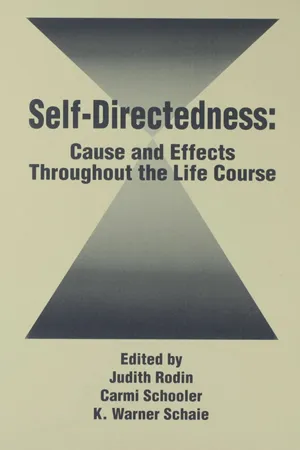
eBook - ePub
Self Directedness
Cause and Effects Throughout the Life Course
- 280 pages
- English
- ePUB (mobile friendly)
- Available on iOS & Android
eBook - ePub
Self Directedness
Cause and Effects Throughout the Life Course
About this book
Information
Publisher
Psychology PressYear
2013Print ISBN
9781138981607
9780805805628
Edition
1eBook ISBN
9781134753413
1
Control By Any Other Name: Definitions, Concepts, and Processes
The purpose of this introductory chapter is to review the various definitions of control and to outline the implications of the use of one definition or another for our views about how control has its effects. I take largely an ahistorical and acultural approach for two reasons. First, this reflects the general state of the field with only a few exceptions. Second, the rest of this volume has been designed to remedy this situation, by taking as an explicit focus the role of sociocultural and historical factors, and by considering the individual across the life span in a variety of domains in which control is thought to be operative.
I begin by describing several perspectives on defining and operationalizing control. Theorists have defined control in various ways, some focusing on achieving behavioral outcomes, others on making choices, and still others on cognitive processes. This has led investigators to operationalize control in a variety of ways. Even the construct has been called many different things including, besides control, self-directedness, choice, decision freedom, agency, mastery, autonomy, self-efficacy, and self-determination. Next I discuss the domains of individual thought and action where control-relevant processes are important. I conclude by pointing to the importance of considering these issues from a life-course perspective, to set the stage for the following chapters.
DESIRE FOR CONTROL
It has been argued that the desire to make decisions and affect outcomes, that is to exercise control, is a basic feature of human behavior (White, 1959). Many theorists in fact view behavior itself as arising from people’s need to be causal agents in their environment (deCharms, 1968). For example, DeCharms (1968) asserted that “man’s primary motivational propensity is to be effective in producing changes in his environment. Man strives to be a causal agent. His nature commits him to this path and his very life depends on it” (p. 269). Others (e.g., Kelley, 1967, 1971) believe that attributional or explanatory processes occur because the individual is motivated to attain cognitive control. This view proposes that cognitive processes are a means of encouraging and maintaining feelings of control. The tendency for individuals to overestimate their degree of personal control over events that are objectively random (e.g., Langer, 1975; Wortman, 1975) is consistent with the assumption that they are motivated to believe that they are able to control their environment.
SELF-EFFICACY
The importance of perceived self-efficacy in human agency is underscored by the work of Bandura and his associates (Bandura, 1977; Bandura, Adams, Hardy, & Howells, 1980). Bandura has argued that, among the different mechanisms of personal agency, none is more pervasive than people’s beliefs in their capabilities to exercise control over their own motivations and behaviors and over environmental demands. Self-efficacy depends on the individual’s belief that he or she can cause an intended event to occur and can organize and carry out the courses of behavior necessary to deal with various situations.
Perceived self-efficacy has directive influence on people’s choice of activities and settings. Through expectations of eventual success, it can also affect coping efforts. Expectations of self-efficacy determine how much effort people will expend and how long they will persist in the confrontation of obstacles and aversive experiences. The stronger the perceived efficacy, the more active the efforts. According to Bandura (1986), those who persist in subjectively threatening activities that are in fact relatively safe, will gain corrective experiences that reinforce their sense of efficacy, thereby eventually eliminating their defensive behavior. Those who cease their coping efforts prematurely will retain their self-debilitating expectations and fears. Expectations of personal efficacy are based on four principal sources of information: direct performance accomplishments, vicarious experience, verbal persuasion, and physiological states. The most effective of the four is direct mastery experience. Successes help develop a greater sense of efficacy, whereas failures undermine it. In addition, redoubling one’s efforts in the face of occasional failures can strengthen self-motivated persistence if experience comes to show that even the very difficult obstacles can be mastered by sustained effort. The effects of failure on personal efficacy consequently depend on the timing and total pattern of experiences in which the failures occur.
INTERNAL–EXTERNAL LOCUS OF CONTROL
Bandura’s view of self-efficacy is quite different from the viewpoint proposed by Rotter (1966). Rotter’s conceptual scheme, focusing on internal versus external locus of control orientation, is mainly concerned with causal beliefs about action-outcome contingencies rather than with personal efficacy. Perceived self-efficacy and beliefs about the locus of causality must be distinguished because convictions that outcomes are determined by one’s action are different from, although they affect, self-efficacy and behavior. These concepts also differ in how they are measured. Rotter used a general scale to measure views about the locus of causality. This scale and others that followed it usually are comprised of multiple factors involving different domains or types of control. In the standard self-efficacy assessment procedure, individuals are presented with graduated self-efficacy scales representing specific tasks varying in difficulty, complexity, or some other dimension depending on the domain of functioning being explored. Subjects designate the tasks that they judge they can do and their degree of certainty regarding the judgment. In contrast to global dispositional assessments of control such as Rotter’s internal versus external locus of control orientation, self-efficacy is measured within task and situation specificity, for example, a measure of cold pressor tolerance self-efficacy used by Litt (1988) asked subjects to indicate how much time they believed they could keep their hand in ice water and to rate their confidence in that judgment.
OUTCOME EXPECTANCY
Outcome expectancies are judgments regarding the potential controllability of an outcome in general, regardless of whether a particular individual is able to influence the outcome. Theoretical difficulties in self-efficacy theory have emerged around the conceptual distinctions made between self-efficacy expectations and outcome expectancy. According to Bandura (1977), efficacy expectations are assumed to be unrelated to outcome expectancies. Although the distinction may seem conceptually clear and logical, operationalization difficulties have occurred with different experimental manipulations (e.g., Davis & Yates, 1982; Manning & Wright, 1983), and several investigators have complained of ambiguity between the two constructs (Eastman & Marzillier, 1984; Kazdin, 1978a).
Self-efficacy theory has also been criticized (Scheier & Carver, 1987) for its inability to account for the fact that some outcome expectancies derive from sources outside of those involving personal self-efficacy. Bandura’s theory, for example, provides no conceptual niche for such influences on the anticipated outcomes as a benign or hostile environment, religious faith or lack thereof, or beliefs in the effectiveness or ineffectiveness of a placebo. To remedy this situation Scheier and Carver (1987) proposed that efficacy expectancy determines what action is chosen but outcome expectancy determines whether to engage in the outcome-relevant behavior. Maddux, Norton, and Stoltenburg (1986) manipulated self-efficacy and outcome expectancy and found that both were non-redundant, independent predictors of behavioral intentions. In another study, Schorr and Rodin (1984) found that the motivation for control over an outcome was independent of feelings of self-efficacy.
PERCEIVED CONTROL
The constructs of self-efficacy, outcome expectancy, and locus of control orientation all relate strongly to other notions dealing with perceived control. Baron and Rodin (1978) defined perceived control as the expectation of having the power to participate in making decisions in order to obtain desirable consequences and a sense of personal competence in a given situation. By comparison, objective control is the actual ability to regulate or influence intended outcomes through selective responding. Although a substantial portion of the empirical work that has been done in the area of control has examined the results of manipulations of actual outcome contingencies on behavior or cognition, in fact actual control may not be nearly as important as a person’s perception of the situation’s controllability.
Generally, not enough information is available in the environment to assess accurately whether or not there is contingency. Thus, we necessarily are forced to rely on our perception of control. There is even corroborating physiological evidence that suggests that it is the perception of control rather than actual behavioral control that may be more important in reducing physical indicators of distress (Blankenstein, 1984). Langer’s (1975) studies support the hypothesis that often people overestimate the amount of control they have in situations that are primarily chance determined. The illusion of control is in a sense the inverse of Seligman’s notion of learned helplessness (Langer, 1983). Although learned helplessness is the erroneous belief that one has no control to affect the outcome of a given event when contingency does in fact exist between response and outcome, the illusion of control involves the erroneous belief that one can produce a positive outcome when such a contingency does not exist. It is the perception of independence between response and outcome, even when response outcome co-variation does exist, which is responsible for the deleterious effects of learned helplessness, according to the theory (Seligman, 1975). Reciprocally, the perception of contingency between response and outcome may immunize against deleterious effects, even when such a contingency does not exist. There is evidence to suggest, for example, that more accurate and realistic perceptions of personal control are seen primarily in depressed individuals (Abramson & Alloy, 1981) and that an illusion of control may be characteristic of much adaptive human functioning (Taylor & Brown, 1988).
It has been suggested that the illusion of control may actually serve to promote mental and physical health (Cantor & Hunt, 1987; Taylor & Brown, 1988). Taylor and Brown emphasized that, in and of itself, the ability to assign meaning to a particular event has been associated with improved adjustment. Because the sense of control appears to be a prerequisite for effective action taking and decision making, even illusory control may be beneficial. Notions of cognitive control also figure in the conceptual distinctions of Rothbaum, Weisz, and Snyder (1982), who have emphasized the importance of what they call secondary control, which is cognitive control, in contradistinction to primary, behavioral control.
In summary, it appears that perceived control is often the more available and the more effective aspect of control-relevant processes on important outcomes. Nonetheless, we should not conclude that explicit awareness of the availability of control is a necessary condition for control to exist as a psychologically relevant event. It may be that control is perceived or cognized at a tacit level of awareness (Turvey, 1977), that is, to paraphrase Polyani (1958), we may know more of control than we can say. It is assumed, however, that although control is sometimes not represented at the level of explicit verbal awareness, it can still be operative as a psychologically relevant process (see Erdelyi’s, 1974, and Shiffren & Schneider’s, 1977, analyses of the conditions under which selective responding may occur without awareness).
DECISION CONTROL
Other theorists have been more interested in what has been called decision control or choice (Steiner, 1970). Decision control is a person’s belief that he or she rather than other people or circumstances selects both the goals sought and the means to obtain them (Steiner, 1970). The notion of decision control is linked conceptually to the model of control advanced by Deci and Ryan (1985), who posit that decision control and feelings of self-determination are central to intrinsic motivation to achieve. They argued that events have varied functional significance, which influences self-determination. Informational events, the most important ones, are those that are experienced as providing effectance-relevant feedback in the context of choice or autonomy. Unlike self-efficacy theory, which emphasizes perceived effectance alone, self-determination theory specifies that effectance feedback is most influential when decision control, (that is, choice) is present. The defining characteristic of intrinsic motivation, they argued, is the experience of self-determination. Ryan (1982) extended this theory by suggesting that not only environmental events, but a variety of intrapsychic events, can influence the sense of self-determination. For example, various forms of self-control or intrapersonal feedback influence perceived competence.
MULTIPLE TYPES OF CONTROL
Several forms of control may be operative at a single time. For example, in the behavior-change area, high levels of both efficacy and outcome expectancy are associated with intent to change behavior, but with respect to the maintenance of the behavior change, the results point to the greater importance of perceived efficacy (Godding & Glasgow, 1985; Maddux & Rogers, 1983; Strecher, Becker, Kirscht, Eraker, & Graham-Tomasi, 1985).
Different types of control might also arise sequentially. Consider how control might be operative in the health context. Different aspects of the disease process may be controllable at different times and the types of control that are most effective undoubtedly shift on the basis of a variety of situational and temporal factors. For example, Cantor and Hunt (1987) emphasized that early in the course of coping with a threatening disease, the illusion of control may serve to cushion the individual. This cognitive cushioning produces the necessary security to enable the person to prepare for appropriate action in the face of uncertainty concerning the etiology, treatment, and outcome of the disease. This recognition that at earlier points in the disease process illusory control may be more relevant than actual control, speaks to the necessity of adopting a flexible and dynamic perspective concerning what may be the most adaptive type of control at different phases in the disease process. Similarly, apparent discrepancies in the literature regarding individuals’ reaction to loss of control may be better understood when viewed within this temporal framework (Derogatis, Abeloff, & Meliasavatos, 1979; Levy, 1984; Wortman & Brehm, 1975).
As suggested by Wortman and Brehm one might expect that a patient’s initial response to the loss of control, which is an inherent part of most disease processes, would be psychological reactance—including hostile and aggressive feelings toward involved medical personnel or the disease process itself. After this initial period of reactance, however, patients may attem...
Table of contents
- Cover
- Halftitle
- Title
- Copyright
- Contents
- Foreword: The Life Course and the Crisis in Social Science
- 1 Control By Any Other Name: Definitions, Concepts and Processes
- 2 Individualism and the Historical and Social-Structural Determinants of People’s Concerns Over Self-Directedness and Efficacy
- 3 Careers, Career Trajectories, and the Self
- 4 Development of Control-Related Beliefs, Goals, and Styles in Childhood and Adolescence: A Clinical Perspective
- 5 What is Intellectual Efficacy Over the Life Course? : Using Adults’ Conceptions to Address the Question
- 6 Control and Health: An Epidemiological Perspective
- Author Index
- Subject Index
Trusted by 375,005 students
Access to over 1.5 million titles for a fair monthly price.
Study more efficiently using our study tools.
Frequently asked questions
Yes, you can cancel anytime from the Subscription tab in your account settings on the Perlego website. Your subscription will stay active until the end of your current billing period. Learn how to cancel your subscription
No, books cannot be downloaded as external files, such as PDFs, for use outside of Perlego. However, you can download books within the Perlego app for offline reading on mobile or tablet. Learn how to download books offline
Perlego offers two plans: Essential and Complete
- Essential is ideal for learners and professionals who enjoy exploring a wide range of subjects. Access the Essential Library with 800,000+ trusted titles and best-sellers across business, personal growth, and the humanities. Includes unlimited reading time and Standard Read Aloud voice.
- Complete: Perfect for advanced learners and researchers needing full, unrestricted access. Unlock 1.5M+ books across hundreds of subjects, including academic and specialized titles. The Complete Plan also includes advanced features like Premium Read Aloud and Research Assistant.
We are an online textbook subscription service, where you can get access to an entire online library for less than the price of a single book per month. With over 1.5 million books across 990+ topics, we’ve got you covered! Learn about our mission
Look out for the read-aloud symbol on your next book to see if you can listen to it. The read-aloud tool reads text aloud for you, highlighting the text as it is being read. You can pause it, speed it up and slow it down. Learn more about Read Aloud
Yes! You can use the Perlego app on both iOS and Android devices to read anytime, anywhere — even offline. Perfect for commutes or when you’re on the go.
Please note we cannot support devices running on iOS 13 and Android 7 or earlier. Learn more about using the app
Please note we cannot support devices running on iOS 13 and Android 7 or earlier. Learn more about using the app
Yes, you can access Self Directedness by Judith Rodin,Carmi Schooler,K. Warner Schaie in PDF and/or ePUB format, as well as other popular books in Psychology & Developmental Psychology. We have over 1.5 million books available in our catalogue for you to explore.