- 502 pages
- English
- ePUB (mobile friendly)
- Available on iOS & Android
eBook - ePub
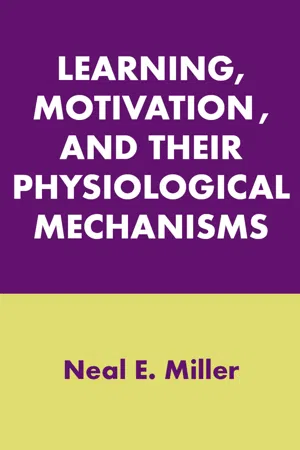
Learning, Motivation, and Their Physiological Mechanisms
About this book
Neal E. Miller's pioneering work in experimental psychology has earned him worldwide respect. This second in a two-volume collection of his work brings together forty-three of Miller's most important and representative essays on learning, motivation, and their physiological mechanisms. They were selected on the basis of their current relevance and their historical significance at the time they were published. In order to emphasize the main themes, essays on a given topic have been grouped together.Learning, Motivation, and Their Physiological Mechanisms begins when the author first discovered the thrill of designing and executing experiments to get clear-cut answers concerning the behavior of children and of rats. The first study was one of the earliest ones on the behavioral effects of the recently synthesized male hormone, testosterone. The second was one of the earliest studies demonstrating the value of using a variety of behavioral techniques to investigate the motivational effects of a physiological intervention. The next studies investigated the satisfying and rewarding effects of food or water in the stomach versus in the mouth and the thirst-inducing and reducing effects of hyper- and hypotonic solutions, respectively, injected into the brain. The last study describes a technique devised for extending the analysis of the mechanism of hunger to the effects of humoral factors in the blood.The study is completed with an examination of trial-and-error learning that was motivated by direct electrical stimulation of the brain and rewarded by the termination of such stimulation. Other studies show that the stimulation via such electrodes not only elicits eating, but also has the principal motivational characteristics of normal hunger. The conclusion deals with a series of experiments that overthrows strong traditional beliefs by proving that glandular and visceral responses mediated by the autonomic nervous system are subject to instrumental learning, which can be
Information
Index
- Aaronson, I., 78 n.
- Acetylcholine, 681-686
- Achievement, motivation for, 344-345
- Activity drive, 344
- Adair, E., 511 n.
- Adlerstein, A., 217-224
- Adolph, E. P., 553, 558, 559
- Adrenalin;
- See Epinephrine
- Adrenergic chemicals, defined, 681;
- See also Chemical coding of behavior in brain
- Adrian, E. D., 138, 168
- Agarie, N., 173 n.
- Aggression, failure to condition, 615-616
- Agitated behavior, 415-422, 430-432
- individual differences, 415-416
- frustration-induced, 412-433
- Ahlquist, R. P., 736
- Airapetjantz, E., 444, 445
- “Alarm” reaction, 563
- Alcohol, assumptions of effects of, 302-303;
- See also Drugs
- Allee, W. C., 159, 168
- Almond, G. A., 368
- Allport, G. W., 124, 167, 168
- Alpha vs. beta receptors, in hypothalamic hunger system, 721-726
- Amnesia, retrograde, 447-471
- artifacts in, 447-459
- different temporal gradients from CO2 and ECS, 465-471
- effects of different intensities of treatment, 465-471
- and retroactive interference, 460-463
- and stimulus change, 460-463
- See also Retrograde amnesia
- Amobarbital;
- See Barbiturates;
- Drugs
- Amphetamine, 686
- accentuates reward effects of brain stimulation, 615
- produces euphoria, 615
- reduction of freezing by, 244, 252
- See also Drugs
- Amylobarbitone sodium;
- See Barbiturates;
- Drugs
- Anand, B. K., 585, 593, 631, 641, 663, 666, 700
- Anderson, E. E., 83 n., 97, 157, 168, 202, 207, 215
- Anderson, Mrs. O., 385 n.
- Andersson, B. L., 225, 227, 228, 378, 558, 559, 561, 565, 606, 617, 679, 692, 700, 701, 715
- Anokhin, P. K., 436, 438, 445
- Anticipatory goal-response, 403-407;
- See also Goal-response, anticipatory
- Antidiuretic hormone, 689-690, 807-808, 840-845
- Ant...
Table of contents
- Cover Page
- Title Page
- Copyright Page
- Contents
- Part VII Learning
- Part VIII Physiological Basis of Motivation
- Part IX Motivating Effects of Electrical Stimulation of the Brain
- Part X Chemical Coding of Motivation in the Brain
- Part XI Instrumental Learning of Visceral Responses
- Bibliography of Work’by Neal E. Miller
- Index
Trusted by 375,005 students
Access to over 1.5 million titles for a fair monthly price.
Study more efficiently using our study tools.
Frequently asked questions
Yes, you can cancel anytime from the Subscription tab in your account settings on the Perlego website. Your subscription will stay active until the end of your current billing period. Learn how to cancel your subscription
No, books cannot be downloaded as external files, such as PDFs, for use outside of Perlego. However, you can download books within the Perlego app for offline reading on mobile or tablet. Learn how to download books offline
Perlego offers two plans: Essential and Complete
- Essential is ideal for learners and professionals who enjoy exploring a wide range of subjects. Access the Essential Library with 800,000+ trusted titles and best-sellers across business, personal growth, and the humanities. Includes unlimited reading time and Standard Read Aloud voice.
- Complete: Perfect for advanced learners and researchers needing full, unrestricted access. Unlock 1.5M+ books across hundreds of subjects, including academic and specialized titles. The Complete Plan also includes advanced features like Premium Read Aloud and Research Assistant.
We are an online textbook subscription service, where you can get access to an entire online library for less than the price of a single book per month. With over 1.5 million books across 990+ topics, we’ve got you covered! Learn about our mission
Look out for the read-aloud symbol on your next book to see if you can listen to it. The read-aloud tool reads text aloud for you, highlighting the text as it is being read. You can pause it, speed it up and slow it down. Learn more about Read Aloud
Yes! You can use the Perlego app on both iOS and Android devices to read anytime, anywhere — even offline. Perfect for commutes or when you’re on the go.
Please note we cannot support devices running on iOS 13 and Android 7 or earlier. Learn more about using the app
Please note we cannot support devices running on iOS 13 and Android 7 or earlier. Learn more about using the app
Yes, you can access Learning, Motivation, and Their Physiological Mechanisms by Neal E. Miller in PDF and/or ePUB format, as well as other popular books in Psychology & Cognitive Psychology & Cognition. We have over 1.5 million books available in our catalogue for you to explore.