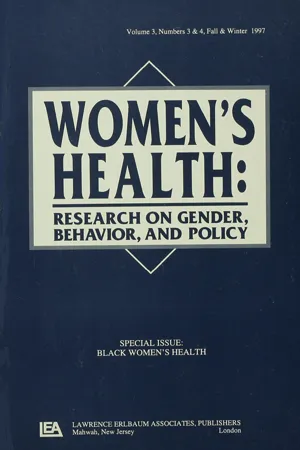
In this special issue, top researchers from a diversity of disciplines provide an overview of and insights into the major social, cultural, and structural variables that play a role in Black women's poor health, and differential morbidity and mortality. The articles focus on the major threats to Black women's health such as diabetes, obesity, cancer, violence, and AIDS, and utilize a wide range of qualitative and quantitative methods from medicine, psychology, sociology, and feminist analysis. Among the articles are:
* An examination of the role of Black women's cultural and ethnomedical beliefs in their use of cancer screening by Laurie Hoffman-Goetz and Sherry Mills of the National Cancer Institute;
* An empirical analysis of Black women's utilization of health services entailing more than 18,000 women by Lonnie Snowden and his colleagues at the University of California-Berkeley Center for Mental Health Services Research;
* A comprehensive review and empirical analysis of the role of violence in Black women's health by Nancy Felipe Russo (Arizona State University), Mary Koss (University of Arizona), and Gwen Keita (APA Office on Women);
* An empirical investigation of the role of social and contextual variables in HIV risk among low-income Black women by Kathleen Sikkema, Timothy Heckman, and Jeffrey Kelly of the Center for AIDS Intervention Research, Medical College of Wisconsin.
Other articles include comprehensive and critical analyses and reviews of diabetes, breast cancer risk perceptions, and obesity among Black women, as well as analyses of Black women's exclusion from research in medicine, women's health, health psychology, and behavioral medicine.
The first issue of any psychology journal to be devoted to the health of Black women, this special issue is a step in the direction of redressing the long-overdue neglect of Black women's health. It provides a cogent overview of the state of Black women's health, numerous empirical investigations, and clear suggestions for future research.
eBook - ePub
Black Women's Health
A Special Double Issue of women's Health: Research on Gender, Behavior, and Policy
- 232 pages
- English
- ePUB (mobile friendly)
- Available on iOS & Android
eBook - ePub
Black Women's Health
A Special Double Issue of women's Health: Research on Gender, Behavior, and Policy
About this book
Information
Publisher
Psychology PressYear
2014Print ISBN
9780805898552
9781138431249
Edition
1eBook ISBN
9781135065041
Intimate Violence and Black Women’s Health
Department of Psychology Arizona State University
American Psychological Association, Washington, DC
University of Arizona
After reviewing the literature on health effects of intimate violence, we report secondary analyses of responses of 439 black women who participated in the Commonwealth Fund’s national survey on women’s health. Lower income women were more likely to experience partner violence but not childhood abuse; and income group was related to self-esteem, depressive symptoms, and perceived health status. Childhood physical and sexual abuse and partner violence were intercorrelated; both abuse history and partner violence were related to greater risk for depressive symptoms, lower life satisfaction, and lower perceived health care quality. Partner violence was also related to lower self-esteem and perceived health status. Sexually abused women had more difficulties in interpersonal relationships, including lower perceived health care quality even with self-esteem and depressive symptoms controlled. Implications for prevention, training, and future research as well as methodological issues in research on violence against black women are discussed.
Key words: black, battering, abuse, health care perceptions, mental health, sexual abuse, victimization
Intimate violence—including physical and sexual abuse in childhood, rape, and battering—is a pervasive threat to black1 women’s health. Although statistics depend on definitions used, it is clear that such violence is a daily fact of life for women in the United States, regardless of race or ethnicity (for reviews of this literature, see Crowell & Burgess, 1996; Gelles & Straus, 1989; Koss et al., 1994; Tjaden & Thoenees, 1997).
We focus here on health-related effects of physical and sexual abuse in childhood, particularly sexual abuse, and violence from a male partner. These are the prevalent forms of intimate violence in black women’s lives. Black women report high rates of childhood sexual abuse, rates similar to their white peers. For example, in one of the most thorough studies, based on a community sample, 40% of black women reported coercive contact of a sexual nature before age 18 (Wyatt, 1985). Black women also report high rates of partner violence. Estimates from the Second National Family Violence Survey suggest that at a rate of 174 per 1,000 couples, 603,000 black women experience partner violence each year, and 244,000 experience severe violence. Rates of severe partner violence for low income black women are particularly high—144 per 1,000, compared to 58 per 1,000 for higher income black women (Hamptom & Gelles, 1994). The finding that partner violence experienced by poor women is more likely to be severe and life threatening than that experienced by higher income women has been reported by others as well (Belle, 1990; Neff, Holamon, & Schluter, 1995; Steele et al., 1982).
Socioeconomic status has wide-ranging health effects that go beyond those associated with increased risk for intimate violence (Adler, 1997; Adler et al., 1994; Adler & Coriell, 1997). Lack of economic resources is associated with a variety of stressful living conditions and events that take their own toll on physical and mental health and on well-being, as well as reflect and cause disruption in interpersonal relationships (Belle, 1990; Lyons, Salganicoff, & Rowland, 1996; Russo & Zierk, 1992). In addition, access to economic resources can mitigate the effects of physical and sexual abuse and violence against women to some extent (e.g., Burgess & Holmstrom, 1978). For one thing, economic resources can be translated into other coping resources, including increased access to quality health care. The combination of higher exposure to stressful life events and lack of access to resources to deal with those events is expected to have direct health-related effects as well as to compound the negative effects of intimate violence. In other words, stress and powerlessness are expected to be a deadly combination (Guttentag, Salasin, & Belle, 1980).
After providing a more general summary of the literature on the health effects of intimate violence, we present data on the health-related effects of childhood abuse and partner violence for lower income as compared to higher income black women. We conclude with a discussion of the implications of the research findings for health prevention and intervention programs, training, and research, with special consideration of methodological issues in survey research on violence against black women.
HEALTH-RELATED EFFECTS OF VIOLENCE
Over the past decade, a substantial literature has begun to document links between intimate violence and a host of negative health outcomes that extend beyond immediate effects of death and direct injury (Abbott, Johnson, Koziol-McLain, & Lowenstein, 1995; Astin, Lawrence, Ogland-Hand, & Foy, 1993; Beitchman et al., 1992; Cascardi, Langhinrichsen, & Vivian, 1992; Goodman, Koss, & Russo, 1993a, 1993b; Koss et al., 1994; Koss & Heslet, 1992; Mitchell & Hobson, 1983; Shepard & Pence, 1988). This research, which is sometimes based on samples that include black women, suggests that intimate violence has a wide-ranging and long-lasting impact on physical and mental health, with profound implications for our health care system (Abbott et al., 1995; Bergman, Brismal, & Nordin, 1992; Eby, Campbell, Sullivan, & Davidson, 1995; Ingram, Corning, & Schmidt, 1996; Laws & Golding, 1996). In fact, severely victimized women not only report more distress and lower well-being, they make physician visits twice as frequently and incur outpatient costs that are more than double those of nonvictims. Further, this higher health care usage does not predate victimization (Koss, Koss, & Woodruff, 1991).
Childhood Abuse and Rape
Although survivors of intimate violence are remarkably healthy considering their experiences, potential long-term consequences of childhood sexual abuse include anxiety, anger, eating disorders, depression, dissociation, impairment of self-concept, interpersonal problems, obsessions and compulsions, posttraumatic stress responses, revictimization, self-mutilation, precocious sexual experience (including earlier onset of masturbation and sexual intercourse), sexual problems, somatization, substance abuse, and suicidality (Beitchman et al., 1992; Briere & Runtz, 1987; Brown & Anderson, 1991; Golding, 1996; Golding & Taylor, 1996; Green, 1993; Laws & Golding, 1996; Moeller, Bachman, & Moeller, 1993; Neumann, Houskamp, Pollock, & Briere, 1996; Stein, Golding, Siegel, Burnam, & Sorenson, 1988; Wilsnack, Klassen, & Vogeltanz, 1994). Higher rates of childhood sexual abuse are found for women seeking treatment for substance abuse problems as compared to women who are in the general population or who are receiving other mental health services (Gutierres, Russo, & Urbanski, 1994; Miller & Downs, 1993; Miller, Downs, Gondoli, & Keil, 1987; Rohsenow, Corbett, & Devine, 1988). This finding persists even after demographic characteristics and parental alcohol problems are controlled (Miller, Downs, & Testa, 1993).
In addition to direct physical and psychological trauma, the experience of victimization can affect health through indirect pathways. Childhood sexual abuse in particular has been linked to high-risk sexual behaviors, which are of particular concern for black women given the spread of AIDS in ethnic minority communities (Cunningham, Stiffman, & Dore, 1994; Koss, Heise, & Russo, 1994). Abused girls have been found to be less likely to use birth control at first intercourse, and more likely to have sex earlier, use alcohol and drugs, be battered, and have traded sex for food, money, shelter, or drugs (Berenson, San Miguel, & Wilkinson, 1992; Boyer & Fine, 1992; Finkelhor, 1987; Meyerding, 1977; Nagy, Adcock, & Nagy, 1994; Nelson, Higginson, & Grant-Worley, 1995; Paone, Chavkin, Willets, Friedman, & Des Jarlais, 1992). Sexual abuse has been linked to teenage pregnancy and motherhood (Wyatt, Guthrie, & Notgrass, 1992) and negligent parenting (Ethier, Lacharite, & Coutoure, 1995). Women experiencing sexual assault in childhood have been found to be three times more likely to become pregnant before age 18 as compared to nonvictimized women (Zierler et al., 1991).
In one of the few studies examining the effects of child sexual abuse among African American women, Wyatt (1990) found African American and Caucasian American women in a community sample to be similar with regard to initial response and short-term effects of the experience, with both groups showing lasting sexual problems. Although this study did not examine a wide range of outcomes, the similarity in responses on the measures used suggests that the range of negative health outcomes of child sexual abuse identified in the literature at large indeed apply to black women.
Research has also identified multiple physical and mental health consequences of rape, and these too can be long-lasting. More than one third of rape victims report sustaining serious physical injury, and more than one half seek medical treatment (Beebe, 1991). In addition to sexually transmitted diseases, gastrointestinal disorders, headaches, and psychogenic seizures, rape victims are more likely to experience chronic pelvic pain and premenstrual symptoms (Golding, 1996; Golding & Taylor, 1996; Koss & Heslet, 1992). Common presenting symptoms of rape victims include anxiety, depression, substance abuse, chronic headaches, abdominal pain, joint and muscle pain, disorders of sleeping and eating, sexual dysfunction, and recurrent vaginal infections (Randall, 1990, 1991). Psychological sequelae of rape include higher risk for major depressive episode, substance abuse disorders, and anxiety disorder (see Crowell & Burgess, 1996; Goodman, Koss, & Russo, 1993a, 1993b). Research comparing the impact of sexual assault on black women and on white women suggests that the physical, psychological, and sexual effects of the experience are similar for both groups (Wyatt, 1992).
Partner Violence
Battering by an intimate partner is the single most common cause of injuries to women requiring medical intervention, accounting for more injuries than automobile accidents, muggings, and rapes combined. An estimated 1 million women each year seek medical assistance for injuries resulting from such battering (see Goodman, Koss, & Russo, 1993a). Injuries vary widely, and can include black eyes, cuts, bruises, concussions, bites, burns, bone fractures, damage to hearing and vision, and knife and bullet wounds (Browne, 1992; Goodman, Koss, & Russo, 1993a). Other health consequences include anxiety, depression, substance abuse, complaints of sexual dysfunction, recurrent vaginal infections, sleeping and eating disorders, and suicide attempts. Victims of violence are also more likely to suffer pain in the form of chronic headaches as well as abdominal, joint, and muscle pain (see Koss & Heslet, 1992; Stark & Flitcraft, 1996).
The idea that psychological and behavioral outcomes are consequences and not simply correlates of battering was explored in a study that compared medical profiles of battered and nonbattered women before and after their first reported episode of injury. Battered and nonbattered women were similar on all factors before their first reported episode of injury except for alcohol abuse, which was found to be higher among battered women. After the first episode, however, battered women were more likely to experience psychosocial problems, alcohol abuse, drug abuse, psychiatric disorders, and suicide attempts, and to use mental health services (Stark & Flitcraft, 1996). These findings suggest a causal role of battering in battered women’s higher risk for depression, drug abuse, and other psychological problems.
In 1985, the Surgeon General of the United States recommended that routine prenatal assessments include evaluation for battering (Koop, 1985). There is good reason for this recommendation: Women are at highest risk for battering in their childbearing years, and pregnant women are more likely to experience violence than other women (Gelles, 1988). Women who have a history of being beaten by their husbands are three times more likely to sustain injuries during pregnancy than women who are not battered (Helton, McFarlane, & Anderson, 1987; Hillard, 1985; Stark & Flitcraft, 1988). Women battered during pregnancy are more likely to have miscarriages and stillbirths and deliver low-birthweight infants (Bullock & McFarlane, 1989; Helton et al., 1987; McFarlane, 1989; McFarlane, Parker, Soeken, & Bullock, 1992; Satin, Hemsell, Stone, Theriot, & Wendel, 1991). Other negative health outcomes include rupture of membranes; placental separation; premature labor; antepartum hemorrhage; fetal fractures; and rupture of the uterus, liver, or spleen (Saltzman, 1990). Likelihood of violence during pregnancy is higher for women who are of lower socioeconomic status, have a history of depression, use alcohol and drugs, receive less emotional support from others for the pregnancy, and are involved with partners who use illicit drugs (Amaro, Fried, Cabral, & Zuckerman, 1990). When other factors are controlled, ethnicity does not appear to predict level of violence during pregnancy. History is the most important predictor: Women with histories of partner violence are three times more likely to sustain injuries during pregnancy than other women (Helton et al., 1987; Hillard, 1985; Stark & Flitcraft, 1988). Although we were not able to explore these effects in our study, no review of the partner violence literature would be complete without mentioning them.
Partner violence is associated with high-risk health behaviors, including risky sexual behavior (Koss et al., 1991; Nelson et al., 1995). Rates of violence are higher among women whose pregnancies are unwanted or mistimed (i.e., unintended pregnancies), regardless of race. One study found that among women who reported that their husband or partner had “physically hurt” them during the 12 months before delivery, 70% also reported their pregnancy was unintended. Among black women, the proportion of women experiencing physical violence during an unwanted pregnancy, 11.7%, was twice that of black women who experienced violence during an intended pregnancy,...
Table of contents
- Cover
- Table of Contents
- Introduction: The State of Research on Black Women in Health Psychology and Behavioral Medicine
- Cultural Barriers to Cancer Screening Among African American Women: A Critical Review of the Qualitative Literature
- Cancer Screening Behaviors of Low-Income Women: The Impact of Race
- Importance of Psychological Variables in Understanding Risk Perceptions and Breast Cancer Screening of African American Women
- Obesity Among African American Women: Prevalence, Consequences, Causes, and Developing Research
- Diabetes in African American Women: The Silent Epidemic
- Health-Care-Related Attitudes and Utilization Among African American Women
- Intimate Violence and Black Women’s Health
- HIV Risk Behaviors Among Inner-City African American Women
- Conclusions: The Future of Research on Black Women’s Health
- Author Index
- Subject Index
- Editorial Acknowledgment of Ad Hoc Reviewers
Trusted by 375,005 students
Access to over 1.5 million titles for a fair monthly price.
Study more efficiently using our study tools.
Frequently asked questions
Yes, you can cancel anytime from the Subscription tab in your account settings on the Perlego website. Your subscription will stay active until the end of your current billing period. Learn how to cancel your subscription
No, books cannot be downloaded as external files, such as PDFs, for use outside of Perlego. However, you can download books within the Perlego app for offline reading on mobile or tablet. Learn how to download books offline
We are an online textbook subscription service, where you can get access to an entire online library for less than the price of a single book per month. With over 1.5 million books across 990+ topics, we’ve got you covered! Learn about our mission
Look out for the read-aloud symbol on your next book to see if you can listen to it. The read-aloud tool reads text aloud for you, highlighting the text as it is being read. You can pause it, speed it up and slow it down. Learn more about Read Aloud
Yes! You can use the Perlego app on both iOS and Android devices to read anytime, anywhere — even offline. Perfect for commutes or when you’re on the go.
Please note we cannot support devices running on iOS 13 and Android 7 or earlier. Learn more about using the app
Please note we cannot support devices running on iOS 13 and Android 7 or earlier. Learn more about using the app
Yes, you can access Black Women's Health by Hope Landrine,Elizabeth A. Klonoff in PDF and/or ePUB format, as well as other popular books in Psychology & History & Theory in Psychology. We have over 1.5 million books available in our catalogue for you to explore.