The clinical interview is an indispensable first step in a comprehensive general medical evaluation. In psychiatry and clinical psychology, it is too frequently the only step in the evaluation.
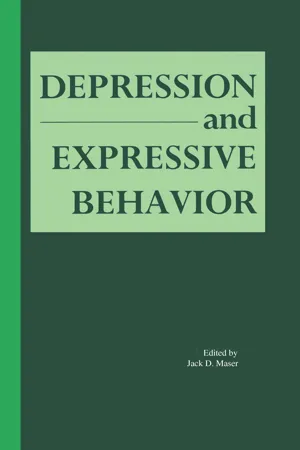
Based on papers presented at an National Institute of Mental Health sponsored workshop, this volume specifically addresses the question of whether the clinical phenomenology necessary for diagnosis of mental disorders can be assessed in ways more objective and accurate than routine clinical observation.
- 128 pages
- English
- ePUB (mobile friendly)
- Available on iOS & Android
eBook - ePub
Depression and Expressive Behavior
About this book
Information
1 | BEHAVIORAL ASSESSMENT IN DEPRESSION |
INTRODUCTION
It is curious that one of the more neglected research areas in psychiatry is the study of behavior. This neglect is all the more noteworthy because the most immediate and salient reason for psychiatric evaluation is an overt change in behavior observed by family, friends, and coworkers. A patient may be described as hostile, withdrawn, confused, “slowed down,” or unresponsive; yet the exact facial, vocal, or bodily signs on which these characterizations are based are unspecified. While many clinicians might be satisfied with such an intuitive approach, we argue that behavioral assessment may aid both clinical decisionmaking and clinical research by improving diagnostic precision, estimating a patient’s strengths as well as weaknesses, predicting relapse, and providing a baseline for behavioral change in general and outcome of treatment in particular.
As used here, the term behavioral assessment refers to a broad spectrum of measures that assess directly three domains of behavior: psychophysiological, verbal/cognitive, and motoric.1 Thought of in this way, behavior is a broad reflection of central nervous system function, and if one assumes that mental disorder involves organic or functional impairment of neural mechanisms, it follows that direct evaluation of behavior should be employed in the diagnosis and treatment of psychiatric problems. Nonetheless, clinical interview procedures do not typically utilize any direct measures of nervous system function. Reports of the patient’s behavior, either by self-report or from significant others, may be filtered through screens of imprecise or distorted recollection, censorship, hidden motives, and other protective strategies that obscure clinicians’ perceptions. Measurement of actual behavior in carefully controlled situations is less liable to management, deceit, or censorship by the patient and, hence, should afford a more objective picture of the patient’s condition and progress.
The approach taken here is limited to the depressive disorders because the authors of the following chapters have begun to apply their techniques to those syndromes. However, affective changes pervade many types of psychopathology and are not limited to depression. For example, Alpert (1982) studied schizophrenics with flat and nonflat affect, as reflected in oscillographic recordings of their speech.
The methods to be described focus on more precise measurement of facial expression, gross body movement, vocalization, and speech pacing. Normative data in these areas are increasingly available, and we encourage clinical researchers to broaden the scope to psychopathological samples, particularly depressed individuals. Furthermore, the technology required to record and analyze facial expression, speech and vocalization, and body movement will soon require only the ownership of a personal computer. What follows is a brief summary of recent trends in assessment, some clinical situations in which behavioral assessments might prove useful, a discussion of depression, and some diagnostic issues that we believe behavioral assessment may help clarify.
TRENDS IN ASSESSMENT
Standardized Clinical Interviews
When a patient meets the clinician, it is usually in the context of a clinical interview. The clinician notes the patient’s motor behavior, tone of voice, and facial demeanor to determine the diagnosis. The ability to sense and detect behavioral cues, weigh them on the balance of prior clinical training and experience, and place them in context with other diagnostic information is the art of the clinician. Only crude estimates of actual behavior, for example, the mental status examination, are part of the standard diagnostic interview.
In response to the need for increased diagnostic precision, the field of psychiatry has developed a series of new diagnostic schema and interview schedules that probe for critical signs and symptoms thought to discriminate between disorders. The Schedule for Affective Disorders and Schizophrenia (SADS), (Endicott & Spitzer, 1978) is a standardized interview that collects the necessary information allowing a clinician to make a reliable diagnosis. The SADS has several forms, making it useful for differential diagnosis and change of diagnosis over time. It is also possible to extract from the SADS, Hamilton Depression Rating Scale scores for both the past week and “worst during episode” (Endicott & Nee, 1981).
The SADS, Research Diagnostic Criteria (RDC), (Spitzer, Endicott, & Robins, 1977), and currently DSM-III (Diagnostic and Statistical Manual, 3rd Revision, American Psychiatric Association, 1980), represent continuing efforts to improve the differential diagnosis of the psychiatric disorders.
The RDC described by Spitzer et al. (1977, 1978) categorized more than a dozen forms of depression. Many of these may be seen in Table 1.1, which presents in outline form many of the major categories, subcategories, and brief definitions. Table 1.2 describes the specific diagnostic criteria for Major Depressive Disorder (MDD).
The DSM-III is, at this writing, in the process of being revised (DSM-III-R). The criteria used in both the third edition and in the revised third edition are clearly derived from the RDC, but in no case are there referents to the range of normal behavior. The clinician must rely on training and personal experience in judging whether or not a patient meets a given criterion.
There is no reason that even more precise and quantitative measures of crucial dimensions of behavior cannot be developed and used by clinical investigators. Quantifiable methods for testing various aspects of memory function, motoric behavior, paralinguistics of speech, nonverbal interactive behaviors, and role performances are well developed and could be implemented in psychiatric research and practice with minor adaptations.
Rating Scales
Another means of assessing depression relies on rating scales and self-report measures. Sartorius and Ban (1986) have recently brought together descriptions of the most frequently used instruments in the United States, Eastern and Western Europe, Africa, and England. While many symptoms are rated for their presence and severity, none are measured directly. For example, the 90-item Hopkins Symptom Checklist asks how much the patient is bothered by:
1. avoiding certain things, places, or activities because they are frightening
2. sleep that is restless or disturbed
3. temper outbursts
4. having to do things very slowly to ensure correctness.
The patient then circles the degree to which he or she is bothered by the item. The examples given here (avoidance, sleep, outbursts of temper, and speed of movement) are behaviors that can be measured directly. Thoughts and emotions are more indirect and hence difficult to assess, but some believe that direct assessment even of these is becoming more realistic.
TABLE 1.1
Research Diagnostic Criteria (RDC) for the Affective Disorders
Research Diagnostic Criteria (RDC) for the Affective Disorders
| Category | Definition | |
A. Depressive Syndrome Superimposed on Residual Schizophrenia | Designed for those patients who meet the criteria for residual schizophrenia and have a superimposed depressive syndrome without any activation of the schizophrenic features. (Frequently designated as a subtype of “Secondary Affective Disorder” or a form of Schizoaffective Disorder.) | |
B. Manic Disorder | Characterized by predominantly elevated, expansive, or irritable mood, but not schizophrenia. | |
C. Hypomania | Describes nonpsychotic manic-like episodes that do not meet the criteria for Manic Disorder. | |
D. Bipolar Depression with Mania (Bipolar I) | Subject must meet the criteria for mania and a depressive disorder (major, minor or intermittent). | |
E. Bipolar Depression Hypomania (Bipolar II) | Designed for patients who have met the criteria for both hypomanic disorder and a depressive disorder, but have never met the criteria for Manic Disorder. | |
F. Major Depressive Disorder (MDD) | See Table 1.2 | |
F1. Primary-Secondary MDD | Primary: A period of MDD that was not preceded by any of the specific list of nonaffective disorders. | |
Secondary: A period of MDD that was preceded by one of the nonaffective disorders. | ||
F2. Simple MDD | A depressive episode that develops in someone who has shown no significant signs of psychiatric illness in the year preceding this episode, with the exception of major or minor depressive disorder or manic or hypomanic disorder. | |
F3. Recurrent Unipolar Depressive Disorder | Two or more episodes of MDD without a manic, hypomanic, or schizoaffective disorder, manic type. | |
F4. Psychotic, Incapacitating, and Endogenous MDD | The term “psychotic” is used when the patient reports delusions or hallucinations and shows signs of stupor. | |
The judgment of severe impairment in functioning defines the subcategory of “incapacitating MDD.” The term “endogenous” (or endogenomorphic) is reserved for patients showing the constellation of vegetative symptoms regardless of the presence or absence of precipitating events. | ||
F5. Situational MDD | An MDD develops after an event or a situation that probably contributed to the appearance of the episode at the time. The clinician must consider the amount of stress, the proximity of the events to the illness, and the cumulative effects of the stress. | |
F6. Agitated and Retarded MDD | Patients who show a disturbance in psychomotor functioning for several days during a MDD episode. | |
F7. Predominant Mood | Characterized as mainly depressed; mainly depressed interspersed with periods of euphoric mood, mainly anxious, anxious and depressed without either predominating, mainly hostile, mainly apathetic or loss of interest or pleasure, and other mood. | |
G. Depressive Disorders Not Meeting the Full Criteria for MDD. (There are 12 subcategories; 4 are provided here.) | These are people who are bothered more than most people by depressive mood and associated symptoms, but who fail to meet criteria for MDD. | |
G1. Minor Depressive Disorder | Nonpsychotic episodes of illness in which the most prominant disturbance is a relatively sustained mood of depression without the full depressive syndrome. It may be chronic or episodic. | |
G2. Intermittent Depressive Disorder | For at least 2 years these patients have been bothered by depressed mood much of the time; period... |
Table of contents
- Cover
- Halftitle
- Title
- Copyright
- Contents
- List of Contributors
- Preface
- 1 Behavioral Assessment in Depression
- 2 Body Movements as Diagnostic Cues in Affective Disorders
- 3 Assessment of Facial Behavior in Affective Disorders
- 4 Vocal Assessment of Affective Disorders
- 5 The Pacing of Speech in Depression
- Author Index
- Subject Index
Trusted by 375,005 students
Access to over 1.5 million titles for a fair monthly price.
Study more efficiently using our study tools.
Frequently asked questions
Yes, you can cancel anytime from the Subscription tab in your account settings on the Perlego website. Your subscription will stay active until the end of your current billing period. Learn how to cancel your subscription
No, books cannot be downloaded as external files, such as PDFs, for use outside of Perlego. However, you can download books within the Perlego app for offline reading on mobile or tablet. Learn how to download books offline
Perlego offers two plans: Essential and Complete
- Essential is ideal for learners and professionals who enjoy exploring a wide range of subjects. Access the Essential Library with 800,000+ trusted titles and best-sellers across business, personal growth, and the humanities. Includes unlimited reading time and Standard Read Aloud voice.
- Complete: Perfect for advanced learners and researchers needing full, unrestricted access. Unlock 1.5M+ books across hundreds of subjects, including academic and specialized titles. The Complete Plan also includes advanced features like Premium Read Aloud and Research Assistant.
We are an online textbook subscription service, where you can get access to an entire online library for less than the price of a single book per month. With over 1.5 million books across 990+ topics, we’ve got you covered! Learn about our mission
Look out for the read-aloud symbol on your next book to see if you can listen to it. The read-aloud tool reads text aloud for you, highlighting the text as it is being read. You can pause it, speed it up and slow it down. Learn more about Read Aloud
Yes! You can use the Perlego app on both iOS and Android devices to read anytime, anywhere — even offline. Perfect for commutes or when you’re on the go.
Please note we cannot support devices running on iOS 13 and Android 7 or earlier. Learn more about using the app
Please note we cannot support devices running on iOS 13 and Android 7 or earlier. Learn more about using the app
Yes, you can access Depression and Expressive Behavior by Jack D. Maser in PDF and/or ePUB format, as well as other popular books in Psychology & Clinical Psychology. We have over 1.5 million books available in our catalogue for you to explore.