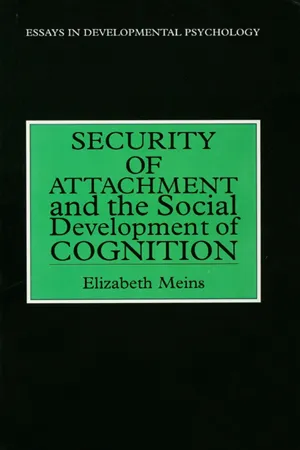
Security of Attachment and the Social Development of Cognition investigates how children's security of attachment in infancy is related to various aspects of their cognitive development over the preschool years. The book thus constitutes an ambitious attempt to build bridges between the domains of social and cognitive development, and as such addresses issues which are of increasing interest to developmental psychologists. In the first two chapters, Meins outlines Bowlby's attachment theory and the research which it has inspired, and develops the theme of a secure attachment relationship providing children with a sense of themselves as effective agents in their interactions with the world (self-efficacy).
The next five chapters describe a longitudinal study of a sample of children whose security of attachment was assessed in infancy. Security-related differences are reported in the areas of object/person permanence, language acquisition, symbolic play, maternal tutoring and theory of mind, but no differences were found in general cognitive ability. Meins argues that the wide-ranging advantages enjoyed by the securely attached children are best explained in terms of their greater self-efficacy and social flexibility, nurtured by a particular kind of early infant-mother interaction.
This book's major contribution is in its approach to explaining why securely attached children may be more self-effective and flexible in social interactions. Meins attempts to account for these differences within a Vygotskian framework, focusing on the secure dyad's greater ability to function within the zone of proximal development. She suggests that a mother's mind-mindedness (the propensity to treat one's infant as an individual with a mind) is an important factor in determining her ability to interact sensitively with her child. In the final chapter, Meins considers how the Vygotskian approach can complement and extend existing theories of attachment, and suggests some ways in which future research might address outstanding questions in this rapidly advancing field.
- 177 pages
- English
- ePUB (mobile friendly)
- Available on iOS & Android
eBook - ePub
Security of Attachment and the Social Development of Cognition
About this book
Information
Publisher
Psychology PressYear
2013Print ISBN
9781138877115
9780863774683
Edition
1eBook ISBN
9781134836574
Chapter One
The Origins of Bowlby’s Attachment Theory
Throughout this enquiry my frame of reference has been that of psychoanalysis … Because some of my ideas are alien to the theoretical traditions that have become established, and so have met with strong criticism, I have been at pains to show that most of them are by no means alien to what Freud himself thought and wrote. On the contrary … a great number of the central concepts of my schema are to be found plainly stated by Freud. (Bowlby, 1969, p.xv)
A mother and her child are in an unfamiliar room together. The child is about a year old and plays with some toys on the floor as the mother reads a magazine. An unfamiliar woman enters and starts to chat to the mother and then tries to play with the child. After a short time, the mother gets up and leaves her child alone with this stranger. What will the child do now? What should the child do now? If the mother returns to the room after a few minutes how will the child respond? The search for answers to these questions forms the basis of modern research into the child’s attachment to the mother (or primary caregiver)1. Children’s responses to being separated from and reunited with their mothers in such “strange situations” (Ainsworth & Wittig, 1969) enable us to establish the quality or security of the infant-mother attachment relationship.
Without knowing anything about attachment theory, or developmental psychology in general, it is possible to imagine what might happen in the above scenario. Indeed, even if a person had never encountered an infant in real life, the chances are that he or she would soon offer suggestions as to what an infant would do if left alone with an unfamiliar woman. It is easy to conceive of infants doing a whole host of things in this situation: they might cry, throw a tantrum or become anxious, attempt to follow the mother out of the door or carry on as if nothing had happened, playing contentedly with the stranger. In observing infants in naturalistic settings and in this laboratory-based strange situation, researchers have witnessed all of these reactions; but taken in isolation, the infant’s reactions to such a separation tell us remarkably little. The crucial issue for attachment research is how children react on being reunited with their mothers.
If we continue to rely on our intuition to predict the infant’s behaviour on reunion, the gap between intuition and reality widens. The mother figure is generally regarded to be the nurturing, caring person in a child’s life; children should therefore respond positively when their mothers return. However, when we observe real life reactions to this reunion, the answer is by no means this simple. Consider children who cry when their mothers leave the room: some of them will be consoled immediately by the mother’s presence, others will need to be picked up and hugged before they can be comforted; but some children will cry more angrily when their mothers return and, when they are picked up to be comforted, may even strike out and stiffen or squirm in their mothers’ arms. Children who attempt to follow their mothers may also react in a number of ways on reunion: they may show a desire for physical contact and closeness by approaching her or clambering onto her knee; alternatively, they may be content with merely greeting her and continuing to interact with her at a distance. Even children who seem oblivious to their mothers’ leaving may surprise us in their reactions on being reunited. Some will carry on playing in much the same way, paying as little attention to the mother’s return as they did to her exit, but others will immediately approach and want to be picked up.
It would seem, then, that there is nothing predictable about the behaviour of children in response to separation from and reunion with their mothers, but patterns in children’s reactions under such circumstances can be identified. Four discrete types of infant-caregiver attachment have been defined, and I shall consider these patterns of attachment behaviour (Ainsworth, Blehar, Waters, & Wall, 1978) in more detail in the next chapter. In the mean time, the following criteria will serve to identify the four attachment groups. Those children who respond positively to their mothers on reunion—greeting, approaching, making or accepting contact with, or being comforted by her—regardless of how they reacted on separation, are described as being securely attached. Those children who do not seek contact or avoid their mother’s gaze or physical touch are described as insecure-avoidant, whilst those who cannot be comforted and are overly passive or show anger towards their mothers are classified as insecure-resistant. Finally, children who seem to be totally disorganised and confused by the mother’s return are described as insecure-disorganised (Main & Solomon, 1986). It is on the basis of these indices of response, observed both in the home and the research laboratory, that the concepts of the securely and insecurely attached child have evolved (Ainsworth et al., 1978). Subsequently, the notion of security of attachment has greatly enriched the field of developmental psychology, since it allows us to consider the wide spectrum of behaviours which may stem from the child’s first social relationships.
The studies which will be reported in this book focus on security of attachment as assessed by the strange situation procedure, and address the consequences and correlates of a secure attachment relationship within the cognitive and linguistic developmental domains. In this chapter, I will discuss the historical beginnings of attachment theory in the work of Bowlby, charting the evolution of his theory from ethological studies and Freud’s work on psychological trauma. In so doing, I wish to approach the field of attachment theory from a slightly different angle. Essentially, I will be considering security of attachment not in terms of how the child reacts to being separated from the mother (the traditional emphasis), but on how well-equipped the child is to cope with this separation. I shall also consider the possibility that the causes of such individual differences lie in the patterns of early dyadic interaction between infant and mother. In order to put these ideas into context, it is first necessary to consider the ideas of those who placed the child’s tie to the mother at the focal point of their work: Bowlby (1958, 1969) and Freud (e.g. 1931).
Bowlby’s Theory of Attachment
Regardless of whether researchers agree with his theoretical claims, John Bowlby’s theory of attachment (1958, 1969) represents the starting point for research into the relationship between infant and caregiver. The theoretical emphasis of his work thus underpins, to varying degrees, virtually all subsequent work on the infant-mother attachment relationship.
The original spur for Bowlby’s investigation of the tie between a mother and her child came from observations he made in his first job, working as a volunteer at a school for maladjusted children. The problems that he encountered in these children convinced him of the importance of balanced family relationships in the development of a psychologically healthy personality, and led to his decision to train as a child psychiatrist (Senn, 1977). In the 1940s, Bowlby embarked on a number of studies which investigated the adverse effects of maternal deprivation and institutional care on children’s psychological well being. This background made him an obvious choice for the World Health Organisation (WHO) when they sought to commission an investigation into the mental health of children made homeless or orphaned by the Second World War. Bowlby first published his findings in a report to the WHO in 1951, in which he detailed his views on the importance of maternal care for the child’s subsequent mental health. Bowlby’s first exposition of a theory of infant-mother attachment was not, however, published until 1958.
The term attachment may be interpreted in any of three ways: (1) the relationship or “bond” between infant and mother; (2) the types of behaviour displayed by the infant to indicate an attachment; and (3) the more abstract psychological tie that one can feel toward a nurturing figure. Bowlby (1958) was primarily concerned with the first two interpretations, citing ethological evidence to support his claims about how human infants use certain types of behaviour to elicit psychological as well as physical care from their mothers. These types of behaviour in turn cement the bond between the infant and mother. In the later version of his attachment theory (Bowlby, 1969), Bowlby became increasingly influenced by ethological perspectives, and his emphasis moved toward a more explicit explanation of the dynamics of attachment behaviour and the attachment relationship. Before moving on to a discussion of broader issues, it is therefore worthwhile to examine how Bowlby’s ideas developed over time.
Bowlby’s Original Attachment Theory (1958)
According to the original theory (Bowlby, 1958), infants demonstrate their attachments to their mothers with basic types of behaviour, such as sucking, clinging, following, crying and smiling. In this paper, Bowlby also discussed the range of psychoanalytic theories that were on offer to explain infant-mother relations. Essentially, there were four alternative theories purporting to explain the nature and origin of the infant-mother tie: (1) the theory of secondary drive (or “cupboard love”), which identified physiological needs for food and warmth as the reason for the child maintaining contact with the mother; (2) the theory of primary object sucking, which stated that infants have an innate propensity to relate first to the human breast, and then to the mother who is attached to the breast; (3) the theory of primary object clinging, according to which infants have an innate propensity for contact with a human being which is independent of their need for food; and (4) the theory of primary return to womb craving, which served to explain the infant’s tie to the mother in terms of resentment at having been taken from the womb.
Of these theories, Bowlby identified most strongly with the notion of innate propensities for relating to the human breast and for contact with a human being, leading him to propose that innate drives and instinctual responses lie behind the child’s desire to maintain contact with the mother. Bowlby’s interest in contemporary ethological research caused him to question the theories of secondary drive and primary return to womb craving. The former theory was rejected since it was based on the premise that only physiological needs are innate; accordingly, the child’s interest in and attachment to a mother figure were merely means to meet the need for food and warmth. In contrast, Bowlby argued that attachment behaviour stemmed from the primary instincts of sucking, clinging and following. His views were supported by evidence from comparative studies, which suggested that the “instinctual responses” identified by Bowlby were innate and independent of physiological needs. Harlow’s (1961; Harlow & Harlow, 1962) classic studies of rhesus monkeys, for example, showed that when infant monkeys were given a choice of surrogate mothers, they spent the majority of their time clinging to the surrogate which offered bodily comfort, rather than one which had a feeding bottle attached. Bodily comfort therefore appeared to be of greater importance than the provision of food in the establishment of the attachment relationship. Bowlby rejected the latter theory (the notion of a desire to return to the womb) as “both redundant and biologically improbable” (1958, p.351), since it appeared to have no plausibility in terms of ontogenetic or phylogenetic survival.
As well as using ethological evidence to criticise the psychoanalytic movement’s prevailing reliance on the theory of secondary drive, Bowlby cited observations of human infants to support his criticisms. He pointed out that time and again, analysts’clinical observations of infants did not tally with their reliance on the theory of secondary drive and the overriding importance of orality. For example, he cited Klein’s (1957) claim that “the whole of [the child’s] instinctual desires and his unconscious fantasies imbue the breast with qualities going far beyond the actual nourishment it affords” (p.5), and described Benedek (1956) as a “prisoner of orality theory” (Bowlby, 1958, p.357). Perhaps the most well-known example of such a lack of consistency is in Anna Freud’s writing. Freud and Dann (1951) reported how six children had become strongly attached to one another after having lived in a concentration camp. None of these children was old enough to take on the responsibility of providing for the others, since they were all aged between three and four years, suggesting that children can develop attachments to people who do nothing to satisfy their physiological needs. Despite these findings, and other observations she made with Burlingham (Burlingham & Freud, 1942), Freud continued to support the theory of secondary drive as an explanation of infant-mother attachment. But although Bowlby rejected traditional psychoanalytic theory, he did not move completely away from Sigmund Freud’s original ideas, arguing that, in contrast to later proponents of psychoanalysis, Freud himself was more open to alternative theories to explain the relationship between infant and mother. Specifically, Bowlby suggested that, at the time of his death, Freud was developing an alternative theory based on innate drives in the infant, and was therefore moving away from the theory of secondary drive.
As a final step to formulating his own theory of attachment, Bowlby considered the dynamic aspects of the infant-mother tie, again drawing on ethological data and criticising accepted psychoanalytical theory. Bowlby discussed how other species use sign-stimuli or “social releasers” to initiate social behaviour patterns such as courtship and parenting. Certain types of social behaviour are also terminated by sign-stimuli, which Bowlby suggested should be called “social suppressors”. A model of this sort, whereby instinctive responses are activated by social releasers and terminated by social suppressors, appears to be a considerable advance on the prevailing psychoanalytical explanation for such phenomena. According to psychoanalytical theory, instinctive responses resulted from an accumulation of psychic energy (Freud, 1894), and would cease when this energy had been used up. But when this theory is applied to an example in the real world, its shortcomings soon become apparent. Consider an example used by Bowlby: a child cries when left alone in a room, but this crying immediately ceases when the child’s mother returns. Using the psychic energy theory, one would have to propose that the child’s cries were due to a build-up in psychic energy which was then dissipated at the time of the mother’s reappearance. In contrast, we could explain the occurrence of crying as an instinctual response to regain contact with the mother, released by her exit and suppressed by her return. Compared with this account of the phenomenon, Bowlby argued that the psychoanalytical explanation was distinctly unsatisfactory.
Extending this theme, Bowlby discussed how the most common actions of the infant—smiling, gesturing to be picked up, following, crying, sucking, clinging—all serve to increase the mother’s involvement with her child and can therefore be regarded as social releasers. The mother figure thus has an important role to play in establishing the attachment relationship, since she must respond to her child’s cues, maintaining the dynamic system involved in the “social releaser—instinctive response—social suppressor” behaviour pattern. Bowlby summarised his theory as follows: “There matures in the early months of life of the human infant a complex and nicely balanced equipment of instinctual responses, the function of which is to ensure that he obtains parental care sufficient for his survival. To this end the equipment includes responses which promote his close proximity to a parent and responses which evoke parental activity” (ibid, p.346).
Despite the fact that Bowlby”s blend of ethology and psychoanalysis represented a major improvement on anything that had previously been written on the nature of the infant-mother tie, his theory still had its shortcomings. Perhaps the two most common criticisms of Bowlby’s early work were his concentration on a single attachment relationship between infant and mother, and his generalisation from clinical observations of children to “normal” children being reared at home. In the original theory, these two views are related to one another. Again using ethological data to back up his claims, Bowlby asserted that infants learn to centre their instinctual responses on their mother: “good mothering from any kind of woman ceases to satisfy [the infant]—only his own mother will do” (ibid, p.370). Bowlby termed this direction of instinctual responses exclusively towards the mother monotropy, and believed that the mother was responsible for facilitating the infant’s integration into the social world. Furthermore, Bowlby argued that the mother’s repeated rejection of such responses would lead to psychological damage in the child. Specifically, Bowlby said that infants incurred the worst damage if their mothers did not accept their infants’ clinging and following responses. He did, however, concede that his views contradicted those of other analysts and were based on “not very systematic clinical impressions” (ibid, p.370).
Bowlby’s Attachment Theory (1969)
These criticisms provide a clue to what is perhaps the most impressive quality of Bowlby’s work: his willingness to adapt his theory in response to research findings which either supported or refuted his ideas. Bowlby was aware of the shortcomings of the original attachment theory, and in his 1969 reworking of it, he discussed in detail the great body of research on infant-mother attachment which had come to light in the intervening years, as well as elaborating on the workings of attachment behaviours and systems. For example, Schaffer and Emerson (1964) reported that one fifth of children’s attachment figures did not participate even to a minor degree in any aspect of their physical care. These results thus refuted the secondary drive explanation of attachment, and confirmed Bowlby’s view that attachments were not formed because infants had learnt that such people would satisfy their physiological needs. Furthermore, the children in this study were not taken from any clinical population, suggesting that the results of the study by Freud and Dann (1951), which were mentioned above, were not merely due to the severe conditions of deprivation and trauma which these children had suffered. The fact that both Schaffer and Emerson (1964) and Ainsworth (1963, 1967) reported multiple attachment figures in samples of normal children did, however, go against Bowlby’s notion of monotropy, leading him to concede that psychologically healthy children could have more than one attachment figure.
In addition to adapting attachment theory in light of these research findings, the major addition to the later version of Bowlby’s attachment theory was a more complete exposition of the dynamics of attachment behaviour. In the first book of his trilogy, Attachment (1969), Separation (1973) and Loss (1980), Bowlby explained the child’s desire to remain close to the mother in terms of a goal-corrected system. According to this view, environmental cues played a vital role in controlling attachment behaviour, and innate responses were deemed to be of less importance.
In this later version of his theory, Bowlby once again discussed psychoana...
Table of contents
- Cover
- Half Title
- Title Page
- Copyright
- Dedication
- Contents
- Preface
- 1. The origins of Bowlby’s attachment theory
- 2. Security of attachment: Correlates and consequences
- 3. Security of attachment and early cognitive development
- 4. Is security of attachment related to the infant’s style of language acquisition?
- 5. Symbolic play and security: A meeting of minds?
- 6. Security of attachment and maternal sensitivity within a tutoring context
- 7. Security of attachment and the understanding of other minds
- 8. Implications and applications
- Appendix 1
- References
- Author index
- Subject index
Trusted by 375,005 students
Access to over 1.5 million titles for a fair monthly price.
Study more efficiently using our study tools.
Frequently asked questions
Yes, you can cancel anytime from the Subscription tab in your account settings on the Perlego website. Your subscription will stay active until the end of your current billing period. Learn how to cancel your subscription
No, books cannot be downloaded as external files, such as PDFs, for use outside of Perlego. However, you can download books within the Perlego app for offline reading on mobile or tablet. Learn how to download books offline
Perlego offers two plans: Essential and Complete
- Essential is ideal for learners and professionals who enjoy exploring a wide range of subjects. Access the Essential Library with 800,000+ trusted titles and best-sellers across business, personal growth, and the humanities. Includes unlimited reading time and Standard Read Aloud voice.
- Complete: Perfect for advanced learners and researchers needing full, unrestricted access. Unlock 1.5M+ books across hundreds of subjects, including academic and specialized titles. The Complete Plan also includes advanced features like Premium Read Aloud and Research Assistant.
We are an online textbook subscription service, where you can get access to an entire online library for less than the price of a single book per month. With over 1.5 million books across 990+ topics, we’ve got you covered! Learn about our mission
Look out for the read-aloud symbol on your next book to see if you can listen to it. The read-aloud tool reads text aloud for you, highlighting the text as it is being read. You can pause it, speed it up and slow it down. Learn more about Read Aloud
Yes! You can use the Perlego app on both iOS and Android devices to read anytime, anywhere — even offline. Perfect for commutes or when you’re on the go.
Please note we cannot support devices running on iOS 13 and Android 7 or earlier. Learn more about using the app
Please note we cannot support devices running on iOS 13 and Android 7 or earlier. Learn more about using the app
Yes, you can access Security of Attachment and the Social Development of Cognition by Elizabeth Meins in PDF and/or ePUB format, as well as other popular books in Psychology & Developmental Psychology. We have over 1.5 million books available in our catalogue for you to explore.