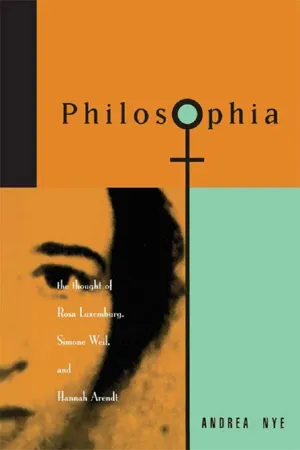
Philosophia brings together, for the first time, the work of three major women thinkers of this century, producing a developing commentary on the human condition as an alternative to the mainstream, masculine, philosophical tradition.
- 302 pages
- English
- ePUB (mobile friendly)
- Available on iOS & Android
eBook - ePub
About this book
Information
III
Hannah Arendt
“After her death, a sheet of paper was found in her typewriter, blank except for the following heading, Judging, and two epigraphs. Sometime between the Saturday of finishing Willing and the Thursday of her death, she must have sat down to confront the final section.”
Mary McCarthy in her Preface to Thinking, Volume I of Arendt’s unfinished trilogy, The Life of The Mind
3
Between Past and Future
The past and future Hannah Arendt found herself between did not inspire complacency. In the past was the nihilism of European culture and politics between the two world wars, the rise of Fascism, the failure of revolutionary Marxism, and finally, the Holocaust. The future looked equally grim, with the prospect of nuclear war, threatened destruction of the natural environment, and the numbing meaninglessness of life in industrialized, bureaucratized societies. In thought, Arendt never moved away from this painful present intersection between the horrors of the past and dangers of the future. In the late twentieth century, with no stable tradition or values intact, with the humanist ideals of the Enlightenment irrevocably compromised, she saw no nonillusory alternative. Her main business as a thinker, as she understood it, was to understand what has happened and what has been done, to learn to live with that knowledge, and to anticipate the future.
Arendt’s relations with traditional philosophy were ambivalent: she deprecated herself as only a political theorist and not a philosopher, at the same time as she was critical of philosophy’s pretensions to sovereign knowledge. She was a favored student of the famous Heidegger, but in a lengthy review of philosophical authorities in The Life of the Mind, she concluded that “professional” philosophical opinion on subjects like thinking and willing was unreliable. Nevertheless, in her attempt to understand past and future, Arendt asked fundamental questions about the nature of knowledge, truth, and reality. She did not come to these “philosophical” topics as a professional, but as someone who must attempt to make sense of the reality she experiences, and who, in the process, is forced to deeper and deeper levels of understanding. The result is that the ways she frames questions differ from traditional formulations. Because her questions and categories come out of problems in experience, she cuts across and through philosophers’ categories and formulations at a level deeper than many have been willing to work.
Western metaphysics has been occupied with the question: what is there in the world in the most general sense? This is traditionally interpreted as a question about what things there are in the world: Are there minds, bodies, atoms, eternal forms, sense data …? Arendt, as she tried to make sense of twentieth-century experience, did not think in terms of ontology but in terms of relations. The problem, as she understood it, is not to reconcile two different kinds of things, mind and body, as has been a major theme in modern philosophy, but to understand the reciprocal relations between a person’s inner space and her appearances to others in public. Similarly in social theory, her concern was not the proper allocation of those “things” which are rights and duties, but the relation between private spaces in which thought is possible and the public world in which we appear to others.
Western philosophers from the classical Greeks to Heidegger have been preoccupied with the prospect of death and mortality. The inevitability of natural change and destruction prompted Parmenides to the original philosophic search for eternal homogenous Being. Even for twentieth-century positivists who claimed to reject metaphysics, contingency and change were the enemy of philosophers as they directed the search for Being to abstract logical structures grounded in the incorrigible “sense data” of science. The theme to which Arendt returned again and again was not mortality, contingency, and death, but “natality.” The most striking thing about human life, she said, is not that we die but that we give birth, not only to children but also to new ways of acting, living, and thinking.
The history of Western philosophy has been intimately connected with the development of logic. Plato and Aristotle replaced ordinary human talk with “Logos,” conceptually ordered discourse and inferences from premises to conclusion. A primary theme in philosophy has been progress in logic: from the syllogism to medieval consequential to modern mathematical logic. Arendt understood logic, as she did everything else, in the context of human life. She focused on logic’s use, especially on its use in totalitarian ideology, where argument was more likely to represent lack of thought than understanding. Convinced that thoughtfulness is the only sure protection against evil, she argued not for training in logic or critical thinking, but for remembrance and stories, narrative forms of understanding which have had little standing in philosophy since Plato banished the poets from his ideal Republic.
Beginning from the standpoint of a rational, autonomous, thinking subject, Descartes mapped out necessary relations between mind and body and established the objectivity of knowledge. Realization of the fragility and disunity of Descartes’s subject has driven postmodern critics to reify its counterpart: objective symbolic structures, constructed or deconstructed, which are prior to individual subjects and which provide the framework within which subjects find an alienated identity. The seemingly unsolvable postmodern dilemma—between the illusory autonomy and freedom of a unitary subject and alienated institutional and symbolic structures no one creates or can control—does not arise for Arendt. She does not start from an essential, autonomous self-consciousness that is a human essence. For Arendt, no aspect of the human condition is essential. Nor does she understand language as symbolic structure. Instead, a relation to the earth conditions a variety of forms of human activity. A relation to others conditions different kinds of linguistic behavior. With Arendt there is no “subject” to be exposed and discredited, no structures in which subjects are constituted to be deconstructed. She returns to Weil’s questions: what is our relation to natural necessity? In making our primary end the mastering of that necessity, do we in fact institute in human life a necessity that should only be found in nature? What kind of spaces are necessary if harmonious human relations are to be maintained and are not to deteriorate into interested and selfish attempts by individuals and groups of individuals to gratify desires and cravings for power?
Philosophers have searched for the eternal, for truths that endure from generation to generation, truths that transcend the contingency of natural and human events. Universal philosophic truth has taken different forms: Plato’s rational vision of the form of the Good, Aristotle’s intuition of the essence in the particular, scholastic deductions from divine revelation, the forms of inductive reasoning in science, the dialectical process of the World spirit, the determinism of economic processes, functional laws that connect social phenomena, the necessity of grammatical structures grounded in the constitution of the human mind, even more recently the necessary ambiguity of any meaning that pretends to be based on a unitary presence. Arendt was never interested in giving such universal accounts of what reality or language must be, cannot help but be, has always been beneath whatever we thought it was. Her thinking begins from what actually happened, is happening, and might happen.
Spaces rather than forms, natality rather than mortality, narratives rather than logic, relations rather than the subject, the particular rather than the universal, understanding rather than refutation: these are the themes of Arendt’s thought about history, society, language. If no discipline has been completely willing to own Arendt—not philosophy, or political science, or sociology, or history—it may be because no “discipline” finds it easy to contain a thought which cuts so deeply into presuppositions that sustain its philosophical foundations. In another sense of philosophy, these anomalies—unacceptablity in any of the accepted frames of knowledge, ability to give new answers to old questions and to reframe new questions relevant to human experience, personal questioning at the deepest levels of accepted modes of reasoning, concern for the threatened survival of human life—qualify as a love of wisdom.
1. Self and World
Real Appearances
Anyone who has tried to take effective action knows how illusory one’s grasp on reality can be. Negotiation for pay raises can go on, while all the while, real power relations in a firm make it certain that a woman will not be promoted. A woman may extract a promise of childcare from her husband and find that his real identity depends upon a sense of himself as masculine that precludes housework. She may run for political office, but discover that the real policies of her party do not reflect her values. She deliberates on difficult questions even as the situation that confronts her shifts and changes: what people say is not what they think, what they think is not what they are, what is true one day is no longer true the next. The philosophers’s question: what is really and truly real?—is not an academic question for women trying to find footing from which to initiate lasting significant change.
The primal impulse in Western philosophy has been the search for a reality that neither dies nor is born. Especially this has been true in times of crisis, in times, as Arendt put it, of the great philosophical impulses—the clash between Hellenic invaders and indigenous Mediterranean culture, the expansion of the Hellenic empire, the wars of religion and conquest of the sixteenth and seventeenth centuries, the mass destructions of the world wars. In reaction to these events, Plato, the Stoics, Descartes, logical positivists, phenomenologists pursued a “Being,” not subject to natality or mortality, which might replace unstable objects of mortal opinion, shifting mores of particular cultures, deceptive sensory impressions, subjective ideals. Because everything in the natural world, including the most permanent structures, is subject to change and mortality, philosophers looked for another hyperreality in opposition to the phenomenal world, a reality that could be relied upon and that could be the basis for infallible judgments. Appearance and reality have been understood in philosophy accordingly, as opposites which take their meanings from each other: appearing is the lack of Being which is true reality; true Being is the lack of illusory appearance.
In contrast, for Arendt, appearances are primary reality and cannot be understood as a negation of anything. If appearances shift and change, it is not because they are unstable reflections of a higher order of Being, but because they are a positive appearing to something or someone. The shifting and changing of appearance is a real “response” to others, directed toward an audience. Living things, perhaps even nonliving things, “appear”; they display themselves: “whatever can see wants to be seen, whatever can hear calls out to be heard, whatever can touch presents itself to be touched” (T 29). Any attempt to reduce the richness and variety of appearances to permanent underlying structures, Arendt argued, distorts substantive reality. Reality is the appearances of life in their confusion and diversity. If philosophy begins with Parmenides’ attempt to escape from “mortal opinion,” from the shifting, changing, “it seems to me” of human affairs, Arendt stays with the phenomenal world as it is, constituted by relations between beings who present themselves to others and the other beings who see them and respond to them. Solitary Being is impossible; all existence is dependent on plurality, on the others who see it, think about it, understand it, judge it, will it to be different. The philosopher’s unreliable, “it seems to me” is the very substance of reality (T 21).
In much modern philosophy, it has been assumed that ultimate reality is represented in science. Descartes, beginning from the shock of realizing that sensory illusion was the basis for earth-centered medieval cosmologies, announced the new mathematical science that would discover and represent real and permanent structures beneath the shifting perceptions of physical things. His conciliatory dualism of separate mental and physical substances was soon replaced by a homogeneous material world of atomic bodies and forces whose objective reality is represented in physics. In the twentieth century in the face of surrealism, nihilism, Nazi rhetoric, non-Newtonian physics and non-Euclidean geometries, the philosopher’s dream of eternal Being took linguistic form in the positivist’s ideal of a perfected logical language of science, self-consistent and anchored in incorrigible protocol sentences.
But to project techniques of science as the one reality that underlies all physical appearances, Arendt argued, is to lose touch with phenomenal reality and see only ourselves and what we can do. In the philosopher’s “science as truth” the real world of appearances has disappeared. A strip miner plots the lines of her excavation, but misses the damage to landscape and wildlife; a manufacturer of diet aids calculates the calories in his packaged milk shake, but misses the cycles of fast and feast that put on weight; an engineer measures the force of the water behind her dam but misses the fact that the fertility of the land below has been lost. In each case the mathematical formulas of science are taken as reality; the real world of experiences and appearances is ignored.
Arendt traced the history of modern science’s eclipse of a common phenomenal world accessible to the senses from its beginnings in the seventeenth century. The “shock” of the revelations of the telescope, which seemed to indicate that what we see with our eyes cannot be trusted, resulted in the strange view that seeing, hearing, touching, are sensations like pain.
Only an irresistible distrust of the capacity of the human senses for adequate experience of the world—and this distrust is the origin of all specifically modern philosophy—can explain the strange and even absurd choice that uses a phenomenon which, like pain or tickling, obviously prevents our senses from functioning normally, as examples of all sense experience. (HC 114–5)
Empiricist philosophers used the analogy of pain—the pain of a cut does not tell us about the nature of the sword that inflicts the wound—to argue that the senses cannot tell us about the external world but, at best, are only evidence for a nonexperiential reality. To see was to have a “visual sensation” similar to a bodily sensation like an itch or tickle. Perception turned inward, imprisoned in a body only able to sense the throbs and ticks of its own physical processes (HC 114–5). When the empiricist’s ideas lose all phenomenal reality and become the nonpsychological logical and linguistic structures of cognitive science, all external reference is gone. We know only the imagined working of our own brains.1
Like Weil, Arendt’s concern was not to refute modern empiricist philosophy but to understand what it is about. She reads in philosophers’ own accounts of knowledge the experiences their philosophy reflects. Empiricist philosophers describe a life in which the communicative relations which allow a common world and a grasp on reality have disappeared. This, Arendt pointed out, is increasingly the modern condition. Without a public life, we have, in fact, come to live in a world where perceptions—sight, sound, touch—are dulled and experience is degraded to inner sensations which are experienced only as pleasurable, painful, interesting, relaxing. In the place of perception, managers and scientists devise ways to reduce or dull the painful sensations and multiply the pleasurable. With the techniques of advertising, women and men lose touch with even their bodily sensations, and come to live in a semiotic world of manipulated symbols.
The epistemological problems that have exercised philosophers in the modern period reflect this experience: how can private sensations support public truths? Does the external world exist? How can private sensations be named and communicated to others? Do other minds exist? Inevitably, Descartes’s nightmare of an evil demon who maliciously deforms thought comes true. The usefulness of non-Euclidean geometries is taken to show that any conceptual scheme might be true—we cannot rely on the structure of our own mind, which God might have made systematically defective (HC 70). The possibility of alternative theories equally supported by evidence suggests that science may be an imaginary projection—an evil demon might be playing with our minds. Either an anarchy of possible scientific worldviews is accepted or a conventionalism that takes as true whatever the scientific establishment at any time takes as true.
A further change in science makes the situation even more dangerous. Weil envisioned a science that acknowledges that it is paths in the natural world, forms of methodical interaction between humans and physical reality. But with contemporary developments in science, this may no longer be possible. Early industrial development was powered by steam, a natural force that was used, molded, and interrupted by workers as Weil describes. But with the invention of electricity and nuclear power, nature itself is changed. From the outside-the-earth vantage point of Descartes’s science, “unearthly” natural processes are invented which have their own dynamics, which cannot be controlled or molded, whose unnatural course is not predictable or related to working methods, and which may turn out to be demonic rather than divine.
If Descartes’s mathematical physics cannot give us the truth about reality, biology, argued Arendt, is not much better. In biology the dominant approach has been functional. Biological structures are understood with reference to their contribution to the survival of organisms, with the understanding that the natural urge to survival itself may be ultimately reducible to genetic or chemical structures. What a functional biology misses, however, is that skin, feathers, fur, behavior may not contribute to survival at all, but express a universal impulse to display and to reach out to others for response, whether sexual, amicable, bellicose, cooperative, defensive, or sociable. The rich profusion of living forms cannot be explained by a unitary and universal urge to physical survival, any more than they can be reduced to underlying mathematical structure.2
Nor can a social science which borrowed its methods from the physical sciences be relied upon for the truth about social matters. The claim of social science to discover a functional reality beneath social phenomena and experience also neglects the reality of appearances and experiences. If there are such things as alienation, powerlessness, or poverty, reference to them cannot be a matter of definition. These are phenomena that exist in the world, not underlying determining structures of behavior or functional regularities. What they are in reality cannot be defined by one researcher studying data or even by a group of researchers, but only in public discussion in which diverse people present themselves and their stories for others. Words cannot be meaningfully used in ways that do not take into account the experiences they name. Social scientists, for example, can define religion as what “functions” as a religion. Under this definition anything can be a religion, just as the heel of my shoe with which I pound in a tack can be a hammer. Marxism “functions” as a religion for Marxists, therefore Marxism is a religion. Television functions as an authority, therefore it is an authority. Once we look at the original experiences that words mark, however, reference is restored and it becomes possible to make a distinction and a judgment, to say: now there is no religion, there is no authority, it is no longer possible to have that experience (BPF 102ff.).
If reality is not metaphysical Being or the mathematical formulas of science, or biological functions, or functional relat...
Table of contents
- Cover Page
- Half Title Page
- Title Page
- Copyright Page
- Dedication
- Contents
- Preface
- Introduction: Feminist Theory and the Philosophical Tradition
- I. Rosa Luxemburg
- II. Simone Weil
- III. Hannah Arendt
- Notes
- Selected and Annotated Bibliography of Works In English
- Index
Trusted by 375,005 students
Access to over 1.5 million titles for a fair monthly price.
Study more efficiently using our study tools.
Frequently asked questions
Yes, you can cancel anytime from the Subscription tab in your account settings on the Perlego website. Your subscription will stay active until the end of your current billing period. Learn how to cancel your subscription
No, books cannot be downloaded as external files, such as PDFs, for use outside of Perlego. However, you can download books within the Perlego app for offline reading on mobile or tablet. Learn how to download books offline
Perlego offers two plans: Essential and Complete
- Essential is ideal for learners and professionals who enjoy exploring a wide range of subjects. Access the Essential Library with 800,000+ trusted titles and best-sellers across business, personal growth, and the humanities. Includes unlimited reading time and Standard Read Aloud voice.
- Complete: Perfect for advanced learners and researchers needing full, unrestricted access. Unlock 1.5M+ books across hundreds of subjects, including academic and specialized titles. The Complete Plan also includes advanced features like Premium Read Aloud and Research Assistant.
We are an online textbook subscription service, where you can get access to an entire online library for less than the price of a single book per month. With over 1.5 million books across 990+ topics, we’ve got you covered! Learn about our mission
Look out for the read-aloud symbol on your next book to see if you can listen to it. The read-aloud tool reads text aloud for you, highlighting the text as it is being read. You can pause it, speed it up and slow it down. Learn more about Read Aloud
Yes! You can use the Perlego app on both iOS and Android devices to read anytime, anywhere — even offline. Perfect for commutes or when you’re on the go.
Please note we cannot support devices running on iOS 13 and Android 7 or earlier. Learn more about using the app
Please note we cannot support devices running on iOS 13 and Android 7 or earlier. Learn more about using the app
Yes, you can access Philosophia by Andrea Nye in PDF and/or ePUB format, as well as other popular books in Philosophy & Modern Philosophy. We have over 1.5 million books available in our catalogue for you to explore.