- 197 pages
- English
- ePUB (mobile friendly)
- Available on iOS & Android
eBook - ePub
About this book
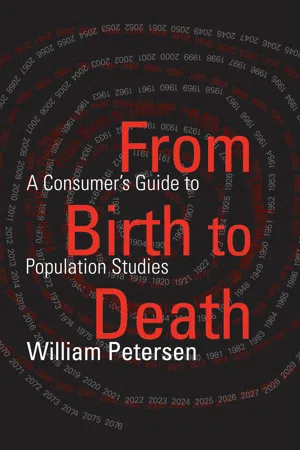
From Birth to Death is a detailed analysis of how population statistics are collected in the United States, particularly by the Bureau of the Census. It describes the errors and other flaws typically found in such data.Petersen sets out the fundamentals of demography and reviews the current proposal to use sampling in the census. He then reviews examples of how ignoring age and sex structure leads to false conclusions. Petersen explores race and ethnicity and the dilemmas inherent in the necessarily ambiguous definitions of these categories. He also analyzes the problems of women who postpone having children to ages when risks of failure become significant.The author also reviews the two most prominent population theories Malthus and the fertility transition and questions why predictions of future population size are often completely wrong. The final chapter discusses the pros and cons of state intervention in the control of fertility and efforts to cut family size in less developed countries and their unclear results. A principal topic is the relative accuracy of population statistics and the degree to which one should accept data as published. The main focus is on the United States and especially on the Bureau of the Census, but general points are sometimes illustrated with examples of how data from other countries should be evaluated.
Information
1
Population: The Fundamentals
The word population derives from the Latin populus, people. Like most verbal nouns, a “population” once designated either a process or a state. One of the charges made against George III in the Declaration of Independence was that he “endeavored to prevent the population of these states,” but in this sense of “growth in numbers” the word has become archaic. The English language never developed a full equivalent of the French peuplement: “peopling” is not standard professional usage, and the usual term in geography, “settlement,” has special connotations.
There is also an obsolete word, population, derived from a different Latin root, which means devastation or laying waste. With the word in that sense, the last reference in the Oxford English Dictionary is from 1747, but it is surprising that one of the more zealous proponents of controlling the increase in the world’s human beings has not revived it.
What is a “Population”?
As demographers understand the term, the population of a designated area is the number of persons who, by specified criteria, are there on a particular date. This is similar to the understanding of the word in biology, but biologists are likely to concentrate only on the number of individuals per unit area and the rate of their increase under varying conditions.1 In counting the members of a nation or of another areal unit, the census can enumerate either all who in some sense belong there (whether or not they are currently present) or all who are physically in residence (whether or not that is their legal domicile). The first is called the population de jure, the second, the population de facto. Some nations count one, some the other, and some both. Since neither system has been generally accepted, any comparison of human populations—to be as precise as possible—ought to be made with an awareness of how each country arrives at the number of its inhabitants.
What is the population of the United States? To this seemingly simple query, there is no single correct answer.
There are three official totals: the civilian population, the total resident population, and the total population including Americans living abroad. Military and diplomatic personnel are not the only ones who may reside outside their country, but also—among others—tourists, professionals of various types, businessmen, Gastarbeiter, missionaries, employees of voluntary services, and students. The practice of the United States in distributing census forms abroad is to use whatever facilities seem to be useful, such as Army and Navy units for their personnel and airlines and passenger ships for others. American consulates have the forms available, but persons not on the public payroll who live abroad are recorded only if they themselves take the trouble to register.
The accuracy of the count may be affected by the complicated definition of nationality. In works on politics authors often use “nationality” rather loosely, meaning more or less a community that defines itself by some process of self-determination, and population statistics sometimes reflect this usage. In typical practice, however, the meaning of the word is based on legal definitions of citizen or subject, which differ considerably from one country to another.
In the United States, the 1940 census was the first in which the census count of aliens was supplemented with a registration by the Immigration and Naturalization Service. There was a disconcertingly large difference in the number of aliens between the enumeration (based on each person’s self-identification) of about 3.5 million and the registration (a summation of persons so defined in a legal context) of about 5 million. One can assume that in every census many aliens report themselves as citizens.
The concept of citizenship has undergone fundamental changes. Under laws enacted in the United States during the first decades of the twentieth century, a naturalized American relinquished his citizenship if he indicated a dual loyalty—as, for instance, by becoming a citizen of another state, or serving in its armed forces, or voting or being a candidate in a foreign election. In a series of subsequent decisions the Supreme Court abandoned all these restrictions on how one defines an “American.” Under today’s law, a person may commit himself to another state without losing his American citizenship unless it is proved that he intended to forgo it. Rabbi Meir Kahane, a rabble-rouser repeatedly arrested in both the United States and Israel, was a striking example. Elected to the Knesset, he pledged to be “faithful to the state of Israel,” but he challenged the revocation of his American passport by claiming that he did not “intend” to forgo his United States citizenship—for he wanted to continue visits to the States in order to raise money for his cause. The subsequent legal battle in American courts became moot when the Israeli parliament passed a law, aimed directly at Kahane, requiring its members to relinquish legal ties to any other country.
As another interesting example, ethnic Japanese living abroad used to be obliged to register with a Japanese consulate, noting both the place of their honseki, or an ostensibly permanent legal residence in Japan, and where they were currently living. The dual record, however, was not very well maintained. Children were sometimes omitted from the prescribed listing, while names of deceased persons remained on it for years; and in countries where the assimilation of Japanese was in process, some did not register their honseki because to do so was considered a symbol of continuing political adherence to Japan.2
From random beginnings, dual citizenship has spread widely. A native-born American with one Irish grandparent, for instance, can obtain an Irish passport and thus the right to work in any country of the European Union without fussing about restrictive regulations. In 1998 Váidas Adamkus, a naturalized American citizen and a former federal employee, was elected president of his native Lithuania. On March 21, 1998 a Mexican law went into effect permitting the citizens of that country to hold an American passport, and the already porous border thus became still more permeable. Scholars in several social disciplines are analyzing the effect of such changes on the actual meaning of nationality, and there is a new periodical, Diaspora, dealing with such issues. Millions of Americans are eligible under the laws of their own or their forebears’ native countries to apply for dual citizenship, but no statistics exist on how many have done so.3
Demography
The word demography is derived from two Greek words meaning “people” and “description of.” It was coined by the French political economist Achille Guillard in his Eléments de statistique humaine, ou démographie comparée (1855). Earlier writings about births and deaths, the growth in numbers, and the relation of population to other social processes went by different names: “political arithmetic” (used to denote the pioneer efforts of such mercantilist writers as the English professor of anatomy William Petty, who coined the phrase); “political economy” (the term current at the time of Thomas Robert Malthus to designate the study of population, among other topics); and “human statistics” or simply “statistics” (used particularly by German analysts of the early modern period).
In some ways demography is a fully developed discipline, with its own national and international professional societies, a wide range of journals, and many persons who identify themselves as demographers. Yet it has also been and to a certain degree remains a rather amorphous congeries, made up of bits and pieces of other disciplines that everyone in the field assembles for himself. As the late American demographer Frank Notestein wrote in his last published paper, “Since the major part of our scientific equipment lies in our background professions, all of us tend to come to the subject with modes of thought, orientation, and prejudices of our background disciplines.”4
This kind of haphazard training, more or less inevitable for a pioneer of Notestein’s generation, has largely continued at least in the United States. Demography is usually taught in departments that offer advanced degrees not in that discipline but in sociology, economics, geography, statistics, or public health; and most aspiring demographers are thus required to become adept also in another set of skills. The consequence is that their training in mathematics and economics may often be less than optimal for population studies, and that in biology and history typically close to nil. It means also that members of the same discipline with diverse points of view may find it difficult to cooperate or even to communicate intelligibly.
There is a more or less fixed interrelation among fertility, mortality, and the structure of the population by age and sex. What is called formal demography, which often is based on technical and mathematical intricacies that laymen may not follow, is essentially the analysis of that interrelation and its reflections in population structure and growth. So-called social demography or population studies, on the other hand, comprises analyses of how population interacts with social, economic, political, geographic, and biological factors, all part of what an early compendium by the United Nations called “the determinants and consequences of population trends.”5 As the nineteenth-century Belgian statistician Adolphe Quetelet pointed out, there is a polarization between practitioners who believe that demography is a natural science with the same kinds of discoverable laws as physics and chemistry and, on the other hand, those who hold that the immutabilities of life and death can be truly understood only in relation to their enormously varied cultural and social settings. The regularity to be found in what he termed “moral statistics” (including data on marriage, divorce, crime, etc., as well as population per se) he saw as a social law comparable to a law of physics. As he conceived them, the characteristics of “Vhomme moyen,” the average man, is based on “constant,” “perturbative,” or “accidental” causes that together set a central point and the dispersion around it.6
The French economist and demographer Paul Vincent, who helped compile the first multilingual demographic dictionary, wrote a cogent article describing how difficult he found it to ferret out an acceptable definition of demography and thus an appropriate range of its terms and concepts. He found that participating in the compilation of such a work forced him to rethink matters that he assumed he already knew.7 After he finished his own comparable work, Roland Pressat, another French demographer, wrote a similar appraisal of his experience.8 For four years Renee Petersen and I worked to write another Dictionary of Demography, with again the same series of perplexities about the nature of the beast we were trying to describe.9
In each case the basic dilemma, as Vincent put it, was whether to define demography in a “restrictive” or an “extensive” manner. In arguing for the second alternative, he asked the reader to imagine the reaction of someone who, “in order to translate a work on demography, had to resort to a whole series of technical dictionaries—sociological, juridical, medical, economic, etc.—after having vainly searched his ‘demographic’ dictionary for terms currently used in demography.” To satisfy fully the supposed user of a dictionary, in short, would require at least brief excursions into all the fields associated with population: biology in relation to birth and death; medicine and epidemiology; law in its regulation of such matters as euthanasia, abortion, international migration, and so on; mathematics, statistics (in particular, vital statistics), and computer science; such social disciplines as sociology, political science, economics, anthropology, geography, and psychology; as well as some notice given to national and international organizations and research institutes. From the 1950s on, moreover, there was a marked shift from earlier description or analysis to a frequent emphasis on recommended policies, with important consequences on how demographic data and techniques were regarded.10 About the same time a new approach emerged called demographics, meaning the analysis of population data as these relate, for example, to markets for particular commodities. Since obviously no single discipline can be all-inclusive over so vast a range, to some degree the limits of demography remain indeterminate and mutable.
Several recent comments on the diversity of demographic works are indicative of new emphases. It is not surprising that Gunther Ipsen, a German demographer in favor during the Hitler period, tried to create a specifically German population theory compatible with National Socialist ideology.11 One article makes the point that there are three quite distinct histories of demography.12 In an interesting paper the American demographer Nathan Keyfitz attempted to resolve differences in analyses of population matters by persons in various disciplines. For example, he argued that physiologists and demographers come to divergent conclusions concerning how nutrition affects population growth because of their predisposition to pose different questions to the data.13
Real or Fabricated Data
International statistics encompass a basic contradiction. For scholars, the cold quantitative record of nations’ achievements and failures is the neutral subject matter of their discipline. Those more concerned with what they deem to be the national interest, however, have often objected to the public display of such facts, and many have used their countries’ publications to broadcast misleading or false data. In 1853, at a statistical congress meeting in Brussels, representatives of 26 countries tried to establish the definitions and procedures that would make the data collected by all governments fully comparable. The permanent commission that evolved out of that congress, however, could get no more than partial and reluctant cooperation from the nations involved. Over the years Germany objected even to the convention that the proceedings were published in French, at the time the standard language of diplomacy. The commission lasted until the Franco-Prussian War, and its successor, which met at irregular intervals between 1878 and 1912, almost foundered during the First World War. Yet the International Statistical Institute did survive, and its serial Aperçu de la démographie des divers pays du monde became for a period the most important source of international population data.14 Eventually they were superseded by the several series of the United Nations and other international agencies established after the Second World War. Though such works reflect the substantial improvement in professional demographic standards over the past several decades, they also display the spread of statistical recordkeeping—of a sort—to a wide array of countries with neither the ability nor usually the will to maintain reasonable standards of accuracy. The technicians of the bureaus who organize such records into international compilations might, in the best case, endeavor to correct the faults and present the highest quality of data feasible. In fact, of course, the technical agencies have not been insulated from the steady politicization of the United Nations as a whole.
How should a responsible reference work deal with the publications of a country that combines in its intricate bureaucracy some technical work of a high quality with a frequent disregard for scholarly objectivity? The issue is fundamental to a large body of work in various disciplines in which such data are unquestioningly accepted. Specialists express doubt about the statistics of the former Soviet Union or of Communist China, but the usual practice is to cite, for instance, population figures of African countries as given, with no warning to the uninformed reader that these are, at best, estimates and, in many cases, figures that have been falsified in order to present the regimes with the best facade possible.
A more general deficiency of population statistics is analyzed in the various works of the American demographer Eugene M. Kulischer, especially in his principal book, Europe on the Move: War and Population Changes, 1917-47.15 In his view, history is a continuous battle ground. As demographic institutions ordinarily define their task, “the role of cataclysms is minimized,” but in fact changes take place “not only by ‘normal’ fertility and mortality but also by wars, epidemics, and other forms of excess mortality, as well as by the uprooting of peoples.” When I introduced into an elementary textbook on population a detailed account of politically sponsored mortality in totalitarian states,16 this new departure was criticized by several more traditional demographers. In my opinion, my implied definition of the discipline represented not only a fuller but also a more realistic view of twentieth-century trends.
Problems in Aggregation
The issue of whether, when, or how much to accept the authority implicit in official data is far broader than that posed by the statistics of less developed countrie...
Table of contents
- Cover Page
- Title Page
- Copyright Page
- Dedication
- Contents
- 1 Population: The Fundamentals
- 2 Age and Sex
- 3 Population Composition
- 4 From Fecundity to Fertility
- 5 Mortality
- 6 Health
- 7 Prehistoric and Primitive Populations
- 8 Population Theories
- 9 Forecasts and Projections
- 10 State Control of Population
- 11 Conclusions
- Notes
- Index
Trusted by 375,005 students
Access to over 1.5 million titles for a fair monthly price.
Study more efficiently using our study tools.
Frequently asked questions
Yes, you can cancel anytime from the Subscription tab in your account settings on the Perlego website. Your subscription will stay active until the end of your current billing period. Learn how to cancel your subscription
No, books cannot be downloaded as external files, such as PDFs, for use outside of Perlego. However, you can download books within the Perlego app for offline reading on mobile or tablet. Learn how to download books offline
Perlego offers two plans: Essential and Complete
- Essential is ideal for learners and professionals who enjoy exploring a wide range of subjects. Access the Essential Library with 800,000+ trusted titles and best-sellers across business, personal growth, and the humanities. Includes unlimited reading time and Standard Read Aloud voice.
- Complete: Perfect for advanced learners and researchers needing full, unrestricted access. Unlock 1.5M+ books across hundreds of subjects, including academic and specialized titles. The Complete Plan also includes advanced features like Premium Read Aloud and Research Assistant.
We are an online textbook subscription service, where you can get access to an entire online library for less than the price of a single book per month. With over 1.5 million books across 990+ topics, we’ve got you covered! Learn about our mission
Look out for the read-aloud symbol on your next book to see if you can listen to it. The read-aloud tool reads text aloud for you, highlighting the text as it is being read. You can pause it, speed it up and slow it down. Learn more about Read Aloud
Yes! You can use the Perlego app on both iOS and Android devices to read anytime, anywhere — even offline. Perfect for commutes or when you’re on the go.
Please note we cannot support devices running on iOS 13 and Android 7 or earlier. Learn more about using the app
Please note we cannot support devices running on iOS 13 and Android 7 or earlier. Learn more about using the app
Yes, you can access From Birth to Death by William Petersen in PDF and/or ePUB format, as well as other popular books in Social Sciences & Demography. We have over 1.5 million books available in our catalogue for you to explore.