Resilient Downtowns provides a guide to communities in reviving and redeveloping their core districts into resilient, thriving neighborhoods. While the National Main Street program's four-point approach of organization, promotion, economic restructuring, and design has been standard practice for cities seeking to rejuvenate their downtowns for decades there is disquiet among downtown managers and civic leaders about the versatility of the program. Resilient Downtowns provides communities with the "en-RICHED" approach, a four-step process for downtown development, which focuses on residential development, immigration strategies, civic functionality, heritage tourism, and good design practice. Examples from fourteen small cities across the US show how this process can revitalize downtowns in any city.
eBook - ePub
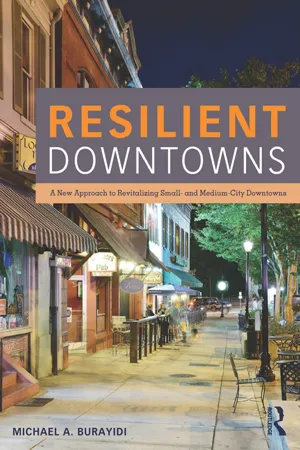
Resilient Downtowns
A New Approach to Revitalizing Small- and Medium-City Downtowns
- 240 pages
- English
- ePUB (mobile friendly)
- Available on iOS & Android
eBook - ePub
Resilient Downtowns
A New Approach to Revitalizing Small- and Medium-City Downtowns
About this book
Information
CHAPTER 1
Bringing Downtowns Back to Life
On March 2, 2012 a devastating EF-4 tornado swept through Southern Indiana, killing forty people in the five states that were in its path. Among the communities affected by the tornado was Marysville, IN, a tiny community of several hundred residents. The town was settled along the railway tracks in 1871, with farming as the community’s economic base. Not much had changed since then until the tornado hit. The tornado wiped out the entire community and left no building standing in its aftermath. The question that remained was whether the community would rebuild. Writing on this subject, the Associated Press made this observation:
When a bigger population center such as Joplin, MO is crippled by tornadoes, there is rarely any question about rebuilding. Larger cities typically have greater resources and defined downtowns to serve as focal points. But this flyspeck village may have suffered a fatal blow.
(Associated Press 2012, p. 18)
The Associated Press’ comment underscores the importance of downtowns in uniting a community. Would Marysville, IN, have rebuilt if it had a town center, a downtown that brought the community together? Such a focal point might have provided a gathering place for the community to commiserate about the town’s future and to decide together what steps to take to rebuild the community, or not. Without a downtown, there is no gathering spot, no togetherness, and each one is left on their own.
The observation made by the Associated Press also underscores the important role that downtowns play, despite the problems that city centers have faced in the last couple of decades. These problems have been well documented in both the popular press and the academic literature. Among these are the loss of middle-class households to the suburbs, deteriorating infrastructure, high poverty rates, and higher housing vacancy rates. This book is not about the problems of downtowns, but about the innovative and successful approaches that cities have used to revitalize their core areas. What most of these communities need is not an enumeration of their problems, but a guide on how they can move forward with programs and policies that can help them rejuvenate their downtowns. No city is alike in structure and in the problems they face. Nevertheless, there is an opportunity for cities to learn from each other and to adapt successful approaches used in other locations to help remediate their unique situation. That is the quest of this book.
The focus of the book is on small cities. While the downtown success stories of large cities such as Boston and Baltimore have been well touted, those of smaller, urban communities where a majority of Americans live are less well known. A study conducted by the Brookings Institution to determine “Who lives downtown?” examined the downtowns of forty-five sampled cities, but shed no light on the downtowns of small, urban communities. In the same vein, Ann Breen and Dick Rigby, the founders and co-directors of the Waterfront Center in Washington, DC, in their book Intown Living: A Different American Dream (2004) sampled mostly large sunbelt cities in making the case that there is a revival in downtown living. The cities studied by the authors were Atlanta, Dallas, Houston, Memphis, Minneapolis, New Orleans, Portland, and Vancouver. The literature on downtown revitalization almost invariably ignores small cities, as though small-city downtowns did not have similar revival stories.
The purpose of this book is therefore to celebrate small-city downtowns and to explain why some downtowns in small cities (defined as settlements of less than 150,000 residents) have been resilient to deindustrialization and boom and bust economic cycles. By doing so, I hope not only to tell the positive stories of downtowns in small cities, but also to provide exemplary cases on which other small communities can model their redevelopment approaches.
Differences between Large- and Small-City Downtowns
Large- and small-city downtowns have similarities, but they also have substantial differences. For example, whether in large or small cities, downtowns were the original sites in which cities were first settled. In many cases, such sites were near a water body such as a river that facilitated the transportation of goods to nearby markets. Later, the railroad influenced the location of settlements, as was the case of Marysville, IN. Also, both large- and small-city downtowns were similarly impacted by decentralization of economic activity to the fringe, starting after World War II and accelerating in the mid-twentieth century following the federal highway program of 1956. But there are also significant differences between large- and small-city downtowns that call for a different approach to their revitalization.
Robertson (2001) enumerated many differences between large- and small-city downtowns. Small-city downtowns have a pedestrian-scale development, such that people are not dwarfed by large high-rise buildings the way they feel they are in large cities. Perceptions of crime and other social vices are more pronounced in large-city downtowns than in small-city downtowns. In addition, large cities have a dominance of corporate presence in their downtowns unlike in small cities. Furthermore, small-city downtowns are less likely than large-city downtowns to be segmented into distinct districts such as retail, residential, entertainment, and historic.
Missing from Robertson’s list are other significant differences between large- and small-city downtowns. First, small-city downtowns have less racial and social diversity than large cities. Until recently, most new immigrants to the United States settled in large cities where others from their country of origin had settled. Thus, immigrant entrepôts such as Los Angeles, New York, and Chicago attracted immigrants from Asia, the Middle East, and South America who settled in neighborhoods that already had a large population of Hispanic and Asian immigrants. This made these cities even more diverse. Also, the migration of African Americans in the United States was from rural areas in the south to predominantly large cities, mostly in the north, with a strong manufacturing base and employment prospects for migrants. Smaller cities and their downtowns attracted considerably fewer minorities, making them less diverse than larger cities. In addition to diversity, smaller cities are less likely to have the level of eccentricity that is typically associated with large-city entertainment districts. In small cities where most people are long-term residents and know each other well, there is a social stigma to “standing out” in the crowd.
Second, there is a significant difference in land prices between large-city downtowns and their suburbs. With many corporations in large cities preferring a downtown location, land prices are higher in downtowns than at the fringe. By comparison, the price gradient for land from downtown to the fringe location in small cities is less steep. These cost differences mean that downtown businesses will be less attracted to the outlying locations of small cities, solely on the basis of cost.
Third, small-city downtowns are typically within easy driving distance of all city residents. In many cases, the downtowns of small cities are no farther than ten to fifteen minutes driving distance from all neighborhoods. However, in large cities, the downtown lies much farther out from most residents and, thus, the impedance to visit downtown is much higher for large-city residents than for small-city residents.
Fourth, and perhaps because of the proximity of the downtown, there is a greater affinity of residents in small cities toward their downtown than is the case for large cities. Most large cities are multinucleated with several of these nuclei providing full-service central business districts. This is not the case in small cities. Thus, residents in large cities have more options for shopping, service, and entertainment in other areas of the city besides the downtown. It is not uncommon for some residents in large cities to have never visited the downtown since they can obtain most of their needs from other neighborhood centers.
Finally, while Robertson finds large-city downtowns to be dominated by corporate presence, in small cities one finds a few prominent families that dominate and influence development and redevelopment decisions. Many of these families have established foundations that play a key role in the redevelopment of the community, particularly their downtowns. Examples of such families abound. In Muncie, IN, it is the prominence of the Ball family who relocated their glass manufacturing business to Muncie, IN, in the 1880s, attracted by the availability of cheap natural gas in the area. The family established two foundations: the George and Frances Ball Foundation, with estimated assets of $86 million, and the Ball Brothers Foundation, with estimated assets of $133 million. Together, the assets of the two foundations rank eighth among Indiana foundations in assets (Slabaugh 2012). Both of these foundations leverage public and private sector funds for the community’s development.
Similarly, the Blandin Foundation was established in 1941 in Grand Rapids, MN, a town of fewer than 10,000 residents. The foundation was established by Charles K. Blandin, the owner of a paper company, with a goal to build healthy communities with strong economies. The Blandin Foundation has over $100 million in assets and gives away $6 million each year toward its causes. As another example of the prominence of families in small-city development, consider the case of the Orton Family Foundation. Founded in 1995 by Lyman Orton and Noel Fritzinger, it is headquartered in Middlebury, VT. The foundation is supported by profits from the Vermont Country Store, a business owned by the Orton family. The goal of the foundation is to promote grass-roots, bottom-up planning and development and to work with small cities and towns to define and shape the development of communities from the residents’ own perspective. Finally, and as we will see later in this book, the Edgar and Elsa Prince Foundation in Holland, MI, is a major contributor to the redevelopment of that city’s downtown.
While small-city downtowns share some of the same characteristics as large-city downtowns, major differences still remain. The solutions that work for the problems of large-city downtowns may have limited success in addressing those of small-city downtowns. Given the differences discussed above, it is imperative that small cities have their own, tailored approach for redevelopment.
The National Main Street Program and Downtown Renewal
The story of downtown revitalization cannot be told without reference to the National Main Street program. For over three decades, the National Main Street program has helped communities revitalize their downtown commercial corridors through the four-point approach of organization, promotion, design, and economic restructuring. By all accounts, this program has been a success and has helped hundreds of communities revitalize their Main Streets. In 1997, the National Main Street Center documented the success stories of forty-four such communities in Main Street Success Stories. At that time, the program had helped over 1,200 communities to reverse the decline of their downtown commercial districts, generated $5.87 billion in new investment, created 115,000 new jobs and 33,000 new businesses, and rehabilitated 34,000 commercial buildings. Today, over 2,000 communities across the country have certified Main Street programs, leading to the reinvestment of $49 billion in commercial districts since its founding in 1980. In Robertson’s (1999) survey of fifty-seven small cities, he found the National Main Street program to be the most successful of the sixteen downtown redevelopment strategies he examined.
Nevertheless, the success stories of the National Main Street program have been on commercial revitalization. Consequently, the redevelopment of residential and other components of downtowns have been largely ignored by the program.
This is understandable, given that the program was designed to reposition downtowns in larger cities to compete with the strip malls springing up on the fringe of these cities. While this formula worked well for cities that already had a stable residential population, it has not been robust enough to tackle the multiplicity of problems that needed to be addressed in downtowns. The program also provides no template for organizing landlords whose property is the subject of rehabilitation, erroneously assuming that downtown retailers own the properties in which they operate. Without the cooperation of property owners, preservation strategies for downtown structures will be futile. As a result of these shortcomings, the program has been of limited benefit to cities that wish to broaden the scope of Main Street revitalization to tackle their declining downtown and near downtown neighborhoods. For example, the City of Mansfield, OH, dismantled their National Main Street program to embrace a broader vision that included revitalization efforts for the city’s downtown historic neighborhoods.
As Phil Meyer, the Director of Community and Neighborhood Services for the City of Holland, MI, remarked:
We were a certified National Main Street program community and gleaned what we could from the four-point approach to Main Street revitalization. However, some of the issues we had were expanding and broadening. We got into housing, traffic and parking issues and we were getting to the level wh...
Table of contents
- Cover
- Half Title
- Title Page
- Copyright Page
- Contents
- Acknowledgments
- Chapter 1 Bringing Downtowns Back to Life
- Chapter 2 Historical and Regional Context of the Resilient Downtowns
- Chapter 3 Cultivating Downtown Living
- Chapter 4 Courting New Immigrants
- Chapter 5 Downtowns as Civic and Cultural Centers
- Chapter 6 Historic Preservation and Heritage Tourism
- Chapter 7 Designing Resilient Downtowns
- Chapter 8 Economic Distress and Downtown Revitalization
- Chapter 9 Downtown Alive!
- Bibliography
- Index
Trusted by 375,005 students
Access to over 1.5 million titles for a fair monthly price.
Study more efficiently using our study tools.
Frequently asked questions
Yes, you can cancel anytime from the Subscription tab in your account settings on the Perlego website. Your subscription will stay active until the end of your current billing period. Learn how to cancel your subscription
No, books cannot be downloaded as external files, such as PDFs, for use outside of Perlego. However, you can download books within the Perlego app for offline reading on mobile or tablet. Learn how to download books offline
Perlego offers two plans: Essential and Complete
- Essential is ideal for learners and professionals who enjoy exploring a wide range of subjects. Access the Essential Library with 800,000+ trusted titles and best-sellers across business, personal growth, and the humanities. Includes unlimited reading time and Standard Read Aloud voice.
- Complete: Perfect for advanced learners and researchers needing full, unrestricted access. Unlock 1.5M+ books across hundreds of subjects, including academic and specialized titles. The Complete Plan also includes advanced features like Premium Read Aloud and Research Assistant.
We are an online textbook subscription service, where you can get access to an entire online library for less than the price of a single book per month. With over 1.5 million books across 990+ topics, we’ve got you covered! Learn about our mission
Look out for the read-aloud symbol on your next book to see if you can listen to it. The read-aloud tool reads text aloud for you, highlighting the text as it is being read. You can pause it, speed it up and slow it down. Learn more about Read Aloud
Yes! You can use the Perlego app on both iOS and Android devices to read anytime, anywhere — even offline. Perfect for commutes or when you’re on the go.
Please note we cannot support devices running on iOS 13 and Android 7 or earlier. Learn more about using the app
Please note we cannot support devices running on iOS 13 and Android 7 or earlier. Learn more about using the app
Yes, you can access Resilient Downtowns by Michael Burayidi,Michael A. Burayidi in PDF and/or ePUB format, as well as other popular books in Architecture & Urban Planning & Landscaping. We have over 1.5 million books available in our catalogue for you to explore.