1
Introduction
Motivation Motivation
Emotion
Chapter summary
Motivation
In many ways the study of motivation is the study of psychology itself. It is concerned with explaining all forms of behaviour, from why you have decided to study psychology, to why some people take up bungee-jumping.
Motivation is an attempt to explain the ‘why’ of behaviour.
Essentially, when we ask why a person or animal acts in a particular way, we are asking about their motivation (Mook, 1996).
When an actor is asked by a director to act in a particular way, the actor may ask, ‘What is my motivation?’ The actor needs to know the reason for an action in order to be able to perform it properly, just as you may need a reason to continue with your studies or even to carry on reading this book.
Motivation is concerned with goal-directed behaviour, what it is that pushes us towards certain forms of behaviour and not others. On the one hand, your reason for reading this book may be purely functional i.e. it will help you pass your exam. On the other hand, your reason may be more personal e.g. to help understand some aspect of your own behaviour or those around you. Whatever the reason, the issues covered in this book will hopefully help you do both of the above.
Some of the issues covered in the chapters of this book are:
Why do some people eat more than others? (Chapter 3)
Why do we have a preference for certain types of food? (Chapter 3)
What makes us start and stop drinking? (Chapter 4)
What is the attraction of alcohol? (Chapter 4)
What is the difference between high and low achievers? (Chapter 5)
Why do some people have the drive to become top athletes? (Chapter 5)
What is it that makes us avoid unpleasant situations? (Chapter 6)
Why do some (strange) people engage in ridiculously dangerous activities? (Chapter 6)
These and other issues will be explained through an emphasis on the interaction between internal and external factors in the determination of our behaviour; this interaction will help us to understand the behaviours outlined above.
Therefore, the book will concern itself with the physiological processes involved in bringing about changes in behaviour, in particular, autonomic reactions involved in maintaining a stable internal environment (homeostasis). But, it will also concern itself with the complex mental processes involved in making an assessment of a particular external situation, before deciding how to act.
As stated above, motivation is concerned with the complex processes that move individuals towards some goal, to try and understand the forces that push them into action. The idea of forces pushing us into action is generally linked to the notion of biological drives and instincts, which compel us to adopt certain forms of behaviour. However, if we see motivation as involving mental processes then it appears to be linked more closely to cognitive factors, which involve a logical assessment of the situation before we decide to act.
Whilst it may be biological drives that cause us to pull back from the edge of a cliff when we get too close, there must be other factors involved in our decision to throw ourselves off the top of a bridge with nothing but a piece of elastic tied to our leg.
Theories of motivation
Theories of motivation centre on three distinct but often interrelated concepts:
- instinct/drive
- incentive
- arousal
Most explanations of motivated behaviour will make some reference to one or other of these three.
Each of these will help to explain the main types of motives, which have been identified by psychologists:
- An instinctive desire to satisfy a specific physiological need or drive. For example, consider the role of physiological drives in relation to eating and drinking:
How do you know when you are hungry/thirsty?
How do you decide when to eat/drink?
How do you know when you have had enough?
According to this approach the answers to all of these questions are physiological and concerned with purely physiological responses e.g. stomach contractions.
In Chapters 3 and 4 we will consider the extent to which it is possible to answer these questions in purely physiological terms.
- A decision to act in a particular way in order to gain satisfaction or reward.
For example, consider the role of rewards in relation to work: What is it that makes you work hard at a particular job?
According to this approach, the only incentive to work hard is the expectation of some future reward (pay, praise etc.).
In Chapter 5 we will assess this possibility in relation to psychological theories of motivation.
- The desire to increase or decrease one’s level of arousal. For example, consider the role of arousal in relation to going on holiday:
Why is it that some people choose extremely adventurous holidays, whilst others just go on holiday to relax?
This approach combines the desire for changes in your physiological state with individual differences in psychological assessment of the situation to explain these behaviours.
The actor’s question, ‘What’s my motivation?’ seems to be rather more difficult to answer than we might have first thought and perhaps the only person who can answer that question is the actor him/herself.
Emotion
What are emotions?
If someone were to come up to you now and say, ‘How do you feel?’ What would you say?
You might refer to your physical state, but you might be just as likely to reply with some reference to your emotional state. For example, ‘I’m happy enough’, or ‘I’m fed up/bored’. Both of these examples can be applied to those things we call emotions.
Whilst these two may not be the first things that come to mind when we consider what emotions are, they would almost certainly fall into the category of emotion.
At this point you may well be expecting some form of definition of what an emotion is. Unfortunately, the situation is not that simple and there have been many attempts to come to an agreed definition of emotions, none of which has so far proved satisfactory. Chapter 7 of this book will look at some of these attempts and consider the possibility of coming to a universal definition of certain emotions. It will also try to identify the physiological factors involved in the production of an emotion, just where do emotions come from?
Let us just say for the moment that emotions involve some appraisal of inner thoughts, feelings and memories, sometimes combined with an assessment of the environment and physiological changes, most often involving a behavioural response (Kleinginna and Kleinginna, 1981).
Consider the emotion of fear, this will often involve:
- An assessment of a particular situation.
- An appraisal of our memory will provide a clue as to whether or not the situation is dangerous.
- This will be followed by a cognitive appraisal of our thoughts about the situation; physiological responses (such as increased heart rate)
- will guide our feelings. This will lead to a behavioural response i.e. running away.
Progress Exercise
Using the previous example as a guide, come up with your own list of emotions, which would fit into these criteria. Are there any other things that do not fit but you would count as emotions? Make a list of those too. Now create one list of emotions in the form of a ‘top ten’ that represent what you think are the clearest/best examples of emotions.
One attempt to provide such a list was carried out by Fehr and Russell (1984), who interviewed 200 Canadian college students and asked them to rate a list of words in order from a very good example of an emotion to a very poor one. The results are shown in Table 1.1.
Theories of emotion
It is one thing to be able to identify an emotion, but it is somewhat more complicated to explain what it is that brings about the physical changes that are usually associated with an emotional state (facial expressions, sweating etc.).
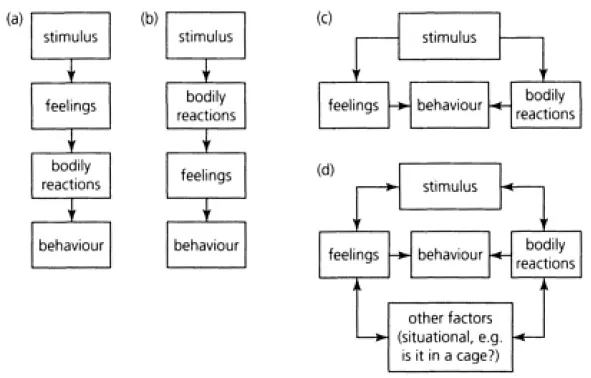
Each of the theories that follows provides some combination of the four factors identified above; feelings, bodily reactions, appraisal of environmental
Figure 1.1Four representations of the sequence of emotional activity
stimuli and behaviour. Each one provides some combination of a scenario involving a stimulus (the sight of a bear or ferocious dog), feelings (I’m scared), bodily reactions (increased heart rate or muscle tension) and behaviour (running away or playing dead) —[bears can run really fast]. Essentially the theories can be broken down into three patterns or sequences of activity, which could be shown up against what might be seen as the common-sense view of emotional experience (Figure 1.1).
Table 1.1 Students' `top ten' emotions
Progress exercise
Which of the four representations fits best with your own experience? Which one makes the most common sense?
- Represents the view that emotions begin with the subjective feeling (fear), which in turn leads to physiological changes (increased heart rate), followed by an appropriate behaviour (running away).
- Represents the view that emotions begin with physiological changes, which cause the subjective feeling of fear.
- Represents the view that physiological changes and subjective feelings occur simultaneously.
- Represents the view that the whole process is far more complex than the other sequential represent...