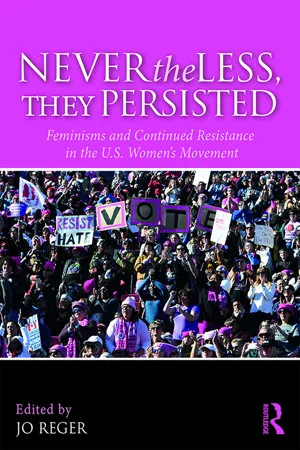
2017 opened with a new presidency in the United States sparking women's marches across the globe. One thing was clear: feminism and feminist causes are not dead or in decline in the United States. Needed then are studies that capture the complexity of U.S. feminism. Nevertheless, They Persisted is an edited collection composed of empirical studies of the U.S. women's movement, pushing the feminist dialogue beyond literary analysis and personal reflection by using sociological and historical data. This new collection features discussions of digital and social media, gender identity, the reinvigorated anti-rape climate, while focusing on issues of diversity, inclusion, and unacknowledged privilege in the movement.
eBook - ePub
Nevertheless, They Persisted
Feminisms and Continued Resistance in the U.S. Women’s Movement
- 228 pages
- English
- ePUB (mobile friendly)
- Available on iOS & Android
eBook - ePub
Nevertheless, They Persisted
Feminisms and Continued Resistance in the U.S. Women’s Movement
About this book
Information
1 The Making of a March
Identity, Intersectionality and Diffusion of U.S. Feminism
Jo Reger
The day before Woodrow Wilson’s inauguration in 1913, an “immense” parade of 5,000 to 8,000 women marched down Pennsylvania Avenue in support of women’s suffrage (Papachristou 1976; Gibson 2011). Spurred by the lack of support for a federal amendment for women’s suffrage, the organizers sought to gain the public’s attention. Faced with large crowds gathered to celebrate the incoming president, “the parade became a riot as mobs of spectators disrupted the orderly march” (Papachristou 1976: 172) and troops were brought in to regain order (Gibson 2011). Moving forward 104 years, while the number of participants have grown, the protests that followed the inauguration of Donald Trump resonate with those at the Wilson inauguration. Both focused on the incoming president’s policies. Suffragists saw Wilson’s inauguration as an opportunity to move from the state-by-state work for suffrage to an all-encompassing federal amendment. In 2017, participants had a wider range of issues but core to many was a concern for the women’s rights (Fisher, Dow and Ray 2017).
The 1913 march, while contested, was not much of a surprise to those who kept up on national politics. The suffrage movement had been mobilized for six decades and the organizers were visible and active leaders (one organizer was President Wilson’s own niece). Moving ahead to 2017, the story changes. Societal pundits had declared that the U.S. women’s movement was either dead or in a state of decline since the late 20th and early 21st centuries. Even the nomination and surprise defeat of Hilary Clinton as the Democratic candidate for president did not signal the coming demonstration with feminists divided on supporting her, and many white women voting for Donald Trump. While scholars debate the idea that the movement was dead (Hawkesworth 2004, Reger 2012), how do we explain the rise and global spread of Women’s Marches in 2017 with a repeat emergence in 2018? Drawing on previous research and social movement theory, in this chapter I argue that the U.S. women’s movement has transitioned from a state of “everywhere” (i.e. diffused into the culture and society) and “nowhere” (i.e. not visible on a mass mobilization or national level) in the 1990s and early 2000s, to a state of mobilization that moved local, grassroots feminism into mass protests. Those mass protests emerged in part because of three mechanisms: the formation of visible feminist collective identity, the importance of intersectionality in contemporary feminism, and the diffusion of feminism in contemporary society. Before I discuss those mechanisms, I begin by describing the Women’s Marches of 2017.
The Women’s Marches of 2017
On January 21, 2017, more than 4 million men, women and children gathered in 654 cities in the United States to protest the inauguration of Donald Trump and advocate for a range of social issues. 1 The United States was not the only site of protest. Globally, more than 300,000 people demonstrated from around the world with countries as far-flung as Ghana, Saudi Arabia, Mexico, Sweden, Portugal, Greece and New Zealand. There was even a small contingent protesting in Antarctica. The cornerstone of the marches was the Washington D.C. protest which brought as many as 500,000 to the streets. After some initial missteps in organizing and naming the march (which I discuss in more detail below), the national co-chairs for D.C. were a diverse group with a variety of grassroots, state and national level organizational as well as corporate and non-profit experience. The speakers included well-known activists (e.g., Angela Davis, Gloria Steinem, Michael Moore), directors of non-profits and service organizations (e.g., National Domestic Workers Alliance, Planned Parenthood, Council on American-Islamic Relations), celebrities (e.g., America Ferrera, Ashley Judd, Janet Mock, Scarlett Johansson) and the mothers of Trayvon Martin, Dontre Hamilton, Eric Garner and Jordan Davis, all victims of police violence.
While the inauguration of Donald Trump drew march participants, the issues covered a range of concerns as illustrated in the diversity of signs. A core sign and symbol in the march addressed Trump referring to women as “pussies,” illustrated in signs such as “This Pussy Bites Back” and the wearing of knitted pink “pussy hats” complete with pointed kitty ears. While many of the protestors came in response to Trump’s comments on women, others carried signs urging women’s empowerment and organizing with slogans such as “Well Behaved Women Seldom Make History,” “Glass Ceilings Are Meant to be Broken” and “Who Runs the World? Girls!” Many referred to the Hillary Clinton campaign with signs such as “I’m with her” with arrows pointing in all directions and “Nasty Women Make (her)Story.” Others carried signs that called for activism during the Trump presidency. For example, one sign was inscribed with a quote from civil rights legend and Congressman John Lewis: “We may not have chosen the time, but the time has chosen us.” Marchers carried signs advocating for abortion and reproductive, transgender, LGBTQIA+ and immigrant rights, as well as valuing science, Black Lives Matter, men’s activism for women, and the need to address climate change, xenophobia, sexual assault and the rape culture, equal pay and access to healthcare. These issues were often intertwined with each other as indicated by one common sign, captured in multiple sites on the Internet:
Love is LoveBlack Lives MatterClimate Change is RealImmigrants Make America GreatWomen’s Rights are Human RightsRemember Love
Also present at the Washington D.C. march were scholars working their way through the crowds of protestors to understand the why and who of the protests. A research team led by Professor Dana Fisher of the University of Maryland found that the protests drew in both experienced activists and those new to protest. Approximately one third of the protestors at the January 21 march had never protested before and most of them had no connection to the 400 plus sponsoring organizations. Although many of the protestors were new to this form of activism, the research team also found that many of them went on to participate in the March 4 Science and the People’s Climate March, held later that year (Fisher 2017). While these researchers can tell us who the participants were and how experienced they were as activists, how was feminism a part of these protests? To answer that question, we need to look at the state of contemporary feminism in the United States.
Where Has Feminism Been?
Since the inception of feminism in the United States in the 1800s, the media has repeatedly declared feminism in decline or dead. Obituaries for feminism reoccur throughout the history of the movement. For example, after suffrage was obtained in 1920, the movement was declared dead by the 1950s (Rupp and Taylor 1987). Some fifty years later Time Magazine’s cover story read, “Is Feminism Dead?” complete with pictures of Susan B. Anthony, Betty Friedan, Gloria Steinem and TV character Ally McBeal (Bellafante 1998). More contemporary coverage included headlines such as “Where to Pass the Torch?” (Winerip 2009) and “The End of the Women’s Movement” (Martin 2009).
This death/not-death of feminism is what I call the “everywhere and nowhere” phenomenon of contemporary feminism (Reger 2012). In a society that has had an active feminist movement since the mid-1800s, feminism has diffused into the culture in ways that are often not easily discernible. Indeed, it is everywhere. It is in the co-ed baseball teams at the local high school, the body positive messages of Dove soap, the educational policies such as Title IX, and the push to get girls in STEM (science, technology, engineering and math) fields. In these examples, women’s movement activism changed the society in profound ways that are often not credited to the movement. In addition, the 1990s and 2000s were times of only a few large national feminist protests and demonstrations. While the national picture of feminism may have looked defunct, an examination of communities provides a different picture. In a study of three different communities, I found that activists were entwined in a series of networks, informal groups and formal organizations focused on the local issues and concerns (Reger 2012). Although the focus of their activism was shaped by the community around them, all the communities articulated a feminist identity that was core to their activism. As Verta Taylor and Suzanne Staggenborg argue (2005), the movement has survived because of its diffusion into fields such as local communities.
In addition to creating local feminist communities, in the 1990s feminist activism moved to the Internet where a myriad of websites, blogs and Facebook pages developed and were devoted to aspects of feminism (Alfonso and Trigilio 1997; Crossley 2017; Daniels 2009; Reger 2012). As a result, when social pundits (or scholars) only examined the national scene for visible feminist organizations, they missed how feminism was embedded in new locales such as social media. Indeed, Alison Crossley notes that “While some people may wonder where the feminists have gone, it is clear that many feminists are online, fueling the feminist movement (2015: 265). This place of resistance and protest also has the potential to bring together generations of feminists (Everett 2004) addressing a range of issues. As such, for the last few decades, feminism has often been described as located in the digital world and focused on new technologies (Alfonso and Trigilio 1997). Crossley (2017: 5) argues that we need to understand how feminism is “enacted in everyday, interactional and intersectional ways, in unexpected locations, in online settings, and in organizations not solely concerned with gender inequality.” (See Chapter 4 in this volume.) When feminists work in “unexpected” spaces on a myriad of issues, the movement can look like “nowhere” even when it is not.
In sum, although the U.S. women’s movement has been declared dead repeatedly throughout its history, it has remained active on a variety of levels including the virtual world of the internet, and in grassroots community organizing where it has diffused into a range of ideas about human worth and marginalization, discrimination and subordination. This diffusion helps explain how locally-focused feminism was a foundation for the marches, but what sparked the mass protests in 2017?
How Do Mass Protests Emerge?
The factors that move people from concern to action are core questions of social movement scholars. Social movement scholars argue that three main factors contribute to the emergence of social movement activism: a plausible threat, pre-existing organizations and coalitions. First, people need to believe that there is a plausible threat to a right or an issue. (Meyer 1993; 2003). David Meyer argues “People pick the route they believe most likely to be effective after surveying their political resources and opportunities” (1993: 458). Those “routes to activism” can be spurred by threats to fundamental human rights, access to needed resources, opportunities and services or a concern for the future. As the signs and speakers at the various 2017 marches indicated, people saw the election of Donald Trump as posing a significant threat to issues important to them. For example, the Washington D.C. march speakers included mothers whose sons has been killed by the police. These women were not addressing hypothetical situations with the police but instead told the crowds the circumstances that resulted in the death of their sons. In sum, when issues of rights, opportunities or resources are threatened and people understand those threats as real, activism is the result. What is striking about the 2017 marches is that so many issues were framed as credible threats, from access to abortion to police brutality to obtaining equal pay to stopping climate change.
Second, once that credible threat has been identified and action to stop that threat seems possible, people often turn to pre-existing groups as a way to address the issues (Tilly 1978; Jenkins 1983). Pre-existing groups often have resources such as the ability to communicate with members and the greater public, funds for permits, and knowledge on how to organize. Some of the pre-existing women’s rights groups that participated in the D.C. march include long-lived organizations such as EMILY’s List, Planned Parenthood, National Abortion Rights Action League (NARAL) and National Organization for Women (NOW). While these pre-existing groups were not the primary organizers, they had the potential to provide resources such as membership lists, communication networks, meeting spaces, and funds for activists. Indeed, since 2017, the Women’s March has grown into a national organization with grassroots outreach and national conventions. This group now serves as a pre-existing organization providing resources to activists who are continuing to organize their communities. For example, on the Women’s March website, under the heading of “Power to the Polls,” it reads:
The national voter registration tour will target swing states to register new voters, engage impacted communities, harness our collective energy to empower grassroots leaders to advocate for policies and elect candidates that reflect the values we marched for on January 21, 2017.(http://www.powertothepolls.com)
Also on the page are places to volunteer to work on a California primary campaign and to register to vote.
Third and finally, large scale demonstrations need coalitions to link together disparate groups into a unified network (Ghaziani 2008; Tilly 1978; Jenkins 1983). The list of “partnering” organizations on the Women’s March website is in the hundreds and covers a range of issues (https://www.womensmarch.com/partner). While the long list of groups may seem hard to coordi...
Table of contents
- Cover
- Half Title
- Title Page
- Copyright Page
- Table of Contents
- List of images
- Acknowledgements
- 1. The Making of a March: Identity, Intersectionality and Diffusion of U.S. Feminism
- part I: Activists
- part II: Issues
- Contributor Biographies
- Index
Trusted by 375,005 students
Access to over 1.5 million titles for a fair monthly price.
Study more efficiently using our study tools.
Frequently asked questions
Yes, you can cancel anytime from the Subscription tab in your account settings on the Perlego website. Your subscription will stay active until the end of your current billing period. Learn how to cancel your subscription
No, books cannot be downloaded as external files, such as PDFs, for use outside of Perlego. However, you can download books within the Perlego app for offline reading on mobile or tablet. Learn how to download books offline
Perlego offers two plans: Essential and Complete
- Essential is ideal for learners and professionals who enjoy exploring a wide range of subjects. Access the Essential Library with 800,000+ trusted titles and best-sellers across business, personal growth, and the humanities. Includes unlimited reading time and Standard Read Aloud voice.
- Complete: Perfect for advanced learners and researchers needing full, unrestricted access. Unlock 1.5M+ books across hundreds of subjects, including academic and specialized titles. The Complete Plan also includes advanced features like Premium Read Aloud and Research Assistant.
We are an online textbook subscription service, where you can get access to an entire online library for less than the price of a single book per month. With over 1.5 million books across 990+ topics, we’ve got you covered! Learn about our mission
Look out for the read-aloud symbol on your next book to see if you can listen to it. The read-aloud tool reads text aloud for you, highlighting the text as it is being read. You can pause it, speed it up and slow it down. Learn more about Read Aloud
Yes! You can use the Perlego app on both iOS and Android devices to read anytime, anywhere — even offline. Perfect for commutes or when you’re on the go.
Please note we cannot support devices running on iOS 13 and Android 7 or earlier. Learn more about using the app
Please note we cannot support devices running on iOS 13 and Android 7 or earlier. Learn more about using the app
Yes, you can access Nevertheless, They Persisted by Jo Reger in PDF and/or ePUB format, as well as other popular books in Social Sciences & Human Rights. We have over 1.5 million books available in our catalogue for you to explore.