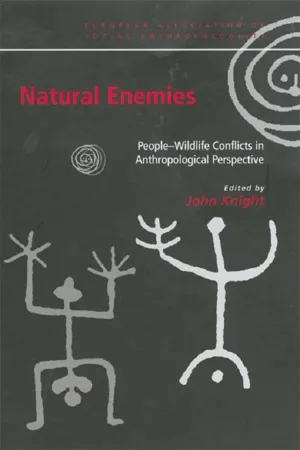
Wild animals raid crops, attack livestock, and sometimes threaten people. Conflicts with wildlife are widespread, assume a variety of forms, and elicit a range of human responses. Wildlife pests are frequently demonized and resisted by local communities while routinely 'controlled' by state authorities. However, to the great concern of conservationists, the history of many people-wildlife conflicts lies in human encroachment into wildlife territory.
In Natural Enemies the authors place the analytical focus on the human dimension of these conflicts - an area often neglected by specialists in applied ecology and wildlife management - and on their social and political contexts. Case studies of specific conflicts are drawn from Africa, Asia, Europe and America, and feature an assortment of wild animals, including chimpanzees, elephants, wild pigs, foxes, bears, wolves, pigeons and ducks.
These anthropologists challenge the narrow utilitarian view of wildlife pestilence by revealing the cultural character of many of our 'natural enemies'. Their reports from the 'front-line' expose one fact - human conflict with wildlife is often an expression of conflict between people.
- 272 pages
- English
- ePUB (mobile friendly)
- Available on iOS & Android
eBook - ePub
About this book
Information
Chapter 1
Introduction
John Knight
The problem
Conflict between people and wildlife is ubiquitous. Rats in Asia ruin the rice harvest, lay waste to grain stores and cause hunger and malnutrition, elephants in Africa plough up crops, bulldoze villages and cause human injury, and wild pigs everywhere feed on crops, trample fields and cause great economic loss. Jaguars in Central and South America attack cattle, tigers in India snatch village animals, and the reintroduction of wolves in Montana is opposed by ranchers fearful of livestock losses. Tigers, wolves, mountain lions, bears, dingoes and eagles all feature in occasional reports of attacks on people.1 These are just a few examples of people-wildlife conflicts; a great many other wild animals (crows, cormorants, mon-keys, hippos, crocodiles, seals, kangaroos etc.) find themselves similarly at odds with nearby human populations.
The wildlife threat elicits a variety of human responses. East African pastoralists ritually sacrifice cattle to protect sorghum and maize fields from monkeys and birds (Fukui 1996: 377), Spanish shepherds invoke Christian saints to protect their sheep from wolves (Catedra 1992: 45), and Japanese farmers bury Buddhist amulets in their fields to ward off wild pigs, deer and monkeys (Kawaoka 1994: 720). In their struggle against rats southeast Asian villagers use traps and cages, employ rat-catching cats and dogs, and try to poison, drown and gas the hated rodents (McNeely and Sochaczewski 1994: 296). Cameroonian farmers ‘sleep in the crop fields to guard them from elephants’ and children ‘lose many school days when they have to help their parents guard the farms or chase [away] the elephants’ (Tchamba 1996: 38). American cattle ranchers, when they encounter protected wolves, simply ‘shoot, shovel, and shut up’ (Youngblood-Petersen 1995: 545).
Human conflicts with wildlife assume a variety of forms, take up much human time and energy, and are often multifaceted in character. People-wildlife conflict is universally found – on land and in rivers and seas, in the north and the south, in the city as well as the country – but tends to be especially marked in human settlements in forest-edge regions. As a threat to agricultural production and an impediment to rural development, wildlife depredations are an area of state concern and an object of expert intervention (‘wildlife control’ etc.), but also overlap with the issue of wildlife conservation (especially in the case of larger wild mammals).
A number of different kinds of people-wildlife conflict can be distin-guished. These include:
• attacks on people (wild predators);
• attacks on livestock (wild predators);
• crop-raiding (wild herbivores and birds);
•forestry damage (wild herbivores);
• competition for wild forage with human gatherers, with livestock or with game animals (wild herbivores);
• competition for prey with human hunters (wild predators);
• house and other building infestations (roosting birds, rats, mice etc.); and
• threats to other natural species and to biodiversity – i.e. ‘environ-mental pests’.
In addition, there are a number of other kinds of conflict.2
This book brings together ten social and cultural anthropologists to examine the phenomenon of people-wildlife conflict. Case studies of par-ticular conflicts are drawn from Africa, Asia, Europe and America, and feature an assortment of wild animals, including predators such as lions, bears, wolves and foxes, and crop-raiders such as baboons, chimpanzees, elephants and wild pigs. In addition to these mammalian pests, two bird pests (ducks and pigeons) are examined in the final two chapters. As anthropologists, we are concerned not just with the material dimension of these examples of wildlife pestilence, but also with their social and cul-tural dimensions. In particular, we focus on the tensions and divisions in human society that affect conflicts with wild animals. One of the main contentions of this book is that many people-wildlife conflicts can be understood as people-people (or people-state) conflicts.
This Introduction identifies some of the main themes that emerge in this anthropological examination of people-wildlife conflicts. These themes include the socially constructed character of pestilence discourses, the relation between wildlife pestilence and conservationism, the sym-bolic dimension of the wildlife threat, the moral specification of dangerous animals, and the variety of ways in which conflicts with wildlife overlap with conflicts among people.
Specifying people-wildlife conflicts
There is an extensive English-language vocabulary for inconvenient, bothersome or damage-causing wild animals: ‘nuisance animals’, ‘trouble-some animals’, ‘problem species’, ‘pests’, ‘vermin’, ‘varmints’, etc. As these terms suggest, the wildlife pest is defined in anthropocentric, util-itarian terms.
People-wildlife conflicts are relations of rivalry or antagonism between human beings and wild animals which typically arise from territorial proximity and involve reliance on the same resources or a threat to human wellbeing or safety. People-wildlife conflicts thus include both competition and predation: competition for food between humans and other animal species and wild animal predation on people. In the first case, the conflict is indirect in character (over a third [plant or animal] species) and between two species which (with respect to the object of competition) share the same trophic level. In the second case, the con-flict takes the form of a direct antagonism between species at different levels of the food chain. This book examines both kinds of people-wildlife conflict – ‘horizontal’ competition and ‘vertical’ predation.
An important qualification must be entered here. As we are dealing with an anthropocentric phenomenon, important aspects of both kinds of conflict are not addressed in this book. Logically, competition works both ways: if wild animals are rivals for human (or human-claimed) foods or territory, human beings are also rivals for the food and territory of wild animals. Predation likewise works in both directions, involving not just wildlife attacks on people, but also human attacks on wildlife – that is, hunting. However, with respect to human livelihood, human hunting represents a different, inverse relation to wildlife in which the prey animal forms a part of (rather than a threat to) human subsistence. This book is principally concerned with the wildlife threat to people, rather than the human threat to wildlife.
A further qualification concerns the scope of the book. The people-wildlife conflicts examined in the following pages concern verte-brate pests, but clearly invertebrate pests would invite similar kinds of analysis. It is also the case that human conflict with other species extends beyond other animals to include plants – that is, weeds (see Knobloch 1996). The weed would be the vegetal counterpart of the animal pest. The farmer’s crop is threatened ‘horizontally’ by weeds as it is ‘vertically’ by pests. Weeds compete with crops to grow; pests compete with the farmer for the crop. The farmer is involved in a twofold struggle – with weeds at the early stage of crop growth and with pests at later stages.
Sometimes horizontal and vertical people-wildlife relations overlap. In what is known as ‘garden hunting’, game animals are killed as they come to feed on (usually swidden) crops which serve, in effect, as a kind of hunting bait (Linares 1976; Wadley et al. 1997: 253–254). In other words, competition (between human and animal) leads to predation (human on animal). But there are other permutations: in the case of crop-raiders such as bears or livestock-predators such as tigers or wolves, ‘horizontal’ rivalry (over crops and livestock respectively) can lead to ‘vertical’ predation – that is, ‘maneating’.
Anthropology and people-wildlife conflicts
There is a large and wide-ranging literature on the subject of people-wildlife conflicts. This is mainly from fields such as applied zool-ogy, applied ecology and wildlife management, and is concerned with the measurement of wildlife damage, the assessment of wildlife pest numbers and population dynamics, the determination of the causes of pestilence, the development of technologies of damage limitation and pest control, and the application of such technologies. It is an interdisciplinary area of research which brings together many different specialists in search of practical responses and solutions to wildlife pestilence, ranging from more efficient techniques of obstruction and repulsion and more effec-tive methods of culling and eradication, to habitat management, crop replacement, and fertility control.3
The topic of people-wildlife conflicts has not attracted much interest from anthropologists. Occasional references to people-wildlife conflicts are made in some of the classic works of anthropology. In The Golden Bough Frazer gives examples of exotic customs for controlling farm pests and other bothersome animals (Frazer 1996 [1922]: 637–638), in Coral Gardens and Their Magic Malinowski refers to the spells recited by Trobriander ‘garden magicians’ to ward off wild pigs (Malinowski 1935a: 117–119, 469n; 1935b: 48), and in Nuer Religion Evans-Pritchard points out the link between totemic ritual and problem animals among the Nuer (‘lions should refrain from killing the cattle of those who respect them, crocodiles should not injure those who respect them, and ostriches should not eat the millet of those who respect them’) (Evans- Pritchard 1956: 79). In general, people-wildlife conflicts, if they appear in anthropological texts at all, do so in the margins and attract little, if any, analytical attention in their own right.
Yet a case can be made for anthropologists paying more attention to people-wildlife conflicts. First, conflict with wildlife is found in a great many societies. In fact, human conflict with wildlife tends to be at its sharpest in the remote, forest-edge locations where much anthropolog-ical fieldwork has been – and still is – carried out. Such conflict with wildlife is set to continue into the foreseeable future as small farmers from Brazil to Indonesia colonize frontier land in tropical forest regions (Rudel and Roper 1997).
Second, an anthropological input into the study of people-wildlife conflicts would also make a contribution to the field of wildlife manage-ment. The importance of the human aspect of wildlife management is becoming increasingly recognized among wildlife managers, especially those who deal with ‘problem wildlife’.
[A] wildlife damage manager is a professional ‘buffer’ between wildlife and humans, protecting humans from animals, while at the same time protecting wildlife from humans. The wildlife damage management professional needs to be able to understand humans as well as he or she understands wildlife. Ironically, this human element tends to be a weak link in our educational chain … [Damage man-agers] tend to be well-trained in their technologies and in wildlife biology, and not well-trained in sociology, anthropology, economics, history, psychology, or political science – the ‘human dimension’ fields.(Schmidt and Beach 1999: 2)
Anthropology is in a position to offset this deficit in understanding of the ‘human dimension’ of wildlife management, especially where this involves cultures different from that of the wildlife professional. One con-tribution anthropology can make is to document and highlight the existence of local or indigenous knowledge and practices in the area of wildlife management and control (for example, Parrish 1995).4
Another can be to help ensure that wildlife management strategies are culturally compatible with the local context in which they are applied. By ethnographically documenting local perspectives on wildlife, anthropology provides a cultural contextualization of wildlife that could help achieve a more locally sensitive wildlife management policy (Breitenmoser 1998: 288).
Anthropology can also contribute to wildlife management by taking it as an object of study in its own right, focusing critically on the cultural assumptions underlying it. Kay Milton has argued that ‘anthropologists are well placed to become theorists of environmentalism’ (1993a: 6), and the same point can be made with respect to the field of wildlife manage-men...
Table of contents
- Cover
- Half Title
- European Association of Social Anthropologists
- Full Title
- Copyright
- Contens
- List of contributors
- Editor's preface
- 1 Introduction
- 2 Wildlife depredations in Malawi: the historical dimension
- 3 Half-man, half-elephant: shapeshifting among the Baka of Congo
- 4 Chimpanzees as political animals in Sierra Leone
- 5 Wild pigs, 'pig-men' and transmigrants in the rainforest of Sumatra
- 6 Animals behaving badly: indigenous perceptions of wildlife protection in Nepal
- 7 Culling demons: the problem of bears in Japan
- 8 The wolf, the Saami and the urban shaman: predator symbolism in Sweden
- 9 The problem of foxes: legitimate and illegitimate killing in the English countryside
- 10 The Great Pigeon Massacre in a deindustrializing American region
- 11 Ducks out of water: nature conservation as boundary maintenance
- Index
Trusted by 375,005 students
Access to over 1.5 million titles for a fair monthly price.
Study more efficiently using our study tools.
Frequently asked questions
Yes, you can cancel anytime from the Subscription tab in your account settings on the Perlego website. Your subscription will stay active until the end of your current billing period. Learn how to cancel your subscription
No, books cannot be downloaded as external files, such as PDFs, for use outside of Perlego. However, you can download books within the Perlego app for offline reading on mobile or tablet. Learn how to download books offline
Perlego offers two plans: Essential and Complete
- Essential is ideal for learners and professionals who enjoy exploring a wide range of subjects. Access the Essential Library with 800,000+ trusted titles and best-sellers across business, personal growth, and the humanities. Includes unlimited reading time and Standard Read Aloud voice.
- Complete: Perfect for advanced learners and researchers needing full, unrestricted access. Unlock 1.5M+ books across hundreds of subjects, including academic and specialized titles. The Complete Plan also includes advanced features like Premium Read Aloud and Research Assistant.
We are an online textbook subscription service, where you can get access to an entire online library for less than the price of a single book per month. With over 1.5 million books across 990+ topics, we’ve got you covered! Learn about our mission
Look out for the read-aloud symbol on your next book to see if you can listen to it. The read-aloud tool reads text aloud for you, highlighting the text as it is being read. You can pause it, speed it up and slow it down. Learn more about Read Aloud
Yes! You can use the Perlego app on both iOS and Android devices to read anytime, anywhere — even offline. Perfect for commutes or when you’re on the go.
Please note we cannot support devices running on iOS 13 and Android 7 or earlier. Learn more about using the app
Please note we cannot support devices running on iOS 13 and Android 7 or earlier. Learn more about using the app
Yes, you can access Natural Enemies by John Knight in PDF and/or ePUB format, as well as other popular books in Social Sciences & Anthropology. We have over 1.5 million books available in our catalogue for you to explore.