- 306 pages
- English
- ePUB (mobile friendly)
- Available on iOS & Android
eBook - ePub
About this book
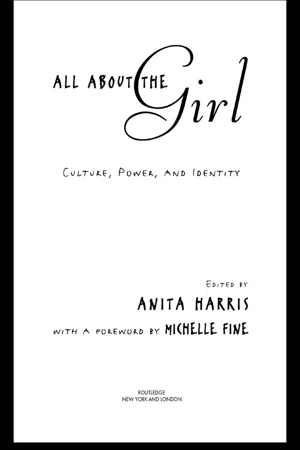
This groundbreaking collection offers a complicated portrait of girls in the 21st Century. These are the riot grrls and the Spice Girls, the good girls and the bad girls who are creating their own "girl" culture and giving a whole new meaning to "grrl" power. Featuring provocative essays from leaders in the field like Michelle Fine, Angela McRobbie, Valerie Walkerdine, Nancy Lesko, Niobe Way and Deborah Tolman, this work brings to life the ever-changing identities of today's young women. The contributors cover all aspects of girlhood from around the world and strike upon such key areas as schooling, sexuality, popular culture and identity. This is new scholarship at its best.
Information
PART 1
Constructing Girlhoods in
the Twenty-First Century
CHAPTER 1
Notes on Postfeminism and Popular
Culture: Bridget Jones and the New
Gender Regime*
ANGELA McROBBIE
This chapter is based on work in progress, its tone is deliberately open-ended, and it quite consciously takes liberties with academic procedures by skimming the surface of popular cultural texts and commenting on observable social behaviors. It first proposes that through a complex array of machinations, elements of contemporary popular culture are perniciously effective in regard to the undoing of feminism; it then proposes that this is compounded by some dynamics in social theory which appear to be most engaged with, and hence relevant to, aspects of gender and social change; and finally it suggests that by means of the tropes of freedom and choice which are now inextricably connected with the category of young women, feminism is aged and made to seem redundant. Feminism is thus cast into the shadows, where at best it can expect to have some afterlife, and where at worst it might be regarded ambivalently by those young women who must in more public venues stake a distance from it, for the sake of social and sexual recognition. Let me start with the film Bridget Jones’s Diary (released 2001); my claim is that it marks the emergence of a new cultural norm, which can be understood in terms of postfeminism.1 Without attempting a full definition of this overused term, I propose instead a complexification of the backlash thesis which hashad currency within forms of journalism associated with popular feminism (Faludi 1997).
My argument is that postfeminism actively draws on and invokes feminism as that which can be taken into account in order to suggest that equality is achieved, in order to install a whole repertoire of meanings which emphasize that it is no longer needed, a spent force. This is particularly prominent first in The (U.K.) Independent newspaper column “Bridget Jones’s Diary” then in the book and film. Postfeminism is, for me at this stage, an enabling concept for the examination of a number of intersecting but also conflicting currents. These include shifts of direction in the feminist academy, as well as generational and political repudiations of feminism from a variety of directions. The notional consent, frequently invoked across political culture—that gender equality was a not unreasonable claim, now happily achieved—permits a wide range of responses, many of which indicate relief and closure; that there is no longer any need for sexual politics, which in turn gives license for such a politics to be undone. Broadly, I am arguing that for feminism to be taken into account, it has to be understood as having already passed away. This is a movement detectable across popular culture, a site where “power … is remade at various junctures within everyday life, [constituting] our tenuous sense of common sense” (Butler et al. 2000: 14).
Some fleeting comments in Judith Butler’s short book on Antigone suggest to me that postfeminism and the new gender regime can be explored through what I would describe as a double entanglement, that is, the coexistence of neoconservative values in relation to gender, sexuality, and family life (for example, George Bush supporting the campaign to encourage chastity among young people) with processes of liberalization in regard to choice and diversity in domestic, sexual, and kinship relations (for example, full recognition that gay couples are now able to adopt, foster, or have their own children by whatever means), and alongside this the coexistence of feminism as at some level transformed into a form of Gramscian common sense, while also fiercely repudiated—indeed, almost hated (Butler 2000; McRobbie 2003). The “taken into accountness” permits all the more thorough dismantling of feminist politics.
It may be helpful to suggest some sense of periodization with 1990 (or thereabouts) as a turning point, marking the moment of definitive self-critique in feminist theory. At this time the representational claims of second-wave feminism come to be fully interrogated by postcolonialist feminists like Spivak, Trinh, and Mohanty, among others, and by feminist theorists like Butler and Haraway who inaugurate the radical denaturalizing of the postfeminist body (Spivak 1988; Trinh 1989; Mohanty 1995; Butler 1990; Haraway 1991). Under the prevailing influence of Foucault, there is a shift away from feminist interest in centralized power blocs (e.g., the state, patriarchy, law) to more dispersed sites, events, and instances of power conceptualized as flows and specific convergences and consolidations of talk, discourse, attentions. The body and also the subject come to represent a focal point for feminist interest, nowhere more so than in the work of Butler. The fact that the concept of subjectivity and the means by which cultural forms and interpellations (or dominant social processes) call women into being, produce them as subjects while ostensibly merely describing them as such, inevitably means that it is a problematically she, rather than an unproblematically we, which is indicative of a turn to what we might describe as the emerging politics of postfeminist inquiry (Butler 1990, 1993).
In feminist cultural studies the early 1990s also marks a moment of feminist reflexivity. In her article “Pedagogies of the Feminine”, Brunsdon queried the hitherto assumed use value to feminist media scholarship of the binary opposition between femininity and feminism—or, as she put it, the extent to which the housewife or ordinary woman was conceived of as the assumed subject of attention for feminism (Brunsdon 1997, first printed 1991). Looking back, we can see how heavily utilized this dualism was, and also how particular it was to gender arrangements for largely white and relatively affluent (i.e., housewifely) women. 1990 also marked the moment at which the concept of popular feminism found expression. Andrea Stuart considered the wider circulation of feminist values across the landscape of popular culture, in particular magazines, where quite suddenly issues which had been central to the formation of the women’s movement (e.g., domestic violence, equal pay, workplace harrassment) were now addressed to a vast readership (Stuart 1990). The wider dissemination of feminist issues was also a key concern in my own writing at this time. Not just the immanent textual processes of popularization but also the contextual intersection of these new representations with the daily lives of young women who, as subjects (called into being) of popular feminism, might then be expected to embody more emboldened (though also of course “failed”) identities. Interested in the dynamics of social change in gender relations, I was also concerned that both academic and activist feminism, worried by these popular and commercial forces, too easily veered toward censoriousness and didacticism, and thus missed the opportunity of at least considering how feminism was achieving, admittedly with a good deal of revision, some degree of effectivity among a wider and younger section of the female population (McRobbie 1994, 1999a).
Thus we have a field of transformation in which feminist values come to be engaged with, and to some extent incorporated across, civil society in institutional practices, in education, in the work environment, and in the media. This is what I mean by “feminism taken into account”, a phrase which is retained throughout this chapter. This process has so far been described only sporadically in, for example, accounts of feminist success in education (see Arnot et al. 1999; Harris 2003). In media studies both Brunsdon and I considered how, with feminism as part of the academic curriculum (i.e., canonized), it is not surprising that it might also be countered. That is, feminism must face up to the consequences of its own claims to representation and power, and not be so surprised when young women students decline the invitation to identify as a “we” with their feminist teachers and scholars (Brunsdon 1997; McRobbie 1999a, b). In the United States there have been extended debates in relation to questions of feminist “failure” and the declining numbers of students enrolling in Women’s Studies courses (Brown 1997).
In the early 1990s, and following Butler, I saw this moment of contestation, and what I would call “distance from feminism,” as one of potential, where a lively dialogue about how feminism might develop would commence (Butler 1992; McRobbie 1994). Notwithstanding the debate inside the academy about women and gender studies and their future, it seems now, a decade later, that this space of “distance from feminism” and those utterances of forceful nonidentity with feminism have consolidated into something closer to repudiation than ambivalence, and it is this vehemently denunciatory stance which is manifest across the field of popular gender debate. This is the cultural space of postfeminism. Its expansiveness is a mark of just how much is at stake in relation to the gender regime. The active, sustained, and repetitive repudiation or repression of feminism also marks its (still fearful) presence or even longevity (as afterlife). The denunciation of feminism coexists, however, with the visibility of a gendered, generational fault line, where young women are championed as a metaphor for social change. And with this there also comes into view, particularly on the pages of (huge circulation, right-wing U.K. daily newspaper) The Daily Mail, something akin to a free market feminism embodied in the figure of the ambitious TV blonde (McRobbie 1999b).2
Nor are these phenomena exclusive to the changing representations of young women in the countries of the affluent West. As Spivak has argued, in the impoverished zones of the world, governments and NGOs also look to the minds and bodies of young women for whom education comes to promise enormous economic and demographic rewards (Spivak 2000). What is consistent is the overshadowing—indeed, displacement—of feminism as a political movement. It is this displacement which reflects Butler’s sorrowful account of Antigone’s life after death. Her shadowy, lonely existence suggests a modality of feminist effectivity as spectral; she has to be cast out—indeed, entombed—for social organization once again to become intelligible. One means by which this is enacted, is through the unfolding of televisual and other popular narratives, where a field of new gender norms emerges (e.g., Sex and the City, Ally McBeal) in which female freedom and ambition appear to be taken for granted, unreliant on any past struggle (an antiquated word), and certainly not requiring any new, fresh political understanding, but instead merely a state into which young women appear to have been thrown, or in which they find themselves, giving rise to ambivalence and misgiving.
The media have become the critical site for defining emergent sexual codes of conduct. They pass judgment and establish the rules of play. Across these many channels of communication feminism is routinely disparaged. This is another Butler point: Why is feminism so hated? Why do young women recoil in horror at the very idea of the feminist? To count as a girl today appears to require this kind of ritualistic denunciation, which in turn suggests that one strategy in the disempowering of feminism includes its being historicized and generationalized, and thus easily rendered out-of-date. It would be far too simplistic to trace a pattern in media from popular feminism (or prime-time feminism, including TV programs like LA Law) in the early 1990s, to niche feminism (BBC Radio 4’s Women’s Hour, and the women’s page of The Guardian newspaper) in the mid-1990s, and then to overtly unpopular feminism (new century), as though these charted a chronological “great moving right show,” as Stuart Hall might put it (Hall 1989). We would need a more developed conceptual schema to account for the simultaneous feminization of popular media with this accumulation of ambivalent, fearful responses. We would certainly need to signal the full enfranchisement of women of all ages as audiences; as active consumers of media and the many products they promote; and, by virtue of education, earning power, and consumer identity, a sizable block of the target market. We would also need to be able to theorize female achievement predicated not on feminism, but on female individualism, on success which seems to be based on the invitation to young women by various governments that they might now consider themselves free to compete in education and in work as privileged subjects of the new meritocracy.
There are various sites within popular culture where this work of undoing feminism with some subtlety becomes visible. Indeed, in some cases it involves utilizing the language of feminist cultural studies against itself. The Wonderbra ad showing the model Eva Herzigova looking down admiringly at her substantial cleavage enhanced by the lacy pyrotechnics of the Wonderbra, was through the mid-1990s positioned in major main street locations in the United Kingdom on full-size billboards. The composition of the image had such a textbook sexist ad dimension that one could be forgiven for supposing some familiarity with both cultural studies and feminist critiques of advertising (Williamson 1987). It was, in a sense, taking feminism into account by showing it to be a thing of the past, by provocatively enacting sexism while at the same time playing with those debates in film theory about women as the object of the gaze (Mulvey 1975), and even with female desire (De Lauretis 1988; Coward 1994). The picture is in noirish black-and-white and refers explicitly through its captions (from “Hello, Boys” to “Or Are You Just Pleased To See Me?”) to Hollywood and the famous lines of the actress Mae West.
Here is an advertisement which plays back to its viewers well-known aspects of feminist media studies, film theory, and semiotics; indeed, it almost offers (albeit crudely) the viewer or passing driver Laura Mulvey’s theory of women as object of the gaze projected as cityscape within the frame of the billboard. Also mobilized in this ad is the familiarity of the term “political correctness,” the efficacy of which resides in its warranting and unleashing such energetic reactions against the seemingly tyrannical regime of feminist puritanism. Everyone, and especially young people, can give a sigh of relief. Thank goodness it’s permissible, once again, to enjoy looking at the bodies of beautiful women. At the same time the advertisement also hopes to provoke feminist condemnation as a means of generating publicity. Thus, within hailing distance of the Wonderbra advertisement generational differences are also generated; the younger female viewer, along with her male counterparts, educated in irony and visually literate, is not made angry by such a repertoire. She appreciates its layers of meaning, she gets the joke.
When in a TV advertisment (1998/1999) another supermodel, Claudia Schiffer, takes off her clothes as she descends a flight of stairs in a luxury mansion on her way out the door toward her new Citroen car, a similar rhetoric is at work. This ad appears to suggest that yes, this is a self-consciously “sexist ad,” and feminist critiques of it are deliberately evoked. Feminism is “taken into account,” but only to be shown to be no longer necessary. Why? Because there is no exploitation here, there is nothing remotely naïve about this striptease. Schiffer seems to be doing it out of choice, and for her own enjoyment; the ad works on the basis of its audience knowing Claudia to be one of the world’s most famous and highly paid supermodels. Once again the shadow of disapproval is evoked (the striptease as site of female exploitation), only instantly to be dismissed as belonging to the past, to a time when feminists used to object to such imagery. To make such an objection nowadays would run the risk of ridicule. Objection is preempted with irony.
A similar strategy can be seen in another advertisement. In a magazine advertisement for Volkswagen cars, the image again appears to quote the history of what came to be known as sexism in advertising by repeating the kind of crude association betwee...
Table of contents
- Cover Page
- Title Page
- Copyright Page
- Acknowledgments
- Foreword
- Introduction
- PART 1: Constructing Girlhoods in the Twenty-First Century
- PART 2: Feminism for Girls
- PART 3: Sexuality
- PART 4: Popular and Virtual Cultures
- PART 5 Schooling
- PART 6: Research With and By Young Women
- Contributor Biographies
Trusted by 375,005 students
Access to over 1.5 million titles for a fair monthly price.
Study more efficiently using our study tools.
Frequently asked questions
Yes, you can cancel anytime from the Subscription tab in your account settings on the Perlego website. Your subscription will stay active until the end of your current billing period. Learn how to cancel your subscription
No, books cannot be downloaded as external files, such as PDFs, for use outside of Perlego. However, you can download books within the Perlego app for offline reading on mobile or tablet. Learn how to download books offline
Perlego offers two plans: Essential and Complete
- Essential is ideal for learners and professionals who enjoy exploring a wide range of subjects. Access the Essential Library with 800,000+ trusted titles and best-sellers across business, personal growth, and the humanities. Includes unlimited reading time and Standard Read Aloud voice.
- Complete: Perfect for advanced learners and researchers needing full, unrestricted access. Unlock 1.5M+ books across hundreds of subjects, including academic and specialized titles. The Complete Plan also includes advanced features like Premium Read Aloud and Research Assistant.
We are an online textbook subscription service, where you can get access to an entire online library for less than the price of a single book per month. With over 1.5 million books across 990+ topics, we’ve got you covered! Learn about our mission
Look out for the read-aloud symbol on your next book to see if you can listen to it. The read-aloud tool reads text aloud for you, highlighting the text as it is being read. You can pause it, speed it up and slow it down. Learn more about Read Aloud
Yes! You can use the Perlego app on both iOS and Android devices to read anytime, anywhere — even offline. Perfect for commutes or when you’re on the go.
Please note we cannot support devices running on iOS 13 and Android 7 or earlier. Learn more about using the app
Please note we cannot support devices running on iOS 13 and Android 7 or earlier. Learn more about using the app
Yes, you can access All About the Girl by Anita Harris in PDF and/or ePUB format, as well as other popular books in Ciencias sociales & Feminismo y teoría feminista. We have over 1.5 million books available in our catalogue for you to explore.