eBook - ePub
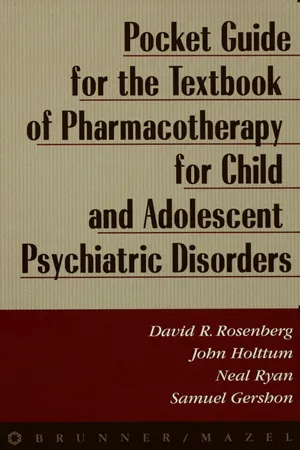
Pocket Guide For Textbook Of Pharmocotherapy
- 192 pages
- English
- ePUB (mobile friendly)
- Available on iOS & Android
eBook - ePub
Pocket Guide For Textbook Of Pharmocotherapy
About this book
The Pocket Guide for the Textbook of Pharmacotherapy for Child and Adolescent Psychiatric Disorders is a quick reference guide for psychiatrists, therapists, social workers, and other practitioners to give them the bottom line about each group of medications. This guide, which discusses the use of psychiatric drugs in patients under 18, accompanies this author team's complete book, Textbook of Pharmacotherapy for Child and Adolescent Psychiatric Disorders.
Clinical indications, dosage guidelines, side effects, common drug interactions and most tables are retained and updated in this new guide. In addition, the guide includes new research findings that have been published recently. This guide assumes the reader has done a complete assessment of all non-pharmacologic methods before treating the patient with medication. It also assumes that the reader has a working knowledge of the types of medication available for treating psychiatric illnesses. Once everything is taken into account, the practitioner can accurately determine the advantages and disadvantages of a specific treatment and relay that to the patient. Above all, the Pocket Guide for the Textbook of Pharmacotherapy for Child and Adolescent Psychiatric Disorders provides the reader with the practical guidelines to safely and effectively prescribe medication.
Information
Topic
MedicineSubtopic
Psychiatry & Mental HealthChapter 1
Introduction
In the preface to this handbook’s parent volume, Textbook of Pharmacotherapy for Child and Adolescent Psychiatric Disorders, the authors stated as a main purpose to provide “a practical guide to the use of modern psychiatric drugs in patients age 18 and under.” Great effort went into making certain the Textbook would be reader-friendly, and we have received very positive feedback not only from psychiatrists, but psychologists, social workers, therapists, nursing staff and students, medical students and residents, pediatricians, and family practitioners. We are delighted that the Textbook has been so well received, but with 554 pages and over 1,400 references, it may have fallen short of practicality. In truth, the original project was meant to be much more like what the reader is now holding—a handbook appropriate for quick reference in both inpatient and outpatient settings, and accessible to any professional involved in the mental health care of young people.
Only during the evolution of the Textbook did it become apparent that any condensed summary of the field ran the risk of becoming dangerously misleading. It is the nature of child and adolescent psychopharmacology that the needs of the patients outrun the state of the art. Clinical trials of medications in children are more expensive, draw from a much smaller subject population, and are complicated by ethical and health-related risks not encountered in comparable studies of adult psychiatric patients. Practitioners are sometimes forced to accept as established, treatments that are in reality only extrapolations of adult therapies. As discussed in Chapter 2, children are not (pharmacologically speaking) merely small adults.
The rational practice of psychopharmacology should obviously be based on scientifically controlled studies. Unfortunately, once the clinician gets away from the best-studied handful of child and adolescent disorders (e.g., obsessive-compulsive disorder and attention-deficit/hyperactivity disorder) there are very few or no definitive acute studies. Furthermore, nowhere in the field of pediatric psychopharmacology are there studies that give clear answers to questions about long-term treatment for prevention of relapse or recurrence. In light of this, the rational psychopharmacologist has been given the choice of either adopting a totally nihilistic approach by deciding that he/she knows too little to prescribe psychiatric medication for children at all (an approach the authors do not find inviting), or forging ahead by extending the data from open clinical trails, anecdotal reports, and perhaps controlled trials in adults to make the best possible decisions.
On a positive note, this disconcerting lack of controlled data for child psychopharmacology is likely to improve over time. Recent efforts by the Food and Drug Administration (FDA) to work with the pharmaceutical industry to support more studies in children and adolescents will be responsible for much of the improvement. In addition, the American Psychiatric Association and the American Academy of Child and Adolescent Psychiatry are working with clinicians to gather a large naturalistic database on clinical practice which should provide a tremendous amount of uncontrolled data useful for examining those questions which are not amenable to controlled study. Against this background it becomes obvious that a thorough understanding of pediatric psychopharmacology requires not only mastery of current practices, but full knowledge of the research bases for those practices, including the astounding lack of definitive research in most areas. Therefore, in the Textbook, brevity was ultimately sacrificed for scientific accuracy and completeness. In this regard, we are pleased that it is now being used as core material for several graduate and postgraduate courses in child and adolescent psychopharmacology.
However, our original aim, that of producing a quick reference handbook, did not disappear. In fact, some readers of the Textbook have virtually demanded a companion pocket guide to serve that purpose, a demand which has now been met in this Pocket Guide for the Textbook of Pharmacotherapy for Child and Adolescent Psychiatric Disorders. In this volume, readers will find the “bottom line” from each of the Textbook chapters. Clinical indications, contraindications, dosage guidelines, side effects and their management, common drug interactions, and most of the tables from the Textbook have all been retained and updated, while the comprehensive critical review of psychopharmacology has largely been omitted. For this reason, the Guide is not intended to be used as a clinician’s sole resource for prescribing practices, but as a portable companion to the Textbook, suitable for “quick looks” and in situ decision making.
For example, in the case of psychostimulants, the reader will find the practical information required to make day-to-day prescribing decisions in the Guide, but should also realize that this is one of the few areas in which controlled studies have established specific indications, outcome measures, pharmacokinetics, and dose/response relationships for patients under 18 years of age. Review of that research background can be found in the Textbook. Similarly, although the Guide states that monoamine oxidase inhibitors (MAOIs) have limited use in current practice, the clinician would be remiss if he did not also review the many clinical successes documented in past research on MAOIs. In the Textbook, one would discover the clinical potential of future compounds with a more favorable risk profile (such as moclobemide) in the treatment of attention-deficit/hyperactivity disorder (ADHD), anxiety disorders, and adolescent depression.
How to Use This Guide
Most chapters presuppose that the clinician has performed a thorough diagnostic formulation of the case in question. It is also assumed that conservative treatment measures have been undertaken in the forms of psychotherapy, environmental structuring, parent education and training, and behavioral therapy. Where appropriate, psychometric testing, medical evaluation, and neurological consultations will have been obtained before the Guide becomes useful. In other words, a comprehensive diagnostic assessment must be completed and all available non-pharmacologic interventions must be tried before treatment with a medication is considered. It is at this point that the clinician can accurately assess the risk/benefit profile of a particular pharmacologic therapy and communicate that assessment to the family.
The Guide further assumes that the clinician possesses a working knowledge of the classes of medication available for the treatment of psychiatric illness. For this reason, chapters are not organized by diagnosis, but by classes of medication. For example, once it has been decided that a heterocyclic antidepressant might be helpful, then review of Chapter 4 (Tricyclic Antidepressants) will provide the needed guidelines for selecting a specific compound, determining dosage, and scheduling follow-up examinations. If there is uncertainty regarding which medication classes can be used to treat a specific diagnosis or symptom, we advise using the index to locate treatment options for that condition. For the treatment of “anxiety” pertinent entries can be found in Chapter 4 (Tricyclic Antidepressants), Chapter 5 (Novel Antidepressants), Chapter 6 (MAOIs), Chapter 10 (Anxiolytics and Sedatives), and Chapter 11 (Adrenergic Agents).
Recent Developments
The authors have attempted to update the Guide to include all significant research findings available since the publication of the Textbook, literally up until the day the manuscript for each chapter was submitted. Nevertheless, time has passed between submission and publication and there are several new developments which bear mentioning. In the management of ADHD, for instance, newer products such as Adderall and guanfacine (Tenex) have seen greater acceptance, while two veteran treatments, pemoline (Cylert) and clonidine (Catapres), have lost some favor.
Adderall is a mixture of four amphetamine and dextroamphetamine salts previously marketed for weight loss as Obetrol. The positive reception of Adderall is at this point based on data from the pharmaceutical company and on anecdotal reports. No independent controlled trials or long-term reviews of side effects have been published as of this writing. However, it should be noted that during the brief withdrawal of the drug by the FDA (for technical reasons not related to safety) there was a surprising outcry from adults with ADHD and parents of children with ADHD who had been doing well on the medication. Clinicians might find it enlightening to monitor public opinion on such matters via the Internet. As of October, 1996, 34 million households in the United States had access to the Internet, corresponding to an incredible 35% of Americans, based on U.S. Census Bureau estimates. Even more remarkable is the fact that this figure has been doubling annually since 1988. Active support groups for patients and parents coping with ADHD, Tourette’s disorder, depression, bipolar disorder, and a variety of other issues are maintained through Internet newsgroups. And there is now a plethora of World Wide Web sites offering mental health information to the public and to clinicians. It has become necessary for physicians to be conversant in this relatively new form of information distribution, as it greatly affects the opinions and perceptions of their clients.
Recent concern over the safety of clonidine was sparked by a report of sudden death in three children taking clonidine and methylphenidate.1 However, it should be noted that none of these deaths could be directly linked to clonidine. One child had no detectable clonidine or methylphenidate in post-mortem blood analysis, the second had extensive fibrotic scarring of the heart thought to be congenital, and the third died after an intentional overdose of fluoxetine. Nevertheless, the need for close cardiac monitoring, especially early in treatment when previously unidentified congenital abnormalities might be uncovered, is underscored by this report.
Similarly, concern about the safety of pemoline was raised when a 14-year-old boy died abruptly of hepatic failure after taking the medication for 16 months.2 This is the third report of fatal pemoline-induced liver failure. Whether or not liver function tests were monitored in this case, and whether or not closer monitoring would have altered the course, are unknown.
In the wake of concern about clonidine, guanfacine has emerged as a probable replacement for use in aggressive, hyperactive children, and particularly for children with both ADHD and Tourette’s disorder. Also an alpha-2 adrenergic agonist, guanfacine causes less sedation and purportedly fewer cardiac side effects than clonidine. Most available data on guanfacine treatment are from open studies, but reports have so far been favorable.
Finally, research continues to find safer and more effective antipsychotic agents. Risperidone is mentioned in Chapter 7, and has seen some success in open trials for psychosis in children and adolescents. However, it has also been associated with substantial side effects in that population, including sedation, weight gain, and galactorrhea.3.4 Olanzapine is a newer antipsychotic, chemically related to clozapine, which has seen success in pre-clinical trials, but is virtually untried in children and adolescents. This agent is of interest because like clozapine, it shows high affinity for dopamine type-4 and 5HT2 receptors, and because unlike clozapine, no cases of agranulocytosis have been reported to date.
By the time the reader sees this Guide, some of it will be outdated. The authors choose to view this as a positive trend. For the first time in the history of child and adolescent psychopharmacology things seem to be moving rapidly. It is the authors’ wish that this book will provide the practical guidance necessary to safely and effectively prescribe medication (when medication is deemed necessary) for child and adolescent psychiatric disorders, but it cannot be used as a cookbook, and it certainly does not comprise the last words on the subject. The practice of pediatric psychopharmacology is itself in adolescence, necessitating that each practitioner participate in and contribute to the growth of our understanding of how best to serve these children.
References
1. Maloney, M.J., Schwam, J.S. (1996). Clonidine and sudden death [letter]. Pediatrics, 6, 1176–1177.
2. Berkovitch, M., Pope, E., Phillips, J., et al. (1995). Pemoline-associated fulminant liver failure: Testing the evidence for causation. Clin Pharmacol Ther, 57, 696–698.
3. Hardan, A., Johnson, K., Johnson, C., et al. (1996). Case study: Risperidone treatment of children and adolescents with developmental disorders. J Am Acad Child Adolesc Psychiatry, 35, 1551–1556.
4. Lombroso, P.J., Scahill, L., King, R.A., et al. (1995). Risperidone treatment of children and adolescents with chronic tic disorders: a preliminary report. J Am Acad Child Adolesc Psychiatry, 34, 1147–1152.
Chapter 2
Characteristics of Drug Disposition during Childhood
A child is not simply a small adult and so will have different pharmacokinetics (drug concentration at the effector site) and pharmacodynamics (drug action at the effector site and end response). Normal maturation results in changes in the physiologic determinants of drug disposition.
Regardless of the age of a child receiving a drug, the dispositional characteristics of the drug will depend on the interaction between the physicochemical properties of the drug and the physiologic process in the patient. Physical properties of the drug include molecular size, charge, pKa or ionic disassociation constant, and lipid solubility. These factors will determine the drug’s distribution, as well as the route of elimination. In general, water-soluble drugs have a small volume of distribution and can be eliminated unchanged in urine, whereas lipid-soluble drugs have a large volume of distribution and require metabolism to more water-soluble moieties prior to elimination.
Volume of Distribution (Vd)
The apparent volume of distribution is defined as the volume into which a drug distributes in the body when at equilibrium, and is related to the pool from which the drug concentration is measured. This theoretical concept reflects the partitioning of the drug among the physiologic compartments in the body.
Apart from the newborn infant, the volume of distribution is approximately linear with body weight. Thus, it is rational and common practice to modify initial loading-dose regimens to achieve a given initial plasma concentration rapidly by factoring in weight.
Protein Binding
Most drugs in plasma are reversibly bound to proteins, with acidic drugs binding predominantly to albumin and basic drugs to alpha-1-acid glycoprotein. Only unbound drug is capable of evoking a pharmacologic response. In general, serum albumin concentrations do not change from early childhood concentrations. The situation for alpha-1-acid glycoprotein is more complex. Higher concentrations of this acute-phase–acting protein are found in children, and t...
Table of contents
- Cover
- Halftitle
- Title
- Copyright
- Contents
- 1. Introduction
- 2. Characteristics of Drug Disposition during Childhood
- 3. Psychostimulants
- 4. Tricyclic Antidepressants
- 5. SSRIs and Newer Antidepressants
- 6. Monoamine Oxidase Inhibitors (MAOIs)
- 7. Antipsychotic Agents
- 8. Lithium
- 9. Anticonvulsants
- 10. Anxiolytics and Sedatives
- 11. Adrenergic Agents in Child and Adolescent Psychiatry
- 12. Opiate Antagonists
- 13. Consultation-Liaison Psychiatry—Pharmacologic Approaches
- 14. Treatment of Substance Abuse Disorders
- Index
Trusted by 375,005 students
Access to over 1.5 million titles for a fair monthly price.
Study more efficiently using our study tools.
Frequently asked questions
Yes, you can cancel anytime from the Subscription tab in your account settings on the Perlego website. Your subscription will stay active until the end of your current billing period. Learn how to cancel your subscription
No, books cannot be downloaded as external files, such as PDFs, for use outside of Perlego. However, you can download books within the Perlego app for offline reading on mobile or tablet. Learn how to download books offline
Perlego offers two plans: Essential and Complete
- Essential is ideal for learners and professionals who enjoy exploring a wide range of subjects. Access the Essential Library with 800,000+ trusted titles and best-sellers across business, personal growth, and the humanities. Includes unlimited reading time and Standard Read Aloud voice.
- Complete: Perfect for advanced learners and researchers needing full, unrestricted access. Unlock 1.5M+ books across hundreds of subjects, including academic and specialized titles. The Complete Plan also includes advanced features like Premium Read Aloud and Research Assistant.
We are an online textbook subscription service, where you can get access to an entire online library for less than the price of a single book per month. With over 1.5 million books across 990+ topics, we’ve got you covered! Learn about our mission
Look out for the read-aloud symbol on your next book to see if you can listen to it. The read-aloud tool reads text aloud for you, highlighting the text as it is being read. You can pause it, speed it up and slow it down. Learn more about Read Aloud
Yes! You can use the Perlego app on both iOS and Android devices to read anytime, anywhere — even offline. Perfect for commutes or when you’re on the go.
Please note we cannot support devices running on iOS 13 and Android 7 or earlier. Learn more about using the app
Please note we cannot support devices running on iOS 13 and Android 7 or earlier. Learn more about using the app
Yes, you can access Pocket Guide For Textbook Of Pharmocotherapy by David Rosenberg,John Holttum,Neal Ryan,Samuel Gershon in PDF and/or ePUB format, as well as other popular books in Medicine & Psychiatry & Mental Health. We have over 1.5 million books available in our catalogue for you to explore.