eBook - ePub
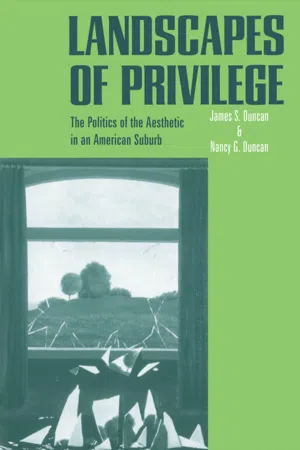
Landscapes of Privilege
The Politics of the Aesthetic in an American Suburb
- 262 pages
- English
- ePUB (mobile friendly)
- Available on iOS & Android
eBook - ePub
Landscapes of Privilege
The Politics of the Aesthetic in an American Suburb
About this book
James and Nancy Duncan look at how the aesthetics of physical landscapes are fully enmeshed in producing the American class system. Focusing on an archetypal upper class American suburb-Bedford in Westchester County, NY-they show how the physical presentation of a place carries with it a range of markers of inclusion and exclusion.
Information
CHAPTER 1
Introduction
One morning in 1993 we were sitting in the archives in the Bedford Town Hall leafing through the correspondence on a zoning controversy. An elderly gentleman walked into the room and said with a faint smile on his face, “So you’re back, are you? What are you finding we’ve done wrong this time?” We recognized him as J.Halstead Park, a descendant of the first white settlers in Bedford—an affluent suburb not far from New York City—and former chairman of the local historical society. We had interviewed him in the early 1970s for an article in which we argued that there were social divides in Bedford between an old WASP elite, a new upper middle class, and an old working class, and that landscape tastes played an important role in the performance of these groups’ identities. Halstead Park explained to us, “Don Marshall [the town historian] came to dinner one night to discuss what we should do with your article. We decided to bury it. It would have ruffled too many feathers.” With that, he wished us a good day, and was gone.
In 1999, the writer Alex Shoumatoff wrote an article for Vanity Fair on the “new” Bedford. He knows the town well, having grown up there, and his perceptive piece, part sociological study and part expose, focuses on the decline over the past two decades of an old Anglo Bedford upper class, of which his family (as Russian aristocracy) are well entrenched honorary members, and the rise of a new, more ethnically heterogeneous, ultra-wealthy elite. His article attracted a lot of letters to the editor in various local newspapers. One paper, the Record Review, published some interviews with long-term residents about Shoumatoff’s portrayal of the town (Lynch 1999b). Among those who felt aggrieved was Jim Renwick, a member of the Town Board whose family is descended from the first settlers. He dismissed the article as “trite, because it was about money, a very shallow subject.”
Before the middle of the nineteenth century, Bedford was a farming community dominated by a few families, some of whom trace their roots back to the first white settlers in 1680. In the 1870s, it began its long, slow transition into the affluent outer suburb that it is today. Since that time, there has been a tension between various social groups in town with differing claims to status, based upon wealth, education, taste, length of residence, and genealogy. We had touched on this tension in our article in the early 1970s when the old Bedford patrician elite was still a force to be reckoned with. Halstead Park “buried” our piece, not because he thought we were wrong, but because he believed that such status battles are best not aired in public. Class is considered a private topic that many Americans are reluctant to discuss. We were intruders and consequently our intervention was “airbrushed” out of town history. Shoumatoff’s more recent intervention, at a time when various traditional elites were feeling overshadowed by wealthy newcomers, was seen as a threatening, even traitorous act. We might add that it was also treated with bemusement by some who didn’t recognize “their Bedford.” But while an obscure article in the Geographical Review (Duncan 1973) can be buried, one in Vanity Fair cannot, and so it was dismissed by many as wrongheaded, trite, and vulgar, although it was much talked about and admired by some for its insightfulness.

Fig. 1.1 Map of Westchester County.
Local histories in the United States are rarely critical or overtly sociological; they are usually celebratory and serve to inculcate residents with traditional values. They are designed to fill them with pride and a sense of belonging. Such a commemorative history of Bedford written in 1955 by the town historian, funded and sold by the town, describes Bedford as “men and women and children who live together in a community, who have a common purpose and a common heritage from history, out of which they have fashioned a philosophy to be followed in striving for the fulfillment of that purpose.” And yet we can see even in such a celebratory statement an acknowledgment that homogeneity is achieved in part through imagination. An imagined community 1 is created out of historical narratives selected to shape the values of the town. The author admits as much when he says:
[S]ince the 250th anniversary in 1930 [when Bedford’s history had last been celebrated publicly] many new families have moved into the Township. Since then, moreover, hundreds of young people have been born in Bedford and some of them have grown to maturity. For these two classes of Bedford folk, there has been but little opportunity of readily obtaining authoritative information with regard to the Town’s history and traditions. (Barrett 1955, 6)
In this history and in a series of newspaper articles titled “Bits of Bedford History,” the town’s historian hoped to create a sense of community and a love of Bedford so that its new citizens would help to preserve it as a sanctuary from what he terms, “the buffetings of a too competitive world” (Barrett 1955, 112). He concludes, “To those who know its rich store of natural resources and its priceless heritage from history, the Town of Bedford is such a sanctuary” (Barrett 1955, 112).
We realize that our present book will be scrutinized by some residents anxious to see whose ox is being gored. In truth, we have no stake in the various status battles in town. Rather, our commitment is to describing in our own words, and in those of our informants, the role that aesthetics plays in the production of place and of identities, while commenting on the wider social consequences of such an aestheticized view of the world. Some, no doubt, will find it focuses on a Bedford that appears largely irrelevant to them. We readily acknowledge that it is selective in its focus principally on pastoral Bedford and on historic Bedford Village, only one of the three hamlets in the town. We explore the ways people produce their identities in and through places, especially homeplaces, such as houses, gardens, and home communities. We are interested in investigating some of the more conservative, defensive attempts at using one’s surroundings to establish individual, familial, and community identities. These identities are defined in large part against and in contrast to an outside world, what some have termed “a constitutive outside.” Homeplaces are the subjects of conscious design effort, even struggle, on the part of those who can afford to shape them aesthetically. But they are equally the materialization of inherent antagonisms, exclusions, unarticulated racism, and reactions to global complexity as a threat to “the local.” We explore the idea that place-based identities can be insecure, even among those with the resources (time, money, and skills) to create ideal settings in which to substantiate desired social identities. We argue that such a high degree of attention on the part of suburban residents to the visual, material, and sensual aspects of place and place-based identity leads to an aestheticization of exclusion. A seemingly innocent appreciation of landscapes and desire to protect local history and nature can act as subtle but highly effective mechanisms of exclusion and reaffirmation of class identity.
We have attempted to supplement existing studies of the constitution of places through exclusionary zoning and environmental legislation with a more social psychological understanding of the politics of place-making and attachment to homeplaces. We hope to achieve a fuller understanding of the cultural practices of producing places and place-based identity. The structural and institutional bases of reinvigorated localism in a globalizing world have too often been studied without more than a cursory reference to the sentiments and emotions behind place-making practices. Similarly, studies of sense of place, place attachment, and belonging are too often studied in isolation from the political-economic flows and processes that are central to place production. 2 Although the former more than the latter is the focus of our attention, we believe both need to be considered in their mutual constitution. We have attempted to discover something of the hopes and fears, longing to belong, sense of community, and insecurities of the residents of a town that is both inwardly focused and defensive of its imagined uniqueness and—at the same time— highly enmeshed in a regional, national, transnational, as well as global production of socio-spatial relations.
Bedford is a very old settlement, having been an agricultural village of the Canitoe and earlier Indian tribes before the arrival of English settlers in 1680. But it is the waves of urbanites who have moved there during the late nineteenth and early twentieth centuries who have had the most impact on the town, turning it into the affluent, Anglophile “lifestyle island” (Dorst 1990) that it is today. While keen to portray itself as a 300-year-old rural community, as a place apart from New York City—forty-four miles away—Bedford is, in a very real sense, a 120-year-old suburb, very much dependent on its socio-spatial and economic relations with New York City and several other sprawling centers of economic activity in Westchester sometimes referred to as “edge cities,” 3 including White Plains, Purchase-Rye, and the Tarrytown area.
Bedford evolved from a community of modest farmers dominated by a small local elite in the mid-nineteenth century into a suburb whose landscape was dotted with large gentlemen’s estates by the late 1920s. In the decades following the Depression and World War II, many of these large estates declined and some were subdivided. By the 1960s, Bedford had achieved a seedy look of elegant decay, a kind of classic upper-class American version of a picturesque English landscape, so aptly described by Lowenthal and Prince (1965). A second wave of settlement began after World War II, producing a mixture of large and relatively more modest houses.
In the 1980s and 1990s, in the years when Wall Street boomed, some new mansions were added to the landscape. Although these houses produced a degree of infill, residential zoning requiring four-acre minimum lot sizes in much of the town ensured that the landscape never changed dramatically from the time of the great estates. Wealthy New Yorkers and West Coast actors disillusioned with the glitzy, fast-paced life in Hollywood have found in Bedford a quiet retreat from the city and the social whirl. It would appear that in Bedford, as in many other places, with escalating globalization there is an increasing fear of placelessness 4 and a longing to belong that produces a kind of reterritorialization and search for traditional values, including localism and reinvigorated nationalism. In the United States, among other things, globalization has produced a nostalgia for small town communities. It is a longing for simpler, quieter, more wholesome places that have an air of historical authenticity and an aura of uniqueness about them, without forcing oneself to be divorced from the many benefits of globalization enjoyed by the more privileged members of society. 5 The sense of community that is longed for is more a symbol or aesthetic of community than the reality of close-knit social relations. In fact, as we will argue, community in places like Bedford has to a large extent been reduced to NIMBYism 6 and the collective consumption of romanticized landscapes of community. Whereas the residents of Bedford and similar communities are remarkably successful in their quest for autonomy, this is at least partially illusionary. As we will show, the town’s borders are in danger of being disrupted and transgressed by various transnational flows, most visibly migration from Central America.
We focus particular attention on Bedford Village and a surrounding estate area characterized by a beautiful landscape of rolling hills with horses grazing on open meadowland. Such a landscape requires a large amount of care and maintenance. It needs not only a lot of labor, but also a highly sophisticated political organization. Residents are extraordinarily vigilant and at times aggressive in protecting the quality of the landscape. Conservationists protect its brooks, ponds, bogs, and forests of spruce and hemlock with zeal. A majority of the town’s residents insists that Bedford retain its many miles of dirt roads, and the Historical Preservation Committee feels so strongly about preserving the villagescape that it has bought, restored, and continued to maintain many of the white wooden shops in the Bedford Village.
A 1997 article in the New York Times (West 1997), titled “Who needs a house in Beverly Hills? Stars now flock to wealthy but unassuming Bedford, N.Y.,” tells of “quiet Bedford“ being transformed by stars into an “in” place. As evidence, a map is produced showing all the famous people living in Bedford, including, among others, Mariah Carey, Chevy Chase, Glenn Close, Michael Crichton, Ralph Lauren, I.M.Pei, and George Soros. For many residents who had only known Bedford as the well-to-do, but sleepy town it was for a half century, its newly found popularity with the rich and famous beginning in the early 1980s has not been an entirely pleasant surprise. Longer-term residents are both proud to be associated with a landscape that attracts the attention of celebrities and worried that newcomers may bring unwanted changes to the landscape. Like Western tourists who seek “unspoilt” countries where they can return in fantasy to simpler ways of life, so Bedford and other attractive country towns located near large cities are sought out as places where one can lead a more wholesome, authentic life. The irony, as with tourism, is that the more people arrive seeking unspoiled landscapes, the more likely it is that the qualities that attracted them will disappear. The residents of Bedford are well aware of this dilemma and their attempts to deal with it have produced a virulent politics of anti-development. One of our tasks in this book is to explore the intended and unintended consequences of these politics. Another task is to examine the role of the landscapes of Bedford as a symbolic resource employed in the quest for social distinction—how residents are invested in this place, socially, psychologically, as well as economically.

Fig. 1.2 Map of Town of Bedford.
Landscapes are produced and lived in an everyday, practical, very material, and repetitively reaffirming sense. Identities are performed in and through landscapes. Here we use the terms “perform” and “performative” as J.L.Austin (1975) defined them—productive, in contrast to denotative—and also as Judith Butler (1990) uses them 7 —to mean everyday embodied practices, embedded in a spatial context that is as much constituted by social practices as it is constitutive of them. As performances of varying types of identity come together to produce a common landscape, it tends to become contested and potentially destabilized. Bedford is a site of aesthetic consumption practices in which the residents achieve social status by preserving and enhancing the beauty of their town. They accomplish this through highly restrictive zoning and environmental protection legislation and by preserving as much undeveloped land as possible through the creation of nature preserves. Thus we argue that romantic ideology, localism, anti-urbanism, anti-modernism, and an ethnic- and class-based aesthetic all lend a political dimension to the desire to live in a beautiful place such as Bedford. Further, we believe that the celebration of the natural environment, historic preservation, and the claimed uniqueness of a local landscape has often diverted attention away from the interrelatedness of issues of aesthetics and identity on the one hand and social justice on the other. The desire to protect nature and history and the seemingly innocent pleasure derived from natural landscapes has a complex cultural and political history that we explore in Chapter Three. Our thesis is that landscape as an aesthetic production acts as a subtle but highly effective mechanism of exclusion. The numbers and types of people who can live and work in Bedford are restricted through various social, economic, political, and legal practices, backed up by appeals to an unquestioned desire to preserve a valuable and unique sense of place. This might not have any significant social consequences if Bedford were, in fact, unique. However, as we demonstrate in our discussion of affordable housing in Chapter Five, many of New York City’s northern suburbs are characterized by similar exclusionary and aesthetic practices. As we explain, these practices are in effect subsidies to the rich that have the effect of reducing available land for the potential development of affordable housing.
Andrew Sayer (2000, 169) has argued that “contemporary cultural studies’ preoccupation with aesthetic values is evident in its focus on style and taste, indeed in the definition of its object of study as ‘the stylization of life’ (Featherstone 1994). There is less interest in moral-political values.” We agree; however, we also believe that these two types of value are in actuality inextricably bound and can be best theorized via the concepts of aestheticization and complex complicity. This we see, in part at least, as a process of displacement whereby moral-political issues can become obscured by attention to aesthetic concerns. We argue that the merely aesthetic often isn’t mere at all. The moral questions here are complicated by the issue of complicity. Christopher Kutz (2000) argues that individuals’ actions and lifestyles are implicated in harm done to others through their association with many other people and institutions. He says (2000, 1),
We find ourselves connected to harms and wrongs, albeit by relations that fall outside the paradigm of individual, intentional wrongdoing… [Although] we stand outside the shadow of evil, we still do not find the full light of the good.
Kutz offers a theory of complicity to replace the deeply ingrained modern individualistic conception of moral agency that exempts individuals from being held accountable for the consequences of joint action where their own contribution is small. He continues (2000, 5), “The individualistic conception drives a wedge between me and us, between private and public.” Because there is “no legitimate moral subject,” he argues (2000, 5), “corresponding to the we, responses to collective harms find no proper target.” We hope in this book to bring to peoples’ attention the interdependence between issues that are too often seen as separate. We hope to show that certain unquestioned goods, such as environmental conservation and historic preservation, may have unintended negative consequences for which individuals may not be accountable qua individuals, but with which they can be seen as complicit.
People in Bedford see landscapes as communicative of identities and community values. They speak of landscapes symbolizing—and even inculcating—political and moral values, as well as creating and conveying social distinction. They also know that their landscapes depend upon a politics of anti development. But while at a certain level being aware of this, for the most part they tend to naturalize their privilege, having no reason to trace the farreaching, unintended consequences and unacknowledged conditions of that privilege. This naturalizing tendency is greatly aided by the spatial structuring and fragmentation of local governments, which results in a high degree of local autonomy and inward focus that to a large extent obscures the regional impact of the collective consequences of their individual actions from them. Clearly our informants are far more knowledgeable than we are about many of the issues that we discuss. We reject any implication that people are in any sense mere agents of the structural processes that we attempt to illuminate. We do think, however, that human agency is a relational achievement with far-reaching institutional and natural histories that are difficult to trace. Consequently, we try to interpret our informants’ own interpretations from a critical, structural, and relational standpoint few of them would share, given the prevalence of the individualistic conception of moral agency.
A place like Bedford is highly interconnected into transnational flows and networks of power, privilege, and as we shall see in Chapter Eight, economically and politically driven migration. In fact some very well-known actors in these global networks live in Bedford. People like the financier George Soros; presidents of major New York banks, multinational companies, law and stock brokerage firms, and major world airlines; and large manufacturers such as Ralph Lauren live there. Regional and national level political organizations, such as the Civil Liberties Union, the Westchester Hispanic Coalition, the Center for Immigrant Rights based in New York City, as well as the Nature Conservancy and Westchester Land Trust, are examples of large-scale institutions that have been enrolled into networks that connect the towns of northern Westchester to the wider region, the nation, and beyond. It is clear that as institutions, such as foreign language newspapers and transnational labor migrant and other political organizations, move into the suburbs, towns like Bedford and Mount Kisco are becoming more highly connected and, from the point of view of nativist residents, increasingly exposed to unwelcome penetration by outside forces.
Since the late nineteenth century, Bedford’s elite has been cosmopolitan and urbane in its public and business life, but deeply a...
Table of contents
- Cover Page
- Title Page
- Copyright Page
- Dedication
- List of Figures
- List of Tables
- Acknowledgments
- Chapter 1
- Chapter 2
- Chapter 3
- Chapter 4
- Chapter 5
- Chapter 6
- Chapter 7
- Chapter 8
- Chapter 9
- Notes
- Bibliography
Trusted by 375,005 students
Access to over 1.5 million titles for a fair monthly price.
Study more efficiently using our study tools.
Frequently asked questions
Yes, you can cancel anytime from the Subscription tab in your account settings on the Perlego website. Your subscription will stay active until the end of your current billing period. Learn how to cancel your subscription
No, books cannot be downloaded as external files, such as PDFs, for use outside of Perlego. However, you can download books within the Perlego app for offline reading on mobile or tablet. Learn how to download books offline
Perlego offers two plans: Essential and Complete
- Essential is ideal for learners and professionals who enjoy exploring a wide range of subjects. Access the Essential Library with 800,000+ trusted titles and best-sellers across business, personal growth, and the humanities. Includes unlimited reading time and Standard Read Aloud voice.
- Complete: Perfect for advanced learners and researchers needing full, unrestricted access. Unlock 1.5M+ books across hundreds of subjects, including academic and specialized titles. The Complete Plan also includes advanced features like Premium Read Aloud and Research Assistant.
We are an online textbook subscription service, where you can get access to an entire online library for less than the price of a single book per month. With over 1.5 million books across 990+ topics, we’ve got you covered! Learn about our mission
Look out for the read-aloud symbol on your next book to see if you can listen to it. The read-aloud tool reads text aloud for you, highlighting the text as it is being read. You can pause it, speed it up and slow it down. Learn more about Read Aloud
Yes! You can use the Perlego app on both iOS and Android devices to read anytime, anywhere — even offline. Perfect for commutes or when you’re on the go.
Please note we cannot support devices running on iOS 13 and Android 7 or earlier. Learn more about using the app
Please note we cannot support devices running on iOS 13 and Android 7 or earlier. Learn more about using the app
Yes, you can access Landscapes of Privilege by Nancy Duncan,Nancy Duncan in PDF and/or ePUB format, as well as other popular books in Social Sciences & Human Geography. We have over 1.5 million books available in our catalogue for you to explore.