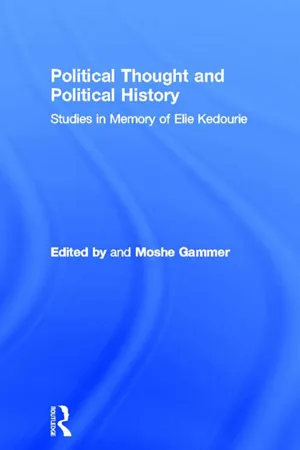
- 186 pages
- English
- ePUB (mobile friendly)
- Available on iOS & Android
eBook - ePub
About this book
This volume is limited to contributions by Professor Kedourie's previous students. It reveals the far-reaching range of his interests and the immense expanse of his horizons. The first part deals with philosophy, political thought and ideology and the second with history and politics.
Information
PART I
PHILOSOPHY, POLITICAL THOUGHT
AND IDEOLOGY
AND IDEOLOGY
1
Schiller's Theory of Aesthetic Semblance
Schiller's Theory of Aesthetic Semblance
PATRICK MURRAY
Schiller's theory of aesthetic semblance forms the content of Letter 26 in his major aesthetic treatise, the Letters on the Aesthetic Education of Man, which was written and revised during the period 1793 to 1795.1 In any discussion of these 27 letters it is helpful to have some overview of their structure and content. Letters 1 to 10 deal with Schiller's diagnosis of the political, ethical and above all psychological ills of contemporary society. Letters 11 to 21 are a philosophical discussion in which he tries to establish a conceptual model of the mind, a conceptual model of beauty, and attempts to interrelate these two models to show the potential beneficial effects of beauty for our psychological harmony. Letters 22 to 27 are concerned with the existential and practical aspects of beauty and art in historical, psychological and educational terms. It is important to distinguish two levels of discussion in the work. Many apparent inconsistencies, which scholars have claimed to notice in the work, arise through a failure to distinguish the philosophical treatment of beauty and mind (in Letters 11 to 21) from the practical and educational discussion of their existential reality (Letters 22 to 27).
The theory of semblance (in Letter 26) has to be seen as developing out of his earlier treatments in the Letters of the nature of beauty per se (in Letters 15 and 16), and the beautiful in art objects (Letter 22). Thus before turning to specifically examine his theory of aesthetic semblance, one has first of all to briefly look at his treatment of these related ideas.
The Aesthetic Letters were written in the aftermath of the French Revolution, and reflect Schiller's pessimism as to the prospects for political reform. He believed that the failure of the revolution, the degeneration of its high ideals into the Terror which followed, was due to men not being ready for freedom. He saw the great mass of men as slaves to their sensuous being, following their natural appetites and pursuing purely material ends. In Schiller's view, durable political reform can only be carried out by men who have become morally and psychologically harmonious within themselves.2 Only men who are free and rational within themselves can create a free and rational political state. To achieve this will necessitate a fundamental reorientation in men's psychology, and Schiller looks to the educative and formative power of beauty and art to effect this.3
In Letter 14 Schiller refers to the beautiful as an object which is for man ‘a symbol of his accomplished destiny’.4 Such an object, in its structural composition, has the same harmonious balance of rational and sensuous elements (or of form and content) that man ought to have within himself psychologically. Most men are ‘savages’ dominated by their sensuous nature. On the other hand, the ruling classes and the intelligentsia are ‘barbarians’, men dominated by their intellect and reason, at the expense of human feeling and emotion.5 The need is for psychological wholeness and the equilibrious balance of the two sides of man, reason and sense, in a manner reflecting the harmony of form and content which the object of beauty puts before us as a symbol of what we should be.
In Letter 15 Schiller proceeds to develop his definition of beauty a little further, calling any object that manifests beauty ‘living form’.6 This stresses that the relationship of form and sensuous content in the object is more than one of harmonious balance, but is a dynamic inter-relationship of these two aspects of its structural composition. One must not take a simplistic literal view of ‘living form’ as meaning the organically structured. Schiller makes it clear that lifeless stones can become the living form of sculpture. On the other hand, living things, for example a human being, may lack beauty7 and that dynamic interrelation of form and content that we recognize as beautiful only when we see it. The mere external mechanical conjunction of form and material content will not produce beauty. They are necessary, but not sufficient, ingredients of beauty. Schiller states that the process whereby they become sufficient to produce beauty in their mutual relationship is unknowable, that is, one does not know how or why in some instances their relationship produces beauty whilst in others it does not. One can only recognize beauty when one experiences it, not formulate it in advance of such an experience.8
As Schiller develops his concept of beauty throughout the Aesthetic Letters, from ‘symbol’ of our ‘destiny’9 to ‘living form’,10 to his treatment of the art object,11 and finally in its most complex form, incorporating the others, as ‘aesthetic semblance’,12 one must bear in mind that, throughout, Schiller is relating his discussion of beauty to the process of the aesthetic psychological development of the individual (or what he terms ‘aesthetic education’13). Thus in developing the notion of beauty as ‘living form’ , Schiller asserts beauty is more than just a symbol of our ideal psychological state, but is also capable of effecting a real psychological education so as to achieve this state.14 By this stage the ideal relationship of our own sensuous and rational natures has also been defined in terms of a dynamic interrelation (in Schiller's concept of the ‘play-drive’).15 This kind of paralleling of his psychological-educational discussion with his aesthetic theory continues throughout the treatise.
In Letter 16 Schiller briefly moves from the plane of ideal beauty to its existential reality. He says that
the highest ideal of beauty is, therefore, to be sought in the most perfect possible union and equilibrium of reality and form. This equilibrium, however, remains no more than an Idea, which can never be fully realized in actuality. For in actuality we shall always be left with a preponderance of the one element over the other…in which now reality, now form, will predominate… Beauty in experience will be eternally twofold.16
These two existential types of beauty are named as ‘Energising’ and ‘Melting’ beauty, according to the psychological effects that they have on the human subject in the course of aesthetic experience.17 Unfortunately, as is typical of Schiller's discussion in the Aesthetic Letters as a whole, there are no empirical examples as to what he is referring to here. He provides no concrete particulars to indicate in what objective form such types of beauty may be experienced. This is because his primary concern is psychological and educational, rather than aesthetic in the narrow sense. Hence, here he discusses how ‘Melting’ and ‘Energising’ can be put to psychotherapeutical use, in which each type of beauty can be utilized to act as a corrective to a one-sided character.18 However, the discussion is rather loose and speculative as no criteria for either psychological diagnosis or accurate psychotherapeutical prognosis are provided. At times one begins to feel that the aesthetic theory is too secondary to Schiller's psychological concerns, being dragged along behind it, and is merely being conceptually developed as required for his educational and psychological purposes.
In Letter 22 the discussion of beauty is in the context of a treatment of the art object. The requirement that beauty should produce the effect of psychological harmony within us is clearly restated: ‘The more general the mood and the less limited the bias produced in us by any particular art, or by any particular product of the same, then the nobler that art and the more excellent that product will be.’19
What Schiller is saying here is that the ‘excellence’ of a type of art, or a particular work of that specific type, is something we can subjectively evaluate in terms of its psychological effects upon us: ‘good art’ has a more general, less limiting, effect on us, affecting both sides of our being —thought and feeling. Such an evaluation is not easy though, for, as Schiller admits, we cannot always blame the art object if we bring to our aesthetic experience a one-sided predisposition towards either thought or feeling.20
Schiller continues his discussion of the art object by saying:
In a truly successful work of art the contents should effect nothing, the form everything; for only through the form is the whole man affected, through the subject matter, by contrast, only one or other of his functions. Subject matter, then, however…all embracing it may be, always has a limiting effect upon the spirit, and it is only from form that true aesthetic freedom can be looked for.21
Schiller, then, ascribes to the formal qualities of an art object its aesthetic value, a value seen in purely subjective or psychological terms. Form appeals psychologically to all our natures, powers and faculties, whereas some definite subject matter appeals to some particular nature or power. For Schiller, form is important for psychological equilibrium and wholeness. At least two criticisms can be made of this position. First, Schiller seems to again shape his aesthetic theory according to the requirements of his ideal psychological model and, in particular, he simply equates what is of aesthetic value with what is of psychological value. Why should not these two values clash? Second, he seems to have shifted his view of the nature of beautiful objects quite radically: from a dynamic interrelation of form and content, to now a form-dominated object in which content is clearly subordinated.
Schiller can be to some extent extracted from this second criticism by reference to his general educational programme in the Aesthetic Letters, in which he seeks to devise an aesthetic means of developing the mass of men from a life in which they are dominated by their sensuous being, to one of rationality and morality.22 Such an educational enterprise requires a form—dominated object, for Schiller holds the view that each side of the art object has the effect of developing the corresponding side of our being.23 However, in that case one may wonder why form should appeal to all our natures and powers, as Schiller claims, and not just to our rationality. Why, for example, could not a highly diverse...
Table of contents
- Cover Page
- Half Title Page
- Title Page
- Copyright Page
- Contents
- Contributors
- Preface
- Introduction: Elie Kedourie as Teacher
- Part I Philosophy, Political Thought and Ideology
- 1 Schiller's Theory of Aesthetic Semblance
- 2 Notes on the Concept of the ‘Civil Condition'
- 3 The Role of Education in the Development of Arab Nationalism in the Fertile Crescent During the 1920s
- 4 Islam vis-à-vis Communism and Socialism
- 5 Sun Yat-sen's Influence on Mu'ammar Qadhdhafi
- Part II History And Politics
- 6 Vorontsov's Campaign of 1845: A Reconstruction and Reinterpretation
- 7 Dating the Past: C.J. Edmonds and the Invention of Modern Iraq
- 8 Nahhas, the Arab League, and the Postwar Order: a Reinterpretation
- 9 The Causes of the Failure of Democracy in Iran, 1941–1953
- 10 The Arab Strategy Towards the Arab—Israeli Conflict, January 1964 to June 1967
- 11 Elie Kedourie's Teaching of Middle Eastern History
- Index
Trusted by 375,005 students
Access to over 1.5 million titles for a fair monthly price.
Study more efficiently using our study tools.
Frequently asked questions
Yes, you can cancel anytime from the Subscription tab in your account settings on the Perlego website. Your subscription will stay active until the end of your current billing period. Learn how to cancel your subscription
No, books cannot be downloaded as external files, such as PDFs, for use outside of Perlego. However, you can download books within the Perlego app for offline reading on mobile or tablet. Learn how to download books offline
Perlego offers two plans: Essential and Complete
- Essential is ideal for learners and professionals who enjoy exploring a wide range of subjects. Access the Essential Library with 800,000+ trusted titles and best-sellers across business, personal growth, and the humanities. Includes unlimited reading time and Standard Read Aloud voice.
- Complete: Perfect for advanced learners and researchers needing full, unrestricted access. Unlock 1.5M+ books across hundreds of subjects, including academic and specialized titles. The Complete Plan also includes advanced features like Premium Read Aloud and Research Assistant.
We are an online textbook subscription service, where you can get access to an entire online library for less than the price of a single book per month. With over 1.5 million books across 990+ topics, we’ve got you covered! Learn about our mission
Look out for the read-aloud symbol on your next book to see if you can listen to it. The read-aloud tool reads text aloud for you, highlighting the text as it is being read. You can pause it, speed it up and slow it down. Learn more about Read Aloud
Yes! You can use the Perlego app on both iOS and Android devices to read anytime, anywhere — even offline. Perfect for commutes or when you’re on the go.
Please note we cannot support devices running on iOS 13 and Android 7 or earlier. Learn more about using the app
Please note we cannot support devices running on iOS 13 and Android 7 or earlier. Learn more about using the app
Yes, you can access Political Thought and Political History by Moshe Gammer in PDF and/or ePUB format, as well as other popular books in Politics & International Relations & Middle Eastern History. We have over 1.5 million books available in our catalogue for you to explore.