- 348 pages
- English
- ePUB (mobile friendly)
- Available on iOS & Android
eBook - ePub
About this book
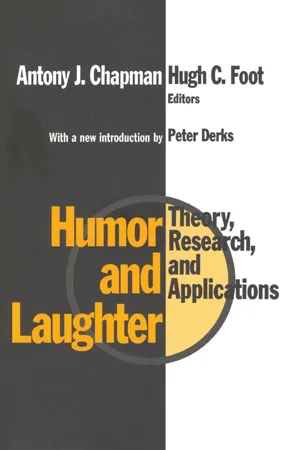
Humor and laughter play a vital part in our everyday social encounters. This book is concerned with the exploration of the psychology of humor and laughter by the foremost professional researchers in these areas. It examines the major theoretical perspectives underlying current approaches and it draws together for the first time the main empirical work done over the course of this century. Peter Berks brings this story up to the moment.The two major parts of the book deal with perception of and responses to humor, and its uses in society at large. The chapters themselves range from cognitive aspects of humor development, through the functions of humor and laughter in social interaction, to the use of humor by comedians and by the mass media. One of the general features of the volume is the concern with the variety of techniques and research methods which are used in studies aimed at understanding our responsiveness to humor and the contexts in which we create it.Humor and Laughter contains chapters by psychologists with longstanding research interests in humor and laughter, including Thomas R. Shultz, Mary K. Rothbart, Goran Nerhardt, Michael Godkewitsch, Walter E. O'Connell, and Harvey Mindess. Humor and Laughter presents wide-ranging theoretical, methodological, and empirical perspectives on an important area of human behavior and social interaction. This book should interest many behavioral scientists and practitioners, particularly those in social and clinical psychology, psychiatry, child psychology and education, sociology, and related disciplines.
Information
Section I
Perceiving and Responding to Humour
Chapter 1
A Cognitive-Developmental Analysis of Humour
This chapter is concerned with the ontogenetic development of humour appreciation, particularly with the cognitive aspects of this development. Answers are sought to questions of the following sort: What are the cognitive processes which are engaged during the appreciation of humour? What is the relation between the structural characteristics of the various forms of humour and these cognitive processes? How do these cognitive processes change with psychological development? And how are these developmental changes related to other more general aspects of cognitive growth?
Although the focus of this chapter is developmental, it is of course necessary to examine the cognitive nature of humour appreciation in adults. Any cognitive-developmental analysis must include the terminal stage towards which development progresses. The chapter begins with such an analysis of the cognitive processes used in adult humour and then travels backwards in ontogenetic time in an attempt to delineate the important developmental milestones that bring the child closer to this final stage. As will become apparent, the farther back the analysis goes, the less certain it becomes in terms of both theory and data. The younger the child, the less is known about the cognitive processes that characterize his appreciation of humour. In fact, for the very young child, the nature of humour itself becomes relatively uncertain.
Humour in Adults
In order to study the cognitive processes involved in humour appreciation, many theorists have attempted to identify the structural characteristics of those situations and events which produce humour. It is commonly assumed that, regardless of what the joke happens to be about, it has the same underlying structure as jokes dealing with other content areas. It is further assumed that the person’s cognitive processes must correspond to this universal joke structure in order for him to fully appreciate any given joke.
Analyses of humour material
If one decides to follow this strategy the next step is to develop a representative collection of humour which can be analysed for its structural properties. Substantial amounts of time and energy can be invested at this point in determining what constitutes humour and what does not. A number of criteria can be used to make these decisions: (a) Does the event elicit laughter or smiling? (b) Was it produced with the intention of eliciting laughter or smiling? (c) Would other members of the culture agree that it was an instance of humour? Each of these criteria can be applied in either an inclusive or an exclusive manner and they can be applied singly or in combination. Each criterion can be quantified to enable decisions about the intensity and consensus with which it can be applied to any given event. A great many events can be classified as humorous or not on all three criteria with little or no disagreement. And there are a great many borderline cases which can generate endless discussion and disagreement. The prudent humour researcher avoids these definitional controversies and proceeds with his research on issues of greater theoretical substance. This can best be accomplished by selecting humour stimuli which clearly satisfy all three criteria simultaneously. In this author’s experience, a good strategy is to use published collections of humour materials such as jokes, riddles and cartoons. These were clearly produced with the intention of eliciting humour, they do in fact elicit humour on empirical test, and most observers would agree to call them humorous. In addition, they are somewhat easier to analyse than many instances of spontaneous humour. This is because spontaneous, real-life humour may depend very much on the context for interpretation and appreciation. Published materials, while they may have at one time been spontaneous, can most often be adequately analysed without detailed knowledge of the surrounding context.
Once having chosen his sample of humorous materials, the cognitive theorist must then analyse their underlying structure. This is largely an intuitive process whereby the theorist attempts to abstract those structural features which are essential to the humour of large numbers of jokes which differ widely in content, Not all humour theorists have reached the same conclusions. Theorists such as Kant (1790), Schopenhauer (1819), Maier (1932) and Koestler (1964) have proposed that the structure of humour is characterized by incongruity. Incongruity is usually defined as a conflict between what is expected and what actually occurs in the joke. It is a concept which accounts well for the most obvious structural feature of jokes, the surprisingness of the punchline.
A number of other theorists, including Beattie (1776), Freud (1960), Willman (1940), Jones (1970), Shultz (1970) and Suls (1972), have argued that incongruity alone is insufficient to account for the structure of humour. They have proposed in various arguments that there exists a second, more subtle aspect of jokes which renders incongruity meaningful or appropriate by resolving or explaining it. Within this framework, humour appreciation is conceptualized as a biphasic sequence involving first the discovery of incongruity followed by a resolution of the incongruity. The mechanism of resolution is apparently necessary to distinguish humour from nonsense. Whereas nonsense can be characterized as pure or unresolvable incongruity, humour can be characterized as resolvable or meaningful incongruity.
In verbal jokes, the incongruity consists in the relation between the last line, or punchline, and the part that precedes the last line. Consider the old W. C. Fields’, joke where someone asked, ‘Mr. Fields, do you believe in clubs for young people?’ and he replied, ‘Only when kindness fails’. At first, his answer does not seem to fit with the question. Whatever expectations were set up by the question are disconfirmed by the answer. This incongruity can be resolved by noticing that part of the material coming before the punchline was ambiguous. The ambiguity in this case resides in the semantic ambiguity of the word ‘clubs’. After initially interpreting ‘clubs’ as social groups, the listener later discovers that ‘clubs’ could also refer to large sticks. A very similar joke was used by Groucho Marx who maintained, ‘I ought to join a club, and beat you over the head with it’. In a one-liner such as this, there is no strict separation between the punchline and the rest of the joke. Nevertheless, the second part of the statement is clearly incongruous in relation to the first part; and the resolution is based on the semantic ambiguity of ‘clubs’.
About half the verbal jokes this author has analysed are resolved on the basis of some sort of linguistic ambiguity. In addition to those resolutions based on lexical ambiguity or semantic ambiguity, resolutions based on phonological and syntactic ambiguities are quite common. Phonological ambiguity occurs when a given sound sequence can receive more than one interpretation. This often results from a confusion about the boundaries between words. An example is given in the joke where the teacher asks the student to construct a sentence containing the phrase ‘bitter end’ and the student replies, ‘The dog chased the cat and he bitter end’. This is quite an incongruous use of the phrase ‘bitter end’ until the listener realizes that it could also be interpreted as ‘bit her end’. Recent developments in transformational theory (Chomsky, 1965) have made it possible to distinguish two types of syntactic ambiguity. Surface structure ambiguity occurs when the words of a sentence can be grouped or bracketed (unlabelled) in two different ways with each bracketing expressing a different interpretation. An example of resolution by surface structure ambiguity is provided in the joke where the stranger asks, ‘Can you tell me how long cows should be milked?’ and the farmer answers, They should be milked the same as short ones, of course’. The farmer’s answer is incongruous but it can be resolved by re-interpreting the initial bracketing of (how long) (cows) as (how) (long cows). In the case of surface structure ambiguity, two different deep structures are projected onto two different surface structures. In contrast, deep structure ambiguity occurs when two different deep structures are projected onto a single surface structure. An example of resolution by deep structure ambiguity is provided in the following joke: ‘Did you know that the natives like potatoes even more than missionaries?’ ‘Yes, but the missionaries are more nutritious’. The initially incongruous reply is based on the ambiguity involved in the syntactic relations between key words in the question. In the first interpretation ‘missionaries’ serve as the logical subject of the verb ‘like’ and in the second interpretation as the logical object of ‘like’.
A great many verbal jokes have resolutions which depend on general, non-linguistic knowledge. An example is a joke discussed by Suls (1972) about a man who was tried for armed robbery and acquitted. His reaction was ‘Wonderful, does that mean I can keep the money?’ This is quite incongruous since it is an admission of guilt when the court has just found him innocent. According to Suls, the resolution is based on the idea that ‘courts make mistakes, that legal truth and actual truth do not always correspond, and that legal truth determines public consequences’ (1972, p. 91). In other words, he can in fact keep the money since, according to the law, he did not steal it.
The incongruity and resolution theory of humour is not restricted to verbal jokes. It has also been successfully applied to cartoons (Shultz, 1972, 1974c), children’s jokes (Shultz and Horibe, 1974), and riddles (Shultz, 1974b). While it may be somewhat extravagant to claim that the incongruity and resolution theory can account for the structure of every instance of humour, this author and others have found it to be of immense heuristic value in accounting for vast samples of humour. It has even been used to explicate the structure underlying jokes, riddles and humorous tales collected from the folklore literatures of a variety of non-Western cultures (Shultz, 1974a). Moreover, there has been no substantive body of humour which has proved intractable to an incongruity and resolution analysis.
Cognitive processing in the appreciation of humour
In addition to being useful in understanding the structure of humour, the incongruity and resolution theory has generated some interesting predictions regarding the cognitive processing of humour. The most general hypothesis is that the incongruity information is processed before the resolution information. Two recent studies were conducted to test the adequacy of this hypothesis in the appreciation of verbal jokes and cartoons by adult subjects (Shultz, 1974c). In the case of verbal jokes, one would expect that the order of information is severely constrained by the temporal nature of linguistic expression. This can be illustrated with W. C. Fields’ ‘clubs’ joke which was discussed above. As long as the recipient hears or reads the joke in its intended order, he should process the first element of the incongruity (Do you believe in clubs for young people?) before the second element of the incongruity (Only when kindness fails). The first or biased meaning of the ambiguity in the resolution (‘clubs’ as social groups) should likewise be processed before the second element of the incongruity. The only joke element which is not so severely constrained is the second or hidden meaning of the ambiguity (‘clubs’ as large sticks). Despite the fact that the hidden meaning of the ambiguity is embedded within the first element of the incongruity and potentially expressed at the same moment as the biased meaning, it should theoretically not be detected until after the second element of the incongruity has been processed. The dis-confirmed expectations produced by the second element of the incongruity presumably lead the recipient to search for a resolution in the form of the hidden meaning of the ambiguity. This last prediction is consistent with previous research indicating that linguistic ambiguities ordinarily go undetected unless one happens to be looking for them (Foss, Bever, and Silver, 1968). All of these predictions were confirmed using a self-report technique in which the subject read each joke and then ranked its four major elements according to the order in which he had first processed them.
Because cartoons are presented in a visual medium, it was expected that they would constrain the order of processing considerably less than do verbal jokes. This was based on the assumption that visual information processing is not subject to the same temporal constraints as is processing of verbal information. In processing cartoons, the subject can presumably direct his gaze towards any of the various aspects of the cartoon’s picture in any conceivable order. Also, he has the option of reading the cartoon’s caption before, after, or embedded within his processing of the picture. In some cartoons the resolution is quite explicit while in others it is only implicit. Using a self-report technique similar to that used with the verbal jokes, it was found that cartoons with implicit resolutions place more restrictions on order of processing than do cartoons with explicit resolutions. Resolution information that was only implied, but not actually present in the cartoon, was generally obtained only after the full incongruity had be...
Table of contents
- Cover
- Half Title
- Title
- Copyright
- Contents
- Introduction the the Transaction Edition
- Preface (1995)
- Preface (1976)
- Introduction
- Section I: Perceiving and Responding to Humour
- Section II: Using Humour
- Index
Trusted by 375,005 students
Access to over 1.5 million titles for a fair monthly price.
Study more efficiently using our study tools.
Frequently asked questions
Yes, you can cancel anytime from the Subscription tab in your account settings on the Perlego website. Your subscription will stay active until the end of your current billing period. Learn how to cancel your subscription
No, books cannot be downloaded as external files, such as PDFs, for use outside of Perlego. However, you can download books within the Perlego app for offline reading on mobile or tablet. Learn how to download books offline
Perlego offers two plans: Essential and Complete
- Essential is ideal for learners and professionals who enjoy exploring a wide range of subjects. Access the Essential Library with 800,000+ trusted titles and best-sellers across business, personal growth, and the humanities. Includes unlimited reading time and Standard Read Aloud voice.
- Complete: Perfect for advanced learners and researchers needing full, unrestricted access. Unlock 1.5M+ books across hundreds of subjects, including academic and specialized titles. The Complete Plan also includes advanced features like Premium Read Aloud and Research Assistant.
We are an online textbook subscription service, where you can get access to an entire online library for less than the price of a single book per month. With over 1.5 million books across 990+ topics, we’ve got you covered! Learn about our mission
Look out for the read-aloud symbol on your next book to see if you can listen to it. The read-aloud tool reads text aloud for you, highlighting the text as it is being read. You can pause it, speed it up and slow it down. Learn more about Read Aloud
Yes! You can use the Perlego app on both iOS and Android devices to read anytime, anywhere — even offline. Perfect for commutes or when you’re on the go.
Please note we cannot support devices running on iOS 13 and Android 7 or earlier. Learn more about using the app
Please note we cannot support devices running on iOS 13 and Android 7 or earlier. Learn more about using the app
Yes, you can access Humor and Laughter by Hugh Foot, Hugh Foot,Antony Chapman in PDF and/or ePUB format, as well as other popular books in Psychology & History & Theory in Psychology. We have over 1.5 million books available in our catalogue for you to explore.