Introduction to Dramatherapy provides a theoretical framework for the practice of dramatherapy, and examines the relationship between the 'self' and the 'other'; the understanding of which, the author argues, is key to harnessing the full potential of dramatherapy as a healing medium.
In Part 1, the individual is introduced in terms of the dramatic metaphor, concentrating on the central issue of identity and the mediation between the internal and external worlds. In Part 2 the elements that make up dramatic reality, specifically play, narrative and role, are examined, and in the final part we witness the value of dramatherapy in practice in practice in a range of clinical settings.
This is not simply a 'how to do dramatherapy' book - it provides an essential foundation in the theory of the subject that will be of great interest to those studying or practicing dramatherapy.
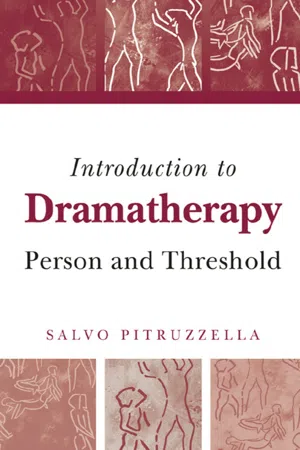
- 208 pages
- English
- ePUB (mobile friendly)
- Available on iOS & Android
eBook - ePub
About this book
Information
Part I
The theatre and the world
Remember that here you are nothing but an actor of a play, which will be brief or long according to the desires of the poet. And if he wants you to represent the character of a beggar, study to represent it properly. The same is true if the character assigned to you is that of a lame man, of a judge or of a common man. What is wanted from you is only to act well, whatever character is destined to you: to choose belongs to another.(Epictetus)
Chapter 1
Person
PERSON AND MASK
You are right to doubt everything, to say the very least . . . I remember myself as a little boy, when my father would come to bid me good night. Flickering and sputtering all the while, the candle would light up his face and it alone, and atrocious doubts would assail me: was that man really my father or was he perhaps an impostor? Was he even a man? And so on . . . In the end I would bid him good night with a sort of complicity, pretending not to notice, not wanting to make a fool of myself in front of him or to give in to my fears. . . . But what the devil am I saying! I’ve gone as far as to recount childhood memories!(Tommaso Landolfi 1958)
The word ‘person’
Words sometimes tell stories. The fortune of the word person has fascinated me for a long time. Used in many European languages to define the complete and complex totality of the single human being, it was formerly used, as is well known, to mean mask. Is this a reversal of meaning? Is it possible that the term used to denote an object, which helps to change one’s identity by concealing the previous identity (that of the actor) and assuming a new one (that of the character), succeeds in expressing the concept of the oneness and permanence of the individual? Or might it be useful to reflect upon possible shifts and intersections of the two semantic fields?
It is certain that during the Middle Ages the Latinate languages had to coin a new word to define the artificial face used in theatre or at carnivals (no longer in sacred places but in secular ones). There are no certain hypotheses to explain the origins of the word mask. In the folklore of northern Italy maschera or masca means the witch, an ancient and demonic creature.
In time, the term person came to be used to designate physical presence and appearance (we must not forget that the Greek equivalent prosopon also had the meaning of visage, or face).
Person draws the visible and recognizable outlines of the individual, and it implies being seen. We could even maintain that it is somehow the act of being recognized by another that bestows identity on the person. In Mozart/Da Ponte’s Don Giovanni, the protagonist slips into the rooms of Donna Anna in disguise. He is able to seduce her because she mistakes him for her fiancé, Don Ottavio. But Don Giovanni is not dressed to resemble Don Ottavio, nor does he give signs that can lead her to recognize him as such. It is Donna Anna’s process of discernment that allows the identification to take place.
Let’s try to reconstruct the scene: at first, she sees a figure. She must decide whether it is a shadow, a vision, or even a ghost. No, it is a person. At this point the second phase of the identification process begins, based on the characteristics of the context. Who can enter my room at this time? Donna Anna proceeds by elimination: it cannot be my servant, who would never enter my room without knocking, nor my father, who is not back yet, I know for sure. Who can it be then? The best solution is that he is my fiancé and future husband. In making this decision, Donna Anna completes the recognition process, even succeeding in identifying her beloved in the physical form of the person standing next to her. That generic person has become a particular Person with a name and a story.
Name and story, together with physical appearance, are elements that allow us to distinguish one person from another. In this sense we can consider the concept of person as a marker of the temporal continuity of identity. ‘Mario Rossi, son of Giuseppe and Maria Bianchi, born in Rome on 1 January 1980 married to Maria Verdi, etc.’ Name and story. In extreme cases, a photograph (a testimony of the form). But the name can be changed, and the story can be told in a thousand different ways. Our new neighbour, so polite and kind, can turn out to be a dangerous terrorist on the point of committing an attack. The same persons can be different people in different times and places. Even in absence of a deliberate deception, the same person can otherwise be perceived as different in different environments. A teenager, for instance, can be gloomy and touchy in his own family, and happy and easy with friends. Nevertheless, we wouldn’t hesitate to affirm that he is the same person. We start doubting when his actions are so radically different from a range of expectations (the width of the range depends only on us) that we state that he is not himself anymore. We may discover that our child is taking drugs; it is similar to the amazement of Ser Bernardone when his son, Francis of Assisi, appears naked before him. It is not the same person anymore.
So we can figure out Donna Anna’s shock when she realizes that the person standing before her is not whom she thought it was. How could this unveiling happen? We can try to imagine the signs through which, in the woman’s perception, a process of revision is established. What until now was a particular Person, with all the relational characteristics associated with him (affection, trust, etc.) returns suddenly to the rank (much more disturbing) of generic person. A smell, perhaps? Certainly something inherent to the physical body, and probably to the physical body in action. Not therefore the face, nor the attire (the scene1 takes place in a dimly lit place), but more likely the feelings provoked by physical contact (which, we can imagine, in the case of Don Giovanni is particularly upsetting), by the rhythm of gestures, by the distance placed between one person and another.
We have a person in front of us, undoubtedly, but the attributes we customarily use to recognize and therefore differentiate someone – name and story – are not available. What remains is a physical body, which enters our perceptive sphere and influences it, forcing us to activate cognitive and emotional processes that allow us to put it into a category, thoughtfully accepted or implicit:
That persons have material bodies is a necessary truth [. . .]. We cannot identify them without identifying material bodies, and what we must always use to identify, we have to regard as pertaining to the person’s identity.(Wilshire 1982: 149)
Person and body
There is an epistemological radicalism in Wilshire’s focus on the body as primary foundation of the person, putting aside at first the theme of the ‘I’, of self-awareness. The school of thought established by the Cartesian Cogito (I think, or I doubt) on the one hand defines man as the reference of man to himself in terms of reflection and conscience, opening the possibility of an ethics of individual responsibility; on the other hand it has introduced the ruinous mind/body dichotomy that has left its mark on Western thought, producing aberrations such as the exaltation of one of the two terms to the total detriment of the other. The derived metaphor of the body as a machine, with or without a ‘ghost’ in the driver’s seat, implies however a drastic idea of separation that experience refuses to accept:
As Merlau-Ponty, William James, and others have seen, we do not first recognize things and then we manipulate them, but, on a level of recognition that is discovery, manipulate and then recognize. It follows that the body is not first known and then set in motion in the world in terms of the already understood responses and skills of the body, but that the world is understandable only within the context of the already occurring, nonthematic, concernful manipulation and perception of the world, which world includes, as one eventual object of studies, the manipulative and perceptive body.(Wilshire 1982: 155)
At birth, the body of the child is both a physical object and a relational entity. It is provided with an external covering that separates it from the rest of the world and defines it, but to exist (in this case the concept of existence is dynamically interwoven with that of becoming), its covering needs to be permeable. The child needs constant interaction with the world, in terms of nourishment, of contact and of sharing feelings, thereby starting that process of discovery in which knowledge and manipulation are the terms of a unique event:
I must experience myself as a body identifiable from the others, so my identity must include how I experience others identifying and experiencing my body. Since in the normal course of events there is similarity of response to human bodies by human bodies, I must experience myself to be – and I must be – essentially similar to others.(Wilshire 1982: 149)
It is also of course a process of differentiation, in the sense that to survive I need to reach a point in which I am able to say ‘I’, to attribute intentions, desires, feelings and projects to myself, perceiving myself as a figure standing out against the background of the world. Otherwise we risk resembling Italo Calvino’s character who becomes a duck, a frog, a fish, then a pear. ‘Does he believe he is a duck? – He believes to be the ducks themselves . . . You know Gurdulù: he doesn’t pay attention’ (Calvino 1960). Gurdulù’s lack of attention is the loss of that distance that allows us to enter into a relationship with other things, first and foremost with other human beings, without being mimetically absorbed. The threat of absorption is always present:
The self is not being pegged in advance as a subject over against objects, but as involved essentially in a body which is pre-reflectively and non-thematically involved with others and in other things. [. . .] Because the body is ubiquitously but peripherally along with everything else in the field of experienced objects, it can be absorbed experientially in these objects. [. . .] The absorption of the experiencing body in the experienced object can proceed to the point where the along-with slips nonthematically into a magical or quasi-magical merging with the other, that being which officially (in Apollonian terms) one is not. The along-with slips into being with or being in.(Wilshire 1982: 156–57)
The feeling of losing oneself into another, in love or in tenderness, or even to lose oneself in things, as when listening to music, gazing at a landscape or observing a natural phenomenon, is something that we have all experienced. This happens because both differentiation/separation and mimetic involvement with the other are a unique dynamic process in the development of the individual, comparable to the systole/diastole cycle of blood circulation. I become myself by differentiating myself from others, from a basic condition of mimetic absorption. The first differentiation is of course from the mother through a progressive and painful separation, which influences one’s way of being in the world. John Bowlby (1988) has shown how many knots are tied on the attachment/separation/loss axis, making life unbearable for a lot of people. Bowlby considers the attachment to the mother from an ethological point of view, trying to go beyond the idea that dependency on the mother for nourishment is fundamental to the attachment process. He takes into consideration Konrad Lorenz’s observations on behaviour patterns of ducklings: ‘they develop a strong bond towards a specific maternal figure without the intermediation of food, since these small birds are not fed by their parents, but nourish themselves on insects’ (Bowlby 1988: 24). At this point ethology turns to the concept of ‘instinct’, which, as Gregory Bateson has shown, is an ‘explanatory principle, explaining everything that is needed to be explained by it’ (Bateson 1972: 75). To proceed from here becomes more delicate. Perhaps the instinct of the ducklings following their mother is the same as Gurdulù who dissolves in a raft of ducks. Gurdulù does not ‘believe he is a duck’, but ‘he believes to be the ducks.’ His ‘being the ducks’ is pure presence, ‘pre-reflexive and nonthematic’, to use the words of Wilshire once again, therefore a basic part of his own being in the world.
At the other end of the spectrum we have the knight Agilulfo who creates his identity through a sequence of rigid separations. Agilulfo has a name and a story, and possesses a coat of shining armour that makes him identifiable by friends and enemies, but he doesn’t have a body, and therefore doesn’t exist. Not having a body makes him impermeable to mimetic absorptions, saving him from possible related emotional troubles, but at the same time it prevents him from growing: the dimension of becoming is blocked.
To conclude, being oneself is based in the end on being a body, and as such being subject to a dynamic flow between the conditions of being mimetically involved with others and being free from such conditions.
Possession and absence
At times the object takes the upper hand and submerges the subject – what Wilshire calls mimetic engulfment – blocking the dynamic possibility that is the only guarantee of a balanced relationship with the world. When Norman Bates commits his crimes in Psycho, Hitchcock’s masterpiece of symbolic/visionary cinema, he is mimetically submerged by the figure of his dead mother. But Norman does much more. He takes on his mother’s whole identity, wearing her clothes and her hair. It is the inverse process of losing oneself in the other in love, in aesthetical rapture and in transcendence. In that case, one’s absorption in the other is a transport toward the other, a temporary but absolutely meaningful liberation from one’s boundaries, or at least from boundaries self-attributed to oneself as a separate entity.
In love, this transport is toward the other as another person, therefore necessarily as a physical body. Accordingly, the mimetic absorption is mutual: ‘You will be a single flesh.’ In aesthetical rapture and in transcendence, it is toward the immaterial world where people for millennia had believed that spirits dwell. The central theme of all the mystical doctrines is the fusion of the individual with an absolute and total spiritual reality, whose meaning cannot be grasped within the limited categories available to our reason.
In a case such as Norman’s, on the contrary, it is the other that takes over the individual, forcefully entering his body and taking abode. The mimetic absorption becomes an invasion, which forces the individual’s boundaries, and cancels all the attributions of the self (purposes, feelings and projects).
Plato called ‘divine folly’ the state of possession by a divinity. Of the various forms of divine folly listed by Plato, through which ‘the greatest goods are bestowed’, the purifying folly has particular relevance to our discussion:
Sometimes, following evil and huge sufferings, effects of ancient resentments of the gods, this folly was generated in some of the people; once the future was foretold, it suggested to the appropriate authorities the way to avert other calamities, and they resorted to prayers and religious ceremonies. Once a way out from the evil of the moment was found for the one who was divinely mad and possessed, it also made those taking part in the purification and initiation rites immune in the present as well as in the future.(Plato, Phaedrus: 244)
The purifying folly, called by Umberto Galimberti (1984) ‘initiatic possession’, is traditionally associated with the name of Dionysus. The origins of this mythological figure are complex and mysterious. They precede Hellenic civilization and vanish in the mists of time. The god of vegetation and fertility, of the phallus and of wine, of death and of rebirth, the stranger god, who came from somewhere else, has been compared to the Indian divinity Shiva, who plays the role of the destroyer, along with Brahma the creator and Vishnu the preserver.
Dionysus is particularly dear to the theatre: Greek tragedy evolved from ceremonies honouring this god. The name τϱαγωδία itself is derived from τϱάγος, the goat, symbolic of Dionysus, which was sacrificed in ceremonies dedicated to him. His is the first theatrical role endowed with an individual character. In the beginning only the choir or two dialoguing choirs existed. It is recounted that the legendary Thespis brought into the tragedy an actor who responded to the two choirs. Yποϰϱιτής, a term subsequently used to designate any actor, means the one who answers. This actor played the role of Dionysus.
Another symbol for this god besides the goat and the phallus is the mask, and it is almost certain that theatrical masks originate from the Dionysian masks used in rites. But the mask of the god can also stand alone, without a body sustaining it: it was adored by the devoted who danced around a tree or pole where it was hung. ‘The mask made the actor seem doubled in a strange way to the spectators: he was extraordinarily near and far at the same time’ (Kerényi 1976).
For these very reasons the mask founds the theatre. Unlike what happens in rites, in which wearing a mask implies divine possession and consequently the annulment of the individual in a process of mimetic engulfment, the theatrical mask, the Persona, allows the regulation of mimetic involvement, in that it includes the concept of absence. The mask of Dionysus in the temple of Ikarion was a sign of the god’s presence during his year of exile (within a two-year cycle; see Kerényi 1976).
At this point, person and mask, the two terms of the opening reflection, can be reconnected. I can be a person since as a physical body I am mimetically involved with others, but I can adjust this involvement by measuring the absence, as well as the presence, of the Other in me. I am perceived and recognized by others as a physical person, endowed with my own individuality and identity.
Th...
Table of contents
- Cover Page
- Title Page
- Copyright Page
- Acknowledgements
- Foreword
- Introduction: A Healing Theatre
- Part I: The Theatre and the World
- Part II: Foundations of Dramatherapy
- Part III: Dramatherapy and Its Applications
- Epilogue
- Afterword
- Appendix: Observation Grids
- Notes
- Bibliography
Trusted by 375,005 students
Access to over 1.5 million titles for a fair monthly price.
Study more efficiently using our study tools.
Frequently asked questions
Yes, you can cancel anytime from the Subscription tab in your account settings on the Perlego website. Your subscription will stay active until the end of your current billing period. Learn how to cancel your subscription
No, books cannot be downloaded as external files, such as PDFs, for use outside of Perlego. However, you can download books within the Perlego app for offline reading on mobile or tablet. Learn how to download books offline
Perlego offers two plans: Essential and Complete
- Essential is ideal for learners and professionals who enjoy exploring a wide range of subjects. Access the Essential Library with 800,000+ trusted titles and best-sellers across business, personal growth, and the humanities. Includes unlimited reading time and Standard Read Aloud voice.
- Complete: Perfect for advanced learners and researchers needing full, unrestricted access. Unlock 1.5M+ books across hundreds of subjects, including academic and specialized titles. The Complete Plan also includes advanced features like Premium Read Aloud and Research Assistant.
We are an online textbook subscription service, where you can get access to an entire online library for less than the price of a single book per month. With over 1.5 million books across 990+ topics, we’ve got you covered! Learn about our mission
Look out for the read-aloud symbol on your next book to see if you can listen to it. The read-aloud tool reads text aloud for you, highlighting the text as it is being read. You can pause it, speed it up and slow it down. Learn more about Read Aloud
Yes! You can use the Perlego app on both iOS and Android devices to read anytime, anywhere — even offline. Perfect for commutes or when you’re on the go.
Please note we cannot support devices running on iOS 13 and Android 7 or earlier. Learn more about using the app
Please note we cannot support devices running on iOS 13 and Android 7 or earlier. Learn more about using the app
Yes, you can access Introduction to Dramatherapy by Salvo Pitruzzella in PDF and/or ePUB format, as well as other popular books in Psychology & Addiction in Psychology. We have over 1.5 million books available in our catalogue for you to explore.