- 324 pages
- English
- ePUB (mobile friendly)
- Available on iOS & Android
eBook - ePub
About this book
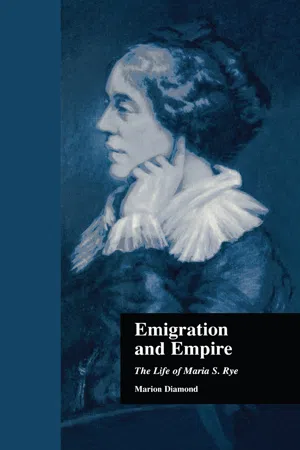
Maria S. Rye, a woman motivated by both feminist and philanthropic ideals, devoted her life to the migration of women and girls out of England. This biography gives an account of Rye's activities from her early engagement with liberal feminism through her association with the Langham Place group in the 1850s, her work as a journalist and with the Society for Promoting Women's Employment, through to her efforts in women's and children's emigration Between 1861 and 1896, Maria S. Rye sent many hundreds of single women out to Australia, New Zealand and South Africa, and more than four thousand children to Canada, all with the promise of a better life in the British colonies than they could expect at home in England. Like many nineteenth century advocates of emigration, she saw it as a panacea for many social ills, taking people from impoverishment in the old world to the hope of better prospects in the new. Unlike other advocates, she linked this enthusiasm for emigration with the ideals of liberal feminism, arguing that women and girls should share the opportunities for advancement that the colonies offered to men and boys Rye played a central role in developing organizations to facilitate the migration of women and girls, starting with the Female Middle Class Emigration Society in 1861. After 1869 she concentrated on the migration of so-called gutter-children to Canada, where her pioneering efforts were followed by numerous other philanthropic associates, such as Barnardo This biography analyzes how feminism and philanthropy intertwined in her activities, and how her early concerns with the rights of women to economic opportunity came to be over-ridden by an authoritarian streak that led to the tragic excesses of her work in juvenile migration.
Information
Chapter 1 A Chelsea Childhood
DOI: 10.4324/9780203775240-ch-1
Maria Susan Rye was born in 1829, the eldest of the nine children of a London solicitor. Her father Edward Rye was the son of a London wine merchant and the grandson of a Norfolk yeoman. He was typical of a new generation of rising men who, in the early nineteenth century, gradually established themselves through better education, profitable marriages, and careful investments as a new professional middle class, able to achieve a status, if not invariably an income, above the world of trade.
Edward's career began badly. In 1833 he formed a partnership with another lawyer, John Harris, but the two men quarrelled, and finally dissolved the partnership with many mutual recriminations and much expensive litigation. In time, however, he built up a large practice, mainly among wealthy Nonconformists.1 In 1828, he made a successful—that is, a profitable—marriage, to the daughter of Benjamin Tuppen, a successful builder from Brighton. Maria Tuppen brought with her a dowry of valuable property at Brighton, one of the fastest growing towns in England. The property rose in value over the course of her life and provided the couple with a secure rental income while Edward established himself in his profession.
The Ryes moved to Golden Square in 1830, the year after Maria's birth. Number 16 was ‘an old house panelled throughout, and tradition said it had once been the residence of the Spanish Ambassador, and that it was the house described by Dickens.’2 Today Golden Square is one of the finest squares in Soho, a cleaner version of the seventeenth century original, but when Charles Dickens wrote Nicholas Nickleby nine years after the Ryes arrived there, he described an area inhabited by people who were only on the borderline of truly polite society:
Although a few members of the graver professions live about Golden Square, it is not exactly in anybody's way to or from anywhere. It is one of the squares that have been; a quarter of the town that has gone down in the world, and taken to letting lodgings. Many of its first and second floors are let, furnished, to single gentlemen; and it takes boarders besides. It is a great resort of foreigners. The dark-complexioned men who wear large rings, and heavy watch-guards, and bushy whiskers, and who congregate under the Opera colonnade, and about the box-office in the season, between four and five in the afternoon, when the orders are given away—all live in Golden Square, or within a street of it... 3
Like many Victorian middle class families, the Rye family rose gradually over several generations from the yeomanry to trade to the professions. They needed both luck and good management to advance in this way. One feature of their rise was the attention they paid to educating sons for the professions; another was an astute eye for real estate. In Edward Rye's case, changes in his address clearly illustrate his changing fortunes.
Maria Rye, the eldest child, was born in 1829 at 2, Lower St James Street, his father's home,4 and the next two children, Elizabeth (1830) and Edward Caldwell (1834), were born at Golden Square. By 1835 Edward Rye's practice improved sufficiently for him to move his growing family to 14 King's Parade, Chelsea, while he kept the house at Golden Square for his business. Three more children, Mary Ann Cubitt (1837), Charles (1839) and Walter (1843), were born there, and to accommodate this growing family, in 1844, he bought 15 King's Parade next door and opened the two houses into a single large one. A further two children, Clara Louisa (1846) and Francis (1848), completed the family. Meanwhile he bought another small property in Golden Square to take the overflow from his business, and help to accommodate his library.
This growing material prosperity was costly in personal terms. According to his son, Edward Rye lost his entire inheritance in the 1830s when his partnership with John Harris failed and through bad investments on the stock market ‘at the time of the railway mania’. He was determined to rebuild his fortune, but the ‘process . . . was not a pleasant one to his family.’5 His day began with a three-mile walk from Chelsea to reach his Golden Square office by ten o'clock, and he seldom left for home until nine at night. Dinner was a solitary affair in Golden Square. These long hours affected the rest of the family. At home his parsimony governed the affairs of the whole household. Walter, the youngest son, recollected in his Autobiography ‘the hardships of living in a practically empty, carpetless house, in which a fire was only lit once a week, and that in the library.’ His sons bore the brunt of these hardships, sleeping in the attics ‘through the faulty windows of which the snow drifted every year’6—or so Walter claimed.
Edward Rye's one extravagance was his library; his books packed nearly every room of the house at Chelsea, and spilled over into the office at Golden Square. The rest of the family must have resented his extravagance when he indulged his hobby at the expense of his own family's comfort, but he was quite at liberty to do so: as husband and father, his word was law, his financial judgments beyond question. And the abundance of books ‘exercised a very good effect on all of us,’ said Walter; ‘when quite young we had acquired a strange lot of miscellaneous information, which has since often been of value to us.’7 In fact, despite a somewhat rudimentary education, they proved to be a clever and scholarly family. His sons went to St Peters Collegiate School in Eaton Square, but only until they joined the law practice at about thirteen years old. Maria Rye went for a short time to a school at Wokingham, until the family decided she was too delicate; after this, she and her sisters were taught at home by a governess.8
This separation of the boys and girls for education was common practice amongst Victorian families, but a clever girl like Maria bitterly resented the lack of any opportunity for serious schooling. ‘We take a family,’ she later wrote,
all branches of which, up to a certain age, are treated in precisely the same manner; their privileges, duties, studies, are alike; but at a given period the boys, who, until that hour, have not evinced the slightest superiority in perception, or exhibited greater aptitude for receiving knowledge, are suddenly removed, and enter upon a course of study, which, from long experience, is well known to brace the mind, produce accuracy of judgment, and give a considerable insight into the realities of after-life; the girls, on the contrary, remain in the lowland of elementaries for some three or four years more, after which they are advanced into the prettinesses of certain frivolities, better known under the general head of “accomplishments;” but, as nothing under the existing regime is accomplished, finished, or completed, we must be allowed to consider that term absurdly inappropriate.9
At least she had the run of the library, and she read widely amongst her father's books, developing a preference for history. She disliked popular novels, the normal fare of young ladies: ‘a good novel,’ she wrote, ‘damp from the printer's . . . is good to kill time or to cure the sulks;’ but it was also ‘a capital excuse for laziness; a powerful anodyne for conscience; a reason for putting off the reading of the Bible; an easy way of teaching slang, cant, &c., to the rising generation; an introduction for our daughters to low society of both sexes . . . and an easy and cheap way of exercising sympathy and benevolence without spending a sixpence or stirring a step!’10 In any case, as the eldest daughter of a large family, she had little time for reading novels, for girls had many domestic duties. Sewing was a chore: ‘Don't you well remember,’ she recalled,
sitting on your mother's knee and learning to sew? or, if not placed so high, at least can recall your post on the little stool at her feet, and how the long strip of muslin, or Harry's new pocket handkerchief, folded over your wee finger, was continually held up for inspection, as stitch succeeded stitch?. . . however the men may talk, women don't take intuitively to their needle and patching, but... a great many of us look with a very uncivil eye on the very necessary, if ignoble, arts of stitching, sewing, and darning … 11
She also contributed to her father's legal practice as an unpaid copyist. She learned ‘law-copying’, the skilful transcribing of legal documents in the approved ‘legal’ hand. The law, with its vast demand for paper, supplied work for a large underclass of scribes and copyists. Edward Rye saved money by training his daughter to do it.
Despite the apparent harshness of their upbringing, childhood in Chelsea had its compensations. The Ryes were all physically active and vigorous, and Chelsea suited their outdoor temperaments. The suburb was still largely rural, with open fields and lanes separating the parish from Kensington. Love Lane and Walnut Tree Walk were ‘beautiful country lanes’ and ‘our favourite entomologizing grounds’,12 while the Hammersmith Marshes were ‘as wet and primeval as any Norfolk Broad’. The brothers shot ‘snipe in Broom House Lane, rabbits on Wandsworth Common, and a hawk at Parson's Green’.13
Certain undertones mark this family off from the stereotypes of Victorian domesticity. There seems to have been little affection between Edward Rye and his children. Indeed, there are hints of a fierce battle of wills between the generations. Unusually for his day, Edward Rye left his entire estate to his widow Maria, unencumbered by any provisions for either sons or daughters. His sons were sent to good schools, but only briefly, and got no further help to establish independent careers. Instead they worked in the law firm for pocket money only. Walter eventually took over the practice, but the transfer was grudging. Although he had worked there since the age of thirteen, his father gave no favours to his son. Walter had to buy the practice, apparently at market rates, although he had to borrow from his friends to do so. His hostility to his father pervades his Autobiography, for he blamed his father's extreme parsimony, and the Spartan regime he imposed, for ‘the seeds of the consumption which killed’ his brother Frank.14 Another son, Charles, died in his early teens, possibly of cholera.
However even the strictest fathers often treat their daughters more indulgently, and an eldest daughter has special privileges. Maria, unlike her youngest brother Walter, could remember the early years, before her father's law firm began to flourish, and she was therefore more sympathetic towards the ingrained financial anxieties that led her father to neglect his family. She was a young woman, visiting friends outside London, when she wrote her first letter home in 1854. ‘My dear Father,’ she began, ‘I am sure you will remember, if I do not remind you that this is the first letter I have ever written to you, that it is so, has certainly not been from any want of affection, but from my not liking to intrude on your time which I know is so fully occupied. However I have been thinking lately that however much I may love you, you cannot know it unless I tell you, & though you might not have time to write, you yet might have leisure to read.’15 Of all the letters Maria Rye must have written to her father, this one alone survives. Perhaps it touched him too deeply to be thrown away like the others.
Most curiously, in an era when marriage was seen as the only appropriate vocation for a woman, not one of Edward Rye's four daughters married. Nor did his granddaughters, the daughters of Edward Caldwell and Walter Rye. Such a record is remarkable. It cannot be explained solely by reference to the ‘surplus woman problem’, that excess of women over men in England that so perplexed Victorian opinion makers. Even without substantial dowries, other women of their class married, and it is hard to explain why none of the Rye women found—or accepted—a husband.
We do not know whether their spinsterhood was self-chosen, or imposed by circumstances. Perhaps the atmosphere of the Rye household discouraged a young woman from putting herself under the legal and financial domination of a man. Perhaps Mary-Ann Tuppen, their maiden aunt, offered an alternative model to that of their frequently pregnant and sorely tried mother.16 In the eyes of the world, their spinsterhood branded them as failures, but it is by no means clear that Maria, Bessie, Annie and Clara saw themselves in any such light. What is, however, certain is that by failing to marry the Rye women seriously jeopardized their financial security, and put at risk their social status in a patriarchal world.
Urban professionals such as the Ryes were part of the ‘uneasy classes’, middle class but vulnerable to financial catastrophe. The income of the landed gentry came from the rent-roll of property. This property needed careful management but the gentry could nonetheless be called a leisured class. The professional classes, on the other hand, depended on the hard work of father and sons to maintain their financial position, whereas the role of the wife and daughters was to demonstrate the family's gentility by emulating the leisured classes and withdrawing from the public world of work. Leisure, which defined the family's status, was the prerogative of the women—although ‘leisure’ inadequately characterizes the multifarious domestic tasks needed to run an average Victorian middle-class household. The role of unmarried daughters was to be decorative and decorous, to contribute to the smooth and economical running of the household under the supervision of their mother, to share in the care of younger children, and to marry appropriately from amongst their father's or brothers' circle of friends and business associates. Such a social division between over-worked male and under-worked female could be a recipe for fraternal conflict, particularly when daughters remained within the household into adulthood.
The security of landed property lay not only in the relatively unobtrusive way it produced an income, but in the protection it gave to widows and unmarried daughters, whose financial welfare was secured against the landed estate. Middle-class professional families did not have this security, for the household'...
Table of contents
- Cover Page
- Half-Title Page
- Title Page
- Copyright Page
- Table Of Contents
- Abbreviations
- Acknowledgements
- Introduction
- Ch. 1. A Chelsea Childhood
- Ch. 2. With the Ladies at Langham Place
- Ch. 3. Solutions for Surplus Women
- Ch. 4. New Zealand
- Ch. 5. Australia
- Ch. 6. An Emigration Agent in London
- Ch. 7. A New Field in Canada
- Ch. 8. ‘Our Gutter Children’
- Ch. 9. Our Western Home
- Ch. 10. Emigration and Empire
- Bibliography
- Index
Trusted by 375,005 students
Access to over 1.5 million titles for a fair monthly price.
Study more efficiently using our study tools.
Frequently asked questions
Yes, you can cancel anytime from the Subscription tab in your account settings on the Perlego website. Your subscription will stay active until the end of your current billing period. Learn how to cancel your subscription
No, books cannot be downloaded as external files, such as PDFs, for use outside of Perlego. However, you can download books within the Perlego app for offline reading on mobile or tablet. Learn how to download books offline
Perlego offers two plans: Essential and Complete
- Essential is ideal for learners and professionals who enjoy exploring a wide range of subjects. Access the Essential Library with 800,000+ trusted titles and best-sellers across business, personal growth, and the humanities. Includes unlimited reading time and Standard Read Aloud voice.
- Complete: Perfect for advanced learners and researchers needing full, unrestricted access. Unlock 1.5M+ books across hundreds of subjects, including academic and specialized titles. The Complete Plan also includes advanced features like Premium Read Aloud and Research Assistant.
We are an online textbook subscription service, where you can get access to an entire online library for less than the price of a single book per month. With over 1.5 million books across 990+ topics, we’ve got you covered! Learn about our mission
Look out for the read-aloud symbol on your next book to see if you can listen to it. The read-aloud tool reads text aloud for you, highlighting the text as it is being read. You can pause it, speed it up and slow it down. Learn more about Read Aloud
Yes! You can use the Perlego app on both iOS and Android devices to read anytime, anywhere — even offline. Perfect for commutes or when you’re on the go.
Please note we cannot support devices running on iOS 13 and Android 7 or earlier. Learn more about using the app
Please note we cannot support devices running on iOS 13 and Android 7 or earlier. Learn more about using the app
Yes, you can access Emigration and Empire by Marion Diamond in PDF and/or ePUB format, as well as other popular books in Social Sciences & Social Science Biographies. We have over 1.5 million books available in our catalogue for you to explore.