eBook - ePub
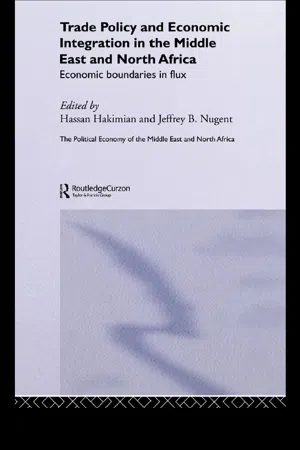
Trade Policy and Economic Integration in the Middle East and North Africa
Economic Boundaries in Flux
- 320 pages
- English
- ePUB (mobile friendly)
- Available on iOS & Android
eBook - ePub
Trade Policy and Economic Integration in the Middle East and North Africa
Economic Boundaries in Flux
About this book
The recent globalization trends have revived a long-standing interest in regional integration in the countries of the Middle East and North Africa (MENA). Despite numerous attempts to encourage economic integration in MENA in the past few decades, there is broad consensus that progress has been painstakingly slow and the record of economic integration in the MENA region largely beset by failure.
This book examines the impact of recent changes in the world economy on trade policy within the MENA region and its economic relations with the rest of the world. It considers regional integration and prospects for trade blocs; trade liberalization and economic restructuring; resource endowments and employment trends; and changes in economic boundaries, especially as a result of labour migration and regional conflicts.
Part I
Past trends and future prospects for growth in MENA
1
Reform and elusive growth in the Middle East—what happened in the 1990s?*
Dipak Dasgupta, Jennifer Keller, and T.G.Srinivasan
1 Introduction
Achieving faster economic growth is a major economic objective and undertaking economic reform provides a main rationale for attaining this objective. The ‘Washington consensus’ of the early 1990s has long advocated a certain set of core reforms as essential in a rapidly globalizing world: minimum standards of macroeconomic stability, and structural reforms to foster openness and an appropriate investment environment. But since the late 1990s, questions are being asked as to whether these reforms are having their intended effects. Despite apparent reforms—albeit not to the same extent in all countries and areas—the growth performance of many developing countries and regions has often been disappointing. Countries in the Middle East and North Africa (MENA) region are no different in their experiences with reform and growth in the past decade.
The political and social implications of reforms and the expected economic growth outcomes are crucial to the success of reform efforts. This is especially critical in the MENA region because of its prevailing unemployment problem. The region’s labour force has grown by about 2.8 per cent a year in the 1990s—roughly the highest rate in the world—while job opportunities have been lagging. Although rapid labour force growth can be a ‘demographic gift’ in the right circumstances, it can also create enormous social problems in the face of lagging job opportunities. Formal unemployment rates in the region (outside of the Gulf Cooperation Council or GCC countries) now average close to 25 per cent, the second highest in the world.1 In some countries—Algeria, Iran, Syria, Libya, Yemen—as much as one-third of the labour force is unemployed. Even the GCC economies, with comparatively low unemployment rates of about 5 per cent on average, have begun to experience growing unemployment among their national populations. The absence of growth combined with rapidly rising unemployment has also coincided with falling real wages in the region—as is to be expected. Consequently, the crisis of growth in the MENA region since the 1980s has translated into an ‘unemployment crisis’, which could spill over into a larger poverty crisis (which the region has so far managed to avoid in most places because of the presence of formal/informal and implicit or explicit social safety nets). Unemployment often impacts young jobseekers the most, contributing to a potentially explosive social situation. Unemployment rates for those under 25 are about twice as high as national averages in Algeria and Tunisia, and as high as two and a half to three times higher in Lebanon and Iran. But this age group is also better educated; hence, unemployment may also potentially be a powerful force for change and a spur to further reforms.
In this context, the main purpose of this chapter is to understand the actual relationship, if any, between reform and growth in the MENA region, especially in the 1990s, benchmarked against the performance of other developing regions and countries. Since the large fall in international oil prices in the mid-1980s, most MENA countries have experienced a marked slowdown in their growth and/or suffered macroeconomic crises. This has forced the adoption of widespread economic reforms and restructuring (albeit to varying degrees) to re-establish stability and to diversify such economies away from oil and from a public sector to a private sector-led growth.
Yet, to many observers within and outside the region, the pay-offs in terms of accelerated growth in the region have been elusive. Regional Gross Domestic Product (GDP) growth averaged 3.2 per cent a year over the 1990s, higher than in the 1980s (2.7 per cent a year), but still not the rebound one might have wished, or expected, to see following a decade of stagnation. On a per capita basis, economic growth averaged less than 1 per cent a year.2 Outside the Gulf economies, growth has been somewhat healthier, averaging 3.5 per cent per year, but remains weak on a per capita basis. This leads us to ask the following questions: Were the reforms inadequate? Were they directed at the wrong areas? Or does exclusive focus on reforms miss acknowledging some other vital ingredients for faster growth—such as improved governance, the role of market institutions, the end of conflict, and favourable geography? This chapter attempts to provide an evaluation of these broad questions.
The structure and principal conclusions of the chapter are as follows: Section 2 examines the relationship between oil prices and aggregate growth to set the context for understanding the factors that affect growth outcomes. Section 3 measures the actual reform effort and its intensity in the diversified economies of MENA. A variety of indicators are used to approximate the choice of policies and instruments (rather than outcomes, which are often wrongly used to measure policy effort). It will be seen that MENA countries have indeed undertaken sizeable reform efforts, but the main area of progress is in macroeconomic stability (expenditure reductions, lower inflation) rather than in core structural reform. In terms of structural reforms (trade policy, private investment environment), MENA countries are latecomers, with significant policy moves in this area only happening from the mid-1990s onwards. This applies to all of the countries we would classify as diversified economies (Morocco, Egypt, Tunisia, and Jordan), which are rated in the chapter as slow or gradual reformers.
Section 4 then turns to a detailed discussion of the sources of growth in MENA from an accounting perspective, and focuses on both trends in factor accumulation and total factor productivity, and their qualitative effect on the extent of reform undertaken. Four main conclusions emerge. First, reform has indeed had a significant growth pay-off, as average annual per capita growth switched from a negative -0.7 per cent in the 1980s to a positive 1 per cent in the 1990s—a swing or turnaround of nearly two per centage points. Second, virtually all or more of this has come from a dramatic turnaround in total factor productivity growth, which was a huge negative -2 per cent a year in the 1980s and improved to a small negative -0.3 per cent in the 1990s. In six out of the ten countries in the region, indeed, total factor productivity (TFP) performance improved relative to the world performance. Third, the principal reason that growth has still not taken off within most of the MENA region (from a supply-side point of view, and abstracting from the income effects of lower oil prices) is the collapse in factor accumulation, especially physical capital. Public investment has certainly fallen, as to be expected with fiscal adjustments. But equally, private investment has neither taken up the slack nor responded vigorously to reforms. In the 1990s, investment has declined dramatically, and without exception, across the region. Fourth, preliminary evidence using cross-country regression panel data including the MENA countries seems to suggest that the macroeconomic reform effort has had the greater positive (and significant) association with improvements in aggregate growth and in total factor productivity. By contrast, the ‘Structural Reform Index’ shows no significant or discernible impact so far. However, this work needs to be extended and examined much more carefully, before any definite conclusions can be drawn. Finally, countries that rank high on an index of sustained total factor productivity growth appear to be those that are successful in rapid diversification, openness, and macroeconomic stability, while countries at the bottom tend to be those that are relatively heavily reliant on primary resources, relatively un-diversified, and subject to larger macroeconomic volatility.
The findings in the chapter represent work in progress and should be seen as a contribution to more careful testing and analyses in future research and debates.
2 Oil prices and growth in the MENA region
Oil has an unusual degree of importance for MENA countries. Three different typologies can be constructed. The first consists of the core set of OPEC oil producers (Bahrain, Kuwait, Oman, Qatar, Saudi Arabia, and the United Arab Emirates—the so-called GCC states), whose economies are dominated by oil and whose objective function is arguably to maximize long-run oil prices and rents in global energy markets. The second comprises larger and more populous OPEC oil exporters (Iran, Algeria, Syria, and Iraq), whose economies are also dominated by oil, but whose objective functions are more diverse (in diversifying their economies away from oil). The third is the set of diversified economies (Egypt, Morocco, Jordan, Yemen, and Lebanon), whose oil exporting sectors are either relatively small or non-existent, but which are still relatively reliant on oil markets either directly as exporters or indirectly for regional export markets for traded goods or labour (worker remittances) and capital inflows from richer regional oil exporting countries.
Real oil prices (measured in $1990 per barrel) collapsed after 1985 and reached a new low in the late 1980s, before recovering modestly in the aftermath of the 1990 Gulf War (see Figure 1.1). Following that, oil prices again fell steadily during much of the 1990s, reaching a low in 1999 (of less than $10 a barrel). Only since the closing months of 1999 have oil prices recovered sharply, to reach $30 per barrel. Much of the period under examination has, therefore, been one of a dramatic fall in oil prices in real terms.
What has been the relationship between such trends in oil prices and regional GDP growth, differentiated by the three different typologies described above? For the region as a whole, the relationship is mixed, as shown in Figure 1.2. More precisely, during the 1970s until 1988 (the period when oil markets were heavily cartelized), it is possible to identify a counter-cyclical relationship—rising oil prices matched by falling GDP growth and vice versa. Since the late 1980s, though, that relationship has broken down and ...
Table of contents
- Cover Page
- Title Page
- Copyright Page
- Figures
- Maps
- Tables
- Contributors
- Preface and Acknowledgements
- Introduction
- Part I: Past Trends and Future Prospects for Growth In MENA
- Part II: Integration Patterns, Trade Blocs, and Regional Policy
- Part III: Trade and Restructuring: Lessons and Outcomes
- Part IV: Resource Endowments, Factor Markets, and Employment Issues
- Part V: Economic Boundaries In Flux
Trusted by 375,005 students
Access to over 1.5 million titles for a fair monthly price.
Study more efficiently using our study tools.
Frequently asked questions
Yes, you can cancel anytime from the Subscription tab in your account settings on the Perlego website. Your subscription will stay active until the end of your current billing period. Learn how to cancel your subscription
No, books cannot be downloaded as external files, such as PDFs, for use outside of Perlego. However, you can download books within the Perlego app for offline reading on mobile or tablet. Learn how to download books offline
Perlego offers two plans: Essential and Complete
- Essential is ideal for learners and professionals who enjoy exploring a wide range of subjects. Access the Essential Library with 800,000+ trusted titles and best-sellers across business, personal growth, and the humanities. Includes unlimited reading time and Standard Read Aloud voice.
- Complete: Perfect for advanced learners and researchers needing full, unrestricted access. Unlock 1.5M+ books across hundreds of subjects, including academic and specialized titles. The Complete Plan also includes advanced features like Premium Read Aloud and Research Assistant.
We are an online textbook subscription service, where you can get access to an entire online library for less than the price of a single book per month. With over 1.5 million books across 990+ topics, we’ve got you covered! Learn about our mission
Look out for the read-aloud symbol on your next book to see if you can listen to it. The read-aloud tool reads text aloud for you, highlighting the text as it is being read. You can pause it, speed it up and slow it down. Learn more about Read Aloud
Yes! You can use the Perlego app on both iOS and Android devices to read anytime, anywhere — even offline. Perfect for commutes or when you’re on the go.
Please note we cannot support devices running on iOS 13 and Android 7 or earlier. Learn more about using the app
Please note we cannot support devices running on iOS 13 and Android 7 or earlier. Learn more about using the app
Yes, you can access Trade Policy and Economic Integration in the Middle East and North Africa by Hassan Hakimian, Jeffrey B Nugent, Hassan Hakimian,Jeffrey B Nugent in PDF and/or ePUB format, as well as other popular books in Economics & Development Economics. We have over 1.5 million books available in our catalogue for you to explore.