eBook - ePub
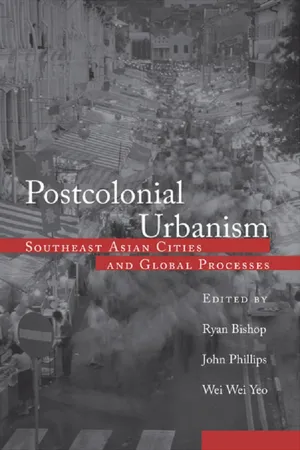
Postcolonial Urbanism
Southeast Asian Cities and Global Processes
- 336 pages
- English
- ePUB (mobile friendly)
- Available on iOS & Android
eBook - ePub
Postcolonial Urbanism
Southeast Asian Cities and Global Processes
About this book
A common assumption about cities throughout the world is tht they are essentially an elaboration of the Euro-American model. Postcolonial Urbanism demonstrates the narrowness of this vision. Cities in the postcolonial world, the book shows, are producing novel forms of urbanism not reducible to Western urbanism. Despite being heavily colonized in the past, Southeast Asia has been largely ignored in discussions about postcolonial theory and in general considerations of global urbanism. An international cast of contributors focuses on the heavily urbanized world region of Southeast Asia to investigate the novel forms of urbanism germinating in postcolonial settings such as Indonesia, Thailand, Singapore, Hanoi, and the Philippines. Offering a mix of theoretical perspectives and empirical accounts, Postcolonial Urbanism presents a panoramic view of the cultures, societies, and politics of the postcolonial city.
Information
1
Perpetuating Cities: Excepting Globalization and the Southeast Asia Supplement
Ryan Bishop, John Phillips, and Wei-Wei Yeo
Contributors from a wide range of disciplinary and interdisciplinary backgrounds were asked by the editors of this volume to explore what we hope will prove to be a unique and productive means for addressing issues of urbanism, globalization, postcolonialism, historicity, and space, as well as the roles that cities in Southeast Asia play in (or are elided from) knowledge production about and legitimization of these phenomena. This introduction seeks to place the other articles in relation to a number of theoretical and disciplinary models related to these various phenomena. As such, we are not proposing a new theory or model or method, but rather a field of potential modes of analysis that could lead to a more qualitatively rigorous set of engagements with the processes usually labeled as global or postcolonial city formation.
The title of the book, Postcolonial Urbanism: Southeast Asian Cities and Global Processes, indicates its topicality and the focus of its general concerns. By focusing on cities in Asia, and particularly in Southeast Asia, this volume addresses the need for an in-depth, geographically specific study of urbanism in the region. However, it also fulfills another urgently felt need in urban and postcolonial scholarship: to address the development and structures of global urbanism generally. The perpetuation of cities, understood in their industrial and postindustrial incarnations, has always been linked to the spread of urban capitalism, which largely determined the unprecedented growth, rebuilding, reconstruction, and reconfiguration of cities around the globe during the late nineteenth and early twentieth centuries. It has become increasingly necessary to emphasize the global nature of this growth and to stress the international and nearly contemporaneous development of cities as truly diverse as Glasgow, Manchester, Chicago, Buenos Aires, Melbourne, Calcutta, Hong Kong, and Singapore alongside New York, London, Paris, and Vienna. The city as such is so diversified a phenomenon that commentators are often constrained to use the terms urban or suburban where the notion of the city no longer applies. Urban processes, then, are perpetuated by a number of forces underpinned by the fundamentally economic ones that govern modern existence, the locus of which is always the city, where labor, ownership, and government coexist often uneasily and where goods and services circulate in systems that are rarely if ever wholly visible. Similarly, the cities in the region exist uneasily within current studies of global urbanism and are rarely visible within them. A comparable situation applies in studies of postcolonialism. The cities in the region have a unique relation to each area of inquiry insofar as they went from being colonial cities serving the material, bureaucratic, technical, ideological, and imaginative needs of distant and varied cosmopolitan sites to explicitly modern, international cities in a matter of years, with the concept of the national playing an important, but oddly peripheral, role in city development, self-imaging, and structuring.
A clear signal that there is a need for a collection of this kind can be found in the editors' introduction to the new edition of the prestigious The City Reader. The editors make the following observation:
This is an international anthology. In an increasingly global world, students must learn from writers beyond the borders of their country of origin. In addition to writers from the United States, the second edition now contains writings by scholars from Austria, Australia, Belgium, Canada, England, France, Germany, Greece, Scotland and Spain. Some of the writers included are world citizens whose countries of birth, academic training, and current residence are all different and whose perspective is truly global. Space limitations preclude including material whose primary focus is on African, Asian or South American cities, but many of the urban realities and urban processes are applicable everywhere precisely because they have become internationalized.1
There are two striking assumptions in this statement: The first is that global urbanism can be regarded as a uniform or homogeneous outgrowth from Europe and America, belatedly affecting Africa, Asia, and South America; and the second is that cities in Africa, Asia, or South America can be understood on the model of cities in Europe, Australia, or the United States. These assumptions implicitly carry over into the notion of what it is to be truly “global,” suggesting that world citizenship erases essential differences between residents of, say, Hong Kong and New York. This collection, in providing a forum that allows experts from various disciplines to address the specificity of urbanism in Southeast Asia, contests assumptions of this kind. Our collection reflects critically on the limits and applicability of theoretical paradigms generally, and represents new types of responses to urban realities and urban processes. Purposeful deviation from canonized views and comfortable patterns of thought together with renewed attention to specificity, no matter how unwieldy the particulars—this constitutes the striking commonality within this volume.
What emerges is that it is because urbanism tends to be regarded as international that radical differences between urban sites need to be addressed when considering the nature of any urban reality or process. Moreover, the history of urbanism in Southeast Asia provides a particular register of change. Although precolonial cities existed such as Yogyakarta, a political and spiritual capital where the god-king resided, colonialism marginalized such cities through its absorption of the entire region as an outpost to the West. Indeed, it gave birth to a new kind of Southeast Asian city, one that is characterized paradoxically by its resistance to definition. Attention to the cultural diversity and social heterogeneity within locales leads to unconventional formulations of the ways in which Southeast Asian cities are placed in relation to the "global," as is seen in the articles by Shirley Geok-lin Lim, Steve Pile, and Wei-Wei Yeo found in this volume.
The region's cultures are irreducibly various. To engage with the question of "globalization" while taking such specificities into full account, one might start with the reminder of exceptions, which are exemplified in both argument and example in George Marcus and Angela Rivas Gamboa's piece on Bogotá in this collection. In Lim's piece, heterogeneity is found in configurations of the relation of Singapore to the region through the markedly different accents on the Southeast Asian context for Singapore's self-reflections in regional politics and Singaporean English narrative.
The repeated emergence of concerns with the historicity and space of the local in the many approaches found here suggests perhaps an inescapable condition, implying that globalization itself is structured by what appears to be inexhaustible variety. Variety—or at least diversity (which need not be simply the commodity friendly term it has become)—would be better considered as a structural condition that underlies processes that are normally described as either global or local. Global diversification and local diversity would be more or less the same thing from different perspectives unless we were able to sharpen our sense of how diversity helps produce the cultural, economic, political, and personal contexts that interest us.
Our introduction focuses on the intrinsic complexity of processes of globalization and of urbanism. We begin by drawing attention to two distinct needs within current urban and postcolonial scholarship. First, despite the fact that the Southeast Asian region has been heavily colonized in the past, it has, with a few outstanding exceptions, been largely neglected in postcolonial theory and in discussions of global urbanism. This collection helps to address this situation. Second, we wish to draw attention to aspects of these areas, as well as of globalization, that still need serious critical reflection. Not only do we resist the notion that Southeast Asian urban sites can be studied on the basis of established knowledge about urbanization processes generally (i.e., as just more of the same), but we also claim that the conditions that resist this secondary status have implications for the study of urban processes everywhere. The cities in the region, therefore, serve as a supplement to assumptions about global cities, both in the ordinary sense, by which they must be added to current knowledge for a truer picture to emerge, and in the sense by which the supplement changes—qualifies or even disqualifies—the earlier assumptions, opening the global whole to parts of it that must be considered as simultaneously inside and outside so that the notion of the whole is itself irremediably fissured.
Two very basic assumptions form the grounds for our theoretical framework. The first accepts that processes such as urbanization, internationalization, and modernization should be grasped in terms of complex and often conflicting historical conditions, which, in this region especially, are tied up with various different manifestations of the transition from colonial to postcolonial rule. The differences in the urbanism of Bangkok, Kuala Lumpur, Jakarta, Manila, Ho Chi Minh City, Hanoi, Phnom Penh, and Vientiane, for instance, indicate diverse relationships to disparate histories. The only directly uncolonized city in this list, Bangkok, in its past and current relations with the United States, France, and England intimates something of this diversity when compared to Kuala Lumpur's relations with Britain, Jakarta's with Holland, and Manila's with the United States. Ho Chi Minh City, Phnom Penh, and Vientiane each also manifest a complex Eurasian historicity. When we add similar relations with countries such as China, Japan, and India, including their diaspora, the region emerges in even more profound complexity. Further, Southeast Asia has often served as the conduit, or the space between, the pulls of Europe/North America and Asia writ large during the colonial, postcolonial, Cold War, and post–Cold War eras. Much of this volume's work excavates the patterns of historicity that characterize given urban sites.
The second assumption recognizes the importance of conflicting interests and trends in contemporary geopolitical relations and rapid teletechno-logical developments. Although the rhetoric of globalization, teletechnology, and economic commodity diversification claims to have rendered the tensions of these histories irrelevant, if not obsolete, studies in the region reveal that the rhetoric is not grounded in a rigorous understanding of the situation, a point Marcus and Rivas Gamboa, John Armitage and Joanne Roberts, as well as others in this collection make. Furthermore, the geopolitical situation, which for more than two hundred years has been subject to drastic changes resulting from developments in mass rapid transit and communications media, can now no longer be considered independently of the effects of real-time electronic technology. Much of the region's financial success, for instance, must be understood in terms of the intensification of vastly unequal distribution of wealth across geographically very proximal territories, made possible by patterns of exclusion and inclusion largely manifested, if not produced, electronically.
The two main foci of the book, global urbanism and postcolonialism, are treated as concomitant phenomena that require simultaneous study. Before going into the discussion of the way these foci operate for us, we need to explore the issues and concepts that underlie these notions in some depth, because there remains some confusion over how these terms can or should be used, and within the confusion are productive possibilities. For this reason what follows does not constitute a conventional introduction to a volume of essays but rather is intended to demarcate the theoretical terrain that the volume represents.
Conceiving the Global and its Metaphoricity
The first task is to deconstruct the “chaotic concept” of globalisation. The latter is often treated in both theoretical and empirical studies as if it were a distinctive and singular causal process in its own right.
— Bob Jessop 2
I intend to deconstruct the universalizing propensities of post-colonial theorizing in order to warn against the danger of dismissing the significance of history.
—Azzedine Haddour 3
To date, the most decisive and effective attempt to construct the global city as a theoretical object of study would arguably be by Saskia Sassen.4 The strength of her intervention undoubtedly lies in her persistent attempts to root out the conditions of possibility that underlie the evident emergences of global economies. On this basis she has been able to establish not only theoretically sound hypotheses on which much discussion of the global city can securely depend, but also empirical criteria for discussing specific urban sites. The distinction between world city and global city establishes what she describes as "the specificity of the global as it gets structured in the contemporary period."5 In other words, while world cities have been in existence for hundreds if not thousands of years in many regions of the globe, accounting for a mere fraction of the world population during this time, the global city is a relatively recent phenomenon intrinsically connected with economic developments of modernity and accounting for massively increased numbers of the world population.6
Many of the great world cities are, therefore, now global cities (like London, Chicago, Amsterdam, Paris, and Geneva), which were actively transformed during the crucial years from the mid-nineteenth century and into the twentieth century. These economic centers of international commerce and exchange undergo extreme makeovers on many levels to incorporate the demands of a developing global economy independent of any state-specific central organization. With the geographic dispersal of global economies, the notion of "global city functions" emerges, allowing us to account for those cities that may have developed certain functions of the global city without necessarily being world cities as such. This way of conceptualizing the global city, in terms of functions rather than sites, allows us to consider how different cities gain access to and are accessed by, or even constructed in accordance with, a relatively heterogeneous set of global city functions. Not all global cities access globalization functions in the same way and, according to the same logic, globalization functions through global cities in diverse ways.
The analysis of globalization that Sassen performs, and about which we are generally empathetic, emerges from the world-system models that Immanuel Wallerstein developed out of the work of Fernand Braudel and others. George Marcus and Michael M. J. Fischer influentially theorized the impact of Wallerstein's models for disciplines traditionally engaged in the study of political and economic systems, exploring how the models met the needs of social science and humanities scholars who, typical of the 1950s and 1960s, saw not only the failure of old paradigms to explain global conditions and processes, but also the failure of the reign of paradigms them-selves.7 In addition to this theorization, they explored how interpretative anthropological concerns could help broaden and enrich the enterprise of world-system analyses while also addressing how world-systems models shaped the ethnographic enterprise. As such, the kinds of theorization proposed by Marcus and Fischer provided a productive middle ground between the earlier Wallersteinian inquiries and Sassen's movement beyond them. Marcus has reengaged the trajectory of his initial interventions in the 1980s, and with his article in this volume he has modified Sassen's project by looking explicitly at a "global city" that is not a global city, but merely one determined in manifold ways by globalization processes and functions over which it has little influence.
One intriguing promise suggested by thinking of global cities in terms of functions would be the possibility of theoretical coherence and relevance when dealing with what Bob Jessop, against the idea of globalization, describes as its "diverse multitude of contested meanings."8 Jessop argues that "globalisation is a complex, chaotic, and overdetermined outcome of a multi-scalar, multi-temporal, and multi-centric series of processes operating in specific structural contexts," and he suggests that it is just one of several phenomena that have helped to shape recent developments in social, political, and economic life.9 There is some comfort in this view, which attempts simultaneously to undermine the international rhetoric of globalization and to deflate the theoretical notion of globalization as the key problematic issue in contemporary economic, social, and political studies. If the rhetoric of globalization supports what Jessop calls "attacks on economic, political and social rights in the name of enhanced international competi-tiveness,"10 then the central concern with globalization in academic discourse indicates a failure to see that globalization processes ...
Table of contents
- Cover
- Title
- Copyright
- Contents
- Acknowledgments
- 1 Perpetuating Cities: Excepting Globalization and the Southeast Asia Supplement
- 2 Global Cities, Terror, and Tourism: The Ambivalent Allure of the Urban Jungle
- 3 The City as Target, or Perpetuation and Death
- 4 From the Hypermodern City to the Gray Zone of Total Mobilization in the Philippines
- 5 Urban Space in the French Imperial Past and the Postcolonial Present
- 6 City as Garden: Shared Space in the Urban Botanic Gardens of Singapore and Malaysia, 1786-2000 .
- 7 Gay Capitals in Global Gay History: Cities, Local Markets, and the Origins of Bangkok's Same-Sex Cultures
- 8 Actually Existing Postcolonialisms: Colonial Urbanism and Architecture after the Postcolonial Turn
- 9 Jakarta as a Site of Fragmegrative Tensions .
- 10 Regionalism, English Narrative, and Singapore as Home and Global City
- 11 Contemporary Cities with Colonial Pasts and Global Futures: Some Aspects of the Relations between Governance, Order, and Decent, Secure Life
- 12 City as Theatre: Singapore, State of Distraction
- 13 Perpetual Returns: Vampires and the Ever-Colonized City
- 14 Benjamin's Arcades Project and the Postcolonial City .
- 15 Deus ex Machina: Evangelical Sites, Urbanism, and the Construction of Social Identities .
- List of Contributors
- Index
Trusted by 375,005 students
Access to over 1.5 million titles for a fair monthly price.
Study more efficiently using our study tools.
Frequently asked questions
Yes, you can cancel anytime from the Subscription tab in your account settings on the Perlego website. Your subscription will stay active until the end of your current billing period. Learn how to cancel your subscription
No, books cannot be downloaded as external files, such as PDFs, for use outside of Perlego. However, you can download books within the Perlego app for offline reading on mobile or tablet. Learn how to download books offline
Perlego offers two plans: Essential and Complete
- Essential is ideal for learners and professionals who enjoy exploring a wide range of subjects. Access the Essential Library with 800,000+ trusted titles and best-sellers across business, personal growth, and the humanities. Includes unlimited reading time and Standard Read Aloud voice.
- Complete: Perfect for advanced learners and researchers needing full, unrestricted access. Unlock 1.5M+ books across hundreds of subjects, including academic and specialized titles. The Complete Plan also includes advanced features like Premium Read Aloud and Research Assistant.
We are an online textbook subscription service, where you can get access to an entire online library for less than the price of a single book per month. With over 1.5 million books across 990+ topics, we’ve got you covered! Learn about our mission
Look out for the read-aloud symbol on your next book to see if you can listen to it. The read-aloud tool reads text aloud for you, highlighting the text as it is being read. You can pause it, speed it up and slow it down. Learn more about Read Aloud
Yes! You can use the Perlego app on both iOS and Android devices to read anytime, anywhere — even offline. Perfect for commutes or when you’re on the go.
Please note we cannot support devices running on iOS 13 and Android 7 or earlier. Learn more about using the app
Please note we cannot support devices running on iOS 13 and Android 7 or earlier. Learn more about using the app
Yes, you can access Postcolonial Urbanism by Ryan Bishop, John Phillips, Wei Wei Yeo, Ryan Bishop,John Phillips,Wei Wei Yeo in PDF and/or ePUB format, as well as other popular books in Social Sciences & Human Geography. We have over 1.5 million books available in our catalogue for you to explore.