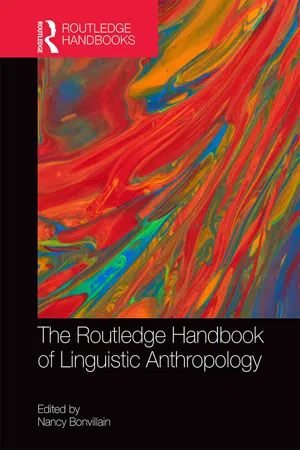
The Routledge Handbook of Linguistic Anthropology is a broad survey of linguistic anthropology, featuring contributions from prominent scholars in the field. Each chapter presents a brief historical summary of research in the field and discusses topics and issues of current concern to people doing research in linguistic anthropology. The handbook is organized into four parts – Language and Cultural Productions; Language Ideologies and Practices of Learning; Language and the Communication of Identities; and Language and Local/Global Power – and covers current topics of interest at the intersection of the two fields, while also contextualizing them within discussions of fieldwork practice. Featuring 30 contributions from leading scholars in the field, The Routledge Handbook of Linguistic Anthropology is an essential overview for students and researchers interested in understanding core concepts and key issues in linguistic anthropology.
- 480 pages
- English
- ePUB (mobile friendly)
- Available on iOS & Android
eBook - ePub
The Routledge Handbook of Linguistic Anthropology
About this book
Information
1
Introduction
Intertwined Traditions
As a research tradition, linguistic anthropology emerged in the United States and Canada under the aegis of Boasian “four-field” anthropology. The name itself predates Boas, and was used for the collection of texts and other linguistic materials among Native North Americans (Gal 2006: 171), but within the Boasian program, carried through by such anthropologists as Sapir, Reichard, Haas, and Voegelin, it came to denote a set of research practices in which language in all its aspects provided an opening into culture, social relations, history, and prehistory. Though located intellectually and institutionally within the field of anthropology, it draws on several intertwined traditions of anthropological and linguistic research, North American and European, beginning in the middle of the nineteenth century. These traditions can be characterized by six intellectual revolutions, each of which reshaped the way we understand language and its social, cultural, and historical reach. These are 1) the discovery of time and of regularity in change; 2) the discovery of structure; 3) the cognitive revolution; 4) understanding language as fully socially embedded; 5) language as a transindividual, interactional phenomenon; 6) a population (or populace) centered view of language. While each of these intellectual movements took place at a specific moment in time, in no sense did they supplant earlier movements; rather, the insights that have come with each transformation have been incorporated into succeeding ones.
The Discovery of Time and of Regularity in Change (Linguistics)
In the middle of the nineteenth century the study of language primarily involved the study of written texts from the past as cultural documents of the time in which they were composed, drawing especially on the classical languages of the Eurasian continents: Latin, Greek, Arabic, Sanskrit, Old Persian, and older texts in Tamil, Chinese, and Japanese. One of the major concerns of these scholars, known as philologists, was identifying relationships among texts, both in a single line of development and through contact with each other. Philologists were especially interested in word histories, but approached them in atomistic ways, without identifying systematic patterns of change from one historically attested stage of a language to another. It was not until the first of the revolutions – often dated to 1876 (Hoenigswald 1978) – that philologists recognized that the texts reflected systematically organized spoken languages, and that the changes from one stage of a language to another were fully systematic. A t sound in an older stage of a language might become a d between vowels, but when it did, it affected all parts of the vocabulary at the same time. The key insight of the Neogrammarians, then, was the doctrine of the regularity of sound change. Older scholars had also noticed that many of the classical and modern languages of Europe and Asia resembled each other, for example Danish, English, Latin, Greek, Sanskrit, and Armenian, but they were unable to show the relationships among them until they focused on systematic differences among them, in the Neogrammarian style. (We now know that all of these languages are members of an extended Eurasian language family, Indo-European, whose progenitor was spoken on the central Asian steppes between 6,000 and 8,000 years ago [Fortson 2010, Anthony 2007, Chang et al. 2015]). The regularity of sound change provided the key tool for understanding groupings of languages into families – not by similarities among them, but by patterned differences.
The Discovery of Structure
Linguistics and Anthropology in language unfolded over almost a half-century, independently in Europe and in America. In Europe, at the beginning of the twentieth century, one of the greatest of the Neogrammarians, Ferdinand de Saussure [1857–1913, trained in Leipzig] was tasked with organizing a course in general linguistics at the university of his home city, Geneva, Switzerland. Saussure divided the task into three domains: the Neogrammarian historical linguistics in which he was trained; linguistic geography (which was of special interest in Switzerland); and synchronic linguistics, the study of language in a single slice of time. Saussure modeled both dialect geography and synchronic linguistics on historical Neogrammarian linguistics, concerned not so much with similarities, as with identifying patterned, systematic differences. “In language,” he wrote, “there is nothing but difference.” Thus, though the French word mouton is translated in French–English dictionaries as sheep, it does not mean the same thing as sheep. In French, mouton is used both for the animal and for its meat; in English, sheep is part of a relational structure that includes the word mutton. Thus sheep in English refers only to the animal, and not to its meat; mutton only to the meat (in spite of its history). Both English words define each other relationally, by what they are not. Saussure’s observations extend to the grammatical systems of languages: Slavic languages such as Russian have very complex aspectual systems, grammatical systems that allow you – nay, require you – to divide the time that an action takes in certain ways; French – like Russian, an Indo-European language – has a fairly simple aspectual system. In each case, the aspectual categories are defined internal to the language as part of an aspectual structure – the aspectual categories of Russian defining their values through their relationship to each other (in Russian) and the aspectual categories of French defining their values through their relationship to each other (in French). The aspectual categories of Russian do not translate easily into the aspectual categories of French, nor vice versa but neither are they random: there are recurrent patterns of value in aspectual systems of languages the world over. Saussure’s famous dictum of “the arbitrariness of the linguistic sign” posited that the relative independence of sound and meaning allowed him to preserve the Neogrammarian principle of the regularity of sound change, since it accounted for the fact that sound change was, by and large, undeflected by the meanings or the meaning classes of words.
Saussure’s posthumously published book, Course in General Linguistics (1916), distilled three sets of his lectures into a broad set of principles for studying language historically and synchronically, and is one of the works that shaped not only disciplinary linguistics, but also adjacent fields: social anthropology, literary analysis, and so forth. It is widely considered one of the master works of the twentieth century.
Just as Saussure was a founding figure of disciplinary linguistics, Franz Boas [1858–1942] shaped the study of anthropology in North America. Trained as a psychophysicist, he began his anthropological journey through the study of observer effects in identifying the color of water in the Arctic. But his training as a student in Germany included a very large dose of pre-Neogrammarian philology, and as he turned his attention to the cultures of Native North America, language became one of the central foci of the newly emerging discipline of anthropology. Language was key to his ethnographic methodology; his students were trained to begin their ethnographic research by doing synchronic philology or philology of the vernacular (Bauman 2008), collecting oral texts, myths, and first-person accounts of cultural practices that documented the cultures that he and his students studied. On the basis of the texts, they would write grammars of Native American languages and develop synthetic, ethnographic accounts of the cultures. Many of the texts were the bases of the doctoral dissertations of his students, and were published in their original languages in collections still accessible today in libraries, especially the Bureau of American Ethnology at the Smithsonian Institute and in the text series published by the International Journal of American Linguistics (founded by Boas himself). Many of these texts serve as the primary documentation that some Native American peoples have of their ancestral language and social practices, and so have become primary sources for language revitalization in Native communities.
Boas’s contributions to the study of language structure are as much milestones as Saussure’s. In his 1889 article, “On alternating sounds,” Boas dismantled the racist idea that speakers of Native American languages were congenitally unable to pronounce words in English and other European languages, and showed that instead, they were pronouncing English following the phonological (sound) canons of their own languages; the “sound blindness” that was frequently attributed to Native Americans was, in fact, an observer effect – the English speakers not understanding the systematics of Native American accents in English. Boas regarded grammatical structure as critical ethnographically, shaping not what one could say, but the way in which the speaker of a language habitually expressed her experiences, so that her experienced world was in part projected from the structure of the grammatical categories (Boas 1911), a position that was to become known as the “Sapir-Whorf hypothesis” after one of Boas’s leading students, Edward Sapir and Sapir’s student Whorf (see Lucy 1996, Hill and Mannheim 1992 for discussion of the history of this idea).
It was Sapir who largely molded the approach that North American anthropologists – and linguists – took to linguistic and cultural patterning. An intellectual virtuoso, Sapir was at the center of the major theoretical developments of the 1920s and 1930s in both fields, and a spokesperson for the fields among other scholars, ranging from poets to psychologists. Like Boas, Sapir specialized in the living cultures of Native North America, grounding his insights in ethnographic and linguistic fieldwork, producing analyses of the languages and linguistically related social phenomena among several of the major North American language families, with a special affinity for languages of the western United States and Canada. Sapir formulated the first precise and cogent accounts of language structure that emphasized the relationality of all aspects of linguistic form, concentrating especially on the sound system (phonology) and on grammatical categories. He was co-discoverer of the basic units of sound, along with a Southern Paiute speaker, Tony Tillohash (Sapir 1933, Fowler and Fowler 1986). And he brought his linguistic insights to culture, highlighting the relational nature of cultural patterns, an emphasis he shared with other Boasians such as Ruth Benedict and Robert Lowie.
A key nexus of Sapir’s work was identifying the ontological status of language and culture. Early in his career, he took on A.L. Kroeber’s famous article, “Culture, the superorganic,” which posited that cultures (and so languages) were held by collectivities, with a rejoiner entitled “Do we need a superorganic?” His reply was a resounding “no”: “It is always the individual that really thinks and acts and dreams and revolts” (Sapir 1917: 442). His theoretical excursions into the nature of language and culture were shaped thereafter by two assumptions: 1) that culture and language are primarily individual phenomena; and 2) that the coherence of culture and language reflected an “innate form feeling” that individuals have for the ways in which their languages and cultures handle everyday experience. While Sapir’s view of culture won the day among the Boasians, later he moved toward a position that favored the second assumption over the first. When older, Sapir treated culture and language as transindividual – culture was not “in” individuals, nor “in” collectivities, but had significant regularities that could be observed in everyday interaction among people (Sapir [1939] 2002, Irvine 2002, Mannheim and Tedlock 1995, Silverstein 1984).
Independently of Sapir, scholars in Europe – particularly the Russian members of the Prague, Linguistic Circle, Trubetzkoy, Karčevsky, and Jakobson – identified principles of language structure based on a Saussurean notion of “value.” Like the Boasians, including Sapir, their starting point was grammatical categories (not surprisingly, in Slavic languages, Jakobson 1936), and the area that most clearly defined the nature of pattern in language was the sound system, phonology (Trubetzkoy 1939, Jakobson 1939). A leitmotif of Jakobson’s work was the principle of relational invariance, that of identifying relational structures in language that remain constant across variable contexts.
Two influential themes emerge from the work of the Russians. The first of these is the importance of identifying principles of language structure comparatively, with the expectation that one can construct an account for the compatibilities and incompatibilities of particular linguistic structures. One of the instantiations of this program was a comparative analysis of phonological systems that attempted to account at one and the same time for: the set of phonological systems that are possible in the languages of the world; possible transitions between systems; the relative order of acquisition in phonological development; and the relative order of loss of phonological distinctions as a result of certain neurological pathologies (Jakobson 1941, Jakobson and Halle 1956). Second, the multifunctionality of all talk. Jakobson (1960) argued that talk is not primarily referential; rather it must be understood as a continually shifting compromise among six distinct functions: the expressive, conative, and phatic functions governing the relationship among participants in social interaction; and the referential, metalinguistic, and poetic functions establishing relationships among linguistic units and between linguistic units and the world. The second of these was especially influential in linguistic anthropology.
After migrating to the United States, Jakobson took up the work of the turn-of-the-century American philosopher Charles Sanders Peirce, and brought Peirce’s “semiotic” into conversation with linguistics and linguistic anthropology. Though disciplinarily a linguist, Jakobson’s influence was felt very firmly throughout the human sciences, particularly in anthropology. Jakobson was the sparkplug of the next three revolutions.
In the course of identifying structural principles of language through their roles in socially situated practices and as conceptual constructs, neither Jakobson’s linguistics nor Sapir’s anthropology met with much approval in North American linguistics or in the social sciences in the post-World War II period, which had become firmly behavioristic. Jakobson’s linguistics, to be sure, provided the groundwork for what became known in anthropology and related fields as “structuralism” (Lévi-St...
Table of contents
- Cover Page
- Half-Title Page
- Title Page
- Copyright Page
- Table of Contents
- Notes on Contributors
- Preface
- PART I Language and Cultural Productions
- PART II Language Ideologies and Practices of Learning
- PART III Language and the Communication of Identities
- PART IV Language and Local/Global Power
- Index
Trusted by 375,005 students
Access to over 1.5 million titles for a fair monthly price.
Study more efficiently using our study tools.
Frequently asked questions
Yes, you can cancel anytime from the Subscription tab in your account settings on the Perlego website. Your subscription will stay active until the end of your current billing period. Learn how to cancel your subscription
No, books cannot be downloaded as external files, such as PDFs, for use outside of Perlego. However, you can download books within the Perlego app for offline reading on mobile or tablet. Learn how to download books offline
Perlego offers two plans: Essential and Complete
- Essential is ideal for learners and professionals who enjoy exploring a wide range of subjects. Access the Essential Library with 800,000+ trusted titles and best-sellers across business, personal growth, and the humanities. Includes unlimited reading time and Standard Read Aloud voice.
- Complete: Perfect for advanced learners and researchers needing full, unrestricted access. Unlock 1.5M+ books across hundreds of subjects, including academic and specialized titles. The Complete Plan also includes advanced features like Premium Read Aloud and Research Assistant.
We are an online textbook subscription service, where you can get access to an entire online library for less than the price of a single book per month. With over 1.5 million books across 990+ topics, we’ve got you covered! Learn about our mission
Look out for the read-aloud symbol on your next book to see if you can listen to it. The read-aloud tool reads text aloud for you, highlighting the text as it is being read. You can pause it, speed it up and slow it down. Learn more about Read Aloud
Yes! You can use the Perlego app on both iOS and Android devices to read anytime, anywhere — even offline. Perfect for commutes or when you’re on the go.
Please note we cannot support devices running on iOS 13 and Android 7 or earlier. Learn more about using the app
Please note we cannot support devices running on iOS 13 and Android 7 or earlier. Learn more about using the app
Yes, you can access The Routledge Handbook of Linguistic Anthropology by Nancy Bonvillain in PDF and/or ePUB format, as well as other popular books in Languages & Linguistics & Linguistics. We have over 1.5 million books available in our catalogue for you to explore.