- 297 pages
- English
- ePUB (mobile friendly)
- Available on iOS & Android
eBook - ePub
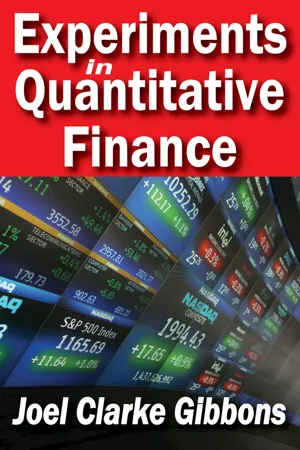
Experiments in Quantitative Finance
About this book
This book presents a novel approach to characterizing markets in quantitative terms. The examples cut across the world of interest rates, price of gold, stock market and corporate worlds that the stock market rests on, and the pricing of options on financial instruments. The emphasis is on methods of inquiry, methods that can just as easily be applied to other markets and other economic phenomena as well. The goal is to make the methods available to the widest possible audience of quantitative analysts and to the trading desks and investment plans they feed.Quantitative research and modeling in finance and economics have a long history going back to Frank Ramsey, mathematician, logician, and economist, who pioneered the application of dynamic models in economics in the 1920s, and to his theory of the Ramsey Tax, which is a rule for apportioning tax rates in a way that raises the maximum tax revenues while impacting the decisions of taxpayers as little as possible. The opposite would be a tax so inefficient that it causes people to avoid doing whatever it is that subjects them to the tax.These experiments yield valuable insight into economic affairs, but they are only a stepping-stone for others—a starting point for discovery. Foremost among them is locating usable statistical findings to the investment world. Gibbons' intention is not to provide investment advice, it is to provide education. These data are subject to changing results, but that should not diminish their educational value. This is a proactive fusion of business economics and sound social science methods.
PART I
Interest Rates and Fixed-Income Securities
This part contains four studies that I carried out between 1987 and 1996, which have in common not only that they focus on the Treasury yield curve but that they approach it from a portfolio-management perspective.
The first chapter concerns a well-known tool for portfolio management: the Nelson-Siegel model of the yield curve. It reduces bond and note pricing to three factors: a short-term risk-free rate, duration, and convexity. The hypothesis is that any default-free security can be priced in terms of the pricing of these three factors plus a small and purely random pricing error. It is possible to test the Nelson-Siegel hypothesis directly by taking advantage of the fact that the Treasury contracts on the Board of Trade, together with a choice of quoted short-term yields, price these factors. The results are somewhat disconfirming and imply that there is no small set of pricing factors from which the pricing of Treasury debt can be deduced.
The second chapter reports on a small exercise designed to test the expectations hypothesis, which states that the difference in yields of Treasury bonds and notes only reflects the risk premium that arises because of their unequal investment risk. The obvious competing hypothesis is that yield differentials need no adjusting and represent real investment opportunities. The evidence lends support, but not overwhelmingly, to the expectations hypothesis.
The third and fourth chapters reflect the oldest experiments discussed in this book. The original research for what has become chapter 3 was done in the spring and summer of 1987, immediately after I joined Harris Bank. The objective was, of course, to develop a quantitative process for taking trading risk in Treasury bonds, i.e., to develop a way of predicting how interest rates would change in the near future. Chapter 4 continues that program but with the focus shifted to the short maturities only.
Chapter 1
A Parsimonious Model of Treasury Futures2
This chapter is about estimating the quantitative parameters of a model of the Treasury futures contracts where the model is based on the Nelson-Siegel model of the Treasury yield curve, and using this model to test the hypothesis that the Nelson-Siegel characterization of the yield curve identifies the true, unobservable default-free discount function.3 We find that the four parameters of the NS model explain most of the variance in contract prices within the sample, which runs from 1982 to August 1996. But we also find compelling evidence against the null hypothesis. Specifically, we find that even when holding the NS curve constant, the Treasury contracts are highly correlated with yields of individual Treasury notes and bonds.
Background
Fixed-income practitioners have made use for more than two decades of factor models of the yield curve both to manage curve risk and define investment policy. The starting point has been the empirical observation that most of the historical variation in bond yields can be ascribed to three factors that correspond to the level of interest rates, the difference between short-term and long-term yields, and the spread between actual intermediate rates and an interpolated average of short and long rates. Whether this three-factor model is an adequate summary of the yield curve is an empirical matter, as these statistical findings recognize. But it is not enough to verify how well they account for Treasury yields. To be broadly useful in fixed-income portfolios requires that they capture most of the curve sensitivity of other fixed-income securities. We take up this issue here, taking specifically the question of how well a factor model of the yield curve explains the pricing of the bond contract.
While some sort of three-factor model is widely accepted as describing most of the variation of the yield curve, we need to fix on a particular way to compute the curve factors. For this purpose, we will use the parameterization given by Nelson and Siegel. Their model actually defines four factors, which correspond to level, slope, and curvature of the curve; and a fourth factor that determines the actual maturity point which will be identified as the “intermediate” yield. It seems naively apparent to us that this fourth factor must be included because there is otherwise no broadly accepted agreement about which maturity is really intermediate. In any case, we will be in a position to test the hypothesis that this fourth factor is needed: that the location of the intermediate maturity point moves around from time to time.
The bond contract has some important advantages for this research. This study is inherently empirical, as we have emphasized. The question is not whether it is possible to replicate any actual bond exactly by a three- or four-factor model. The three curve factors—level, slope, and curvature—do not even exactly replicate the behavior of Treasury yields. They are much less likely to replicate a bond with embedded put-and-call options and embedded credit risk. Rather, our goal is a more modest one of assessing whether a factor model can reproduce the essential features of an actual bond, including the behavior of embedded options. If it is true that this can be done, then it is possible to apply empirical methods to quantify the factor weightings of a bond or of an entire portfolio. This is the essential step that is required to use the factor approach as a practical tool for fixed-income management.
Review of the Nelson-Siegel Model
The Nelson-Siegel model starts from the premise that the forward curve, f(t), is a solution of a second-order differential equation that has constant coefficients. One rationale for such a model is that yields are determined by two pieces of information: an estimate of the rate at which inflation will accelerate in the near term, and an attenuation rate at which this timely forecast reverts to a slow-moving long-term forecast. In the general case, the solution of this equation for any given initial level of the curve is given by
1. f(t) = L + S1 * exp(-beta1 * t) + S2 * exp(-beta2 * t).
The coefficients L, S1, and S2 are determined by the initial conditions: f(0), the instantaneous rate at time zero, and the initial growth rate, df(0)/dt. L is equal to the asymptotic forward rate. The initial slope and curvature of the forward curve are also simple linear combinations of L, S1, and S2, from which we can solve for the L and the S’s as functions of the initial conditions. In general, the betas can be real or complex numbers; but if equation 1 is to replicate an actual yield curve, they have to be positive real numbers. There is a special case of this model in which the roots of the characteristic polynomial are equal, in which case, the forward curve takes the form
2. f(t) = L + S * exp(-t / tau) + C * t * exp(-t / tau).
NS attempted to fit both equations 1 and 2 to actual forward curves. Though their data extends out to only a one-year maturity, they conclude that equation 2 fits that data tolerably well, and that equation 1 overparameterizes it.
The parameters of equation 2 have an interesting interpretation in terms of the yield curve. Assuming that tau is positive, so the curve eventually levels off, L is equal to the asymptotic forward rate, which is the interest rate at infinity—the rate at which the curve is leveling off. S is equal to the difference between the instantaneous spot rate, f(0), and the interest rate at infinity, i.e.,
| L = f(∞) | |
| 3. | |
| S = f(0) - f(∞). |
The exact interpretation of C is not as intuitive, but C is related to how sharply the curve bows up or down relative to a simple exponential curve. One of the complications of interpreting C is that C depends upon the exponential parameter tau.
Tau does admit of a simple intuitive interpretation. It modifies the time scale itself by converting nominal time, t, into absolute time, t / tau. If tau is small, the curve very quickly (i.e., “quickly” in terms of nominal time) approaches its asymptotic val...
Table of contents
- Cover
- Half Title
- Title
- Copyright
- Dedication
- Contents
- Introduction
- PART I INTEREST RATES AND FIXED-INCOME SECURITIES
- PART II SOME USEFUL MATHEMATICS
- PART III EMPIRICAL STUDIES IN FINANCE AND ECONOMICS
- Index
Trusted by 375,005 students
Access to over 1.5 million titles for a fair monthly price.
Study more efficiently using our study tools.
Frequently asked questions
Yes, you can cancel anytime from the Subscription tab in your account settings on the Perlego website. Your subscription will stay active until the end of your current billing period. Learn how to cancel your subscription
No, books cannot be downloaded as external files, such as PDFs, for use outside of Perlego. However, you can download books within the Perlego app for offline reading on mobile or tablet. Learn how to download books offline
Perlego offers two plans: Essential and Complete
- Essential is ideal for learners and professionals who enjoy exploring a wide range of subjects. Access the Essential Library with 800,000+ trusted titles and best-sellers across business, personal growth, and the humanities. Includes unlimited reading time and Standard Read Aloud voice.
- Complete: Perfect for advanced learners and researchers needing full, unrestricted access. Unlock 1.5M+ books across hundreds of subjects, including academic and specialized titles. The Complete Plan also includes advanced features like Premium Read Aloud and Research Assistant.
We are an online textbook subscription service, where you can get access to an entire online library for less than the price of a single book per month. With over 1.5 million books across 990+ topics, we’ve got you covered! Learn about our mission
Look out for the read-aloud symbol on your next book to see if you can listen to it. The read-aloud tool reads text aloud for you, highlighting the text as it is being read. You can pause it, speed it up and slow it down. Learn more about Read Aloud
Yes! You can use the Perlego app on both iOS and Android devices to read anytime, anywhere — even offline. Perfect for commutes or when you’re on the go.
Please note we cannot support devices running on iOS 13 and Android 7 or earlier. Learn more about using the app
Please note we cannot support devices running on iOS 13 and Android 7 or earlier. Learn more about using the app
Yes, you can access Experiments in Quantitative Finance by Joel Gibbons in PDF and/or ePUB format, as well as other popular books in Business & Bonds. We have over 1.5 million books available in our catalogue for you to explore.