This book presents a longitudinal study dealing with developmental changes within and between self-concepts and their relation to personal functioning. Within the psychological literature -- and the developmental literature in particular -- the interest in the ideas people hold about themselves and their relation with personal functioning is rapidly growing. This interest is reinforced by the emphasis on individuality in Western society.
The self-system is now thought to consist of a collection of self-concepts in which a distinction is made between domain-specific self-concepts -- the real and ideal -- and context-related self-concepts -- the academic, the athletic and the social. It is also considered to be subjective rather than objective. This subjective self involves characteristics such as continuity and distinctiveness from others. These characteristics have been the primary focus of recent research.
In existing literature on the development of the self-system, little is known about the structural characteristics -- that is, developmental changes in the interrelationships among domain-specific and context-related self-concepts, or between and within self-concepts. Similarly, little information is available about the relationships between individuals' real and ideal self concepts, their perceived concepts of others, and the actual ideas others have about the same individuals. This book integrates hitherto separate and different components or aspects of self-knowledge into one encompassing, multidimensional self-system.
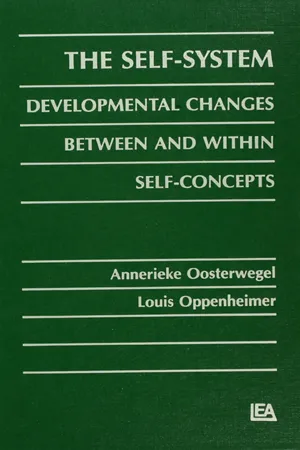
eBook - ePub
The Self-system
Developmental Changes Between and Within Self-concepts
- 208 pages
- English
- ePUB (mobile friendly)
- Available on iOS & Android
eBook - ePub
The Self-system
Developmental Changes Between and Within Self-concepts
About this book
Information
1 | A Theoretical Overview and Resulting Model on the Self-System |
In the present chapter, the self-concept is described as a multidimensional and dynamic self-system that refers to both the product of self-conception as well as the active process of perception and organization of information about the self. The purpose of this chapter is to present an integrative model of such a self-system. Prior to this, consideration will be given to those aspects of the self-system that are relevant to the model as they appear in the existing literature. In the model, as well as in the relevant overview of the literature, the structural, functional and developmental aspects of the self-system are emphasized.
The Self as Knower
Versus the Self as Known
Versus the Self as Known
Although during the 1960s and 1970s the self-concept was often considered a static and global construct, the contemporary view of the self-concept is that it is a dynamic and multidimensional construct. This change in the perception of the self-concept corresponds to the understanding of the “Self” by early theorists such as James (1890/1950) and Mead (1934/1972, cf. Gordon & Gergen, 1968; also Markus & Wurf, 1987). Hitherto only the “Me” was emphasized, that is, “an empirical aggregate of things objectively known” (James, 1890/1950, p. 400; i.e., the self as known to the individual or agent, or the social environment). The perception of the self-concept as an active and dynamic structure, however, required the introduction of the “I” as an integral part of the self-concept. The “I” involves the agent as thinker or that which knows the self as objectively known (James, 1890/1950). It is the organizing and structuring self, that part of the self that processes, interprets, and organizes knowledge about the self.
Simultaneously with the renewed interest in the “I,” the problem whether the “I” can be empirically studied reemerged. Whereas according to James (1910/1968) the empirical study of the “I” was not possible, Mead (1934/1972) assumed that it could be done, though only through the “Me”, that is, by way of static self-representations given by the subject.
Studying the “I” implies studying the intrapersonal activities and processes, the way the self-concept is formed and how organization is established. Because the formation and organization of the self-concept are the result of often implicit and unconscious processes, these processes themselves are difficult to assess. Consequently, although it is often claimed that the “I” is studied, in reality the “Me” has been assessed; that is, often the manifestations, reflections, or temporary states (i.e., their contents or the “Me”) of the “I” are assessed from which the “I”-processes are deduced. In other words, because the “I” is defined as the knower and the “Me” as what is known, the direct study of the “I” is thought to be impossible by definition. Hence, all knowledge about the “Self” (i.e., here denoted as self-system) is part of the “Me.” The “I” is inseparable from contexts and contents.
Only two recent attempts to study the contents of the “I” from a developmental point of view have been found (i.e., the models of Damon & Hart, 1982, 1988, and Harter, 1983). Damon and Hart presented a model for “self-understanding” that involves the two dimensions of the self-the “Me” and the “I.” The model permits the exploration of the individual’s understanding of the self as knower, that is, the individual’s understanding of the “I.” Following James (1890/1950), four “I” -characteristics were presented: continuity, distinctness, volition, and self-reflectivity (Damon & Hart, 1982). Only three remained in a latter publication: agency, continuity, and distinctness (Damon & Hart, 1988). Children’s understanding of these components was studied through self-descriptions and was thought to develop gradually from the concrete in infancy to the more abstract in adolescence. Continuity was expected to shift from the conception of an unchanging physical body to the conception of continuous psychological and physical processes through which the nature of self evolves. Distinctness was thought to shift from a conception based on bodily or material attributes to a conception derived from the subjectivity and privacy of the self’s experiences. Volition or agency was postulated to develop from the idea that one body part “tells” another to do something, to active and self-initiated modifications of conscious experiences. Finally, self-reflection was thought to shift from an awareness of body features, typical activities, and action capabilities to the recognition of conscious and unconscious psychological processes (Damon & Hart, 1982, p. 860). In discussing the latter component of this model, Damon and Hart (1988) noted that because this dimension is “inaccessible to us because of methodological difficulties” (p. 70), it was omitted from the model. However, the study of the former components, that is, continuity, distinctness, and volition, was also limited because of the methodology. The active “I”-components were not only derived from, but also defined in terms of the content of the self-concept or the “Me” (i.e., by means of self-descriptions). As Damon and Hart (1988) emphasized, their model involves “progressions in conceptions of the self-as-subject and not in the self-as-subject per se” (p. 69).
In her review of the literature on the development of the self-concept (i.e., self-system), Harter (1983) described several theories dealing with the processing of self-relevant information in adults. Based on these theories, she presented a model for the development of the “Me” and the “I” in which structural changes (i.e., changes in the organization of the self-system) are the result of a process of differentiation and integration. The model includes four developmental stages that involve simple descriptions, trait labels, single abstractions, and higher order abstractions, in this prescribed order. Each stage is divided into two levels. At the first level, higher-order integrations of items from the preceding stage take place. At the second level, these integrations become differentiated again and require new and higher order integrations in the first level of the succeeding stage. As with Damon and Hart (1982, 1988), these structural changes were derived from the content of self-descriptions. The organizational changes with regard to the “I,” assessed by the “Me-tool” (i.e., self-descriptions), reflected how the content dimensions of self-descriptions are organized (Harter, 1983, p. 305).
Hence, in both of these contemporary approaches to the study of the “I” (i.e. either through Damon and Hart’s study of the development of self-understanding or Harter’s study of the self-system), support is given to Mead’s (1934/1972) assumption that the “I” can only be studied through the “Me.” That is, in both models, the study of self-descriptions forms the basis for an examination of the development of children’s ideas about “I”-components of the self-system. In short, changes in the organization of Me-characteristics in relation to “I”-components are studied rather than structural characteristics of the “I” itself. In short, both Harter and Damon and Hart considered these problems to be methodological constraints with respect to the study of the “I.”
However, there is an alternative way to study the “I” – though, again by means of the “Me” – by emphasizing its structure and structural organization. It may well be that “I”-concepts such as agency, continuity, and distinctness (Damon & Hart, 1988) are related to (subjective) experiences based on the interrelations among different structural components of the self-system. For instance, Shavelson, Hubner, and Stanton (1976) described the self-system as a hierarchically organized structure thought to consist of different self-concepts that are organized along a continuum from situation specific to abstract (see also Marsh, 1989). Based on James’ (1890/1950) assumption that “a man has as many social selves as there are individuals who recognize him” (p. 294), Markus and Wurf (1987) postulated “working self-concepts,” assuming that the overall self-concept consists of a number of self-representations that are not simultaneously conscious. The working self-concept is that part of the self-concept or those characteristics of the self that become salient in a particular situation.
In accordance with the approach of Shavelson et al. (1976) and Markus and Wurf (1987), the model for the self-system that will be presented in this chapter is structure oriented, that is, the emphasis is on the organization of self-knowledge as reflected in the relationships between several parts of the self-system. This model is presented following a description of the relevant aspects of the self-system as they appear in the literature on the self-concept. These aspects involve the content of the self-system, the several subconcepts within the self-system, the influence of the environment, the active role of the individual, and the characteristics that reflect the organization of the self-system. Accordingly, the emphasis is on the function and especially the development of each aspect.
The Content of a Self-Concept:
Self-Descriptions
Self-Descriptions
In the first part of this chapter it was noted that the self always exists within contexts and that the self-system is inseparable from contexts and contents. The way people describe themselves and the characteristics they use constitute the body of the self-system or a self-concept. Despite the large number of studies dealing with the question of how people describe themselves, only a few general notions are discussed here, that is, the situation specificity, the personal relevance, and the level of abstractness of self-descriptions.
The study of the self-concept by means of self-descriptions has resulted in an accumulation and stock-taking of characteristics and items used to describe the self. These items or descriptions can be hierarchically grouped into several descriptive categories belonging to context-related self-concepts such as the academic, social, physical, and emotional self-concept. The descriptive categories of each of these context-related self-concepts can again be ordered along a continuum consisting of general descriptions at one pole (i.e., valid for all different context-related self-concepts) and situation-specific descriptions at the other pole (i.e., characteristics only applicable to one particular context-related self-concept). General self-descriptions are more stable than situation-specific descriptions (Shavelson et al., 1976).
Self-descriptions also differ in their importance. Some descriptions possess a high personal relevance and function as central or core characteristics of the individual, whereas other descriptions are less personally relevant and more peripheral (Markus & Wurf, 1987). This differentiation between central (or core) and peripheral characteristics is, among others, reflected by Markus and Wurf’s (1987) distinction between the “working” self-concept in a particular situation and the various nonactive self-concepts. Not all self-representations (i.e., self-concepts) are simultaneously functional. Which self-representations are active at a particular moment depends on the individual’s experiences in a particular context. In the active self-concept, that is, the self-concept that is activated in a particular context (i.e., the working self-concept), the self-relevant core characteristics are relatively stable. Depending on the circumstances, peripheral characteristics can also be observed (Markus & Wurf, 1987).
Irrespective of their personal relevance, the characteristics used to describe the self have been found to follow a developmental course identical to those used to describe other people. Numerous studies have indicated that the understanding of other people, assessed by means of other-descriptions, follows a developmental shift from concrete to abstract (e.g., Livesley & Bromley, 1973; Oppenheimer & De Groot, 1981; Peevers & Secord, 1973; Scarlett, Press, & Crockett, 1971). In their developmental model for self-understanding, Damon and Hart (1982, 1986, 1988) also assumed such a developmental progression. Based on their review of the literature, they expected self-descriptions in early childhood, late childhood, early adolescence, and late adolescence to show progressive shifts in content, respectively from physical, to activity-related, to social, to psychological. This developmental shift was studied by Oppenheimer, Warnars-Kleverlaan, and Molenaar (1990) with children between the ages of 7–12 years. The latter authors reported that simultaneously with a shift from physical, to activity-related, psychological, and social descriptions, an increase in the variety of descriptive contents could also be observed. Oppenheimer et al. (1990) further concluded that Damon and Hart’s (1982) category of social self-descriptions is too global and should be divided into psychological (i.e., trait) and social (i.e., relational) categories of self-descriptions. Damon and Hart’s category of psychological self-descriptions was then redefined as “self-reflective” self-descriptions. According to the model of Harter (1983), the developmental progression from concrete to abstract self-understanding fits a stage-like developmental course through a process of differentiation and integration (see earlier).
In short, the characteristics to describe the self (i.e., self-descriptions) can be more or less abstract, more or less relevant, and more or less situation specific. In addition, a relative increase in the number of abstract self-descriptions is observed, whereas the way in which children describe themselves becomes more varied and context-dependent.
Concepts Within the Self-System
Real Versus Possible Selves
In addition to the issue of context dependence outlined earlier, a further dimension of self classification is possible. This alternative categorization scheme involves the postulation of “domains” (Higgins, 1987), which James (1890/1950) characterized as the “immediate and actual, and the remote and potential” selves (p. 315). That is, within the self-system a further distinction can be made between different types of self-concepts or domains of the self-system, such as the real, ideal, and ought-to-be self-concepts. In contrast to the real or actual self-concept, the ideal and ought-to-be concepts were referred to as “possible selves” by Markus and Nurius (1986). The real self-concept presents the way people actually perceive themselves and is that aspect of the self assessed by Damon and Hart (1982, 1988) when they studied the development of self-understanding, and presented by Harter (1983) in her studies of the self-system. Possible or potential selves refer to how people think about their potentials and future, and they describe what the person would like to be or should become. Possible selves, by contrast, are cognitive representations of a person’s goals, aspirations, and fears and serve a motivational function, because people strive to achieve their positive or desirable selves and to avoid their negative or undesirable possible selves (Markus & Nurius, 1986; see also Hewitt & Genest, 1990). These possible selves also serve an evaluative function, because people perceive their real self-concept in relation to their possible selves. The potentials that the possible selves present give meaning to the real self-concept (Markus & Nurius, 1986; see also Ogilvie, 1987) and are important in the process of self-regulation (Markus & Wurf, 1987). Although the ideal self-concept involves ideas about how people would like to be or become (Rogers, 1951), the ought-to-be self refers to what they believe they should be or become (Higgins, 1987), with the latter self-concept involving moral or cultural norms. Additional possible selves such as the self one could become, the hoped-for self, and dreaded selves have also been distinguished (Markus & Nurius, 1986; Ogilvie, 1987).
Like different context-related real self-concepts, the possible selves will also be salient at different moments and in different contexts. The possible selves are less obvious to other people than the active real self-representations. According to Markus and Nurius (1986), this partly accounts for the lack of agreement between a person’s self-evaluation and their evaluation by others (cf. Shrauger & Schoeneman, 1979), that is, it is often unclear to others which possible self the individual is utilizing to evaluate the self. Because possible selves are more private and (therefore) less anchored in social experience than the real self-concept, they can be more sensitive to incentives from and changes in the environment. However, for the same reason, a possible self can function beyond reality and either maintain or distort a person’s self-evaluations (Markus & Nurius, 1986). An individual can construct a possible self in such a way that it almost matches the real self so that the real self is evaluated in an extremely positive light, or an individual can aim at such high goals that they never can be met. Such unrealistically low or high goals in the possible selves will be less rectified by the environment than real self-concepts because of the more private, uncontrollable character of the former.
The Development of Differentiation
between Real and Possible Selves
between Real and Possible Selves
According to Markus and Nurius (1986), possible selves develop from previous social comparisons or from past selves. “Development can be seen as a process of acquiring and then receiving or resisting certain possible selves” (p. 955). Based on Werner’s (1957) orthogenic principle by which higher levels of development are perceived to imply a greater degree of differentiation, Zigler and colleagues (Katz & Zigler, 1967; Katz, Zigler, & Zalk, 1975; Phillips & Zigler, 1980; Rosales & Zigler, 1989; Zigler, Balia, & Watson, 1972) studied the presence of age-related changes in the relationship between the real and the ideal self-concept. They hypothesized an increase in differentiation between the real and ideal self-concepts as children become older. In these studies different groups participated, consisting of children from Grades 5 to 11 with a high and a low IQ, from high and low socioeconomic backgrounds, institutionalized and non institutionalized, adjusted and maladjusted, and Black and White children, as well as boys and girls. An additional study was done with children from Grades 2 to 5. The results of these studies show a larger difference between the real and ideal self-concepts in the older and more mature children than in the younger children. Cognitive developmental factors, such as intelligence, orientation on thought versus action, and role-taking ability, contributed significantly to this differentiation between the real and ideal self-concepts. Whereas these cognitive variables were thought to be causally related to the differentiation between these self-concepts, children’s social experiences were found to exert a moderating influence on this relationship (for an extensive review of these studies, see Glick & Zigler, 1985).
According to Mead (1934/1972), social experience plays an important role in self-understanding. A person gets to know himself only through others; that is, he cannot experience himself directly as such “but only indirectly from the particular standpoints of other individual members of the same social group, or from the generalized stand-point of the social group as a whole to which he belongs” (p. 138). In agreement with this assumption, Leahy and colleagues (Leahy & Huard, 1976; Leahy & Shirk, 1985) assumed that the differentiation between self-concepts was related to role-taking abilities. To study this relationship, 63 children, aged 10, 11, and 12 y...
Table of contents
- Cover
- Half Title
- Title Page
- Copyright
- Contents
- Preface
- Introduction
- 1. A Theoretical Overview and Resulting Model on the Self-System
- 2. Method
- 3. Reliability and Related Data
- 4. Differentiation between Intraindividual Self-Concepts
- 5. Differentiation between Interindividual Self-Concepts
- 6. Discrepancies between Intraindividual Self-Concepts
- 7. Discrepancies and Emotional Functioning
- 8. Conclusions: The Model and The Data
- References
- Author Index
- Subject Index
Trusted by 375,005 students
Access to over 1.5 million titles for a fair monthly price.
Study more efficiently using our study tools.
Frequently asked questions
Yes, you can cancel anytime from the Subscription tab in your account settings on the Perlego website. Your subscription will stay active until the end of your current billing period. Learn how to cancel your subscription
No, books cannot be downloaded as external files, such as PDFs, for use outside of Perlego. However, you can download books within the Perlego app for offline reading on mobile or tablet. Learn how to download books offline
We are an online textbook subscription service, where you can get access to an entire online library for less than the price of a single book per month. With over 1.5 million books across 990+ topics, we’ve got you covered! Learn about our mission
Look out for the read-aloud symbol on your next book to see if you can listen to it. The read-aloud tool reads text aloud for you, highlighting the text as it is being read. You can pause it, speed it up and slow it down. Learn more about Read Aloud
Yes! You can use the Perlego app on both iOS and Android devices to read anytime, anywhere — even offline. Perfect for commutes or when you’re on the go.
Please note we cannot support devices running on iOS 13 and Android 7 or earlier. Learn more about using the app
Please note we cannot support devices running on iOS 13 and Android 7 or earlier. Learn more about using the app
Yes, you can access The Self-system by Annerieke Oosterwegel,Louis Oppenheimer in PDF and/or ePUB format, as well as other popular books in Psychology & Developmental Psychology. We have over 1.5 million books available in our catalogue for you to explore.