- 400 pages
- English
- ePUB (mobile friendly)
- Available on iOS & Android
eBook - ePub
About this book
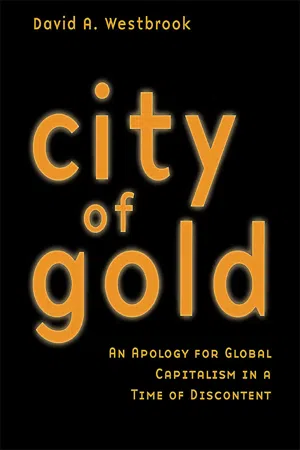
David A. Westbrook argues that we live in "the city of gold"--a global, cosmopolitan polity where politics are done through markets, and where global capital markets, not states, have become the dominant force in our social life.
Information
PART 1: Desire’s Constitution
Most wars end with meetings. Such meetings provide not only the terms of the peace, demarcate borders and so forth, but also the rough drafts of the stories we will later tell, in order to know what the war meant, and if the war was an important one, who we are.

Paul Delvaux, The Congress (1941)
So the meetings at the end of the Thirty Years’ War ended with the Peace of Westphalia (1648), which again committed much of Europe to the nominalist conception of politics announced at Augsburg (1555) and soon afterwards known under the slogan cuius regio, eius religio, under which the ruler decides the religion of a territory. More generally ultimate things, even God, are to be decided or, after Westphalia, tolerated, by national sovereigns. The Peace of Westphalia is the traditional marker for the birth of what is still called the modern era of international politics, in which international law and relations were dominated by, even defined as, interactions between nation states, and more deeply, in which the nation was understood as the fundamental unit of our lives together.1 Conversely, the meetings at the end of World War Two engendered plans for the economic integration of nation states. It has become evident that the processes of economic integration have as fundamentally transformed the grammar of politics as did the historical processes signified by the Treaty of Westphalia. More specifically, at the end of World War Two, supranational capitalism was used to found a new polity, the City of Gold, to supercede the nominalist nation state inaugurated at Westphalia as the fundamental unit of civilized political life. Part One of this apology sketches political life under the new constitution.
CHAPTER I: Conception
Founding of City. Bureaucratic character. Difficulties for modern political thought. Founders’ understanding of history of nationalism. Responses to nationalism. Responses to communism. Relation between economics and politics in founder’s conception. Emergence of post-enlightenment politics.
Most polities look to a founding, a mythic point in history when the people came into being as a collectivity, from when it made sense to think in terms of “we.” As with individual humans, the circumstances of a polity’s birth are seen to influence the identity and career of its people. So Rome had Romulus and Remus, suckled by a wolf, and for centuries thereafter the Romans ranged the world. The Russians turned back the Teutons on the ice outside Novgorod, thereby beginning the violent half of the dialectic with Western Europe that would continue at Tannenberg, Moscow, Tannenberg again, and through the Cold War (and that would nurture not just Eisenstein and Solzhenitsyn, who treated these particular battles, but more broadly the Russian tradition of Turgenev, Tolstoy, and Dostoevsky, artists who sought a Russian identity vis-à-vis Europe). Although there has always been an England, the nation appears to have founded and lived its political life on the grass, from the meadows at Runnymede, to the playing fields of Eton, and more recently, Prime Minister Major’s evocation of shadows lengthening on village greens. Lawyerly gentlemen of independent means founded the United States through enlightened argument. Such are the myths that have informed lives in other polities.
What follows is the foundational myth of the City of Gold. After World War Two, the mandarins of the victorious North Atlantic powers founded the City by fostering the “economic” integration of “free” peoples (especially those defeated in battle) across national borders. Economic integration was intended to break the identity of geography, government, economics, culture, and emotion that had too often engendered violent nationalism, and to create instead a new cosmopolitan situation, in which geography, government, economics, culture and emotion are polymorphously linked rather than coterminously arrayed. Integration was to be accomplished in three major ways: the Allied reconstruction of the Axis powers, the Bretton Woods Institutions, and, a little later, the European institutions.1 The mandarin effort was more profoundly successful than could have been imagined by men born into another age. We now plainly see that their efforts amounted to the redesign of Western Europe and Japan, the transformation of North America, the development of great swaths of Latin America, Asia, and even some of Africa, and, through the Bretton Woods Institutions, the establishment of a supranational regime that linked and interconnected what was then called the free world, and what has since come to include most of the planet. In short, this was the birth of our world, a world which has now, in the wake of the Cold War, reached its majority.
The institutions through which the City has been constructed (“the metropolitan institutions”) reflect the mandarin character of their founders. Although the reconstructions of the defeated nations were projects of limited duration, the metropolitan institutions have had decades to establish their existence and patterns of operation, their institutional characters and cultures. The metropolitan institutions work through bureaucratic toil in relative obscurity; by paying serious attention to and having involvement with contemporary thinking, that is, by possessing an openness to truths emerging from other sectors of the establishment, notably the university; by the gradual building of consensus; by cooperating with established forces in the political, corporate, and financial worlds; by possessing the ability to alter course, while rarely admitting error; and through the accretion of legal authority. The City has been established under the auspices of bureaucratic meritocracies. It is therefore unsurprising that their personnel display a filmily veiled lack of genuine egalitarian sentiment; exhibit a hubristic estimation of the manageability of facts; seem unashamed of their lack of transparency and palpable disregard for the substance, if not the form, of democracy; and the most damning, if perhaps the most difficult to articulate characteristic of the mandarins, are somehow inauthentic. In the face of perennial and often trenchant criticism along these lines, the metropolitan institutions foster the political skills pejoratively implied by the term “Byzantine”: a somewhat hypocritical culture of modesty; a self-effacing desire to facilitate quiet and orderly transactions while denying the existence of institutional power; and an insistence on the necessity of whatever particular choice is under criticism, thereby disclaiming guilt for the inevitable losses. The metropolitan institutions, in short, are bureaucratic, for better and worse.
The mandarin character of our founding institutions poses a problem for our political thought. The modern political imagination remains dominated by the figure of the prince, the national sovereign, ever liable to become a tyrant. We just know that those with power inevitably try to increase the scope and depth of their power; we fear that political success culminates in totalitarianism. If power corrupts, and absolute power corrupts absolutely, then the object of political thought is to devise ways to frustrate power’s tendency to tyranny. So we worry about the amorality of the prince; we find it necessary to have checks and balances and perhaps federalism and certainly rights (consider the first ten amendments to the U.S. Constitution) lest Leviathan grow too strong; we fear the tyranny of the majority; and as every administrative lawyer knows, we have a hard time thinking about bureaucracy except in terms of granting and then limiting discretion. The fear of tyranny revealed by such familiar political tropes is sensible enough, and modern political thought has done well to confront tyranny, nobly even though too often unsuccessfully.2 However, this fear has produced a certain astigmatism, if not outright blindness, with regard to less dramatic forms of political life, in particular, bureaucracy, or more broadly, civil life conducted within a bureaucratic legal frame. The mandarin is not a prince; the bureaucrat tends to seek order and comfort rather than glory. Emphasis on the prince fosters superficial understandings of mandarin politics in general, and in particular obscures the seductiveness of orderly markets. As a result of its focus on restraining the political lust of national sovereigns, the modern political tradition fails to articulate much that is required for an understanding of the City.
Metropolitan political thought, as opposed to political thought oriented to the nation state, could begin by shifting attention from the prince to the mandarins who founded the City and who continue to serve its institutions. Rephrased, we should think less about the will to power, and more about the normative structures that inform bureaucratic policy. Such structures are not drawn on an empty canvas. Mandarins perforce learn from experience. Public policy is informed by the policy community’s interpretation of historical events it believes to be relevant. History, in this sense, is a mythic and therefore normative narrative. Such history may or may not be true, but it cannot be ignored. Just as we may learn the wrong lessons from our individual experience, the received interpretation of historical events may be wrong. But the policy community nonetheless can only think, or act, or refuse to act, in terms of the history it believes it knows. Not only is the policy community informed by its understanding of history, when there is a need to act, the policy community literally must tell itself a story in the course of deciding how to act.3
Men like John Maynard Keynes and Harry Dexter White, George C. Marshall and Dean Acheson, Jean Monnet and Robert Schuman, members of the class of educated officials that great powers require for administrative purposes, are rarely revolutionaries. Career bureaucrats and military men, along with leading academics and businessmen called to advisory public service, are hardly the sort of men that we, romantics that we remain, might expect to make grand social changes like founding the City of Gold. But the end of World War Two was an epochal moment; the victorious understood world history to demand an epochal response. Winning the war was not enough—it was necessary to “win the peace.”4 The mandarin understanding of their times, and so what was at stake for their policies, was not without reason. By any absolute and most relative measures, World War Two was the largest war that had ever been fought. Millions and millions were dead. Whole countries were devastated. Barbarism—the Holocaust—had broken out at the heart of Europe, calling into question not only European civilization, but the very possibility of history as a progressive narrative, the notion of civilization toward which we still gesture when we speak of development. Old antagonisms between liberalism and communism had reemerged, more virulently than before, feeding war in China and beginning a sequence of violent confrontations throughout the developing world. The United States had developed a new type of weapon, with theoretically limitless power, and proven its efficacy on Japanese people. There was a widespread sense that the world would not survive the next major war, especially if it were fought with such weapons. Confronted with this situation, the history that significant parts of the North Atlantic policy community told itself implied the policies expressed by the founding of the City of Gold.
These mandarins’ history may be sketched roughly as follows: The long peace following the Napoleonic Wars withered at the end of the nineteenth century. Germany and Italy united, industrialized, and fought wars in the process of forging various principalities into nation states. Russia struggled to modernize. Seeking markets and sources of raw materials, the nations of Europe entered a dangerous scramble for colonies in the as yet uncolonized parts of Africa and Asia, and competed everywhere. Acquisition of colonies required the building of navies to protect the sea lanes between the colonies and Europe; Germany’s navy soon rivaled Britain’s. Attempting to defend their nascent industries, the nations of Europe and the United States erected protective tariffs. Aware of the intensifying antagonisms, nations entered military alliances in an effort to ensure their own security, but only succeeded in further heightening tensions. By the time war broke out, the belligerents had industrial economies integrated along national lines, but military obligations and thus vulnerabilities that spanned the globe. As a result, there was both wherewithal and reason to continue the killing until the economies—and so, the nations themselves—imploded. War in Europe had become total.5
After what was for a time called the Great War, the victors met and demanded reparations from the vanquished, standard practice. The French, in particular, recalled the German levies after the Franco-Prussian War. German reparations may or may not have contributed to the hyperinflation of 1922–23, but they certainly contributed to the resentment of a large part of the German people toward France and the other Allied powers. Unwilling to enforce the impoverishment of Germany, which might have required colonizing the country, the Allies watched as the German economy was rebuilt, stronger than before, and again on a national basis. Meanwhile, even before World War One had ended in the West, the Russian government’s efforts at liberalization failed, and the communists seized control of Russia.
After the armistice, there was a widespread sense that civilization somehow had to organize itself in order to prevent horrors like the Great War. A host of international institutions were founded, most notably the League of Nations. President Wilson was unable to prevent Americans, most of whom had not wanted the war, from retreating to their own shores and their own concerns. American isolationism, among other things, rendered the League, the Kellogg-Briand Pact prohibiting wars of aggression, and other expressions of pacifistic internationalism ineffectual against the rising tide of hostilities. At the same time, economic competition among nations intensified. The Smoot-Hawley Act, raising U.S. tariffs, was passed in 1930 over the protests of the economics profession.6 Tariffs impoverished domestic consumers and encouraged other nations to erect tariffs of their own. As crossing borders became ever more expensive, contacts, experience, and horizons tended to stop at the border. Life came to be lived within the bounds of individual nations; foreigners became strangers. Nationalism was further aggravated by competitive devaluation, which led to ruinous competition.7 When the worldwide Great Depression hit, millions of workers lost their jobs and with them their personal security, and it was easy enough to blame others (Jews, foreigners, capitalists, and so on), and to look to strong leaders for salvation. Strong leaders, in turn, sought to consolidate their power base and extend their glory in the most traditional way, warfare, or even more spectacularly, the declaration of empire, a rising sun, the rebirth of Rome, a thousand-year Reich. Hitler is thus the dark prince against whom metropolitan politics is organized.
Drawing on such a view of history, the North Atlantic mandarins believed that economic isolationism fostered the development of competitive national societies that were capable of, and indeed had incentives for, warfare. Prevention of future wars required the suppression of nationalism; the vehicle for such suppression was economic integration. More generally, economics came to be seen, not as opposed or ancillary to politics, but as a constitutional mechanism in its own right.8 Properly deployed, economic interests could prevent the coalescence of the identity that had made Hitler so powerful: mass nationalism, the military power of the state, and modern industrial capacity integrated along national lines. Just as Madison thought that faction based on economic interest was the best security against the mob’s seizure of the power concentrated in the new, more centralized, national government, so the North Atlantic mandarins believed that private economic connections spanning national borders could provide a web of financial interest, emotional affinity, and practical difficulties in which larval tyrants would be ensnared, unable to mature and gather their forces.9
This vision of an integrated peace after World War Two was established in three major institutional ways: the reconstruction of the defeated Axis powers; the establishment of the Bretton Woods Institutions and exchange rate system; and the establishment of the European Communities and their attendant institutions. Such political organizations are not achieved overnight, and planning for the peace began long before the war was over. In a series of conferences, mandarins from different countries met to discuss how the war was to be won, and what was to be done with the defeated.10 Germany was almost exclusively the focus of negotiations by the time the war ended, because Italy had in the meantime joined the Allies. Japan was controlled solely by the United States, and so was the subject of less negotiation (mostly involving Soviet commitments to open an Eastern front), but Japan generally was to be treated in the same way as Germany. Although the consensus that emerged from these negotiations was soon to be eroded by the Cold War, the consensus held long enough to establish the institutions that would foster the new world.
The metropolitan institutions could not have been established if the Allies had not reconceived what it meant to win a war. It was agreed that, in contrast to the end of World War One, the Allied victory in World War Two was to be regarded, to the extent possible, as the liberation of people subject to military dictatorship. The dictators would be punished in accordance with the law. New laws, even new constitutions, would be enacted as necessary. Power would be organized along democratic lines, and a thoroughly modern state would be returned to the German and Japanese people as soon as practicable. The Allies, especially the United States, would maintain an extensive presence in Germany and Japan, for geopolitical reasons of their own and to support the stability of the new regime. Economies devastated by the war would be rebuilt. Rather than reparations, the Allies would provide material aid to the impoverished. Rather than salting the earth, the Allies would help to rebuild the industrial economy (with a few limitations on military technology), in part to provide markets (and some reparations), in part to prevent the resurgence of resentments such as those that followed World War One. At Harvard University on June 5, 1947, one-time General, then U.S. Secretary of State George C.Marshall announced that the United States intended to create, in cooperation with the Europeans, a massive program of credits and grants. Although not uncontroversial, such aid was openly understood to be in the interests of the United States as well as Europe. Not only did the United States hope that peace could be put on a more secure footing than it had been after World War One, deepening ideological competition with the Soviet Union, discussed further below, counseled generosity. The fact remains, however, that a program of generosity was chosen in lieu of the traditional prerogatives of the conqueror. And it appears to have worked—Allied generosity, indeed mercy in the face of extreme provocation, continued Allied presence, and the rapid reintegration of the vanquished nations into the fabric of international life ensured that there was no serious resentment, no talk of vengeance, no new belligerency in the conquered lands.
Economic reconstruction and integration was not the only approach to security at the end of the war. The Allies also created a new, global, security regime to ensure the peace, the United Nations. Unlike the old League of Nations, the new security regime was intended to have enforcement powers, and the United States, along with the other great powers, would have permanent representation in a “Security Council” empowered to conduct police actions, to go to war to ensure the peace. The Wilsonian dream would be realized at last. Rather than an alliance organized against past and possible future threats, the United Nations would prevent the outbreak of violence by creating a true community of nations, where violence between nation states was as barely thinkable and completely unfeasible as it is in a well-ordered civil society. Germany and Japan would be recreated, and as reborn, integrated into that dream. Thus the political/military and the social/economic approaches to security complemented one another.
As already suggested, policy is an expression of beliefs about history. The interwar years, to say nothing of the war years themselves, provided a powerful negative object lesson into how the international economic order should function. The metropolitan institutions can be understood as the antithesis of the economic policies leading up to and including World War Two. So, where the victors of the First World War had demanded reparations and sought to prevent the recovery of economic capacity, the mandarins sought to facilitate rebuilding. Where the interwar years had competitive devaluation and the collapse of the gold standard, the mandarins sought to construct a fixed exchange rate system.11 Pressures on the exchange rate would be addressed by an institution that could extend credit as necessary until the pressure subsided or the currency could be repegged, the International Monetary Fund (IMF). Where the interwar years had been marked by excessive and rising tariffs, the mandarins sought to establish sen...
Table of contents
- Cover Page
- City of Gold
- Title Page
- Copyright Page
- Acknowledgments
- Introduction
- Part 1: Desire’s Constitution
- Part 2: Constitutional Critique
- Part 3: Exhausted Philosophies
- Part 4: Toward a Metropolitan Political Economy
- Notes
Trusted by 375,005 students
Access to over 1.5 million titles for a fair monthly price.
Study more efficiently using our study tools.
Frequently asked questions
Yes, you can cancel anytime from the Subscription tab in your account settings on the Perlego website. Your subscription will stay active until the end of your current billing period. Learn how to cancel your subscription
No, books cannot be downloaded as external files, such as PDFs, for use outside of Perlego. However, you can download books within the Perlego app for offline reading on mobile or tablet. Learn how to download books offline
Perlego offers two plans: Essential and Complete
- Essential is ideal for learners and professionals who enjoy exploring a wide range of subjects. Access the Essential Library with 800,000+ trusted titles and best-sellers across business, personal growth, and the humanities. Includes unlimited reading time and Standard Read Aloud voice.
- Complete: Perfect for advanced learners and researchers needing full, unrestricted access. Unlock 1.5M+ books across hundreds of subjects, including academic and specialized titles. The Complete Plan also includes advanced features like Premium Read Aloud and Research Assistant.
We are an online textbook subscription service, where you can get access to an entire online library for less than the price of a single book per month. With over 1.5 million books across 990+ topics, we’ve got you covered! Learn about our mission
Look out for the read-aloud symbol on your next book to see if you can listen to it. The read-aloud tool reads text aloud for you, highlighting the text as it is being read. You can pause it, speed it up and slow it down. Learn more about Read Aloud
Yes! You can use the Perlego app on both iOS and Android devices to read anytime, anywhere — even offline. Perfect for commutes or when you’re on the go.
Please note we cannot support devices running on iOS 13 and Android 7 or earlier. Learn more about using the app
Please note we cannot support devices running on iOS 13 and Android 7 or earlier. Learn more about using the app
Yes, you can access City of Gold by David A. Westbrook in PDF and/or ePUB format, as well as other popular books in Economia & Business generale. We have over 1.5 million books available in our catalogue for you to explore.