Early Education Reformed provides a strong foundation of knowledge about aspects of early years education, by summarising the current status and outlining paths of development for now and the future. Specially commissioned papers by some of the most respected academics currently working in the field of early childhood and education means that this book will be essential reading for early years teachers and staff, social and child-care workers, researchers and policy-makers.
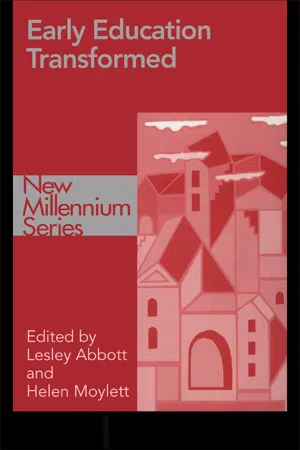
- 232 pages
- English
- ePUB (mobile friendly)
- Available on iOS & Android
eBook - ePub
Early Education Transformed
About this book
Information
1 Inspecting the Future
Rosemary Peacocke
The telephone rang and Rachel, my granddaughter, asked if she might interview me for her project. I agreed to do this and enquired, ‘Is this for English or do you want to know about the House of Commons?’ ‘Oh no,’ she replied, ‘you’re History!’ This chastening thought made me think that perhaps, over the long period I have been involved with the early years I have been a part of a lively, exciting and certainly challenging piece of history which is now coming into the new millennium.
As a very new head of an infant school I received a visitor who also wanted to interview me, saying he was a researcher for a committee which was set up under the chairmanship of Lady Plowden. He was interested to learn my views on the most effective ways in which young children learn, and also that he would like to return regularly to observe and ask further questions. I did not know at this juncture that I was about to be a very small part of another important part of history.
Few reports have been so widely quoted and misquoted over the past thirty years in this country. The Plowden Report published in 1967, has been praised and blamed for the development of primary education. Internationally it is still considered one of the most important and influential reports about how young children learn, and the principles and philosophy described are being followed in other countries. Buildings, especially in America, are still being constructed based on those described in the report.
It is worth glancing at the text at the end of the millennium to see a few examples of the thinking at that time. The first two sentences of Chapter 2 are worth quoting, ‘At the heart of the educational process lies the child. No advances in policy, no acquisitions of new equipment have their desired effect unless they are in harmony with the nature of the child, unless they are fundamentally acceptable to him’ (Chapter 2. The language may be dated, but this premise still stands.
In the 1960s, a survey showed that 29 per cent of all homes had five books or less. It would be interesting to know if this statistic is similar at the millennium, since reading now has to compete with TV and video. Strong recommendations were made in the Report to foster parental involvement, and many examples of good practice were described.
The 1960 descriptions of the schools in educational priority areas are stark, and unfortunately prophetic. ‘We have ourselves seen schools caught in vicious circles and read accounts of many more…We noted the grim approaches; incessant traffic noise in narrow streets; the absence of green playing spaces; gaunt looking buildings; often poor decorative conditions inside; narrow passages; unheated and cramped cloakrooms;…it is becoming particularly hard to find good heads of infant or deputy heads of junior schools. We are not surprised to hear of the rapid turnover of staff, of vacancies sometimes unfilled or filled with a succession of temporary and supply teachers of one kind or another’ (The Education Committee, 1995). And the above was written not in the 1960s but in 1995!
In 1995 the Select Committee for Education in the House of Commons produced a report on Performance in City Schools. It echoed the words of Plowden, described the depressing effects on the staff and pupils of vandalism, theft and arson in the school. The report goes on to say ‘There are significant problems of high teacher mobility in schools in some deprived urban areas, and within individual schools…New ways must be found to encourage able, experienced teachers to work in city schools and remain long enough to provide stability and continuity’.
For the purpose of this chapter the most significant recommendation in the Plowden Report is that ‘Eventually there should be nursery places for all children whose parents wish to attend from the beginning of the school year after the age of three’ (Chapter 9, p. 116, para. 343).
A similar recommendation, except that the age of entry proposed is four, was made by the Select Committee for Education, Science and Arts in a report on Educational Provision for the Under Fives in 1988, by the same committee in its report on Standards of Reading in Primary Schools in 1991, and also by the Education Committee in the report Performance in City Schools in 1995. It is extraordinary that such similar recommendations are being made through the decades and consistently being ignored.
Fascinating and, perhaps, disturbing, though this tour through the highways and byways of the Plowden Report and glances at successive reports can be—and there are many more we could follow—I would like to return to the first quotation ‘At the heart of the educational process lies the child…’ not the curriculum, not subjects, not organization, but the child. It is in this context that I want to consider the social, moral, cultural and spiritual development of the young child and peer through the mist at what might be the inspection priorities in 2000. This is not an area which has only been recognized as an important part of the curriculum in the years in which OFSTED has been inspecting schools. Plowden also had something to say,
Emotional, social and intellectual aspects are closely intertwined in mental growth: the child is a total personality. Emotional life provides the spur and in many ways gives meaning to experience. Moral development is closely associated with emotional and social development. The child forms his sense of personal worth and his moral sense from early experiences of acceptance, approval, and disapproval. (Chapter 2)
The word ‘spiritual’ is not mentioned in Plowden in this context, and is only used once in the section on Religious Education. The very term ‘spiritual’ development causes problems for some teachers, and not only teachers. As long ago as the drafting of the 1944 Education Act, William Temple, then Archbishop of Canterbury tried to find a word that would not offend the members of the Houses of Parliament, and he tried to avoid the word ‘religion’. His assistant Canon Hall found the answer, and he wrote, ‘The churches were in such a state at that time that we thought if we used the word “spiritual” they might agree to that because they didn’t know what it was. They all had very clear ideas about what religion was and they all knew they did not agree with anyone else’s definition of it’.
Traditionally, and the use of the word by Canon Hall shows this, spiritual development and spirituality have been associated with religious faith, but the terms are now used in a much wider fashion, though still conveying something belonging to a person’s inner life. The National Curriculum Council in 1993 offered the following definition:
spiritual development needs to be seen as something fundamental in the human condition which is not necessarily experienced through the physical senses and/or expressed through every day language. It has to do with relationships with other people and, for believers, with God. It has to do with the universal search for individual identity with our responses to challenging experiences, such as death, suffering, beauty and encounters with good and evil. It is to do with the search for meaning and purpose in life and for the values by which we live.
We have evidence that spiritual experience is not restricted to those who consider themselves religious believers. As long ago as the end of the 1960s Alister Hardy, an Oxford biologist, carried out a survey inviting responses from the general public on variants of the question, ‘Have you ever been aware of or influenced by a presence or power, whether you call it God or not, which is different from your everyday self?’ 5,000 responses were received. Since then twelve similar surveys have been carried out showing that 20–48 per cent have claimed to have had some experience of the numinous. Most of the people who responded admitted that they had told no-one of their experiences for fear of being thought either stupid or unbalanced.
From the survey conducted by Hardy all the material which referred to young children, that is the adult’s memories of their own experiences, was collated by Eric Robinson in his book The Original Vision. It is interesting to note that most of the experiences described were to do with the natural world, and also the very young age these children had these experiences.
This well documented extract from the book illustrates both these points,
The most profound experience of my life came to me when I was very young—between four and five years old. I am not mistaken in dating this because I remember both the place where it occurred and the shoes I was wearing at the time, of which I was rather fond. Both of these facts relate only to this particular period of my life; I have a dated photograph of myself wearing the shoes in question.
My mother and I were walking on a stretch of land in Berkshire, known locally as ‘the moors’. As the sun declined and the slight chill of evening came on, a pearly mist formed over the ground. My feet, with the favourite black shoes with silver buckles, were gradually hidden from sight until I stood ankle deep in gently swirling vapour. Here and there just the very tallest harebells appeared above the mist. I had a great love of these exquisitely formed flowers, and stood lost in wonder at the sight. Suddenly I seemed to see the mist as a shimmering gossamer tissue and the harebells, appearing here and there, seemed to shine with a brilliant fire. The vision has never left me. It is as clear today as it was fifty years ago, and with it the same intense feeling of the love of the world and the certainty of ultimate good. Of course at the early age of four or five I could not have expressed anything of the experience in the words I have now used. (Robinson, 1983, p. 110)
That last sentence is important. Young children do not have the language to describe their experiences, and we underestimate them because of their inability to talk about it. Some poets and writers however, have described vividly how they viewed the world in the early years, and their perceptions of amazement, awe and wonder. Traherne was one such writer. In The Centuries he introduces a section with the words ‘Is it not strange that an infant should be heir of the whole world, and see those mysteries which the books of the learned never unfold?…The dust and stones of the street were as precious as gold: the gates were at first the end of the world. The green trees when I first saw them through one of the gates transported and ravished me, their sweetness and unusual beauty made my heart to leap, and almost mad with ecstasy, they were such strange and wonderful things’ (Traherne, 1963, p. 110).
Although, doubtless, children’s inability to express themselves is one difficulty, it can also be relevant that often they do not have anyone to listen if they are prepared to talk. This is becoming even more apparent in the climate of the primary classroom where 4-year-old children are in large groups, and the pressure is towards more formal teaching for the 5-year-olds.
Clive Erricker (1997), in his work in the Children and Worldviews project, suggests that spiritual development is best encouraged by eliciting children’s explanations to significant events in their own lives and then relating them to other children who can then reflect on such accounts in relation to their own experience.
The following edited extract, from a much longer contribution, was made in response to another child’s comment that she thought her Dad had gone to heaven.
Before my Nan died she told me lots of things because she knew she was going to die. She said she would be happy when she died. On that day she got a picture of her and all the family, stuck it on a postcard and wrote on the back ‘I’ll see you in my heart’. Now she’s always with me. Now I talk to her all the time. I talk to her when I’m lonely. When I’ve argued with my friends I go and sit on the wall and think about her and talk to her…. She says she’s going to ring me up. She says things in my head, she rings up my brain and talks to me. When she went up to heaven she took one of her special secrets. She took it with her and she can just ring me up, it’s clever. This special secret makes her able to do that. I keep wanting to tell people things but they don’t understand. (Erricker, 1997, p. 47)
This remarkable outpouring was only made possible by the fact that another child had stimulated it and there was a sympathetic listener. The child had, with the help of a supportive family, come to terms with her grandmother’s death and, in her own way, reflected on her experience using metaphorical language to interpret her feelings.
Death is something which some teachers find it very difficult to deal with, however this is not the only sense of loss with which many children have to cope. The divorce rate now means that the children involved in separation from one parent is increasing. Young children are caught up in an emotional situation that they are unable to understand but of which they are an important part, and often have no-one to talk to because of the relationships of the adults. Personal and social development in schools cannot ignore the pressures some of these children are experiencing, which we know from empirical evidence affect the children’s work and relationships with their peers and teachers.
There is evidence to show that in some cases children are struck if they mention to one parent that they wish to visit the other and, often, the children find it difficult to talk about their problems, even to their peers. In another extract from the Children and Worldviews project, where a boy is talking to the researcher about his parents splitting up he says
Talking’s the best way to get it off your mind a lot, cos well you get the chance to talk about things, cos this is the first time we’ve actually got to discuss it with somebody. But if it was like a group or a class of children, about ten people, I couldn’t say anything then cos I’d be scared cos I would think people might take the mickey out of me. (Erricker, 1997, p. 109)
Another boy said ‘I talked to N about what happened to me, he was another person I thought I could talk to because he’s, his Mum and Dad were on the verge of splitting up and he felt what I felt then, and he, he keeps it a secret’.
The two boys gained such confidence from the discussion that they decided to talk to the headteacher and ask permission to set up a meeting so that they could share problems they had never been able to talk about before. The meetings were arranged and were chaired by the children; the headteacher was present but did not speak unless invited to. The subjects for discussion were placed anonymously in a box during the week.
What do we learn from all this about the needs of the child? Certainly that time must be made to listen to individual children, and then sensitively encourage the children to share their experiences, but perhaps most importantly is that we recognize and respect the children’s thinking and in doing so enhance their self esteem. In spiritual, social, moral and cultural development, this is not only the key to enhancing each of these areas, but the fundamental need of every child to have a strong concept of self worth or as they say across the Atlantic ‘Feel good about yourself’.
A good self image is just as important for adults to succeed in whatever they are doing, and it can be something said or assumptions made which can affect an individual. An amusing example of this occurred when I was a newly appointed HMI and was visiting a probationary teacher who was having problems with a class of 5- and 6-year-olds. At the end of the morning a valiant, but not very successful, attempt was being made to clear up the classroom after a session which included seven different craft activities. I was sitting silently on a small chair by the door observing all that was going on, when a small girl came over to me and whispered ‘Are you learning to be a dinner lady?’ It is salutary, but not always comfortable, to see ourselves as others see us, but the self image presented to me that day has lived with me for many years!
If it is accepted that a child will not be able to learn effectively if she has low self esteem, how can this be improved in the early years? There are a variety of ways and perhaps the most important is that other people, and especially the adults who spend a lot of time with the child, take her seriously, listen to what she says and warmly accept her as a person. High esteem also comes from doing things well, knowing that she can trust people and being sure in the knowledge that her friends enjoy her company. Only when the child is secure will she want to learn, be able to learn and be motivated to do so.
With a good self image also comes self-knowledge and an understanding of other people and empathy with them. The poem ‘Childhood’ by Cornford expresses...
Table of contents
- Cover Page
- New Millennium Series
- Title Page
- Copyright Page
- List of Figures
- Acknowledgments
- Preface
- Foreword: The Importance of Having a Vision
- Introduction: A Vision for the Future—Reforming or Transforming?
- 1 Inspecting the Future
- 2 The Good, the Bad and the Possible? Linguistic and Cultural Diversity: Changing Perceptions and Practices
- 3 In Praise of Inspired and Inspiring Teachers
- 4 Quality and Professionalism in Early Childhood
- 5 Another Way of Seeing: Perceptions of Play in a Steiner Kindergarten
- 6 Protecting Playfulness
- 7 The Search for Expertise: The Importance of the Early Years
- 8 Valuing Young Children
- 9 Accounting Early for Lifelong Learning
- 10 Musings from a Nursery Inspector and Letters from a Pupil 1990–98
- 11 Planetary Influences
- 12 ‘If This was on the Computer We Could Hear the Lion Go Roar’—Information and Communications Technology in Early Years Education
- 13 Early Childhood Institutions as a Democratic and Emancipatory Project
- 14 Early Childhood Education in the Postmodern World
- 15 The Role of Research in Explaining the Past and Shaping the Future
- 16 Young Children and Their Families: Creating a Community Response
- Conclusion: Drawing the Threads Together
- Notes on Contributors
Trusted by 375,005 students
Access to over 1.5 million titles for a fair monthly price.
Study more efficiently using our study tools.
Frequently asked questions
Yes, you can cancel anytime from the Subscription tab in your account settings on the Perlego website. Your subscription will stay active until the end of your current billing period. Learn how to cancel your subscription
No, books cannot be downloaded as external files, such as PDFs, for use outside of Perlego. However, you can download books within the Perlego app for offline reading on mobile or tablet. Learn how to download books offline
Perlego offers two plans: Essential and Complete
- Essential is ideal for learners and professionals who enjoy exploring a wide range of subjects. Access the Essential Library with 800,000+ trusted titles and best-sellers across business, personal growth, and the humanities. Includes unlimited reading time and Standard Read Aloud voice.
- Complete: Perfect for advanced learners and researchers needing full, unrestricted access. Unlock 1.5M+ books across hundreds of subjects, including academic and specialized titles. The Complete Plan also includes advanced features like Premium Read Aloud and Research Assistant.
We are an online textbook subscription service, where you can get access to an entire online library for less than the price of a single book per month. With over 1.5 million books across 990+ topics, we’ve got you covered! Learn about our mission
Look out for the read-aloud symbol on your next book to see if you can listen to it. The read-aloud tool reads text aloud for you, highlighting the text as it is being read. You can pause it, speed it up and slow it down. Learn more about Read Aloud
Yes! You can use the Perlego app on both iOS and Android devices to read anytime, anywhere — even offline. Perfect for commutes or when you’re on the go.
Please note we cannot support devices running on iOS 13 and Android 7 or earlier. Learn more about using the app
Please note we cannot support devices running on iOS 13 and Android 7 or earlier. Learn more about using the app
Yes, you can access Early Education Transformed by Lesley Abbott,Dr Helen Moylett,Helen Moylett in PDF and/or ePUB format, as well as other popular books in Education & Early Childhood Education. We have over 1.5 million books available in our catalogue for you to explore.