- 352 pages
- English
- ePUB (mobile friendly)
- Available on iOS & Android
eBook - ePub
About this book
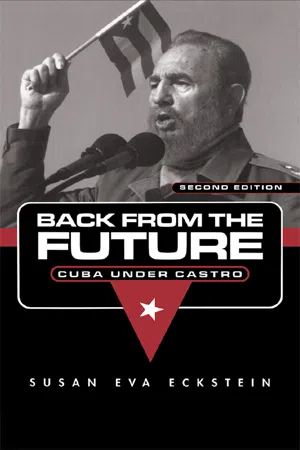
This book has long been regarded as the definitive history of Castro's communist regime, beginning in 1959 through the 1990s. This updated, second edition contains a new epilogue by the author that covers the last decade, including such newsworthy events as the Elian Gonzalez controversy, the growing immigrant community of Cuban-Americans in Florida, the role of Cuban-Americans in the 2000 presidential election, the withering U.S. sales embargo and the inevitable transition of power now that Castro is in his mid-70s.
Information
Subtopic
International RelationsIndex
HistoryChapter One
THE LIMITS AND POSSIBILITIES OF SOCIALISM
CUBA IS AN ISLAND of some ten million people, only ninety miles from the United States. Despite its small size, its revolution shook the world. Marching triumphantly into Havana in January 1959, Fidel Castro led a nationalist and then socialist movement that defied the “Colossus of the North,” in a region considered the United States’ sphere of influence. And Castro succeeded even though Cuba was heavily dependent on its northern neighbor for trade and investment.
The Cuban revolution is Fidel’s revolution. Without his charisma modern Cuban history would be different. Yet to see developments in Cuba as the act of a single individual assigns an importance to Fidel he does not deserve. He reshaped Cuba, and even influenced other Third World countries, but under circumstances not of his choosing. Castro had to come to terms with the limits of his personal power over the years. There are historical and structural limits to leadership. Fidel is no exception.
Historical and structural factors that will be shown in the chapters that follow to shape Castro’s ability to make and remake society are rooted, as noted in the preface, in the global political economy and, domestically, in dynamics rooted in the state apparatus itself and in civil society.1 After discussing how and why these factors are of consequence, a brief history of prerevolutionary Cuba and the conditions giving rise to the revolution appear. And because the state is so central to this study of economic and social policy-making, the chapter ends with a brief description of the evolution of the state and of state-civil society relations under Castro.
CONTEXTUAL FACTORS AFFECTING STATE POLICY OPTIONS
The Weight of the Past
The seizure of power is an event. But any government, including one born of revolution, is limited in what it can do by the productive capacity of the “inherited” economy. In Third World countries where resources are meager and poorly developed, this constraint is especially great.
Castro very quickly had to come to terms with the peculiarities of the island’s economy, above all the key role sugar played. His efforts to develop a balanced nationally oriented economy were shaped by this vestige of the past. Cuba was historically integrated into the world economy as a sugar producer.
People, moreover, do not easily break with the values, beliefs, and attitudes they have long had, passed on for generations by families. Culture is embedded in national as well as class and race-specific experiences. Spanish colonialism brought with it slavery and associated racism, plus a Catholic world order premised on hierarchy and elitism. The abolition of slavery and independence never entirely wiped out the colonial heritage, although nationalism in the course of the independence struggle became an additional cultural force, and postcolonial subjugation to U.S. influence added a materialist strand to Cuban culture that was felt strongest in Havana.
Slavery, in turn, never entirely obliterated the beliefs and traditions of the subjugated population. Slaves brought from Africa for the developing sugar economy retained, in modified form, certain tribal customs and values. Since many slaves came as late as the mid-nineteenth century, their African past was only a generation old at the time of independence. Newly formed Afro-Cuban religions functioned as “cultures of resistance,” not only to white elite-imposed Catholicism but also to slavery and Colonialism. They were important in the independence movement and have remained so since.
After taking power Castro sought to socialize the populace to new values and new loyalties. He sought to create what Ernesto “Ché” Guevara, the Argentine-born doctor turned revolutionary who collaborated closely with Castro, defined as the “new man” (and woman): egalitarian, selfless, cooperative, nonmaterialistic, hardworking (at both manual and non-manual tasks), and morally pure. Even when people outwardly appeared to take on these new values, they privately retained old sentiments and passed them on to their children. Sometimes the new beliefs were fused with the old. Reflecting fusion, it became not uncommon to find among the laboring classes statues of Santa Barbara, a syncretic, brown Virgin, alongside glasses of water for the spirits and pictures of Fidel, Ché, and other revolutionary heroes.2
The revolutionary government was not merely haunted and “held back” by traditions rooted in the past. Castro also astutely used history, historical symbols, and national passions. Even after a generation of Communist rule he still identified the revolution with the island’s main national heroes, heroes of Cuba’s struggle for independence, and with the major battles of the independence movement. He portrayed the revolution less as a break with the past than as a fulfillment of the revered heroes’ mission, all the more so after the delegitimation of world Communism.
Global Geopolitical, Political, and Economic Dynamics
Were the past the determinant of the present, little could or would change. Leadership’s ability to remake society is also influenced by global political and economic forces at hand. No country, especially in the Third World, can operate in an international vacuum.
Developments in the less industrial world, since the close of World War II until the collapse of the Soviet Union, were shaped by Cold War politics, along with longer standing but constantly changing world market structures. Third World governments have had to come to terms with these externally rooted factors. Cold War politics pressured Third World countries to ally with one of the two superpowers: the United States or the Soviet Union. Each superpower influenced countries within its bloc economically, politically, and ideologically. The United States appropriated Latin America into its “sphere of influence,” to the point that Latin American countries became heavily dependent on their northern neighbor for aid and trade, and they allied with the United States internationally. The United States, in turn, felt it could intervene directly or indirectly in the internal affairs of bloc-affiliated countries.
The evolution of the Cuban revolution is a by-product of the Cold War. Hostile to a nationalist movement in its backyard that jeopardized its own businessmen’s interests, Washington first tried to contain and then to subvert the revolution, only to contribute to its radicalization and to Cuba’s alliance with the Soviet Union. While the movement’s radicalization illustrates how Washington mistakingly overestimated its ability to shape developments in its claimed “sphere of influence,” superpower rivalries help explain why the Soviets were willing to provide Cuba with aid and trade and why Castro embraced the Soviets. When the Soviet Union ceased to be a- superpower, much less exist, Cuba was hard hit by the costs of its former Soviet alliance, with few remaining benefits.
Shaped by the Cold War, Castro never became a complete pawn of Moscow. As will be documented, he on occasion implemented policies at odds with Moscow’s and he manipulated Cold War politics to his country’s advantage.
Moreover, at the global level capitalist-market dynamics had a bearing on socialist Cuba, much more so than Cold War politics led observers to recognize. Analysts who perceived a “Sovietization of Cuba,” a common theme in the literature of the revolution through the mid-1980s, tended to assume, analytically and, in the main, empirically, that the Soviet and Western blocs were competing, mutually exclusive systems, and that the revolution served mainly to shift island dependency on the United States to the Soviet Union.3 But the Soviet bloc never was self-contained. Soviet policies toward bloc-member countries were, in part, adapted to global market conditions. And member countries on their own were directly affected by world market dynamics and policies of capitalist countries. World systems theory, discussed in the preface, helps account for why governments ideologically committed to socialism that “socialized” ownership of most of their economy might be concerned with external market-oriented trade and financing, and other foreign exchange-linked activity.
But Third World options have also been shaped by international politics, independently both of Cold War and world market dynamics. Governments have certain discretionary power that may affect their foreign dealings. U.S. policy toward Cuba, for example, will be shown not to be explained merely in terms either of trade-based market considerations or superpower politics. Washington remained hostile to Cuba while being conciliatory to Communist China and the Soviet Union, even after Castro encouraged foreign investment and even after Castro had the country’s constitution revised to strengthen foreign investment guarantees. Washington’s stance toward Cuba is partly a function of the island’s proximity to the United States and continued enforcement of the nineteenth-century Monroe Doctrine. It also was influenced by administration ties, especially under Presidents Ronald Reagan and George Bush (1980 to 1992), to the Florida-based Cuban-American exile community. Washington’s strategy toward Cuba became a domestic and not merely a foreign policy matter, 4 especially with the growth of the Cuban-American voting bloc (with successive waves of emigration) and the increased economic and political power of conservative Cuban-American lobbyists.
Third World governments, if skillful, can mediate the impact of global geopolitical and economic forces. A master tactician, Castro will be shown not only to have extracted more concessions from Moscow than other Third World Communist-bloc members did but also to have influenced world politics disproportionate to the country’s global economic importance. His strengths, however, ultimately became his weakness. In the post-Cold War, Castro’s Cuba became exceptionally isolated and economically vulnerable.
Formal and Informal State Dynamics
Fidel might wish that he could say l’état c’est moi. However, the Cuban state is much more than his institutional personification.5 He has been circumscribed in what he has been able to do even by state economic, political, and administrataive exigencies, and by state bureaucratic and organizational dynamics.
Indeed, the government’s efforts to address simultaneously economic, political, and administrative matters may create problems. In expanding the productive capacity of an economy, for example, governments typically can count on the political loyalty of those whose living standards improve. But in stimulating investment governments may cut into their own revenue base and weaken their political support, especially in the short run—their economic base to the extent that they allow enterprises, including state-owned enterprises, to retain profits, and their political base to the extent that they tax economic activity and emphasize investment over consumption. Governments may also sacrifice domestic consumption for export, to finance imports and repay foreign loans (and accumulated interest on loans) contracted to complement meager domestic sources of capital; these sacrifices may also be politically costly.
Ideological antipathy to capitalism did not keep Communist governments during the Cold War from seeking the products of capitalism and capitalist financing to attain them. While Western funds expanded state socialist economic opportunities, they also came to drain fiscal resources when Western bank interest rates soared in the latter 1970s and when governments faced difficulties generating hard currency earnings for repaying accumulated debts.
In capitalist economies governments have depended heavily on creating conditions that induce private investment.6 By contrast, when economic ownership is largely nationalized a government need not face the risk that enterprises will divest should revenue-absorbing policies that cut into enterprise profits be implemented; in general, their investment decisions need not be driven as much by profit considerations at the micro, or enterprise, level. But they are faced with other constraints that limit their economic effectiveness.
Under state socialism ownership of the “means of production” eliminated private business resistance to prolabor policies, but as János Kornai has persuasively argued, budgetary problems have arisen because of the politicization of state allocations: firms have not been pressured to balance expenditures with earnings, 7 because the state absorbs excess expenditures. When subsidies, taxation rules, credit repayment conditions, and pricing are all negotiable, they make for what he calls “soft” budgetary constraints. Demand for inputs and investments tend to be unconstrained and to induce shortages in turn. Under the circumstances, politics may undermine the most efficient allocation of resources and pressure the state to overspend and spend wastefully.
Economic problems of state socialist regimes have been further compounded by low labor productivity. Removing the threat of unemployment, the governments have sought to motivate workers out of a com mitment to the collective good. Sometimes state managers have also encouraged labor’s commitment by involving workers in enterprise decision-making and by making workers feel—through consultations—that they are so involved. But workers in state socialist regimes have not, for reasons discussed below, necessarily identified and collaborated fully with management.
Faced with problems of chronic shortages and low productivity and distortions in the allocation of resources, state socialist governments have tried a diverse range of corrective measures over the years.8 Reformers in state-planned economies have argued that the introduction of certain market features would help correct for inefficiencies of central planning and allow for the “best of both worlds.” However, partial reforms never resolved old problems adequately, and they generated new distortions and imbalances. The history of state socialist economies has been punctuated by cycles of decentralization and centralization, expanding markets and restoration of bureaucracy. Oscillation between market and plan each set off political and economic pressures for the alternative coordinating mechanism, to correct emergent imbalances. However, even when reforms raised production and productivity and improved consumer satisfaction, they typically did not resolve state fiscal exigencies. Budgetary constraints remained soft while the reforms reduced state control over the economy and society.9 Market reforms reduce the share of the surplus directly appropriated by the state, in allowing enterprises to retain some of the profits they generate and in allowing small-scale private (or cooperative) activity that is difficult to monitor (and tax). Unless production expands substantially, state revenues may diminish while individuals and firms prosper.
Tension between central government and enterprise economic priorities thus are embedded in market forces. Production and productivity may be maximized when market features operate, and enteprise interests may thereby best be served. Yet when market forces are kept at bay, the government can maximize its control over what gets produced and the revenue generated, in accordance with economic plans. Therefore, official policies th...
Table of contents
- COVER PAGE
- TITLE PAGE
- COPYRIGHT PAGE
- LIST OF TABLES
- PREFACE TO THE SECOND EDITION
- PREFACE TO THE FIRST EDITION
- ABBREVIATIONS
- CHAPTER ONE THE LIMITS AND POSSIBILITIES OF SOCIALISM
- CHAPTER TWO THE “PUSH FOR COMMUNISM” AND THE “RETREAT TO SOCIALISM”
- CHAPTER THREE THE LATE 1980S CAMPAIGN TO “RECTIFY ERRORS AND NEGATIVE TENDENCIES”
- CHAPTER FOUR FROM COMMUNIST SOLIDARITY TO COMMUNIST SOLITARY
- CHAPTER FIVE THE IRONY OF SUCCESS
- CHAPTER SIX “A MAXIMUM OF RURALISM, A MINIMUM OF URBANISM”
- CHAPTER SEVEN INTERNATIONALISM
- CHAPTER EIGHT THE RELEVANCE OF THE REVOLUTION
- CHAPTER NINE EPILOGUE
- APPENDIX TABLES
- NOTES
Trusted by 375,005 students
Access to over 1.5 million titles for a fair monthly price.
Study more efficiently using our study tools.
Frequently asked questions
Yes, you can cancel anytime from the Subscription tab in your account settings on the Perlego website. Your subscription will stay active until the end of your current billing period. Learn how to cancel your subscription
No, books cannot be downloaded as external files, such as PDFs, for use outside of Perlego. However, you can download books within the Perlego app for offline reading on mobile or tablet. Learn how to download books offline
Perlego offers two plans: Essential and Complete
- Essential is ideal for learners and professionals who enjoy exploring a wide range of subjects. Access the Essential Library with 800,000+ trusted titles and best-sellers across business, personal growth, and the humanities. Includes unlimited reading time and Standard Read Aloud voice.
- Complete: Perfect for advanced learners and researchers needing full, unrestricted access. Unlock 1.5M+ books across hundreds of subjects, including academic and specialized titles. The Complete Plan also includes advanced features like Premium Read Aloud and Research Assistant.
We are an online textbook subscription service, where you can get access to an entire online library for less than the price of a single book per month. With over 1.5 million books across 990+ topics, we’ve got you covered! Learn about our mission
Look out for the read-aloud symbol on your next book to see if you can listen to it. The read-aloud tool reads text aloud for you, highlighting the text as it is being read. You can pause it, speed it up and slow it down. Learn more about Read Aloud
Yes! You can use the Perlego app on both iOS and Android devices to read anytime, anywhere — even offline. Perfect for commutes or when you’re on the go.
Please note we cannot support devices running on iOS 13 and Android 7 or earlier. Learn more about using the app
Please note we cannot support devices running on iOS 13 and Android 7 or earlier. Learn more about using the app
Yes, you can access Back From the Future by Susan Eva Eckstein in PDF and/or ePUB format, as well as other popular books in History & International Relations. We have over 1.5 million books available in our catalogue for you to explore.