The past decade has witnessed an explosion of interest and research on close relationships and social cognition. In both areas, numerous handbooks, textbooks, and journal articles have been published. However, it is the editors' impression that although cognitive theories and concepts have filtered through to research dealing with close relationships, much of this research reflects a relatively untutored understanding of the theoretical and empirical work in social cognition. Conversely, the research literature that provides a more sophisticated perspective on the role of cognition in close relationships typically reveals a relatively limited knowledge of the literature on close relationships.
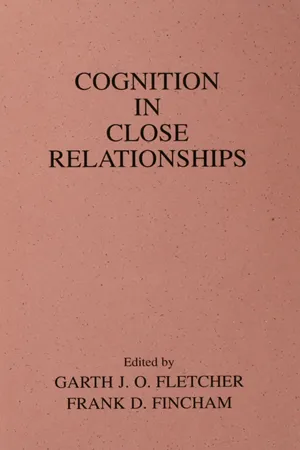
As researchers who have worked in both social cognitive processes and close relationships, Fletcher and Fincham are convinced that each field has much to offer the other. In fact, their book is based on two important postulates: first, that a social cognitive framework offers a valuable resource for developing our understanding of close relationships; and, second, that studying cognition within close relationships has the potential to inform our understanding of basic social cognitive processes.
- 374 pages
- English
- ePUB (mobile friendly)
- Available on iOS & Android
eBook - ePub
Cognition in Close Relationships
About this book
Information
Publisher
Psychology PressYear
2013Print ISBN
9781138970960
9780805805680
Edition
1eBook ISBN
9781134753970
| I | CONCEPTUAL FOUNDATIONS |
This book is concerned with the interface between two areas that have witnessed a burgeoning of attention and interest over recent years: close relationships and social cognition. The chapters in this first section of the book, in part, reflect the historical development of both social cognition and the science of close relationships, and the relations between them. As is made clear in several of these chapters, these two fields have tended to develop in parallel rather than in tandem. Hence, in spite of the common use of cognitive explanations in close relationship research, and the increasing flow of research concerned with cognition in close relationships, there exist very few comprehensive theoretical accounts that focus on cognitive structures and processes as they function within close relationships. The first section in this book is designed to fill this lacuna.
The cognitive perspective in social psychology predates by several decades the cognitive revolution in psychology and its offshoot of social cognition. Moreover, the most influential and imperialistic theory in social psychology to immediately predate the modern social cognitive movement in the 1970s was attribution theory: a cognitive theory concerned with the schemata and processes involved when people explain one another’s behavior. Indeed, attribution theory has remained popular partly because it has been widely exported to other areas in psychology, including the psychology of close relationships. In fact, research taking an attributional perspective is more voluminous than any other body of work explicitly concerned with the role of cognition in close relationships.
In chapter 1, Attribution Processes in Close Relationships, Fletcher and Fincham briefly review this body of research and the underlying standard attribution theory that has been adopted for use in close relationship work. They argue, however, that adherence to this standard model, derived from the classic attribution statements of Heider, Kelley, and others, has saddled the relevant research with various problems and gaps. Accordingly, they co-opt a model that attempts to locate attributional processing within a general, information-processing context. A central feature of this attempt is the use of a dimension that has had considerable currency in cognitive psychology and social cognition: the distinction between automatic and controlled processing.
In contrast to attribution theory, social cognition is more obviously an outgrowth of modern cognitive psychology with its focus on general features of information processing—a feature that is readily obvious in chapter 2, Information Processing in Close Relationships. In this chapter Scott, Fuhrman, and Wyer take one of the most fine-tuned and rigorously tested models of social cognition, developed by Wyer and Srull, and apply it to close relationship settings. As noted by these authors, social cognition theories have not been specifically developed to cope with the complexities of interpersonal communication or dyadic behavior. Hence, in their adroit application of the Wyer and Srull model to close relationships, these authors buttress the Wyer and Srull model with characteristically social features including communication norms and the reciprocity of emotional communications.
In chapter 3, On the Coherence of Mental Models of Persons and Relationships: A Knowledge Structure Approach, Miller and Read draw on one of the major challenges to the traditional information-processing approach in cognitive science, namely, what have been variously termed connectionist models, neural networks, or parallel distributed processing models. Such models are essentially massive networks of parallel structures, typically thought to be arranged in layers, that operate in terms of simple associative principles. The jury is still out on the validity of such an approach, the main problem being whether such models can adequately account for the sort of higher order cognitive abilities, such as reasoning and language use, that are presumably part and parcel of cognition in close relationships. All the more impressive, therefore, that Miller and Read, have imaginatively grafted a theory of explanatory coherence by Thagard (which in turn is based on a connectionist approach) onto a more traditional knowledge structure approach. Miller and Read’s general aim is to understand how people build elaborate cognitive models of personal relationships and the individuals in those relationships. Their attempt is a pioneering one for social cognition, as well as for the science of close relationships.
Cantor and Malley’s chapter, Life Tasks, Personal Needs, and Close Relationships, shares some features with Miller and Read’s chapter, in that it also takes personal and relationship goals to be central elements in individuals’ knowledge structures. However, Cantor and Malley move in a novel direction by building a general theory in which goals, personal needs, and what they term life tasks are all applied to close relationships. Compared to the other chapters in this section, Cantor and Malley’s contribution is most concerned with the long sweeps of time in which close relationships take place, and also with the wider societal structures in which relationships are located.
In the last chapter in this section, A Contextual Model for Expanding the Study of Marital Interaction, Bradbury and Fincham provide a compact and updated summary of a general model that has already had an impact on the field of close relationships. Indeed, the pervasiveness of some of the concepts in this book, such as the distinction between proximal and distal contexts or classes of variable, can be traced, in part, to their use in this model. As well as showcasing their own research derived from the Contextual Model, a distinctive feature of Bradbury and Fincham’s analysis is the diverse set of research areas they tap into, including the clinical, behavioral, psychophysiological, and social psychological arenas. Although explicitly aimed at marital interaction, their general thesis can be regarded as a wellspring for this entire section, namely, that general theories are desperately needed to interpret and integrate the welter of past research dealing with close relationships as well as to provide theoretical direction for future research endeavors.
| 1 | Attribution Processes in Close Relationships |
University of Canterbury
University of Illinois
Attribution theory is primarily concerned with describing and explaining the cognitive structures and processes involved in the layperson’s causal explanations for human behavior. Over the past decade, interest in attribution processes has been maintained, in part, through the application of attribution theory to a wide range of areas within psychology, including close relationships. Research on close relationships, like other areas of applied attribution research, has derived its theoretical base from assumptions and ideas found in the classic attribution theories of Heider (1958), Jones (Jones & Davis, 1965), Kelley (1967), and Weiner (Weiner et al., 1972).
To better understand the application of attribution theory to close relationship settings, it is important to appreciate that the classic statements of attribution theory and research preceded the emergence of social cognition within social psychology. In contrast to attribution theory, social cognition is more obviously a child of modern cognitive psychology—a pedigree that is clearly evident in social cognition’s focus on general features of social information processing (such as encoding, storage, and retrieval of information) and its appropriation of methodologies and concepts from cognitive psychology.
Moreover, the model of human cognition that has informed much social cognitive research stands in stark contrast to that embraced by attribution theory. In the classic attribution models the layperson is assumed to have similar aims to those of the scientist—explanation, understanding, prediction, and control—and attribution processes are conceived of as largely rational and dispassionate. In social cognitive circles the layperson has come to be seen as a cognitive miser whose thinking revolves around simple heuristics or rules that produce endemic bias and error in social judgments. As Fiske and Taylor (1984) note, “Instead of a naive scientist entering the environment in search of the truth, we find the rather unflattering portrait of a charlatan trying to make the data come out in a manner most advantageous to his or her already-held theories” (p. 88).
In this chapter we attempt to reconcile the naive scientist and cognitive miser models, and to outline a model of attributional processing in close relationships that combines the best features of traditional attribution theory with contemporary theorizing from social cognition and cognitive psychology. Toward this end, this chapter is divided into three major sections. First, we provide an overview of research on attributions in close relationships and critically analyze the standard attribution model largely adopted for use in close relationship research. Second, we present a model of attributional processing within close relationships that attempts to locate attributional processes within a general, social, information-processing context. Finally, we discuss the applicability of three different models of social cognition to close relationships: laypeople as naive scientists, as cognitive misers, and as naive lawyers.1
ATTRIBUTIONS IN CLOSE RELATIONSHIPS: RESEARCH AND THEORY DERIVED FROM THE CLASSIC ATTRIBUTION ACCOUNTS
The Nature of Attributions
Apparently simple-minded questions often highlight serious conceptual confusions or problems with psychology theories; the question “What are attributions?” is a good example. The term attribution has been used in at least three ways that have frequently been confounded: general attributions to the person or environment that do not necessarily have causal status, explicit causal attributions, and what are sometimes termed responsibility attributions (see Hewstone, 1989).
To illustrate these distinctions, an individual might attribute the disposition of aggressiveness to his or her partner not in an attempt to explain the behavior, but merely to describe it. If the individual subsequently uses this attribution to explain the behavior (e.g., yelling at the partner), then the disposition becomes a causal attribution. Perhaps one may also use the attribution of aggressiveness in an attempt to pin the blame on the partner and justify his or her own response (e.g., yelling back). Because this attribution deals with accountability, it would then qualify as a responsibility attribution. These distinctions may be particularly important in close relationship contexts, given the wealth of anecdotal evidence from clinical psychologists that attributions of blame or responsibility are common in such relationships.
Attribution research has been criticized for the common use of dependent measures or interpretations that ignore, or are ambiguous with respect to, these distinctions (e.g., Hewstone, 1989; Shaver & Drown, 1986). This problem is probably linked to the fact that these distinctions are also blurred in the classic attribution models. For example, Kelley’s famous analysis of variance model of attribution assumes that the process of dispositional inference is equivalent to that of causal inference. Kelley (1973) writes, that “all judgments of the type ‘Property X characterizes Entity Y’ are viewed as causal attributions” (p. 107). Not surprisingly, studies of attribution in close relationships sometimes overlook the distinction between attributions as descriptive dispositions and as causal attributions (e.g., Fichten, 1984).
However, in close relationship research it is more common for confusion to arise between causal attribution and responsibility attribution. For example, Kyle and Falbo (1985) interpreted the results from a causal attribution measure (a single-item scale ranging from “extreme situational” to “extreme dispositional”) as indicating that “people in high-stress marriages gave their spouses less credit for their positive interpersonal behaviors and more blame for their negative interpersonal behaviors than people in low-stress marriages” (p. 349).
We agree with the arguments of Shaver and Drown (1986) and others that researchers should be cognizant of the distinctions, noted above, in devising their dependent measures. One can only wonder, for example, what goes through subjects’ heads when answering attributional questions that simply ask to what extent people are responsible for a particular event. Moreover, the research we discuss later is consistent with the proposition that dispositional ascriptions, responsibility attributions, and causal attributions may be represented cognitively in rather different ways. However, we will also argue that accepting such conceptual distinctions does not mean that these conceptualizations do not overlap, and also that exemplars of these categories do not, at times, reside in more than one category in everyday cognition.2 These issues are not purely conceptual, as we shall see, but have direct implications for our understanding of the cognitive processes involved in causal attribution.
Attribution Dimensions
An additional conceptual difficulty, that close relationship research work has inherited from the classic attribution models, concerns the appropriate causal attribution dimensions for use in close relationship settings. The internal-external dimension is pivotal in attribution theory. However, this dimension has various meanings not always differentiated in attribution theory or research. We might mean internal–external in a spatial sense (usually termed locus), which entails that everything located inside the person, such as personality dispositions, emotions, intentions, and illnesses, is internal, and everything outside, such as the behavior of other people, is external. Alternately, one might construe the dimension in terms of control. In this sense emotions, some abilities, and personality traits tend to be external (i.e., not under the control of the individual), and plans, beliefs, intentions, and effort are internal (i.e., under the control of the individual). Although there is evidence that these dimensions are psychologically distinct (Ross & Fletcher, 1985; Weiner, 1986), this distinction has almost invariably been interpreted in terms of locus of causality in close relationship research (see Bradbury & Fincham, 1990). Accordingly, when referring to the internal–external dimension we shall mean locus of causality, unless otherwise specified.
However, no matter how we interpret the internal-external dimension, it raises problems when applied to close relationship contexts (Fincham, 1985; H. Newman, 1981). At the individual level, attributions made to one’s partner are external (in terms of locus). At the relationship level, however, where the relationship becomes the unit of analysis, factors outside the relationship become external attributions. Moreover, attributions toward oneself or one’s partner may be directed at the individual (e.g., I am a bad-tempered person; she is an extrovert) or focus on the interaction between the partners (e.g., we communicate well; he gets uptight when I don’t have meals cooked on time). These latter attributions have been dubbed interpersonal attributions by H. Newman (1981). The evidence suggests that interpersonal attributions are commonplace in close relationships (Fletcher, Fincham, Cramer, & Heron, 1987; Howe, 1987).
The Association Between Attributions and Relationship Satisfaction
Much of the research concerned with attributions in close relationships has examined differences between satisfied and dissatisfied couples in the way they explain positive and negative partner behaviors. The major findings, with respect to causal attributions, are summarized in Fig. 1.1. The basic idea, represented in the standard attribution model, is that people in happy relationships make attributions that maximize the favorable implications of positive behavior but minimize the implications of negative behaviors. Conversely, the attributions of folk in unhappy relationships, relative to those in happy relationships, deemphasize the favorable implications of positive behaviors but accept the unpleasant implications of negative behaviors.

FIG. 1.1. The relation between relationship satisfaction and attributions for interactive behaviors within close relationships: The standard attribution model.
To give an example using causal attributions, a happily married man explains his partner’s warm greeting with a stable, internal, and global cause (e.g., she is a warm, wonderful person), but attributes his partner’s sharp rebuke to an unstable, externally located, and specific cause (e.g., she must have had a hard day at work...
Table of contents
- Cover
- Halftitle
- Title
- Copyright
- Contents
- Preface
- Part I: Conceptual Foundations
- Part II: Cognition and Affect
- Part III: Applications and Extensions
- Part IV: Overview
- Author Index
- Subject Index
Trusted by 375,005 students
Access to over 1.5 million titles for a fair monthly price.
Study more efficiently using our study tools.
Frequently asked questions
Yes, you can cancel anytime from the Subscription tab in your account settings on the Perlego website. Your subscription will stay active until the end of your current billing period. Learn how to cancel your subscription
No, books cannot be downloaded as external files, such as PDFs, for use outside of Perlego. However, you can download books within the Perlego app for offline reading on mobile or tablet. Learn how to download books offline
Perlego offers two plans: Essential and Complete
- Essential is ideal for learners and professionals who enjoy exploring a wide range of subjects. Access the Essential Library with 800,000+ trusted titles and best-sellers across business, personal growth, and the humanities. Includes unlimited reading time and Standard Read Aloud voice.
- Complete: Perfect for advanced learners and researchers needing full, unrestricted access. Unlock 1.5M+ books across hundreds of subjects, including academic and specialized titles. The Complete Plan also includes advanced features like Premium Read Aloud and Research Assistant.
We are an online textbook subscription service, where you can get access to an entire online library for less than the price of a single book per month. With over 1.5 million books across 990+ topics, we’ve got you covered! Learn about our mission
Look out for the read-aloud symbol on your next book to see if you can listen to it. The read-aloud tool reads text aloud for you, highlighting the text as it is being read. You can pause it, speed it up and slow it down. Learn more about Read Aloud
Yes! You can use the Perlego app on both iOS and Android devices to read anytime, anywhere — even offline. Perfect for commutes or when you’re on the go.
Please note we cannot support devices running on iOS 13 and Android 7 or earlier. Learn more about using the app
Please note we cannot support devices running on iOS 13 and Android 7 or earlier. Learn more about using the app
Yes, you can access Cognition in Close Relationships by Garth J.O. Fletcher,Frank D. Fincham in PDF and/or ePUB format, as well as other popular books in Psychology & Cognitive Psychology & Cognition. We have over 1.5 million books available in our catalogue for you to explore.