eBook - ePub
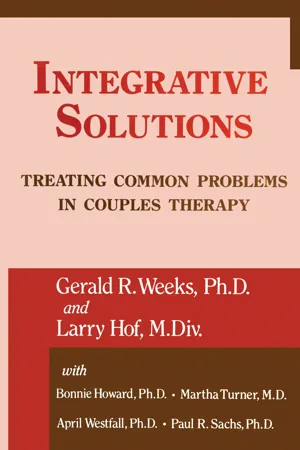
Integrative Solutions
Treating Common Problems In Couples Therapy
- 260 pages
- English
- ePUB (mobile friendly)
- Available on iOS & Android
eBook - ePub
Integrative Solutions
Treating Common Problems In Couples Therapy
About this book
First published in 1996. This books presents a problem-solving model of marriage and couples therapy called the Intersystem Model, which assesses and treats couples' problems from individual, interactional, and intergenerational perspectives. The authors address problems of commitment, intimacy, anger, and conflict, and the complexities relating to the treatment of depression: addictions and extramarital sexuality, marital adjustments to aging, and problems of inhibited sexual desire. They suggest techniques therapists can use to resolve problems that may occur in couples therapy and ways couple can move toward a higher level of functioning and personal growth.
Information
1
THE ELUSIVE ELIXIR:
FOSTERING HOPE IN MARITAL-RELATIONSHIP
THERAPY
Larry Hof, M.Div.
Healthy, well-functioning couples have a positive view of their potential, a basic sense of trust regarding the world in general and their relationship in particular. When they are called upon to cope with difficult situations and resolve specific problems, a sense of optimism generally prevails and the presence of hope is clearly evident. On the other hand, dysfunctional couples have relatively greater degrees of negativism, distrust, pessimism, and hopelessness or despair (see Beavers, 1985).
The degree of hope or hopelessness/despair in the individuals and couples presenting for marital therapy is an important element in the therapeutic process, and the development of an individual's hopefulness is considered a key ingredient in enabling people who are burdened with despair and “learned helplessness” to develop “learned optimism” (Seligman, 1991).
Snyder (1994), through research based upon his own hope scale, described three significant characteristics of individuals who have high levels of hopefulness. They have the ability to envision a much wider range of goals than most people, greater determination and more energy in the pursuit of their objectives, and the skills and competence needed to create a greater variety of ways and means to achieve their desired outcomes.
People with lesser degrees of these abilities perceive themselves to be proportionally less competent and less able to cope successfully with the vagaries of life. They are, in fact, less hopeful than those I have just described; and if that condition is not addressed and corrected, it can be detrimental to any therapeutic process.
The instillation and maintenance of hope is described as a crucial aspect in all of the psychotherapies (Frank & Frank, 1991; Yalom, 1970). Luborsky (1976) notes that several studies indicate that expectations of early benefits expressed in early sessions in the therapeutic process are the best indicator or predictor of later benefits. Frank and Frank (1991) reviewed the placebo response and the role of expectations in medical and psychological treatment, and go so far as to assert:
(H)opelessness can retard recovery or even hasten death, while the mobilization of hope plays an important part in many forms of healing in both nonindustrialized societies and our own. Favorable expectations generate feelings of optimism, energy, and well-being and may actually promote healing, especially of those illnesses that have a large psychological or emotional component. (p. 132)
In the literature in the field of marital and family therapy, however, we find few references to hope. The entire Journal of Marital and Family Therapy, from the first issue in 1975 through the third issue in 1994, had only one article with hope in its title, and it was the only one that dealt with hope directly (Beavers & Kaslow, 1981). In addition, a survey of the indexes in 14 familiar and widely used books in the field yielded one, two-word reference, “pathological hope,” in a chapter by Whitaker and Keith (1981) in the volume by Gurman and Kniskern (1981), and four references to hope in a book by Beavers (1985). Twelve of the 14 were totally silent on the subject (Becvar & Becvar, 1988; Glick, Clarkin, & Keesler, 1987; Goldenberg & Goldenberg, 1980; Gurman, 1981 & 1982; Gurman & Kniskern, 1991; Nichols & Schwartz, 1991; Sauber, L'Abate, & Weeks, 1985; Scharff & Scharff, 1987 & 1991; Stuart, 1980; Weeks, 1989).
Two notable exceptions are the recent work of Waters and Lawrence (1993) and that of Sherman, Oresky, and Rountree (1991). Waters and Lawrence (1993) note that:
In helping people to change, it is critical to understand what they were hoping for, their sense of possibilities, and what strengths and abilities they feel they can call upon (if any) to get them there. A competence approach works to engender a strong sense of positive possibility, of hope, while remaining respectful of people's sense of negative possibility and their realistic limitations (p. 82).
They suggest that hope and change are fostered, in part, through a therapeutic process that creates a vision in the clients (and in the therapist) of what is possible for themselves as multifaceted individuals or “selves,” a vision that respects and honors the past of the individual family members and the family unit, but is oriented towards the future. The process also requires a differentiation between clients' “patterns” and their “person,” between the often limiting habits developed over years of coping and surviving, and the “real self” with “healthy impulses toward mastery and belonging” (p. 87).
Sherman, Oresky, and Rountree (1991) deal with the issue of hope in referring to developing “the art of encouragement.” They discuss several structured techniques (e.g., the Appreciation Party and the Encouragement Meeting), and several “tips and tactics for encouragement” (e.g., affirmation rather than discounting, blocking tactics, affirming tactics).
Unlike the majority of the literature in the field of marital and family therapy, we find many direct and indirect references to hope in the lyrics, children's stories, and the folklore of American society. Frank Sinatra sang about it in a song that included reference to an ant, a rubber tree plant, and the part that hope played in helping the ant to move that rubber tree plant!
There is also the proverbial Little Engine That Could (Piper, 1990), at the foot of the mountain, one of a number of engines that would not, or could not, make the grade. Off the Little Engine went with the somewhat questioning, but also hopeful and optimistic words, “I think I can, I think I can,” until it was over the top of the mountain, and the words turned to an increasingly rapid, “I thought I could, I thought I could, I thought I could.”
These two illustrations are contrasted against what might be called the “Eeyore syndrome.” Eeyore is the rather pathetic donkey in Winnie the Pooh who is about as pessimistic a character as you would ever want to meet. If it is a beautiful day and Christopher Robin greets him with a joyful, “A good day to you, Eeyore,” the lop-eared creature proceeds to hypothesize that the day will probably turn out to be at least a disappointment if not an outright disaster! Left to his own devices, Eeyore could influence those around him with his gloomy assumptions, creating a series of self-fulfilling prophecies and hopeless situations.
There is also what can be called the “Paul or Paula Pollyanna syndrome.” For people infected with or enamored with this approach, life is always viewed as having a silver lining. This, in itself, is not necessarily harmful, but for people afflicted with this syndrome, even the most potentially dangerous, insidious, or pernicious aspects of life may not be avoided or attended to with an appropriate sense of balance, fear, or care. They could potentially “walk in where angels fear to tread,” without appropriate evaluation of the consequences. (This is perhaps an example of the “pathological hope” of Whitaker and Keith [1981].)
Hope plays a key role in all of these examples. In the first two, the presence of hope leads to the successful accomplishment of a task and assists in the attainment of a goal. In the third example, the relative absence of hope contributes to a pessimistic outlook on life or a series of self-fulfilling negative prophecies and “learned helplessness” (Seligman, 1991). In the last case, the presence of unrealistic hope contributes to potential damage or disaster.
Many of the clients seen in treatment mirror the ant, the engine, Eeyore, or Paul/Paula Pollyanna. They are often alienated from each other, extremely angry, and almost always in significant pain. With those couples who enter treatment earlier rather than later, there is often a modicum or more of hope that the relationship can be different, that people can change. There is sometimes even a firm belief in the possibility of positive outcomes, and a commitment to the attainment of them.
With those couples who seek treatment in the later stages of marital decay, despair or fear may be felt, and there may be a belief in the impending death of the relationship, along with the virtual absence of hope regarding the future of the relationship. These couples frequently enter a therapeutic relationship as a last resort, long after preventive maintenance would have been helpful, and long after the optimal time has passed for effective intervention. Nonetheless, they frequently have the expectation, or hope (there is that word again), that the therapist will be able to perform some kind of a miracle and breathe life into a lifeless corpse of a marriage, or the hope that the clinician will at least be able to help the couple to end the marriage with as little acrimony as possible, perhaps for the sake of the children whom they will still be required to parent.
For those couples who are somewhere in between, there is usually some clear sense of fear regarding the future or the direction of the relationship, but also a clear sense of hope that the difficulties can be defined and resolved and that the relationship can continue.
In all of these instances, hope plays a crucial role in the therapeutic process, either to build the relationship or to end it constructively. If the therapist is to be helpful, s/he must be able to reveal, clarify, or instill hope within the couples who are presenting for treatment. To paraphrase the old proverb, “Where there is no vision, the people perish”; where there is no hope, the partners, their relationship, and the therapy either perish or it becomes extremely difficult to move to a level of healthy, well-functioning interaction. (Of course, where there is too much hope, unrealistic hope, or pathological hope, the therapist is frequently called upon to foster a balanced view of reality that will permit attention to areas of needed change and appropriate change efforts on the part of the clients.)
HOPE DEFINED
Webster's dictionary (Webster's Ninth New Collegiate Dictionary, 1985) defines hope in the following way: “to cherish a desire with expectation of fulfillment” (p. 581). Expanded a bit, it could be said that hope is to entertain or harbor in the mind, deeply and resolutely, a conscious impulse toward something that promises enjoyment or satisfaction in its attainment, with the expectation that it will happen. If individuals and couples in treatment believe in that definition, and have such a hope, that is close to half of the basic “battle for initiative” (Barnard & Corrales, 1979), a battle that the therapists must lose and the clients must win. The therapist cannot want them to be in treatment more than they themselves want to be, cannot want an outcome more than they do, and cannot be the driving force in their lives or in their therapy. But if the clinician can uncover hope, enable them to express hope, or instill hope in each of them as individuals and in the couple, then the prognosis for treatment becomes much more positive.
BLOCKS TO HOPE
What prevents a couple from experiencing hope, or prevents them from believing that they have hope or that the situation is hopeful? Some clients were raised in dysfunctional families in which little, if any, positive change was experienced. They often have no concept of change, and remain stuck in familiar, destructive patterns of interaction. If both marital partners had such a family-of-origin experience, there is often little belief in, or expectation of, positive change; there are significant skill deficits in the areas of problem solving and decision making; and there is little experience of positive reinforcement in marital/family interactions. This can contribute to continued failures in current interactions and change efforts, with increasing demoralization and, eventually, the apathy that can come from the conclusion, “It is hopeless.”
Even where there was not a significant amount of dysfunction in the family of origin, clients might say, “We have waited so long!” and in that statement there is implied a major block, a history of negative interactions and relationship failures leading to loss of hope. For a significant number of couples seeking treatment, that would include a habitual aspect to the relationship, a homeostatic balance, a functional equilibrium, a negative reciprocal spiral or cycle (which may include object relations issues such as unconscious or preconscious primitive projections upon each other)—all of which provide some degree of predictability, control, and protection to the system. The latter, however, are not attained without significant cost to the individuals and the couple: continuous feelings of powerlessness, frustration, anger, and pain; perpetual cycles in which one or both partners vilify or blame the other; and cognitive distortions that become permanent or universal descriptions of each by the other and the relationship, with a disastrous impact on hope (Seligman, 1991).
Related to the idea of “we have waited so long,” and the blocks to hope inherent in that statement, is the concept of the Dynamics of Negative Conflict. A conflict in which a couple presenting for treatment is embroiled can be viewed in the following way (reading from the left and the right simultaneously): Wish/Fear/Defensive Behavior/CONFLICT/ Defensive Behavior/Fear/Wish.
In other words, the conflict exists between two persons, each of whom is engaging in defensive behavior because both are in fear that some wish will not be fulfilled. If the therapist and the therapeutic process cannot enable the clients to get to the wish on a consistent basis, the fears prevail, and in an attempt to protect themselves, the individuals who form the dyad feel justified in maintaining their defensive posture and conflict-oriented stance. The couple remains trapped in the cycle, with a predictable negative impact on hope. (Early in the treatment process, this theoretical construct can be used to demonstrate defensive posturing and reciprocal spirals of interaction to couples. For those whose preferred learning style is abstract conceptualization, its use may help increase awareness of their interactions and, thus, contribute to the hope that the relationship can change. See the following section, “Instilling Hope.”)
Another factor that blocks the experience of hope and even contributes to its demise in couples is the negativism that appears so often when their romantic notions have collided with the realities of daily living, without any preparation or even the expectation that problems in relating are a normal part of building a relationship. This is what Vincent (1973, 1977) referred to as the inevitable consequence of the “myth of naturalism,” the belief that all a couple has to do is to love each other and everything else will just somehow magically fall into place, without intentional effort and practice and surely without bad feelings or negative outcomes. This belief is only one of many possible cognitive distortions (Beck, 1976...
Table of contents
- Cover
- Half Title
- Full Title
- Copyright
- Dedication
- Contents
- Preface
- Acknowledgments
- The Authors
- 1. The Elusive Elixir: Fostering Hope in Marital-Relationship Therapy
- 2. Commitment and Intimacy
- 3. Anger and Conflict: Theory and Practice
- 4. Conflict Utilization: A Synthesis of the Whole
- 5. A Happy Marriage: Pairing Couples Therapy and Treatment of Depression
- 6. Addictions in Marital/Relationship Therapy
- 7. Working Through the Extramarital Trauma: An Exploration of Common Themes
- 8. Marital Adjustment to Life Changes Associated with Aging
- 9. Inhibited Sexual Desire
- Name Index
- Subject Index
Trusted by 375,005 students
Access to over 1.5 million titles for a fair monthly price.
Study more efficiently using our study tools.
Frequently asked questions
Yes, you can cancel anytime from the Subscription tab in your account settings on the Perlego website. Your subscription will stay active until the end of your current billing period. Learn how to cancel your subscription
No, books cannot be downloaded as external files, such as PDFs, for use outside of Perlego. However, you can download books within the Perlego app for offline reading on mobile or tablet. Learn how to download books offline
Perlego offers two plans: Essential and Complete
- Essential is ideal for learners and professionals who enjoy exploring a wide range of subjects. Access the Essential Library with 800,000+ trusted titles and best-sellers across business, personal growth, and the humanities. Includes unlimited reading time and Standard Read Aloud voice.
- Complete: Perfect for advanced learners and researchers needing full, unrestricted access. Unlock 1.5M+ books across hundreds of subjects, including academic and specialized titles. The Complete Plan also includes advanced features like Premium Read Aloud and Research Assistant.
We are an online textbook subscription service, where you can get access to an entire online library for less than the price of a single book per month. With over 1.5 million books across 990+ topics, we’ve got you covered! Learn about our mission
Look out for the read-aloud symbol on your next book to see if you can listen to it. The read-aloud tool reads text aloud for you, highlighting the text as it is being read. You can pause it, speed it up and slow it down. Learn more about Read Aloud
Yes! You can use the Perlego app on both iOS and Android devices to read anytime, anywhere — even offline. Perfect for commutes or when you’re on the go.
Please note we cannot support devices running on iOS 13 and Android 7 or earlier. Learn more about using the app
Please note we cannot support devices running on iOS 13 and Android 7 or earlier. Learn more about using the app
Yes, you can access Integrative Solutions by Gerald R. Weeks,Larry Hoff,Martha with Turner,Bonnie Bellamy Howard in PDF and/or ePUB format, as well as other popular books in Psychology & Mental Health in Psychology. We have over 1.5 million books available in our catalogue for you to explore.