- 234 pages
- English
- ePUB (mobile friendly)
- Available on iOS & Android
eBook - ePub
About this book
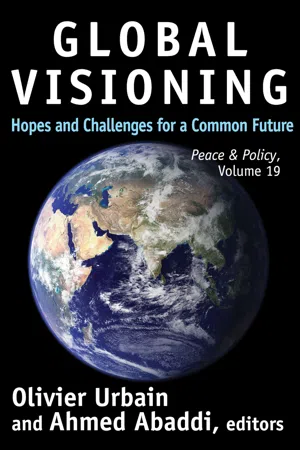
This volume makes the case for global visioning: the collective process of looking at a larger picture and building common ground for the future. The contributors agree that only by such a process will people be able to address mounting problems like global warming, war, terrorism, and poverty, which threaten the Earth's population.This latest volume in the Peace & Policy series addresses three main themes. "On Spirituality and Ethics" advocates an international culture of nonviolence. "International and Transnational Relations" makes a case for global fellowship. "On Education and Culture" argues that educating children is the first step in reforming the world. The contributors seek solutions to the question of how people can start seeing issues from a global point of view, rather than from narrow national perspectives.In keeping with the global nature and scope of the world's problems, the contributions come from very diverse countries, including Japan, Morocco, South Africa, Germany, Italy, Belgium, and the United States. This work will inspire participation in this much-needed exercise of collective global problem solving.
Information
A Cosmo Vision for a Common Future: Becoming Moral Cosmopolitan Humanists in the Global Village, the WorldHouse, the International Solidarity of Peace- Loving Nations, and the Global Commonwealth of Citizens (VHSC)
Gandhi, King-Mandela, Ikeda
Lawrence Edward Carter Sr.
Introduction
The central task of global visioning is to articulate those transformative principles and values (coherently criticized wants) for the common good we should agree on that inform and sustain right relationships and ensure our nonviolent coexistence, while avoiding our violent co-annihilation. In order for those principles to rise to the level of being global ethical options, they must help persons universalize, obligate, and evaluate. These principles are the result of an ongoing dialogical vision and debate of global concerns and responsibilities across the ages by the best minds that think. The willingness to question and be questioned, and the desire to comprehend the inherent value of difference and commonality, for the sake of learning and living together is the beginning of dialogue and discourse. Dialogue is the centering process by which persons collect and identify themselves en route. This Cosmo vision is a comparative study because our global survival is threatened by ideological and religious conflicts.
The Age of Soft Power, Daisaku Ikeda
In the Age of Soft Power, through dialogue, a new consciousness, a global consciousness is born. Daisaku Ikeda (1928–present), a Buddhist humanist, teaches that dialogue as “soft power” creates inner transformation of consciousness in each citizen and contributes to the implementation of elements of an inclusive global civilization whose core values are coexistence, global ethics, harmony, interdependence, and tolerance. Genuine dialogue involves reflection, disciplined intervention, recognition of tensions, contradictions, and examined experience. Dialogue moves us beyond stale and monotonous security; toward more mature attempts to harmonize value experience. Feedback from dialogue provides a new operational framework, beyond restrictive definitions, for the discussion of challenges, consequences, inflexible assumptions, and problems of knowing and change. Change is anticipated in reflection. In genuine dialogue people evolve into agents of change. We are changed only by what we know, when our knowledge is related to or rooted in our existential realities, where ambiguities of anxiety, doubt, fear, hope, joy, pain, and worry are mediated through the interpersonal dynamics of dialogue, dramatic reenactment, and symbols (Stinnette Jr. 1968, 83–110).
Principles facilitate processes of human transformation from our common concern about our planetary and cosmic home, but they are not designed to simply unify diversity. They defend and celebrate it, while helping us move toward a deeper more meaningful level of harmonizing cooperation, without losing the life giving distinctiveness, affirmative meaning, and ultimate purpose of a given tradition or group. Principles provide a philosophical framework for the realization of sustainable global peace and “dignity security.” They help us see ourselves as one large family with many distant relatives. Ethical principles are not a biological science or a social science; they are a science of ideals (Sheffield Brightman 1933, 1–32). As Dr. Warren Bryan Martin suggested to the American Council of Education:
We must in the context of relativism not absolutism, agree to shared principles—not limited to one religion, civilization, culture, but something more general and encompassing—a secular, non-sectarian philosophy. We need pivots, or hinges on which the details of our daily life can fasten. We need reference points, milestones, privileged zones, tuning basins, provisional certitudes even though we may never arrive at absolute certainty (Carter Sr., Miller, and Radhakrishnan 2001, 22).
Global virtue-ethics are the foundation for obedience to cosmopolitan democratic laws, which links their application to the human will to be “obedient to the unenforceable,” the area of action between law and pure personal preference, where we can’t be forced to obey (Silber 1995, 50–54). This is exactly what Iranian exiled Muslim humanist and Nobel Peace laureate Judge Shirin Ebadi (1947–present) had in mind in a lecture at Rice University on February 5, 2006, when she said, “And Democracy is not a gift to be given to other people or a commodity to be exported to other countries. And human rights can’t be dropped on people with cluster bombs. Democracy and human rights [are] only achievable by the will of the people” (Ebadi 2011). Actualizing and practicing virtue is how we make abstract ethical principles concrete experiences, hence the term virtue-ethics. Thinking ethically as wise “philosopher-kings,” leaders of dialogue and debate, helps us build our respect for the dignity and diversity of life (Plato 1994, 507). We evolve to become the enforcers of universal cosmopolitan law upon ourselves, creating the grounds of a global society of transformed citizens for peace and creative coexistence. Jason D. Hill defines cosmopolitans as persons who, against their place of birth, choose a transnational identity located at the intersection of boundaries, nations without nationalism. The new millennium person reflects a new morality evolution and identity not regulated by cultural and ethnic markers.
Ikeda is calling for moral cosmopolitan humanists (universal ethical respect, advancement and interest in the “dignity security,” survival and growth needs, values, welfare, wholeness, and sanctity of all persons) in his thirty-first, 2013 Peace Proposal, when he says,
One pressing threat to the dignity of far too many people in our world today is poverty. The pervasive stress of economic deprivation is compounded when people feel that their very existence is disregarded, becoming alienated and being deprived a meaningful role and place within society. This underlies the need for a socially inclusive approach focused on the restoration of a sense of connection with others and of purpose in life.
Regardless of circumstance, all people inherently possess a life-state of ultimate dignity and are in this sense fundamentally equal and endowed with limitless possibilities. When we awaken to our original worth and determine to change present realities, we become a source of hope for others. Such a perspective is, I believe, valuable not only for the challenges of constructing a culture of human rights, but also for realizing a sustainable society (Ikeda 2013, 5).
International human rights laws, however, are instruments like treaties and agreements between states intended to have binding legal effect between parties that have agreed to them, to promote human rights at the international and domestic levels; while not legally binding, they contribute to the implementation, understanding, and development of international human rights law and have been recognized as a source of political obligation.
Cosmopolitan law is based on a relationship between an interrelated community of states dependent on global transcendent ideal norms or principles for state law and practice. The cosmopolitan view recognizes a set of “transcendent obligations” to respect every person’s humanity and rights over national or state laws. International law is founded on a system of autonomous nations. Cosmopolitan laws, however, exist on the invincible conviction that there is a moral order, higher than civil codes; they are rights and duties transcending state judgments.
I am proposing that we evolve to the humane moral heights of cosmopolitan democratic law beyond or over international law in order to strengthen human rights enforcement internationally and increase the number of national treaties that sanction the United Nations Educational, Scientific and Cultural Organization’s (UNESCO) Convention on the Protection and Promotion of Diversity of Cultural Expression. The enforcement of human rights places a limitation on state sovereignty and encourages nonviolent intervention into foreign domestic affairs by other nations for the sake of every individual’s “dignity security” over another’s job security. Dr. Robert W. Fuller, (1936–present) former president of Oberlin College, teaches that “dignity security” is freedom from rankism, putdowns, ridicule, exploitation, humiliation, degradation, denigration, banishment, insinuations, a sense of nobodiness, teasing, bullying, rejection, predatory uses of power, being a target, and ones identity being limited to membership in a tribe: “We are on the threshold of a dignitarian era” (Fuller and Gerloff 2008). Cosmopolitan law is about “transcendent obligations” requiring critiques, debates, and reflective dialogues regarding social policies to respect the dignity of personhood and human rights over national or state laws. The future of personalism and the increase of moral cosmopolitan humanists in the world will be determined by our understanding of “the category of the person “being “deemed ontologically and axiologically fundamental” (Buford and Oliver 1994, xiv).
Ikeda, the president of the Soka Gakkai International, speaks as a moral cosmopolitan Mahayana Nichiren Buddhist humanist about “the category of the person” when he says,
The Soka Gakkai International’s (SGI) efforts to grapple with the nuclear weapons issue are based on the recognition that the very existence of these weapons represents the ultimate negation of the dignity of life. It is necessary to challenge the underlying inhumanity of the idea that the needs of states can justify the sacrifice of untold numbers of human lives and disruption of the global ecology. At the same time, we feel that nuclear weapons serve as a prism through which to bring into sharper focus ecological integrity, economic development and human rights—issues that our contemporary world cannot afford to ignore. This in turn helps us identify the elements that will shape the contours of a new, sustainable society, one in which all people can live in dignity (Ikeda 2013, 35–36).
Baptist Christian Humanist, Martin Luther King Jr.
Martin Luther King Jr. (1929–1968) nonviolently demonstrated the significance of understanding the dignity of persons with innate capacities for defining and striving toward authentic identity in an unprecedented philosophical theistic personalistic activism, and moral cosmopolitan Baptist Christian humanist engagement, during the Civil and Human Rights Nonviolent Movement in the United States of America. Dr. Peter A. Bertocci (1910–1989), who taught both Martin Luther King and myself at Boston University, defined a person as aware of him or herself as a unique, telic, indivisible unitas-multiplex, but a complex self-identifying unity of activity-potentials, not levels, but dimensions, best characterized in consciousness, and self-consciousness as a purposeful knower, criticizing, sensing, feeling, desiring, remembering, imagining, thinking, willing, oughting, allotting, anticipating, and appreciating the activities we distinguish as esthetic and religious that are able to develop reason and values (Bertocci 1988, 8–9).
These activities, [says Bertocci], enable a person to know an external world, to plan and will the satisfaction of his [or her] wants in the light of those social, moral, esthetic, [theoretical, economic, political,] and religious ideals to which he [or she] comes to feel obligation (Bertocci, unpublished manuscript).
This understanding of the person is the underpinning in Martin Luther King Jr.’s philosophical conception of the “the category of the person” as a sacred personality and his position as a theistic personalistic idealist and moral cosmopolitan Christian humanist, who preached that injustice anywhere is an impeachment of personhood and an affront to human dignity, to be immediately addressed. The moral cosmopolitan humanist’s concentric circles of relational states in the WorldHouse reflect the unacknowledged philosophical buttresses of Martin Luther King’s ethical personalism. “Since personalism makes person its central interpretive principle, it promotes the idea of the profundity of the worth and sacredness of all persons.” Rufus Burrow Jr. (1951–present) gives an example:
[F]rom the standpoint of ethics, personalism holds that all ethical principles must be conditioned by the highest conceivable estimate of the worth of persons as such. Not only does personalism require the highest possible conception of the worth of humanity, it conceives of reality itself as personal. The idea that reality is personal may be personalism’s most controversial trait (Burrow Jr. 1999, 1).
Personalism is an unpopular philosophy perhaps because it fights against the dehumanization and depersonalization of marginalized groups, blacks, gays, immigrants, lesbians, women, refugees, and minorities. The person is ultimately real, valuable, and irreducible.
For King, the person’s structure is shaped, at least in part, by the value conferred upon it. Thus, there is no separation between the structure, or how the person is defined, and the value, or how the person might be viewed in light of the definition (Carter Sr. 2006, 219).
George Zimmerman and the “Category of the Person”
The George Zimmerman (1983–present) of Sanford, Florida, situation brings us face to face with the issue of the American historical interpretation of “the category of the person.” The history of slavery and racism in the United States has come to manifest itself in a number of significant ways. The present-day echoes of the historic American disrespect of “the category of person” include: Stand Your Ground Laws, now in twenty-nine states, the increase of state legislation giving citizens the legal right to “open carry” a gun, even in church and school; the moves against immigration legislation, political attacks on women’s rights regarding abortion, to control their own bodies; police racial profiling, laws to restrict voting rights in heavily populated African American and Hispanic communities; human trafficking and child sex exploitation in the United States; and the Pentagon’s frequent use of the term “collateral damage” to justify the accidental killing of innocent men, women, and children in war. There are currently 1,958 officially institutionalized US Air Force pilots flying unmanned drones, remotely piloted aircraft (RPA) to target and kill running fearful militants overseas. This further depersonalization of war in Iraq and Afghanistan is conducted from Randolph, Creech, Cannon, Ellsworth, and Whiteman Air Force bases, located in Texas, Nevada, New Mexico, South Dakota, Colorado, and Missouri, respectively, as the legal justifications are being questioned in light of the fact of a February incident where twenty-three Afghan civilians were killed after a drone crew mistakenly identified a convoy of women and children as militants on the move (Dillow 2010; Zakaria 2013). Also included are the echoes of violence in video games, music, and movies. Let us never forget that in the spring of 1964, in St. Augustine, Florida, Martin King discovered so much violence that he exclaimed at a press conference that St. Augustine was the most lawless community they had encountered in the civil rights movement, and he could have added, a lawlessness demonstrated when Sheriff L. O. Davis deputized scores of Ku Klux Klansmen (KKK), and with support from Florida governor Farris Bryant, both risked a federal contempt of court citation from federal judge Bryan Simpson, who ordered Davis to stop any cruel and unusual punishment of prisoners.
Against this abbreviated historical backdrop, the outcome of the George Zimmerman–Trayvon Martin trial may cause you to easily conclude that Mr. Zimmerman was trapped in a gr...
Table of contents
- Cover Page
- Title Page
- Copyright Page
- Contents
- Chadwick F. Alger—In Memoriam
- Greetings and Acknowledgments from the Editor-in-Chief and Director of the Toda Institute
- Preface: Intercivilizational Dialogue: A Typological Approach and Background Proposals
- A Message of Felicitations for the International Conference on Global Visioning for a Common Future
- Introduction to the Volume: Global Visioning: Hopes and Challenges for a Common Future
- Building Faith in the Twenty-First Century: Some Pitfalls and Potential Paths
- A Cosmo Vision for a Common Future: Becoming Moral Cosmopolitan Humanists in the Global Village, the WorldHouse, the International Solidarity of Peace- Loving Nations, and the Global Commonwealth of Citizens (VHSC)
- Building a Global Culture of Peace and Nonviolence
- Introducing: Search for Common Ground: Keeping the Global Vision of a Better World at the Center
- Toward a Global Civilization?
- Impeding Our Capacity for Global Visioning: Perpetrators, Victims, and Bystanders behind the Blinds of Cultural Violence
- Global Values in Educational Leadership toward Creating Cultures of Peace
- Peace Gardens: Transforming Schools for Global Peace
- After Postmodernism, Waiting for Spring: On Longing, the Grand Narrative of the Egyptian Revolution, and the Role of the Arts
- We All Have a Role to Play in Peacebuilding Because We Are All Connected around the World in Our Daily Life: What Are You Doing, and What Should You Be Doing?
- Author Biographies
Trusted by 375,005 students
Access to over 1.5 million titles for a fair monthly price.
Study more efficiently using our study tools.
Frequently asked questions
Yes, you can cancel anytime from the Subscription tab in your account settings on the Perlego website. Your subscription will stay active until the end of your current billing period. Learn how to cancel your subscription
No, books cannot be downloaded as external files, such as PDFs, for use outside of Perlego. However, you can download books within the Perlego app for offline reading on mobile or tablet. Learn how to download books offline
Perlego offers two plans: Essential and Complete
- Essential is ideal for learners and professionals who enjoy exploring a wide range of subjects. Access the Essential Library with 800,000+ trusted titles and best-sellers across business, personal growth, and the humanities. Includes unlimited reading time and Standard Read Aloud voice.
- Complete: Perfect for advanced learners and researchers needing full, unrestricted access. Unlock 1.5M+ books across hundreds of subjects, including academic and specialized titles. The Complete Plan also includes advanced features like Premium Read Aloud and Research Assistant.
We are an online textbook subscription service, where you can get access to an entire online library for less than the price of a single book per month. With over 1.5 million books across 990+ topics, we’ve got you covered! Learn about our mission
Look out for the read-aloud symbol on your next book to see if you can listen to it. The read-aloud tool reads text aloud for you, highlighting the text as it is being read. You can pause it, speed it up and slow it down. Learn more about Read Aloud
Yes! You can use the Perlego app on both iOS and Android devices to read anytime, anywhere — even offline. Perfect for commutes or when you’re on the go.
Please note we cannot support devices running on iOS 13 and Android 7 or earlier. Learn more about using the app
Please note we cannot support devices running on iOS 13 and Android 7 or earlier. Learn more about using the app
Yes, you can access Global Visioning by Ahmed Abaddi in PDF and/or ePUB format, as well as other popular books in Politics & International Relations & Education Theory & Practice. We have over 1.5 million books available in our catalogue for you to explore.