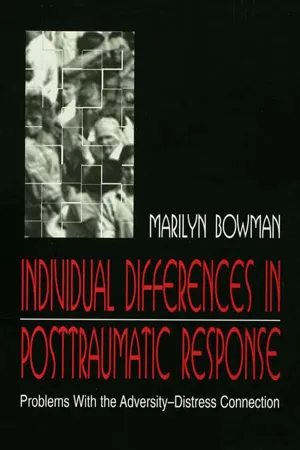
This book challenges the assumptions of the event-dominated DSM model of posttraumatic stress disorder. Bowmam examines a series of questions directed at the current mental health model, reviewing the empirical literature. She finds that the dose-response assumptions are not supported; the severity of events is not reliable associated with PTSD, but is more reliably associated with important pre-event risk factors. She reviews evidence showing the greater role of individual differences including trait negative affectivity, belief systems, and other risk factors, in comparison with event characteristics, in predicting the disorder. The implications for treatment are significant, as treatment protocols reflect the DSM assertion that event exposure is the cause of the disorder, implying it should be the focus of treatment. Bowman also suggests that an event focus in diagnosis anad treatment risks increases the disorder because it does not provide sufficient attention to important pre-exisiting risk factors.
eBook - ePub
individual Differences in Posttraumatic Response
Problems With the Adversity-distress Connection
- 198 pages
- English
- ePUB (mobile friendly)
- Available on iOS & Android
eBook - ePub
individual Differences in Posttraumatic Response
Problems With the Adversity-distress Connection
About this book
Information
1
Is There a Problem in Understanding Postevent Distress?
A striking scene was observed on the seashore one August in which men and women wept and lamented loudly. As a result of what had happened, they knew they were forever damned and doomed. In another setting, two little children burst into tears when a man was killed by a gunshot close by. In yet another situation, a man described a certain three decades of his life as having been fun: “I am filled with gratitude for the friends, the adventure, the love, the learning, the excitement, the sheer fun of those years” (Rittenberg & Bennett, 1993, p. 447). Which of these people had been subject to a toxic event, and what was its nature?
The men and women expressing powerful despair had tried to feed themselves to sharks at the mouth of the Hugh river in India in 1640 because they were devout Hindus of a sect who believed this sacrifice was to their spiritual benefit (Manrique, 1927/1967). When they found the already-sated sharks unwilling to eat them, they concluded that they had been found unworthy because they had been too sinful to have their sacrifice accepted, and wailed at their ill luck in not being eaten. In the second case, the children were crying because they had been unable to see a prisoner being executed by soldiers. They became quickly content when their father, a Chinese warlord in Szechuan in the 1920s, held them up so they could see all they wanted of the gory details of the dying man's suffering in the murder (Gervais, 1934). In the final case, the man was Sidney Rittenberg, a young American soldier who stayed in China after World War II. He was describing a period that included two extended imprisonments totaling more than 15 years in solitary confinement in harsh prisons during the turbulent political and military events of the era.
Such accounts provide striking examples of the extreme variability of the ways that humans interpret life events. They show how these interpretations have a powerful effect on well-being that can be contrary to common expectations about the power of life events in affecting emotions. Professional mental health activities are increasingly directed to traumatic life events as the cause of distress disorders, yet these examples suggest that event characteristics may be much less powerful than is commonly assumed.
This book examines assumptions and evidence about the connections between the experience of an adverse event and reports of distress that are attributed to that adversity. Special attention is given to the power of events in comparison with individual differences in shaping responses to life events. The evidence reviewed shows that acceptance of false assumptions about the significance of events has contributed to ill-directed diagnostic and treatment rhetoric. These errors in understanding the origins of distress have led to professional methods that fail to incorporate important information about individual differences as factors centrally contributing to well-being and distress.
POPULAR ASSUMPTIONS ABOUT ADVERSITY AND DISTRESS
There are a number of popular and professional assumptions that are currently used to explain human experience following adverse life events. Assumptions related to the nature of events include the following: Acute toxic life events are rare; there is a dose–response relation between toxic life events and postevent distress; toxic events per se account for most postevent distress. There are also assumptions concerning the response to toxic events, including: It is normal to respond to acute toxic life events with significant distress; distress responses diminish with time; distress arises from event characteristics more than from individual factors; distress is validly represented by expressed and reported emotion. Finally, there is the assumption that professional treatment can remedy event-attributed distress.
These assumptions place a major emphasis on external events and on the emotional facets of experience as responses to these, rather than on enduring personal dispositions such as temperament or beliefs. Events are typically given a tautological psychological descriptor that prejudges their assumed subjective effects: they are traumatic events. To avoid this over-determined label, for the purposes of this book, significant adverse life events will be termed toxic events. This term is used for events that include “violent encounters with nature, technology, or humankind” (Norris, 1992, p. 409). These are acute, objectively observable events intruding on the normal course of life, threatening physical harm or loss of resources, and typically not under the perceived control of individuals. The term toxic is chosen to separate the definition from the subjective connotations that the word traumatic provides and to place events in a more objective biological domain in which a high dose exposure may be toxic to an organism even if the object of its effects has no awareness of these.
Event-attributed distress syndromes may include fear and anxiety associated with serious threats to well-being of self or others, as well as depression attributed to losses. In the usage of the popular adversity–distress model, individuals who have encountered a toxic life event are typically described as victims and survivors, terms that emphasize passivity rather than activity, adaptation, or agency. Individuals are seen as deeply vulnerable to adverse life events that intrude into what would otherwise be a distress-free existence.
These assumptions are related to long-standing issues studied within psychology outside the purely clinical domain. These issues include personality research concerning the relative contributions of person and situation to behavior, the consistency and change in behavior across time within individuals, and the relationships between objective events and subjective experience. The assumptions about adversity and distress support the legitimacy of major professional mental health involvement in the lives of individuals and communities to treat the effects of toxic event exposures on victims.
This book reviews the evidence underlying assumptions supporting the professionalized model of event-attributed distress. Extending work reviewed by Wortman and Silver that focused on coping with the irrevocable losses of bereavement and physical disability (Wortman & Silver, 1987), the book focuses on a broader range of adverse experiences and a more narrow range of outcomes. In particular, outcomes of anxiety and posttraumatic stress disorder (PTSD) frame the examination of the literature.
ASSUMPTIONS OF THE MENTAL HEALTH PROFESSIONS
Toxic events have played a core role in psychological theories of emotional distress syndromes because these derive from the strongly experiential and environmentalist assumptions found in models as different as Freudian and behavioral. The idea that everyday life is full of dangers to long-term emotional well-being represents an update of long-standing 20th-century ideas about emotional pathology that started out in Freudian theory. Trauma (real or imagined) dating to the earliest years of life was asserted to affect all of subsequent emotional life either directly, or indirectly through repression of the conflicts arising from the trauma. A recent review noted explicitly that Freud's original model of neurosis was a posttraumatic paradigm (Wilson, 1994). A book about psychological trauma by psychiatrist Judith Herman (1996) asserted that “everyone is a prisoner of the past” (p. 235). As dynamic models of psychological development expanded to incorporate events across the entire life-span (e.g., Erikson, 1963), both psychologists and popular culture extended the idea of the power of adverse life events in creating clinically significant emotional disorders from beyond early childhood to across the span of adulthood.
From the ideologically opposite camp of behaviorist theory, there is also an emphasis on specific environmental antecedents to specific emotional experiences and behaviors. This similarly represents a model identifying the powerful factors affecting emotional functioning as being events in the external world. The main difference is that these are restricted to more recent and immediate experiences, rather than sought in remote childhood events. When distress persists long after a toxic event, behaviorists have sought to explain chronicity by invoking mechanisms of conditioning and intrusive images as providing persistent re-exposure experiences (Baum, O'Keefe, & Davidson, 1990).
Despite this common adversity model, there is often little clarity about what specific significant effects adverse events might reliably elicit. Confusion about the consequences of adverse life experiences was exemplified in a newspaper article in which a violence consultant spoke to delegates at a conference concerning children who are exposed to violence. She told them that “while some may respond with shortened attention spans, increasing hostility and aggression, others produce outstanding academic work, standards of perfection (hiding a fear of failure) and overly responsible behavior” (Strachan, 1994, p. B9). Using this reasoning, every kind of behavior has the possibility of being construed as a pathological response to earlier toxic life events.
TOXIC EVENTS CAUSE DISTRESS SYNDROMES EVEN IF THEY ARE NOT SHOWN
Because mental health (MH) models assert that toxic events create distress, yet data to be reviewed suggest limited emotional distress during or after toxic events, there has been implicit pressure to turn symptomless presentations into pathologies through the use of theoretically derived constructs such as repression and denial, based in psychodynamic theory. The discrepancy between true effects and self-report is explained through the use of these dynamic mechanisms of psychological defense. An individual who fails to show the expected emotional display is seen as in denial and at risk of further peril (Shontz, 1975). In a recent study, individuals who reported good mental health on routine questionnaires and showed low neuroticism on formal tests were nevertheless regarded as being in denial by clinicians who decided, instead, that the subjects were not mentally healthy on the basis of a clinical procedure (Shedler, Mayman, & Manis, 1993).
A popular extension of the model assumes that everyone has suffered sufficient adverse life events to have significant emotional disorders, and therefore everyone needs therapy. Self-help 12-step group programs for every kind of troubled behavior, based on the Alcoholics Anonymous program, use such reasoning to assert that people who are not actively in the healing stage are in denial of their emotional problems. This mass-culture model has been critically examined by Wendy Kaminer (1992) in her book I'm Dysfunctional, You're Dysfunctional. The model is little different from therapeutic ideas used by most psychodynamic MH professionals. They make use of concepts such as repression, denial, identification with the aggressor, and other defense mechanisms to explain how emotional problems date from early childhood events, even if these are entirely inaccessible to verification or only erratically accessible to memory. A recent example may be seen in a discussion of the “illusion of mental health,” in which the argument was put forward that people bias self-reports of mental health, describing themselves as more healthy than judgments made by experienced clinicians (Shedler et al., 1993, p. 1117).
The assumption that an absence of emotional symptoms during or after an event must be pathological leads at times to strange commentary. A recent study relating to the Oakland California fire of 1991, for example, was described in a major newspaper report as showing that heightened emotionality during the disaster was psychologically helpful because this elicited care, whereas calmness during the disaster was followed by a delayed PTSD response seen 7 months later (Goleman, 1994). Closer examination, however, shows that those who had not been highly emotional had not been calm at all during the disaster, but rather had shown dissociation so extreme that they often tried to rush back into their fiery homes (Koopman, Classen, & Spiegel, 1994). This study, therefore, does not provide evidence that pathology is proven by a display of calmness during a disaster.
It has been argued that symptomless presentations are pathological even to the point that a lack of symptoms is taken as proof that pathology is present. In a small study of sexually abused teenage girls, Brooks (1985) failed to find enough evidence of a significant distress syndrome to meet her expectations. She concluded that the failure to show problem or complaints must itself represent behavior pathognomonic of repression and denial. That is, her model of the assumed power and trauma of sexual abuse prevailed over the evidence in front of her.
Because the adversity–distress model is so prevalent, it can contribute to victimization of individuals who fail to conform to expectations after a notable event. There are reports that individuals who violate the expectation that they should show distress after a significant loss are not well received if, instead, they show happiness or well-being (Wortman & Silver, 1987).
Because of the difficulty of verifying hypotheses concerning repression and denial in accounting for symptomless responses as evidence of hidden distress to toxic events, this line of argument is not pursued further in this review.
PTSD: A PROTOTYPE OF THE ADVERSITY–DISTRESS MODEL
Among the event-attributed distress syndromes where distress is freely reported, posttraumatic stress disorder has become the prototype disorder. Other emotional disorders have also been considered as reactions to adverse life events, including general mood disorders of anxiety, depression, and adjustment disorder. These are all recognized as mental disorders in the latest edition of the American Psychiatric Association's Diagnostic and Statistical Manual of Mental Disorders (DSM–IV, American Psychiatric Association, 1994). Although another new event-related disorder, acute stress disorder, was added to DSM–IV, because it is a short-lived condition it is not of as much relevance to study of the main adversity–distress paradigm that underlies the PTSD idea.
The development of the diagnostic category of PTSD represents an attempt to insert consistency into long-lasting distress symptoms attributed specifically to toxic events, and it is the most relevant disorder to a review of the adversity–distress model. Key features include attributing prolonged postevent distress to a specific and extreme external event, emotional symptoms defined as event-specific, and an explicit assumption of an adversity–distress dose–response model. Distress is attributed to the event rather than to pre-existing individual characteristics, and PTSD is considered to be a general trauma-derived syndrome with cross-cultural relevance.
PTSD only entered into the DSM as a formal diagnosis in the third edition (American Psychiatric Association, 1980). Its institutionalization as a formal diagnosis was accompanied by much controversy at the time. There were those who believed it merited representation as a distinct and significant syndrome deriving from events, whereas others were unconvinced of the central power of events in symptoms of distress.
In particular, proponents argued that veterans of the Vietnam war showed a characteristic stress syndrome (Figley, 1978), and this built upon thinking from World War II in which combat neurosis was described (Grinker & Spiegel, 1945).
In subsequent revisions of the DSM, PTSD criteria have been increasingly clarified in response to diagnostic problems and disputes. In particular, event definitions have become broader, starting from the requirement in DSM–III that the event be “outside the range of usual human experience” (p. 236). This was disputed by those who wished to include women and children suffering from family violence, which was not regarded as meeting that criterion. In response, DSM–IV redefined the event characteristics to include events that were not necessarily “outside the range of usual human experience.” Further, a person no longer has to experience an event outside the range of usual human experience, but has only to be exposed (defined as experienced, witnessed, or was confronted with) to an event that posed a threat of death or injury. Prior to the 1994 revision of DSM, there was controversy between researchers attempting to field test revised criteria and the governing Task Force, concerning whether an event was even an essential feature of the disorder. Field test workers wanted to ignore stressor event characteristics entirely, while the Task Force refused to accept diagnostic criteria based solely on distress response symptoms (M. First, personal communication, October 27, 1994). This dispute concerns the core problem in the diagnostic formulation: whether or not events have the power over emotional condition that is required in the formal criteria.
As currently defined PTSD has some unusual features, in that its emphasis on self-reported subjective experience and a specific external cause for an emotional disorder is relatively unique within the diagnos-able mental disorders. All but 1 of the 20 person-description criteria of PTSD in the latest 1994 version can be provided solely as self-reported symptoms rather than objectively determinable signs. The one objective sign (physiological reactivity on exposure to key cues) is an optional criterion. The other sole criterion is the existence of a threat from an extreme event.
Both popular and professional use of the posttraumatic concept has become increasingly broad. In common parlance, life events ranging from comments heard in childhood to horrendous assault are equally represented as traumatic. A wide range of behavioral aberrations are described as demonstrating the effects of traumatic stress.
The breadth of the event definition and the subjectivity of the symptom definition provide challenges to the validity of the diagnosis in individual cases. Arising from this there are studies attempting to identify more objective biological indices that might provide signs of the syndrome, to remove the subjectivity that is currently...
Table of contents
- Cover
- Half Title
- Full Title
- Copyright
- Contents
- Preface
- 1 Is There a Problem in Understanding Postevent Distress?
- 2 How Prevalent Are Toxic Events and Event-Attributed Clinical Distress Disorders?
- 3 Do More Terrible Events Lead to More Serious Disorders?
- 4 What Are Typical Responses to Direct Exposure to Toxic Life Events?
- 5 What Are the Effects of Indirect Toxic Exposures?
- 6 How Much Do Individual Differences in Pre-Event Competencies Affect Responses to a Toxic Event?
- 7 How Powerful Are Individual Differences in Emotionality?
- 8 Do Beliefs Affect Individual Reactions to Toxic Events?
- 9 Do Groups Differ in Postevent Reactions?
- 10 Which Has More Power in Determining Distress, the Event or the Person?
- 11 Why Are Clinicians Reluctant to Look for Causes Beyond the Event?
- 12 How Important Are Emotions as a Guide to Weil-Being?
- 13 Can Professional Treatments Remedy Event-Attributed Distress?
- 14 Conclusion and Implications
- References
- Author Index
- Subject Index
Trusted by 375,005 students
Access to over 1.5 million titles for a fair monthly price.
Study more efficiently using our study tools.
Frequently asked questions
Yes, you can cancel anytime from the Subscription tab in your account settings on the Perlego website. Your subscription will stay active until the end of your current billing period. Learn how to cancel your subscription
No, books cannot be downloaded as external files, such as PDFs, for use outside of Perlego. However, you can download books within the Perlego app for offline reading on mobile or tablet. Learn how to download books offline
Perlego offers two plans: Essential and Complete
- Essential is ideal for learners and professionals who enjoy exploring a wide range of subjects. Access the Essential Library with 800,000+ trusted titles and best-sellers across business, personal growth, and the humanities. Includes unlimited reading time and Standard Read Aloud voice.
- Complete: Perfect for advanced learners and researchers needing full, unrestricted access. Unlock 1.5M+ books across hundreds of subjects, including academic and specialized titles. The Complete Plan also includes advanced features like Premium Read Aloud and Research Assistant.
We are an online textbook subscription service, where you can get access to an entire online library for less than the price of a single book per month. With over 1.5 million books across 990+ topics, we’ve got you covered! Learn about our mission
Look out for the read-aloud symbol on your next book to see if you can listen to it. The read-aloud tool reads text aloud for you, highlighting the text as it is being read. You can pause it, speed it up and slow it down. Learn more about Read Aloud
Yes! You can use the Perlego app on both iOS and Android devices to read anytime, anywhere — even offline. Perfect for commutes or when you’re on the go.
Please note we cannot support devices running on iOS 13 and Android 7 or earlier. Learn more about using the app
Please note we cannot support devices running on iOS 13 and Android 7 or earlier. Learn more about using the app
Yes, you can access individual Differences in Posttraumatic Response by Marilyn L. Bowman in PDF and/or ePUB format, as well as other popular books in Psychology & Clinical Psychology. We have over 1.5 million books available in our catalogue for you to explore.