- 224 pages
- English
- ePUB (mobile friendly)
- Available on iOS & Android
eBook - ePub
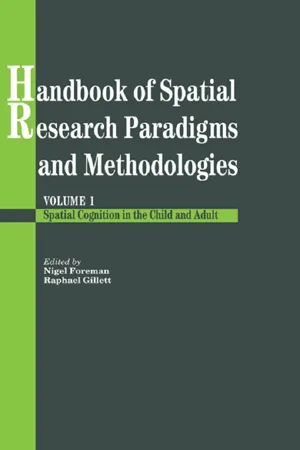
Handbook Of Spatial Research Paradigms And Methodologies
About this book
Spatial cognition is a broad field of enquiry, emerging from a wide range of disciplines and incorporating a wide variety of paradigms that have been employed with human and animal subjects. This volume is part of a two- volume handbook reviewing the major paradigms used in each of the contributors' research areas.; This volume considers the issues of neurophysiological aspects of spatial cognition, the assessment of cognitive spatial deficits arising from neural damage in humans and animals, and the observation of spatial behaviours in animals in their natural habitats.; This handbook should be of interest to new and old students alike. The student new to spatial research can be brought up-to- speed with a particular range of techniques, made aware of the background and pitfalls of particular approaches, and directed toward useful sources. For seasoned researchers, the handbook provides a rapid scan of the available tools that they might wish to consider as alternatives when wishing to answer a particular "spatial" research problem.
Trusted by 375,005 students
Access to over 1.5 million titles for a fair monthly price.
Study more efficiently using our study tools.
Information
Subtopic
Cognitive Psychology & CognitionIndex
Psychology| 1 | |
| Organising Gestures in External Space: Orienting and Reaching |
Henriette Bloch and Frangoise Morange
Laboratory of Developmental Psycho-Biology, EPHE-CNRS, Paris,France.
INTRODUCTION
Living organisms assure their survival only by means of exchanges with their physical environment. It is from the environment, directly or through conspecifics, that they obtain the necessary resources. It is on the environment that they exert a large part of their activity. The more complex an organism—the higher the evolutionary level of its species—the more numerous, extended and diversified are its exchanges with its environment; but at the same time, it will require a large part of its life to establish, organise, and strengthen these relations. Primates, and man in particular, seem at the beginning of their life to be singularly unable to provide for these relations: they are unable by themselves to assure their basic resources, nor to find their food; they do not at first move about independently. However, they are, from the moment of their birth, in an environment that is not entirely foreign. The mortal and changing individual is not confronted by an invariable and eternal universe. His or her environment has been populated, structured, or—even better—shaped by preceding generations. It is composed of objects that have an ecological value for its species. For man, a good number of these objects, natural or artificial, are specific to a civilisation, if not peculiar to an epoch. Space, in the most general sense, in which the individual grows, is neither shapeless, nor infinite, nor silent. It is the origin of impressions, and its various aspects are a factor in cognitive development. The infant, and later the child and the adult, are neither independent of, nor passive in relation to what surrounds them (Gibson, 1979). They do not merely react to external stimulation. They have a need to explore, a curiosity, a searching which are powerful drivers of their relations with the world. To characterise this, one might say that the individual and his environment approach one another. For his part, a young child has at his disposal multitudinous methods and procedures, which, in the course of his development, will prove effective, or will acquire their effectiveness.
The goal of this chapter is to demonstrate how two important sorts of relations, intimately connected to one another—spatial orientation and reaching towards external objects—develop and transform during the first stages of life.
Our bodies are put together, and our organs arranged along axes which determine their orientation. We have a “front” and a “back”; we have identical members on each side of the cephalo-caudal median axis. As with all organised beings, the human body possesses an apparent left-right symmetry, which is accompanied by hidden symmetries and asymmetries, from the level of cells up to highest organic structures. Functional asymmetries appear in this organisation in more or less obvious ways: actions which call for competition between the two hands reveal to the naked eye that each hand has a role that is different from that of its counterpart. While the regular alternation of steps conceals the fact that, in walking, the two feet do not do exactly the same thing. Finally, it has taken a long time to understand that the two hemispheres of the brain do not govern the same behaviours, or else play different roles. Functional asymmetries permit the individual to make distinctions in the environment, as we shall see.
On one hand, the environment is composed of objects, islands of matter that occupy a certain volume, or a certain area, surrounded by empty spaces: they therefore have a position that can be defined either relative to the observer’s position, which constitutes a directional source, or relative to other objects’ positions. Gestalt theoreticians have stated that “we perceive objects, not the voids that lie between them” (von Hornbostel, 1896, cited by Koffka, 1935). Although this assertion should be qualified, it contains a part of the truth: it is objects that constitute the poles of attraction. It is objects that possess noticeable qualities and dimensions, a size, a colour, a shape, a border. These objects can themselves be oriented; they can have different faces and can appear different depending on the observer’s point of view. All constituents of the physical world can be perceived as objects: a cloud, the current of a river, a sea wave, the smoke rising from a chimney, a soap bubble, the grain on the bark of a tree, a melody, a smell. But solid bodies enjoy a special status due to their intrinsic stability. “If there were no solid bodies,” wrote Helmholtz, “our geometrical faculties would remain undeveloped and unused, just as an eye would be useless if there were no light” (Physiological Optics, Part III). To orient one’s body (or a segment thereof) in space is in fact to orient it towards one or more objects. To maintain or to vary the orientation during a movement amounts to exercising this “geometrical faculty” of which Helmholtz spoke, for it is to distinguish directions and distances, either absolutely, starting from one’s own position, or relative to points or landmarks. Therefore, our objective is not merely to describe orienting behaviour, gestures and movements that put us in contact with external objects, or our judgements concerning their orientation. It is also to demonstrate how this behaviour contributes to our knowledge of the environment, and how, in its transformation through time, it takes part in the formation of the general and abstract conception that we call “space”. Ordinary language implicitly subscribes to the famous definition of Kant: “space is the necessary form of exteriority”—we cannot represent or imagine any external quality without a spatial context. If we accept this definition we are not obliged to suppose that it is present initially, as an innate category of understanding. We will have to determine whether such a conception of space is naturally inscribed in our structures, or if it is a result of the acquisition of relations, of the elaboration of successive notions—whether it is the product of a progressive construction.
We shall begin by describing our methods and the premises on which they are based. We shall distinguish between two categories of experiments, those concerning perceptual localisation, and those concerning motor acts of reaching for external objects.
THE ORIENTING RESPONSE AND PERCEPTUAL LOCALISATION
Although in man all the sensory systems are still immature at birth, the new-born does not live in an undifferentiated environment. Two reactions attest to its capacity to perceive differences and to its sensibility to spatial variations: the orienting response and figure-ground segregation.
The orienting response
Our sensory organs act on a field of extension defined by their own orientation; yet, when we are not in motion, some peripheral stimuli can activate a movement that makes them enter our span of apprehension. This is what is called the orienting response. Gently touching a new-born’s peri-buccal area provokes a twisting of the mouth and a turning of the head in the same direction. This reaction is called the “cardinal-point reflex”, a reflex which constitutes an item of normality in the post-natal neurological examination. Such a reaction is not directed at only contact stimulation. Preyer (1882) was the first to show that 9-day-old infants, supine in their cribs, react to a noise by turning their heads in its direction. Much later, Wertheimer (1961) studied infants in the delivery room itself. By producing clicks alternatively to the left and to the right of the infant, he observed the infant opening its eyes in response to the sound and turning them towards the direction of the source of the sound. Many observations have confirmed that the infant is capable of responding to distal stimuli (Butterworth and Castillo, 1976; Alegria and Noirot, 1978), to auditory, visual and olfactory stimulation by an eye and head movement towards the source of the stimulation. Sometimes the reaction involves the torso or the trunk. The reaction is slower on the average than in the adult, and is obtained only at higher thresholds and lower eccentricities.
Several characteristics of this precocious reaction should be examined: the fact that it often mobilises several parts of the body is due to poor control of the axis motor system. This has resulted in its being classified as a reflex motion, one which proceeds automatically starting from an initial global command. It is a sign of alert rather than of a search that ends in the exact direction of the stimulus. In other words, the orienting response is directional rather than positional. The model of this reaction is based on studies of visual function. It is the excitation of the peripheral retinal region, the origin of the major tectal pathways, that brings about the orienting response; for this excitation is more global than that of the central retinal region. The principal function of the visual subsystem formed by these receptors and pathways is spatial localisation: it gives information on the location rather than the identity of visual objects, where rather than what. Its activation could nevertheless be a preparatory step towards vision of shape and detail. But, because of the immaturity of the new-born’s fovea, it could initially be limited to an attention-getting (Cohen, 1973; Bronson, 1974). This hypothesis is contested by observations of visual capture and pursuit that the new-born can initiate starting from a peripheral stimulus (White, Castle and Held, 1964; Harris and MacFarlane, 1974; Aslin and Salapatek, 1975; Carchon and Bloch, 1996).
At the very least, the orienting response permits the infant to distinguish directions in surrounding space, directions determined by its own movement. It can thus induce proprioceptive feedback which helps to locate stimuli in relation to oneself. The fact that the orienting response can give rise to habituation means that it should be denied the status of a “simple” reflex. It has been shown that repeated presentation of a peripheral stimulus in the same place leads to a decrease in the frequency, of the amplitude, or of the duration of the orienting movement towards the stimulus, and that a change in location suffices to restore the response close to its initial level. However imprecise it might be, the location of the stimulus is therefore “learned” and memorised.
For a very young infant, who is unable to move about by himself, distinguishing spatial directions means first of all relating them to himself. This relation is the cause, according to certain researchers, of a lateral perceptual asymmetry, which results in the right side being preferred over the left. The new-born preferentially adopts an asymmetric body position, in continuity with the foetal position (Prechtl, 1984; Cioni, Ferrari and Prechtl, 1989; Bullinger, 1991), which has been described as close to that of an archer, with the head most often turned to the right. Turkewitz and Birch (1971) estimate that while supine the infant spends 90% of his time with his head turned to the right. This postural preference demonstrates, according to some, an innate and genetically determined asymmetry (Previc, 1991) which would be the origin of the hemispheric specialisation. It is also true that mothers and nurses are encouraged to put the infant in this position, as it eases regurgitation and favours a regular and full respiratory rhythm. The experience of this posture could be enough to make a difference. Turkewitz (1977) has shown that infants respond preferentially to a sound coming from their right. But keeping the subject in a symmetric, head upright, position for 15 minutes before the experiment is enough to diminish or neutralise this bias. This procedure was subsequently applied by Lewkowicz, Gardner and Turkewitz (1979) to premature subjects. The stimulus was somesthetic (a light peri-buccal touch). These authors locate the onset of a preference for the right around the 35th week of gestational age. However, Trehub, Corter and Schosenberg (1983), who place the lateralisation of spontaneous movements (stamping of the feet, gripping, lateral bending of the trunk, etc.) around the 33rd week, observe that the bias to the right is only marginal. Bullinger and Jouen (1983) compare object detections in the left and right periphery, made by full-term infants aged between 1 and 4 months, either in the symmetric position, head upright, facing the centre of the field, or in a chair turned 45 degrees to the left or right. They observe that in the first condition (symmetric posture) the detection field is skewed towards the right. In the second condition (asymmetric posture) the detection field follows the orientation of the head. It should be noted that a number of experiments, in which the subjects (new-borns or infants between 1 and 3 months) were kept in a symmetric position, supine or sitting upright, have not found significant lateral differences in either the orientating response or detection of visual stimuli (Regal, Ashmead and Salapatek, 1983; Carchon and Bloch, 1993). It is possible that visual processing, due to projections of the pathways in the two hemispheres, constitutes an exception. It is also possible that the lateral bias is neither as general nor as persistent as had been supposed. Left-right symmetry does not, however, imply indifferentiation. During the first weeks of life, the infant considers his environment as two separate left-right hemifields: he often halts a visual pursuit begun on the left or right periphery as soon as it reaches the median; when his hand moves towards an object, its movement is limited to the ipsilateral hemifield. Perhaps this behaviour is due to the paucity of interhemispheric connections. In man, the maturation of the corpus callosum is slow. One could also suppose that this division of surrounding space helps in the formation of an egocentric frame of reference which permits the subject to locate objects in his environment by the direction of his own movement. In this respect, maintaining orientation in the direction where an object has disappeared, or the orientating response, supply useful data.
FIGURE-GROUND SEGREGATION
A spontaneous distinction organises our perceptual fields into two zones of unequal importance. This division depends on physical conditions that are independent of the subject: there must be a real discontinuity for it to occur. It is brought about by a difference in lighting, a contrast in colour, an edge, a contour. The most strongly ...
Table of contents
- Cover
- Full Title
- Copyright
- Contents
- List of Contributors
- General Introduction
- 1 Organising Gestures in External Space: Orienting and Reaching
- 2 Children’s Understanding of Spatial Representations of Place: Mapping the Methodological Landscape
- 3 New Perspectives on Spatial Representation: What Different Tasks Tell Us About How People Remember Location
- 4 Research Paradigms and Methodologies for Investigating Children’s Wayfinding
- 5 Search Tasks as Measures of Cognitive Development
- 6 Investigating Spatial Choice and Navigation in Large-scale Environments
- 7 Use of Virtual Reality Computing in Spatial Learning Research
- Author index
- Subject index
Frequently asked questions
Yes, you can cancel anytime from the Subscription tab in your account settings on the Perlego website. Your subscription will stay active until the end of your current billing period. Learn how to cancel your subscription
No, books cannot be downloaded as external files, such as PDFs, for use outside of Perlego. However, you can download books within the Perlego app for offline reading on mobile or tablet. Learn how to download books offline
Perlego offers two plans: Essential and Complete
- Essential is ideal for learners and professionals who enjoy exploring a wide range of subjects. Access the Essential Library with 800,000+ trusted titles and best-sellers across business, personal growth, and the humanities. Includes unlimited reading time and Standard Read Aloud voice.
- Complete: Perfect for advanced learners and researchers needing full, unrestricted access. Unlock 1.5M+ books across hundreds of subjects, including academic and specialized titles. The Complete Plan also includes advanced features like Premium Read Aloud and Research Assistant.
We are an online textbook subscription service, where you can get access to an entire online library for less than the price of a single book per month. With over 1.5 million books across 990+ topics, we’ve got you covered! Learn about our mission
Look out for the read-aloud symbol on your next book to see if you can listen to it. The read-aloud tool reads text aloud for you, highlighting the text as it is being read. You can pause it, speed it up and slow it down. Learn more about Read Aloud
Yes! You can use the Perlego app on both iOS and Android devices to read anytime, anywhere — even offline. Perfect for commutes or when you’re on the go.
Please note we cannot support devices running on iOS 13 and Android 7 or earlier. Learn more about using the app
Please note we cannot support devices running on iOS 13 and Android 7 or earlier. Learn more about using the app
Yes, you can access Handbook Of Spatial Research Paradigms And Methodologies by Nigel Foreman,Raphael Gillett in PDF and/or ePUB format, as well as other popular books in Psychology & Cognitive Psychology & Cognition. We have over 1.5 million books available in our catalogue for you to explore.